
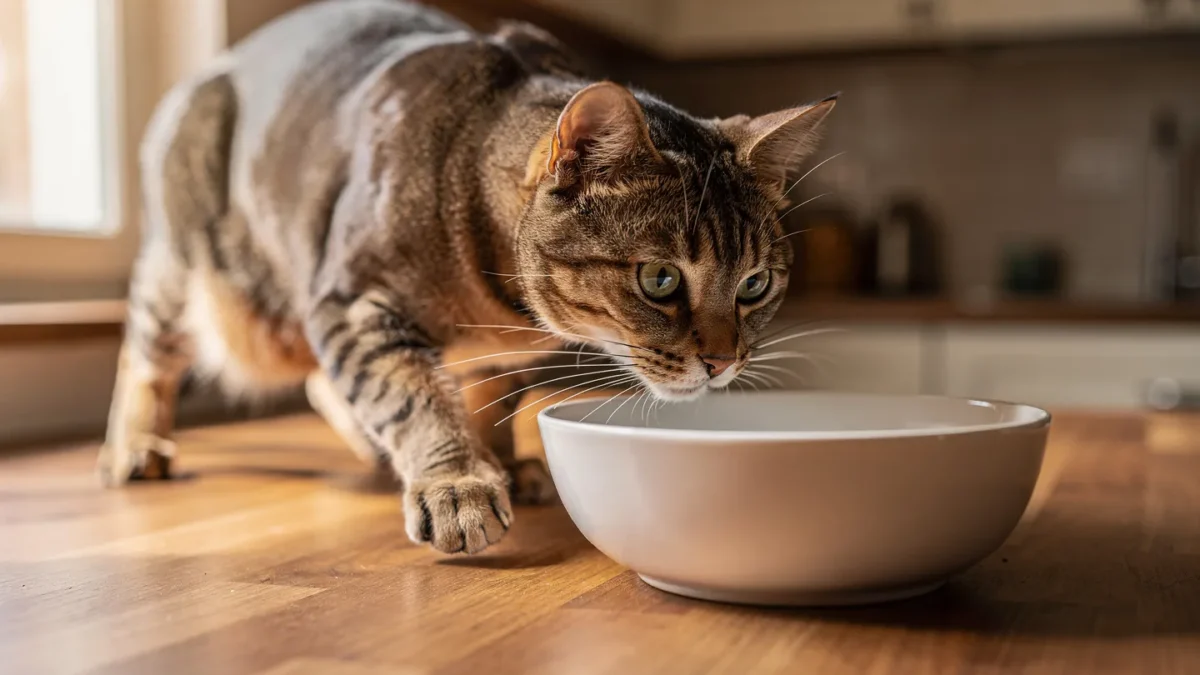
You set down your cat’s food bowl, and instead of diving in like usual, she sniffs it…
paws the food out… and walks away.
What you’re likely dealing with is whisker fatigue in cats — a surprisingly common and overlooked issue.
You’ve tried three different foods this week. She eats fine from your hand.
But the bowl? She acts like it’s the enemy.
I’ve been there. I spent weeks thinking my cat was just being dramatic —
until I stumbled across something called whisker fatigue.
Honestly, I was skeptical at first. But after switching to a flat plate,
her behavior changed within two days.
If you’re watching your cat struggle at mealtime and can’t figure out why,
you’re not alone — and this might be exactly what’s going on.
Quick note: This article is for informational purposes only and is not
a substitute for professional veterinary advice. Always consult your vet
for health concerns about your cat.
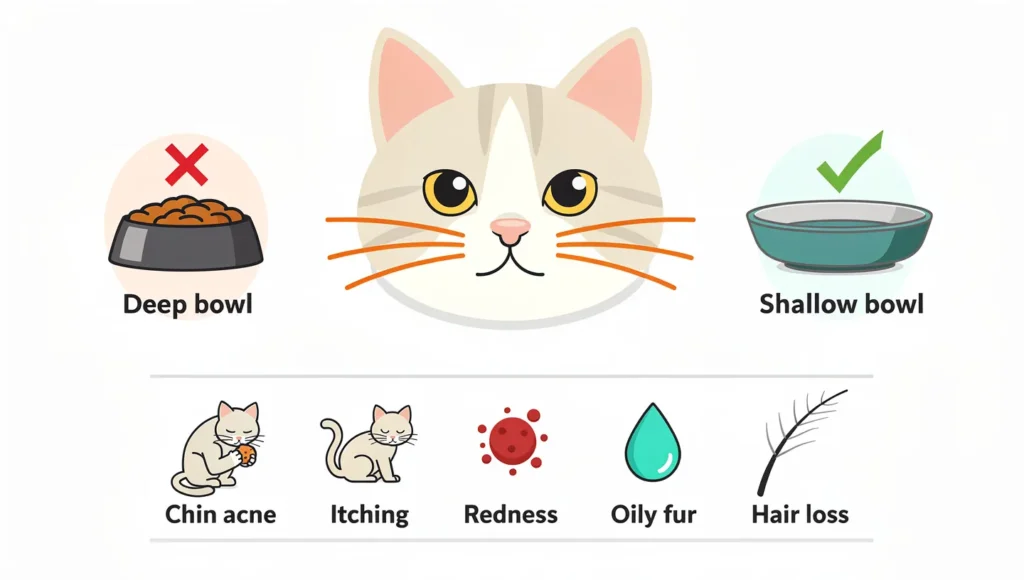
Table of Contents
- What Is Whisker Fatigue in Cats?
- Your Cat’s Whiskers Are a Sensory Superpower
- Why Food Bowls Can Become a Stress Trigger
- Is Whisker Fatigue in Cats Real — or Just a Myth? ⚖️
- What Research and Experts Actually Say
- Why So Many Cat Owners Notice Real Changes
- Signs of Whisker Fatigue in Cats 🚨
- What Actually Causes Whisker Fatigue? 🧬
- The Main Culprit: Bowl Design
- Not Every Cat Is Affected the Same Way
- How to Fix Whisker Fatigue in Cats 🛠️
- ✅ Quick Checklist — Save This!
- 🧠 Expert Tip
- When It’s NOT Whisker Fatigue ⚠️
- Common Mistakes to Avoid 🚫
- FAQ (Question: What causes whisker fatigue in cats?) ❓
- Can whisker fatigue actually hurt my cat?
- Is it permanent if left untreated?
- Do all cats experience whisker fatigue?
- What’s the best bowl for whisker fatigue?
- Can kittens develop whisker fatigue?
- Final Thoughts
What Is Whisker Fatigue in Cats?
To understand whisker fatigue, you first need to know what whiskers actually do —
because they’re way more than decoration.
Your Cat’s Whiskers Are a Sensory Superpower
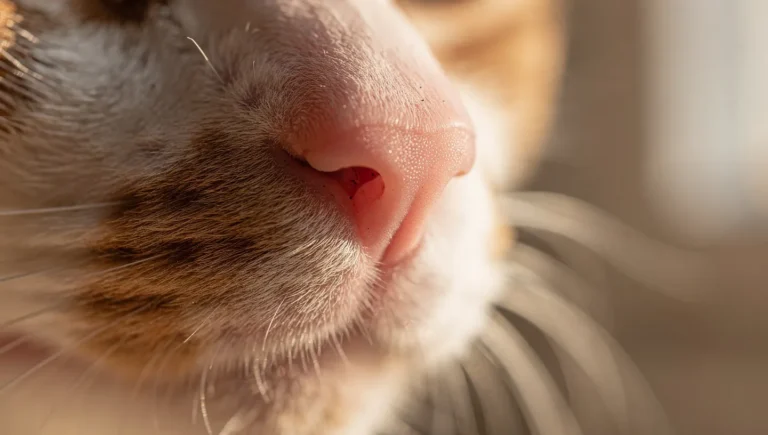
A cat’s whiskers (technically called vibrissae) are deeply embedded in
the skin and connected to a rich network of nerve endings.
According to information from ASPCA,
whiskers help cats navigate space, detect movement, and gauge distances
with remarkable precision.
Think of them like built-in antennae — constantly sending signals to your
cat’s brain about everything around her.
They’re not just sensitive. They’re hypersensitive.
Here’s what that means in practice:
- Whiskers can detect even the slightest changes in air currents
- They help cats judge whether they can fit through a tight space
- They communicate mood and emotional state
- They’re one of the most nerve-rich parts of your cat’s face
So what happens when those whiskers are repeatedly pressed, bent, or
stimulated against the sides of a food bowl — multiple times a day,
every single day?
That’s where the problem begins.
Why Food Bowls Can Become a Stress Trigger
From what I’ve observed and researched, the issue isn’t the whiskers
themselves — it’s the repeated contact they make with deep or narrow bowls.
Every time your cat dips her head into a deep bowl to reach her food,
her whiskers brush against the sides. Once, twice, no big deal.
But over the course of a meal — dozens of times — that constant
stimulation can build up into genuine discomfort.
Imagine wearing noise-canceling headphones all day, then being asked
to have a conversation in a crowded room.
Your senses would be overloaded. That’s roughly the experience
many cats may have at mealtime.
The result? Your cat starts associating the bowl with discomfort —
and mealtime becomes stressful instead of enjoyable.
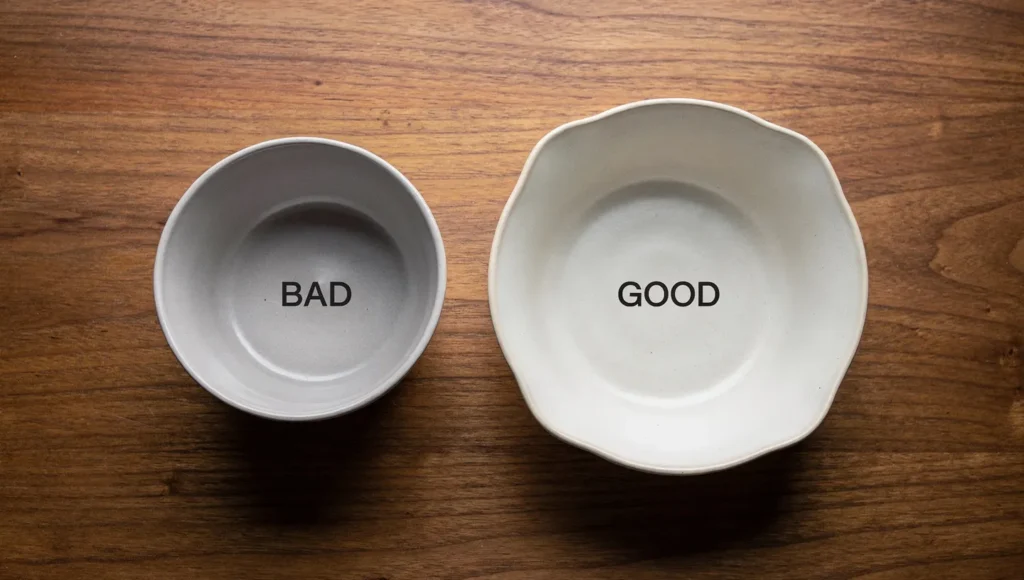
Is Whisker Fatigue in Cats Real — or Just a Myth? ⚖️
This is honestly one of the most debated topics in the cat care world right now.
Search it online and you’ll find two camps: cat owners swearing it changed
their cat’s life after switching bowls, and skeptics calling it a marketing
trick invented by pet product companies.
So where does the truth land?
What Research and Experts Actually Say
Here’s what I found after digging into this properly:
Whisker fatigue isn’t yet recognized as a formal medical diagnosis in
veterinary literature. Some vets prefer the terms whisker stress or
whisker aversion — which are considered more precise descriptions
of what’s actually happening neurologically.
And that distinction matters.
Because whiskers aren’t hair. They’re sensory organs — directly wired
into your cat’s nervous system. According to general information shared
by AVMA,
the nerve-rich follicles surrounding cat whiskers are among the most
sensitive receptor systems in feline anatomy.
This means the “fatigue” isn’t surface-level irritation.
It’s neurological overstimulation — and that’s a meaningful difference.
Curious about what else your cat’s whiskers reveal?
If you’ve ever noticed unusual whisker loss, this guide on
why cat whiskers fall out
explains what’s normal and what isn’t.
Why So Many Cat Owners Notice Real Changes
Here’s the thing about the “myth” debate — even the skeptics tend to
agree on one point:
Switching to a wider, shallower bowl rarely makes things worse.
And based on what I’ve seen in cat owner communities and from my own
experience, the behavioral shifts after switching bowls are often
surprisingly quick.
- Cats eating more confidently
- Less food pawing
- Calmer mealtime behavior
Whether you call it whisker fatigue, whisker stress, or whisker aversion —
the practical solution is the same. And it costs almost nothing to test.
Bottom line: The science is still catching up to the name —
but the behavioral reality many owners observe is hard to dismiss.
Signs of Whisker Fatigue in Cats 🚨
All of these are classic indicators of whisker fatigue in cats.
This is where things get practical. Because recognizing the signs early
can save your cat a lot of daily stress.
From what I’ve observed and researched, here are the most common
behavioral signals:
- Refusing to eat from the bowl — even when hungry
- Pawing food out onto the floor before eating it
- Only eating from the edges of the bowl where whisker contact is minimal
- Walking away mid-meal and returning repeatedly
- Acting anxious or agitated around feeding time
- Approaching the bowl slowly with visible hesitation
- Eating enthusiastically from your hand but ignoring the bowl
If you’re noticing 2 or more of these signs consistently,
keep reading — the fix is simpler than you think. 👇
One important note: some of these behaviors can also signal health issues
unrelated to whisker stress. I’ll cover that clearly in a later section.
What Actually Causes Whisker Fatigue? 🧬
Understanding the cause makes the solution obvious — so bear with me
for a moment.
The Main Culprit: Bowl Design
The core issue is simple physics combined with feline sensitivity.
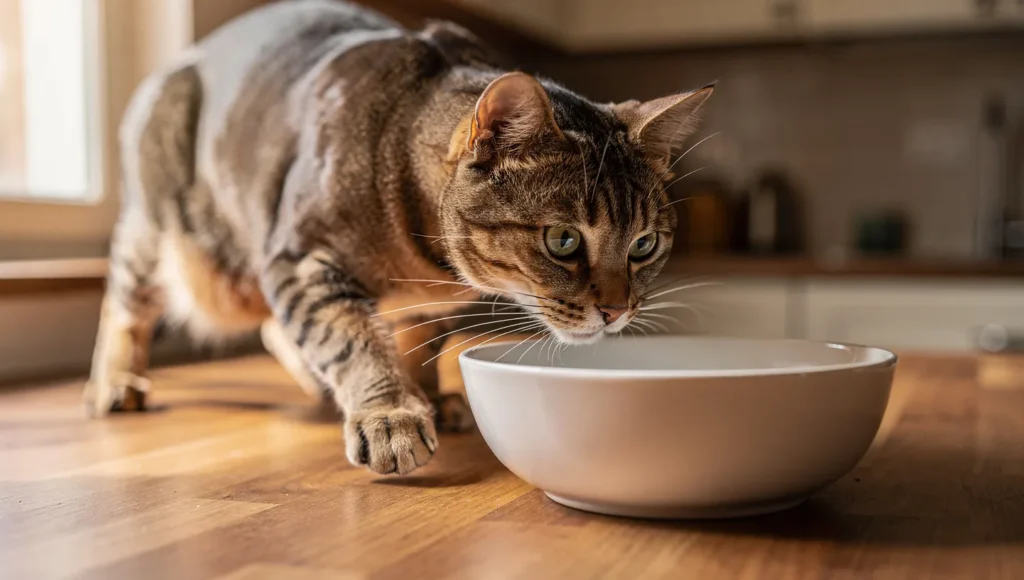
When a cat eats from a deep or narrow bowl, her whiskers inevitably
make contact with the sides — repeatedly, throughout every meal,
every single day.
Each individual touch isn’t painful. But the accumulation of that
constant stimulation across dozens of meals can create a kind of
sensory overwhelm that your cat starts to associate with feeding time.
The result? A cat who acts “picky” but is actually stressed.
Key bowl-related triggers include:
| Bowl Feature | Why It’s a Problem |
|---|---|
| Deep sides | Forces whiskers to bend inward constantly |
| Narrow diameter | Whiskers touch both sides simultaneously |
| Plastic material | Can retain odors that increase aversion |
| High walls | Limits head angle, increases whisker pressure |
Not Every Cat Is Affected the Same Way
This is an important nuance worth mentioning.
Some cats eat from deep bowls their whole lives without any visible issue.
Others show signs within weeks of kittenhood.
Factors that may influence sensitivity include:
- Whisker length and thickness — longer whiskers = more contact
- Individual nervous system sensitivity — some cats are simply
more reactive than others - Breed — cats with wider faces and longer whiskers may be more affected
- Stress baseline — a cat already dealing with anxiety may be
more susceptible
Understanding your cat’s body language during mealtime can reveal a lot.
If you haven’t already, this
cat body language guide
breaks down exactly what those subtle signals mean — and how to read them
correctly.
How to Fix Whisker Fatigue in Cats 🛠️
The most effective way to address whisker fatigue in cats starts with one simple swap — the bowl.
The good news? This is one of the easiest cat problems to solve.
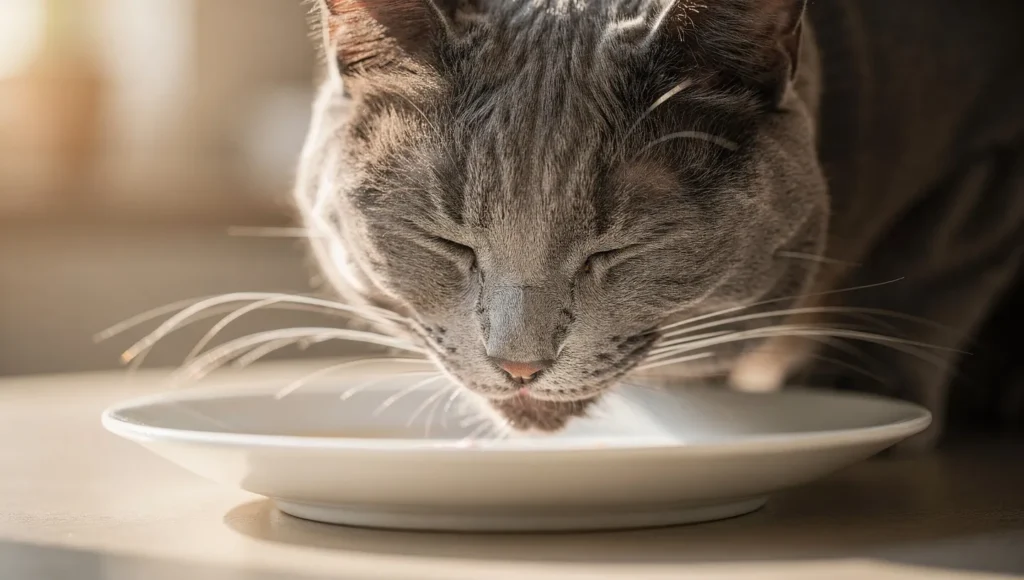
Step 1: Start with a flat plate test
Before buying anything, grab a flat dinner plate from your kitchen and
serve your cat’s next meal on it. If she eats more confidently —
you have your answer.
Step 2: Switch to a wide, shallow bowl
Look for bowls that are:
- At least 6–7 inches wide
- Less than 1.5 inches deep
- Made from ceramic or stainless steel (not plastic — more on that below)
Step 3: Ditch the plastic bowls entirely
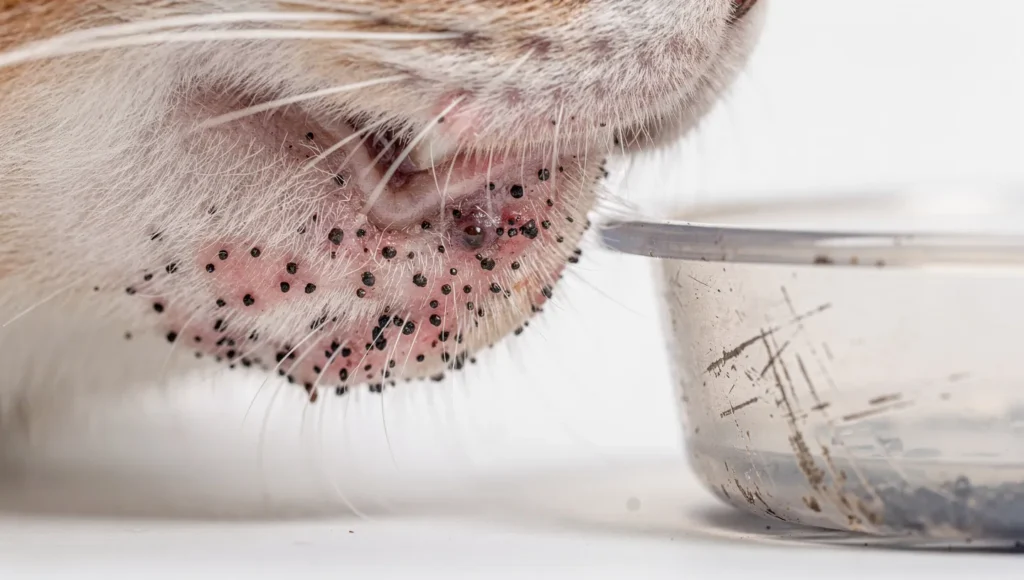
Beyond whisker contact, plastic bowls develop tiny scratches over time
that harbor bacteria — and can cause feline chin acne
(small blackhead-like bumps under your cat’s chin).
Ceramic and stainless steel are cleaner, more hygienic, and whisker-friendly.
Step 4: Rethink the feeding setup
- Place the bowl in a quiet, low-traffic area
- Avoid corners where your cat feels trapped
- Keep water separate from food (cats prefer distance between the two)
Step 5: Give it 3–5 days
Behavioral changes rarely happen overnight.
Watch for reduced pawing, calmer approach, and more consistent eating.
✅ Quick Checklist — Save This!
Run through this before your cat’s next meal:
- [ ] Bowl is wide and shallow (6–7 inches wide, under 1.5 inches deep)
- [ ] No plastic bowls in use
- [ ] Feeding area is calm and quiet
- [ ] Water bowl placed separately from food
- [ ] Flat plate test done at least once
- [ ] Behavior monitored for 3–5 days consistently
🧠 Expert Tip
One mistake I often see: owners switch the bowl but keep it in the same
stressful spot — next to the washing machine, in a busy hallway,
or right next to the litter box. The bowl matters.
But so does where you put it.
If you’re also rethinking your litter box setup, this guide on
litter box placement
covers the best and worst spots in your home.
When It’s NOT Whisker Fatigue ⚠️
Not every mealtime problem traces back to the bowl.
If your cat is also showing any of the following, the issue may be medical:
- Sudden weight loss
- Lethargy or unusual hiding
- Vomiting after meals
- Drooling or dropping food (possible dental pain)
- Complete food refusal lasting more than 24 hours
These signs need a vet — not a new bowl.
For a full breakdown, check out
these 10 critical signs your cat might be sick —
it’s a solid checklist to rule out anything serious.
And if your cat is vomiting regularly after eating, this guide on
why cats throw up after eating
breaks down when it’s normal and when it’s not.
Common Mistakes to Avoid 🚫
- Buying an expensive “whisker fatigue bowl” immediately —
test with a plate first, it’s free - Switching food at the same time as the bowl —
change one thing at a time so you know what worked - Giving up after one day — give behavioral changes at least 3–5 days
- Ignoring other symptoms — bowl issues and health issues can overlap
- Using deep bowls for water too — whisker stress applies to
water bowls as well
FAQ (Question: What causes whisker fatigue in cats?) ❓
Can whisker fatigue actually hurt my cat?
It doesn’t cause physical injury — but the chronic stress around mealtime
can affect appetite, mood, and overall wellbeing over time.
It’s worth taking seriously.
Is it permanent if left untreated?
The condition itself isn’t permanent — but the behavioral aversion to
the bowl can become a learned habit that’s harder to break the longer
it continues. Earlier is better.
Do all cats experience whisker fatigue?
No. Some cats eat from deep bowls without any visible issue their whole
lives. Sensitivity varies by individual, breed, and stress baseline.
What’s the best bowl for whisker fatigue?
Wide, shallow ceramic or stainless steel bowls — or even a flat plate.
Function matters more than the “whisker fatigue” label on the packaging.
Can kittens develop whisker fatigue?
Yes — and they may be more sensitive early on since their nervous systems
are still developing. Starting with appropriate bowls from day one
is a smart preventive habit.
Final Thoughts
Whisker fatigue in cats might not have a unanimous scientific consensus
behind its name — but the solution it points to is simple,
harmless, and often surprisingly effective.
A wider bowl. A calmer feeding spot. A few days of observation.
From what I’ve seen, these small adjustments can genuinely shift your
cat’s relationship with mealtime — less stress, more confidence,
better eating habits overall.
And if the bowl change doesn’t help? That’s useful information too.
It narrows down what to look at next.
Your cat can’t tell you what’s wrong. But she’s always showing you —
you just have to know what to look for.
This article is for informational purposes only and does not replace professional veterinary advice. If your cat shows persistent health concerns, please consult a licensed veterinarian.