

It was a Tuesday afternoon when my phone buzzed.
Lisa — a coworker and one of the most devoted cat moms I know — was on the other end, and I could hear the panic in her voice before she even finished her first sentence.
“She just… ate her food and then threw it all back up. Like, immediately. Is that normal? Should I be rushing to the vet right now?”
I took a breath and told her to slow down.
I’ve been living with cats for years — multiple cats at once, actually — and I’ve seen this happen more times than I can count. Sometimes it’s nothing. Sometimes it’s a sign something’s off. The tricky part? Knowing which one you’re dealing with.
So I walked Lisa through everything I knew, and by the end of the call, she felt a lot better. Her cat, Rosie, ended up being completely fine — but Lisa said something that stuck with me:
“I just wish I’d known this before I panicked.”
That’s exactly why I wrote this. In this guide, we’ll dive deep into the real reasons behind post-meal vomiting, from “scarf and barf” habits to potential health concerns.
If your cat throws up right after eating and you have no idea why does my cat throw up after eating or whether to worry, you’re in the right place. We’re going to break it all down — the causes, what the vomit actually means, and most importantly: when to call the vet and when to just breathe.
📌 Quick heads-up: This article is based on my personal experience as a multi-cat owner and research from trusted sources like the ASPCA and PetMD. It’s here to inform and help you ask better questions — not to replace your veterinarian’s advice. If your cat seems seriously unwell, please contact your vet directly.
Table of Contents
- First, Is It Actually Vomiting? (Most People Get This Wrong)
- What Is Vomiting?
- What Is Regurgitation?
- Why Does My Cat Throw Up After Eating? 7 Real Causes
- 1. Eating Too Fast
- 2. Hairballs
- 3. Food Sensitivity or Allergy
- 4. Switching Food Too Quickly
- 5. Overeating
- 6. Eating Dry Food on an Empty Stomach
- 7. An Underlying Health Issue
- What Does the Vomit Look Like? Your Color & Type Guide
- The Timing Matters — What It Means Based on WHEN It Happens
- Immediately After Eating (0–5 Minutes)
- 20–30 Minutes After Eating
- 1–2 Hours After Eating (or More)
- My Cat Throws Up After Eating Every Day — Should I Worry?
- When to See the Vet — The Decision Tree
- What You Can Do at Home (Practical Solutions)
- Frequently Asked Questions
- Why does my cat throw up undigested food?
- Why does my cat throw up after eating dry food specifically?
- Why does my cat throw up after eating wet food?
- My cat throws up after eating but acts completely normal — okay?
- Why does my cat throw up right after switching food?
- One Last Thing
First, Is It Actually Vomiting? (Most People Get This Wrong)
Before we even talk about causes, there’s something most cat owners completely miss — and honestly, it changes everything.
Not every time your cat “throws up” is actually vomiting.
There’s a real difference between vomiting and regurgitation, and knowing which one you’re seeing will help you figure out what’s going on a lot faster.
What Is Vomiting?
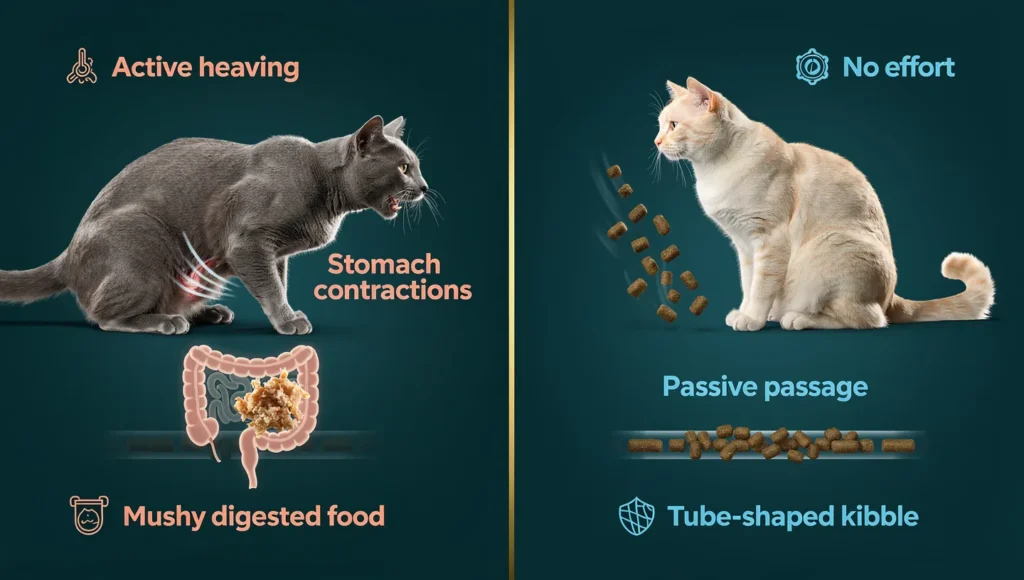
Vomiting is an active process. Your cat’s whole body gets involved — you’ll see the heaving, the stomach contractions, maybe some retching sounds.
The food that comes up has usually already started to digest, so it looks mushy or liquidy, sometimes with bile. It can happen several minutes after eating, not always immediately.
What Is Regurgitation?
Regurgitation is passive. It’s almost effortless — the food just slides back up with little to no warning. No heaving, no drama. And the food? It looks almost exactly like it did going in. Tube-shaped, undigested, sometimes still in the shape of the kibble.
This is where things get important.
If your cat is regurgitating, the issue is likely in the esophagus or related to eating too fast — not the stomach. If it’s true vomiting, the stomach or digestive system is involved, and the causes are a little different.
Here’s a quick breakdown:
| Feature | Vomiting | Regurgitation |
|---|---|---|
| Effort involved | Active — heaving & retching | Passive — no warning |
| Food appearance | Digested, mushy, with bile | Undigested, tube-shaped |
| Timing after meal | Minutes to hours later | Immediately or very soon |
| Sound/warning | Usually audible heaving | Often silent, sudden |
| Likely origin | Stomach or intestines | Esophagus or eating speed |
Honestly, just watching your cat for a minute or two during an episode tells you a lot. I know it’s hard when you’re panicking — but try to notice: is she straining? Or did it just… happen?
Why Does My Cat Throw Up After Eating? 7 Real Causes
Okay. Now that we know what we’re looking at, let’s talk about why it’s happening.
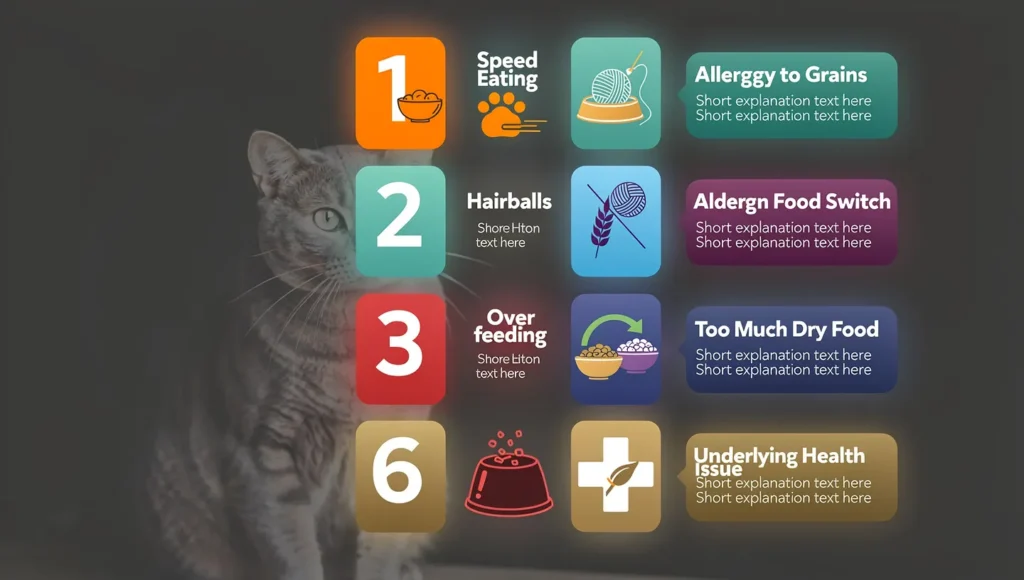
Understanding why does my cat throw up after eating starts with looking at these 7 real causes. Most cases are harmless, but some require a quick change in your routine. Some are completely harmless. A couple need attention. And one or two? Don’t ignore those.
1. Eating Too Fast
When people ask “why does my cat throw up after eating immediately?” the answer is often “Scarf and Barf.” This is the most common reason and, luckily, the easiest to fix.
Some cats inhale their food like they haven’t eaten in weeks. The stomach fills up faster than it can handle, and the body’s response is simple: send it back.
You’ll usually see this as regurgitation — undigested food, almost immediately after eating. The cat seems totally fine afterward. Maybe even looks at you like “can I have that back?”
A slow feeder bowl made a huge difference for two of my cats. It sounds almost too simple, but it genuinely works.
2. Hairballs
Classic. Cats groom themselves constantly, and all that swallowed fur has to go somewhere. Usually it comes up as a hairball — that lovely little tube of compressed fur that appears on your floor at 2am.
Occasional hairball vomiting is normal, especially in long-haired breeds. But if it’s happening very frequently, it might be worth looking into hairball-control food or brushing your cat more regularly.
Speaking of which — if you haven’t already checked out this guide on how to brush your cat properly, it covers exactly how to reduce shedding and hairball buildup.
3. Food Sensitivity or Allergy
Some cats just don’t do well with certain proteins or ingredients.
Chicken, beef, grains — it varies by cat. If your cat vomits consistently after eating but seems otherwise healthy and active, food sensitivity is worth considering.
The tricky part is figuring out which ingredient is the problem. That usually means a food elimination trial — something worth discussing with your vet.
If your cat has a sensitive stomach in general, this breakdown of the best cat food for sensitive stomachs might save you a lot of trial and error.
4. Switching Food Too Quickly
This one catches a lot of people off guard — especially new cat owners.
If you change your cat’s food abruptly — like, Monday she’s eating Brand A and Tuesday you switch to Brand B — her digestive system doesn’t have time to adjust. The result? Vomiting, diarrhea, or both.
The right approach is a gradual 7-day transition. Start with 75% old food / 25% new, and slowly shift the ratio over a week. We cover the full process in detail here: How to Switch Cat Food Safely.
5. Overeating
Similar to eating too fast, but slightly different. Some cats — especially indoor cats with unrestricted access to food — simply eat more than their stomach can hold.
The fix here is portion control. Measured meals at set times instead of free feeding. It sounds strict, but it’s actually much better for your cat’s digestion and weight in the long run.
6. Eating Dry Food on an Empty Stomach
Here’s something I didn’t know for a long time.
Dry kibble expands when it hits stomach acid and moisture. If a cat eats a large amount of dry food on a completely empty stomach, that sudden expansion can trigger vomiting — often yellow bile or foam rather than undigested food.
A small amount of wet food before the main dry meal can help buffer this. Worth trying if you notice your cat vomits mostly in the morning before the first meal of the day.
And if you’re wondering about the wet vs dry debate in general — this guide breaks it down without all the fluff.
7. An Underlying Health Issue
This is the one nobody wants to think about — but it deserves an honest mention.
Chronic or frequent vomiting can sometimes be a sign of something more serious: kidney disease, hyperthyroidism, inflammatory bowel disease, or even intestinal parasites.
According to the ASPCA, persistent vomiting in cats should always be evaluated by a veterinarian, especially when accompanied by weight loss, lethargy, or changes in appetite.
If your cat has been vomiting regularly for more than a week, or you’re noticing other symptoms alongside it — don’t wait. Get it checked.
What Does the Vomit Look Like? Your Color & Type Guide
I know this isn’t exactly dinner table conversation — but hear me out, because this section might be the most useful thing in this entire article.
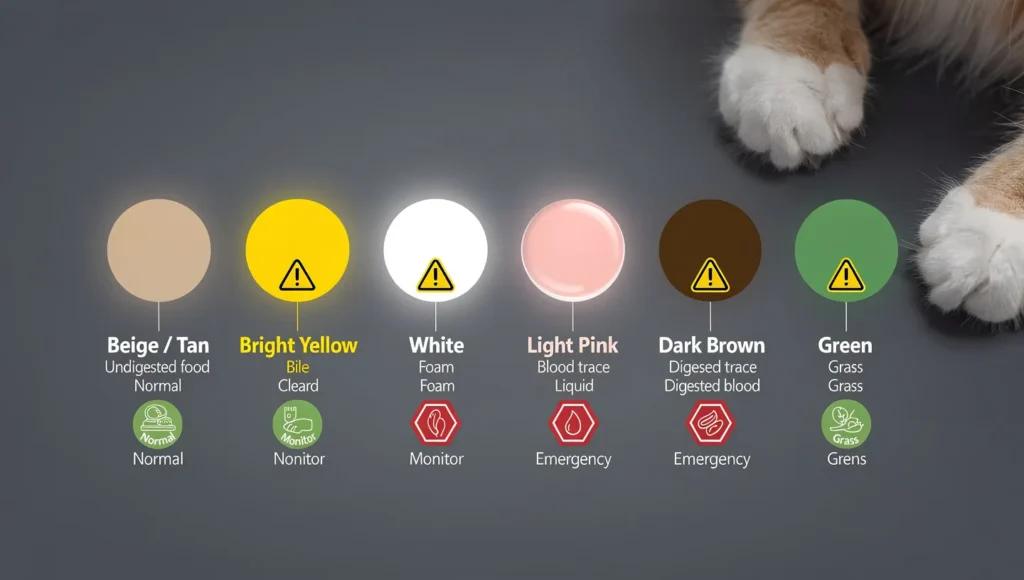
The appearance of your cat’s vomit actually tells you a lot. Color, texture, what’s in it — these are clues. And once you know how to read them, you stop guessing and start knowing.
Here’s a straightforward breakdown:
| Vomit Type / Color | What It Usually Means | Risk Level |
|---|---|---|
| Undigested food | Eating too fast, regurgitation | 🟢 Usually fine |
| Yellow or greenish | Bile — empty stomach or delayed digestion | 🟡 Monitor |
| White foam | Empty stomach, hairball attempt, or acid buildup | 🟡 Monitor |
| Clear liquid | Saliva or stomach fluid — often pre-hairball | 🟢 Usually fine |
| Pink or red-tinged | Possible blood — irritation or something serious | 🔴 Call vet |
| Dark brown or black | Digested blood — potential internal bleeding | 🔴 Emergency |
| Grass or plant pieces | Normal self-regulating behavior | 🟢 Usually fine |
Most people only panic when they see blood — and rightfully so.
But I’d also keep an eye on repeated yellow bile vomiting. It’s easy to dismiss, but if it’s happening daily, it usually means your cat’s stomach is sitting empty too long between meals.
This is where something as simple as adjusting feeding timesor adding a small evening snack can genuinely help. More on that in a bit.
The Timing Matters — What It Means Based on WHEN It Happens
Here’s the thing most articles completely skip over.
The timing of “why does my cat throw up after eating” is a major clue. Whether it happens in 5 minutes or 2 hours tells us exactly where the digestive process failed. The timing gives you a direct clue about where in the digestive process things went wrong.
Immediately After Eating (0–5 Minutes)
Almost always regurgitation, not true vomiting.
The food never made it to the stomach — it came back from the esophagus. The most likely cause? Eating too fast. Or in some cases, a condition called megaesophagus (an enlarged esophagus that can’t move food properly) — but that’s less common and usually comes with other signs like weight loss.
If this is a one-time thing and your cat seems fine — relax. Watch and see if it repeats.
20–30 Minutes After Eating
This is classic stomach-level vomiting.
The food made it down, but something triggered the stomach to reject it. Could be overeating, food sensitivity, or the stomach being irritated by a particular ingredient.
If you recently switched foods and this is happening — that’s almost certainly the culprit.
1–2 Hours After Eating (or More)
When vomiting happens well after the meal, it’s often related to slower digestive issues — hairballs working their way up, intestinal irritation, or sometimes the early signs of a systemic health issue.
This timing, especially if it’s recurring, is worth mentioning to your vet.
Here’s a simple way to think about it:
⏱️ TIMING GUIDE
0–5 min after eating → Likely regurgitation (esophagus / eating speed) 20–30 min after eating → Stomach issue (overeating / food sensitivity) 1–2+ hours after eating → Deeper digestive issue (hairball / health concern) Vomiting before meals → Bile / empty stomach (adjust feeding schedule)
And one more thing — if your cat is also refusing food around the same time the vomiting started, that combination is worth taking seriously.
We cover what to do when a cat stops eating completely in this detailed guide: Cat Not Eating — Here’s Exactly What It Means.
My Cat Throws Up After Eating Every Day — Should I Worry?
Occasional vomiting? Usually fine. Daily vomiting? That’s a pattern — and patterns mean something.
I actually circled back to Lisa on this a few weeks after our call. Turns out Rosie had been vomiting a few times a week for a while before Lisa even noticed it was frequent. Once she switched to smaller, more frequent meals and a slow feeder bowl — it stopped almost completely. Simple fix. Big difference.
If you are constantly wondering “why does my cat throw up after eating every day,” the situation is a bit more urgent. Patterns matter, especially when they become a daily occurrence:
- Once a day, undigested food, acting normal → likely eating too fast
- Once a day, yellow bile, especially in the morning → empty stomach between meals
- Multiple times a day, any type → call your vet
- Daily vomiting + weight loss + lethargy → don’t wait, see a vet now
According to PetMD, chronic vomiting in cats is defined as vomiting more than once or twice a week consistently — and it always warrants a professional evaluation.
If diarrhea is also part of the picture, this guide covers both symptoms together: Why Does My Cat Have Diarrhea?
When to See the Vet — The Decision Tree
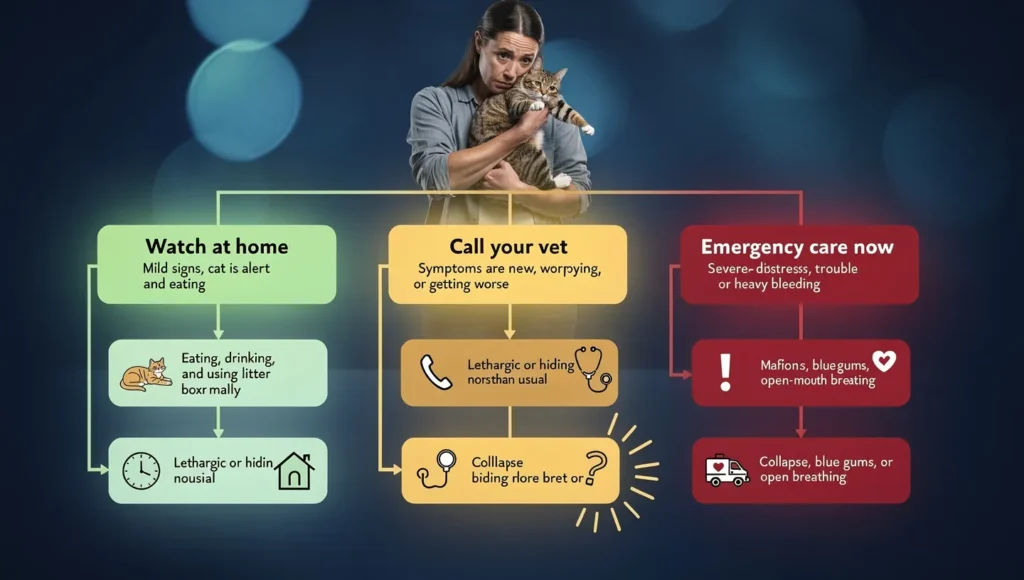
Use this as your quick reference:
🟢 Watch at home if:
- Single vomiting episode, cat acts normal afterward
- Undigested food, likely ate too fast
- Known hairball, happened once
🟡 Call your vet if:
- Vomiting more than 2–3 times a week
- Yellow bile every morning for several days
- You recently changed food and vomiting started
- Cat seems a little off but is still eating
🔴 Go immediately if:
- Blood in vomit (pink, red, or dark brown)
- Cat is vomiting AND not eating
- Signs of pain, bloating, or extreme lethargy
- Vomiting + hiding + no litter box use
For a broader look at warning signs, this guide on how to tell if your cat is sick covers 10 critical signs every owner should know.
What You Can Do at Home (Practical Solutions)
Most cases of post-meal vomiting are fixable without a vet visit.
Here’s what actually works:
- Slow feeder bowl — the single most effective fix for cats who eat too fast
- Smaller, more frequent meals — 3–4 small meals instead of 1–2 large ones
- Elevate the food bowl slightly — helps some cats with regurgitation
- Transition food gradually — always 7 days minimum when switching
- Add wet food or mix with dry — easier on the stomach, better hydration
On that last point — proper hydration plays a bigger role in digestion than most people realize. This cat hydration guide is worth a quick read if your cat is primarily on dry food.
Frequently Asked Questions
Why does my cat throw up undigested food?
Almost always regurgitation — food came back before reaching the stomach. Main culprit: eating too fast. Try a slow feeder.
Why does my cat throw up after eating dry food specifically?
Dry kibble expands in the stomach. Eating too much too fast on an empty stomach = vomiting. Try smaller portions or mixing with a little warm water.
Why does my cat throw up after eating wet food?
Less common, but possible if eaten too fast or if there’s a sensitivity to a specific protein in that formula.
My cat throws up after eating but acts completely normal — okay?
If it’s occasional and she bounces right back — probably just speed-eating or a mild sensitivity. Monitor for frequency. If it’s happening multiple times a week, get it checked even if she seems fine.
Why does my cat throw up right after switching food?
The digestive system needs time to adjust. Abrupt changes almost always cause vomiting or diarrhea. Always transition slowly — full guide here: How to Switch Cat Food Safely.
One Last Thing
Rosie is doing great, by the way. 🐱
Lisa texted me a few weeks after our call — slow feeder bowl, adjusted meal schedule, and one food swap later — zero vomiting.
She also told me she’d never paid that much attention to how Rosie ate before. Now she watches every meal. That kind of awareness? That’s what makes a great cat owner.
If this article helped you figure out what’s going on with your cat, I’d genuinely love to hear about it. Drop your story in the comments — what was happening, what you tried, how it turned out.
These stories help other owners more than you know. And if you have a friend or family member who’s new to cats or going through something similar — share this with them. The more we understand our cats, the better we can take care of them.
They can’t tell us when something’s wrong.
So we have to pay attention.