

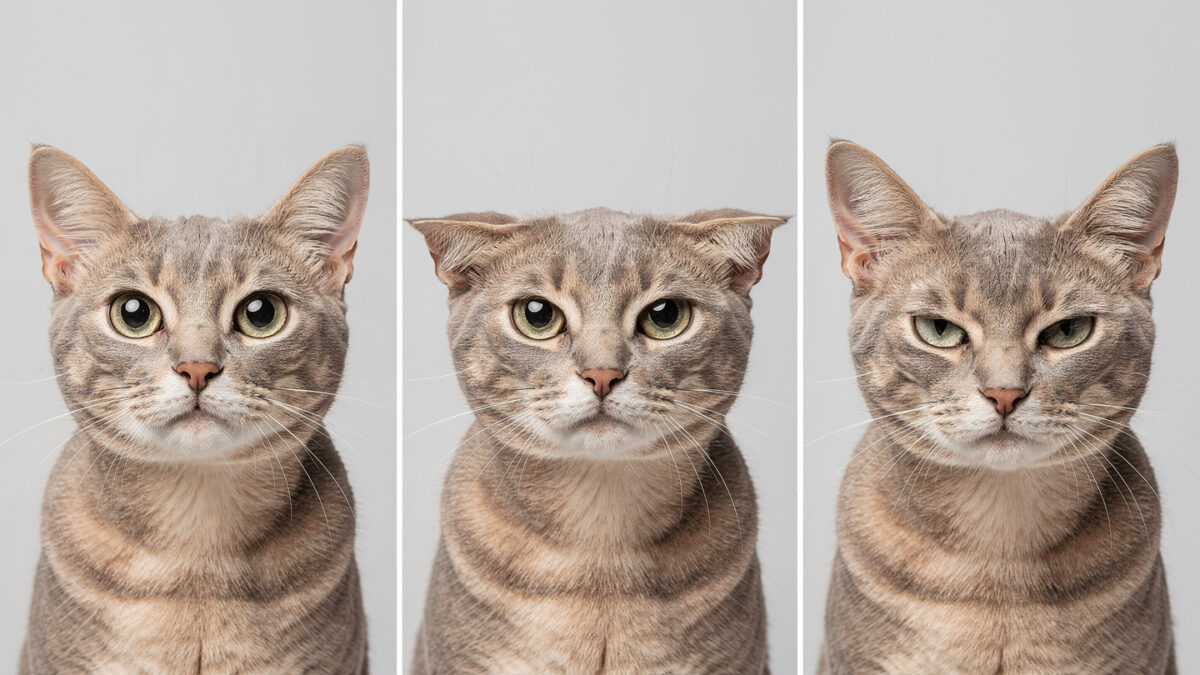
The Day I Realized I’d Been Offending My Cat for Three Years Straight.
I’ll never forget that Tuesday evening — the one that finally taught me how much I’d been misreading cat body language my entire life.
Luna was sitting in the middle of the hallway, completely still, with her back barely arched and one ear twisted sideways like a broken antenna. I crouched down, looked her dead in the eyes, and said — out loud, to my cat — “Luna, what are you trying to tell me?”
She stared at me for exactly four seconds. Then she turned around, walked to her bed, and curled up with her back facing me.
I had been dismissed. By a six-pound animal.
And the worst part? I had absolutely no idea what I’d done wrong.
That night, I went down a rabbit hole. Not five minutes of casual googling — I mean a full two-hour deep dive into feline behavior, academic studies, and every cat forum I could find. What I discovered genuinely embarrassed me. Luna hadn’t been “weird” or “moody” all those years. She had been talking. Constantly. With her tail, her ears, her eyes, her posture — a full running commentary on her inner world.
I just hadn’t been listening.
Here’s the thing: cat body language is a complete communication system, and once you understand it, everything about your relationship with your cat shifts. Not a little — a lot.
This guide breaks down 17 real signals your cat uses every single day, organized into a simple framework that actually makes sense. No fluff, no generic advice — just the stuff that changes how you see your cat starting today.
Quick note: Everything in this guide is based on my personal experience as a multi-year cat owner, combined with research from trusted sources like ASPCA and AVMA. I’m not a vet, and this isn’t medical advice — it’s one cat person sharing what they wish they’d known sooner. For health concerns, always loop in your vet.
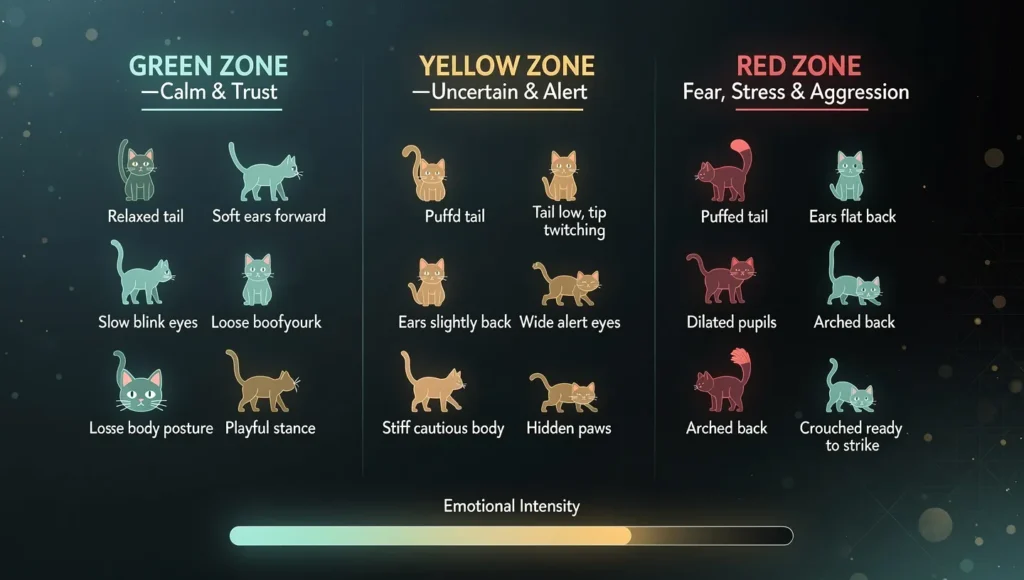
Table of Contents
- The Cat Emotion Decoder: A 3-Color System That Changes Everything
- 🟢 Green Zone — “I’m Good, Human”
- 🟡 Yellow Zone — “I’m Not Sure About This”
- 🔴 Red Zone — “Back Off. I Mean It.”
- The One Rule That Changes Everything
- The Triple-Signal System: Tail + Ears + Eyes Together
- 🐈 Cat Tail Language — The Mood Barometer That Never Lies
- 📡 Cat Ear Position — The Satellite Dishes of Doom (and Delight)
- 👁️ Cat Eyes — Dilation, Slow Blinks, and the Cosmic Stare
- Reading All Three Together — Real Examples
- The Belly Trap: What That Adorable Exposed Tummy Really Means
- The Silent Cry: When Cat Body Language Is Screaming “I Need Help”
- The 3 AM Questions: Fast Answers to What Google Can’t Explain
- My cat stares at the wall for minutes. Should I be worried?
- My cat slow-blinks at me but then walks away. Does that mean she hates me?
- Why does my cat suddenly attack my feet for no reason?
- My cat’s tail puffs up while playing. Is that fear or excitement?
- My cat follows me everywhere but won’t let me touch her. What’s going on?
- A Thank-You Note to the People Who Keep Me (and My Cats) Sane
The Cat Emotion Decoder: A 3-Color System That Changes Everything
Most cat guides give you a long list of signals with no way to connect them.
You read “tail up means happy” and “ears back means scared” — and then your cat does all three things at once and you’re completely lost.
Here’s the problem: cats don’t send one signal at a time. They send a full package. And reading one piece in isolation is like trying to understand a sentence by looking at a single word.
This is where most people get it wrong.
After years of living with cats — and one humbling Tuesday evening with Luna that I’d rather not revisit — I built a simple mental framework for reading cat body language that actually works. I call it the Cat Emotion Decoder, and it uses three zones.
🟢 Green Zone — “I’m Good, Human”
Your cat is relaxed, content, and comfortable in their environment. This is the baseline you want to see most of the day.
What it looks like as a full package:
- Tail: upright with a soft curl at the tip, or loosely wrapped around their body
- Ears: forward-facing and relaxed, not rigid
- Eyes: half-closed or slow blinking — what I call the “I trust you enough to lower my guard” look
- Body: loose, soft, no tension in the muscles
- Posture: lying flat, rolling, or the classic “loaf” position
When Luna slow-blinks at me from across the room, that’s her version of a text message that says “we’re good.” I slow-blink back every single time. It sounds ridiculous. It works.
If you want to understand the slow blink specifically, we have a full breakdown in our guide on cat slow blink meaning — it’s genuinely one of the most underrated things you can learn as a cat owner.
🟡 Yellow Zone — “I’m Not Sure About This”
Your cat is processing something. They’re not in danger, but they’re not comfortable either. This is the zone most people completely miss — and it’s the most important one to catch early.
What it looks like as a full package:
- Tail: low or tucked, moving slowly side to side — not aggressive, just uncertain
- Ears: slightly rotated sideways, like they’re tracking something they can’t locate
- Eyes: wide but not dilated to full black — alert, watching
- Body: weight slightly shifted back, muscles a little tighter than normal
- Posture: crouching low without being flat — ready to move either direction
This is the zone where intervention helps the most. A cat in yellow zone is telling you: “I need either reassurance or space — please read the room.”
Personally, I’ve learned that Luna’s yellow zone almost always means she needs quiet and a few minutes alone. The moment I back off, she resets to green within ten minutes. Every time I ignored the yellow zone and tried to pick her up instead — she went straight to red.
🔴 Red Zone — “Back Off. I Mean It.”
This is full stress, fear, or aggression. Your cat feels cornered, threatened, or overwhelmed. This zone gets people scratched — not because cats are mean, but because the earlier signals were missed.
What it looks like as a full package:
- Tail: puffed up like a bottlebrush, or lashing hard from side to side
- Ears: flat against the skull — this is non-negotiable, always take this seriously
- Eyes: fully dilated pupils in bright light (fear) OR narrowed to slits (aggression)
- Body: arched back, fur standing up along the spine
- Posture: cornered crouch OR full-forward aggressive lean
- Sounds: hissing, growling, or complete silence with intense focus
Most people only call this “red zone” when the hissing starts. By then, you’ve already missed four or five earlier signals. The real skill is catching yellow before it becomes red.
The One Rule That Changes Everything
Never read a single signal in isolation. Always read the full package.
A puffed tail with relaxed ears and a playful bounce is excitement during zoomies.
A puffed tail with flat ears and a rigid body is a cat about to escalate.
Same tail. Completely different meaning.
This is the foundation of everything that follows in this guide. Keep the 🟢🟡🔴 system in the back of your mind as you read — it’s the lens that makes every other signal make sense.
| Zone | Core Feeling | Key Signal Combo | Your Move |
|---|---|---|---|
| 🟢 Green | Content / Safe | Soft tail + forward ears + slow blink | Engage, interact, enjoy |
| 🟡 Yellow | Uncertain / Anxious | Low tail + rotated ears + wide eyes | Give space, stay calm |
| 🔴 Red | Stressed / Threatened | Puffed/lashing tail + flat ears + dilated pupils | Back off immediately |
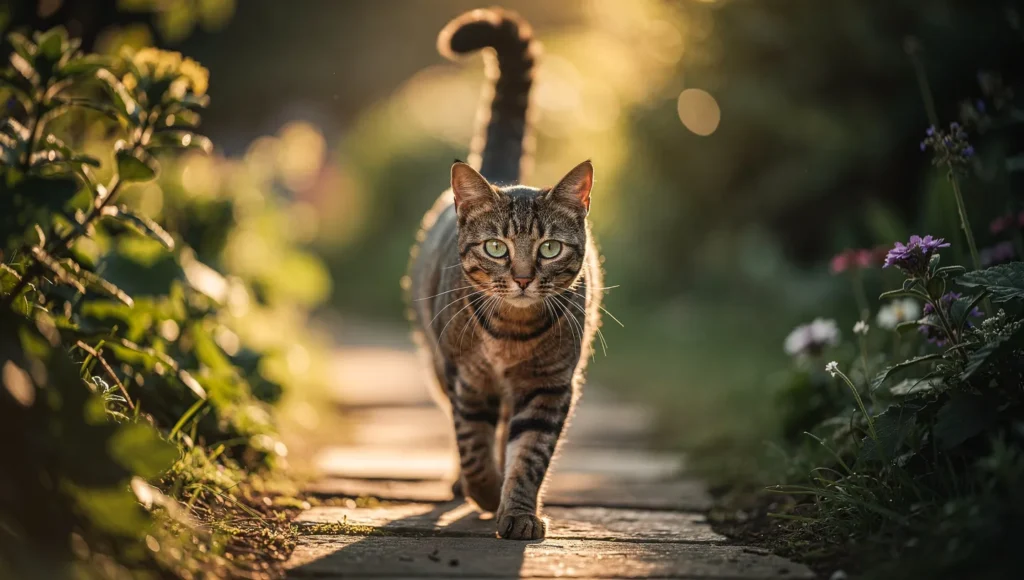
The Triple-Signal System: Tail + Ears + Eyes Together
Okay. You have the 3-color framework. Now let’s get specific.
Think of your cat’s body like a dashboard. The tail is the speedometer. The ears are the radar. The eyes are the engine light. You can glance at one gauge — but if you only watch the speedometer while ignoring the engine light, you’re going to break down on the highway.
This section is about reading all three together. By the end of it, you’ll have genuine “OHHH, that’s what that means” moments about things your cat has been doing for years.
I promise.
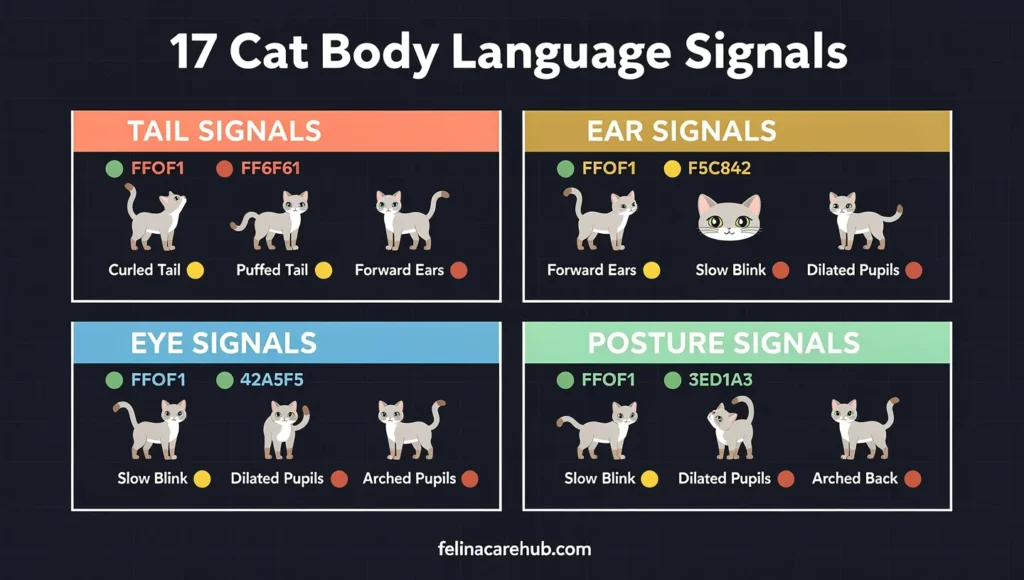
🐈 Cat Tail Language — The Mood Barometer That Never Lies
When it comes to cat body language, the tail is the most honest part of your cat. Unlike their face — which can stay completely neutral — the tail reacts faster than your cat can control it. It’s basically an involuntary emotional readout.
Here’s the thing most guides miss: it’s not just the position, it’s the movement and the texture.
A tail held high means something completely different depending on whether the fur is smooth or puffed. A tail moving side to side means something different at slow versus fast speed. These details matter.
| Tail Signal | What It Usually Means | Zone |
|---|---|---|
| Straight up, smooth fur, soft curl at tip | Happy, confident, greeting you | 🟢 |
| Wrapped around their own body | Relaxed, settled, content | 🟢 |
| Upright and quivering slightly | Excited to see you — pure joy signal | 🟢 |
| Low and slow side-to-side | Uncertain, mildly annoyed, processing | 🟡 |
| Tucked under the body | Anxious, submissive, or in pain | 🟡 |
| Puffed up like a bottlebrush | Frightened or startled — not aggressive yet | 🟡🔴 |
| Hard, fast lashing side to side | Overstimulated or actively aggressive | 🔴 |
Luna does the slow side-to-side when I’m petting her for too long. For years I thought she was relaxed because she wasn’t running away. She was actually saying “I’ve been patient for four minutes and I need you to stop now.” I only understood that after I started reading the tail with the rest of her body.
For a deeper breakdown of tail signals specifically, our guide on cat tail language goes into every position in detail — it’s worth a read after this.
📡 Cat Ear Position — The Satellite Dishes of Doom (and Delight)
Ears are fast. Faster than the tail. Your cat’s ears can rotate almost 180 degrees, and they move independently — each one tracking a different sound source simultaneously.
This is why the ears are your best early-warning system. They shift into yellow or red zone before the tail catches up.
Most people don’t notice ear position until the ears are completely flat. By then, they’re already in red zone territory. The magic is in catching the subtle rotations before that.
| Ear Position | What It Usually Means | Zone |
|---|---|---|
| Forward-facing, relaxed | Curious, content, comfortable | 🟢 |
| Slightly forward, twitching | Interested, tracking a sound | 🟢 |
| Rotated sideways — “helicopter ears” | Uncertain, mildly anxious, overstimulated | 🟡 |
| One ear forward, one back | Conflicted — processing two things at once | 🟡 |
| Pressed slightly back | Irritated, approaching threshold | 🟡🔴 |
| Flat against the skull | Fear or full aggression — non-negotiable red flag | 🔴 |
The “helicopter ears” stage is the one I want you to memorize. That’s where every experienced cat owner learns to pause and reassess. It’s the yellow zone broadcasting itself loudly — and it almost always precedes the full flat-ear position if you don’t respond.
I once watched Marcus — my relentlessly well-researched friend who somehow turns every cat conversation into a TED Talk — catch Luna’s helicopter ears from across the room and immediately say “she needs everyone to lower their voices.” He was right. Within thirty seconds she had walked to her quiet corner. He saw it coming three minutes before it happened.
For the full picture on ear signals, our dedicated guide on cat ear position meaning covers every variation with context.
👁️ Cat Eyes — Dilation, Slow Blinks, and the Cosmic Stare
The eyes are where people get the most confused — because pupil size changes fast and it doesn’t only respond to emotion. Light levels affect dilation too.
This is important: always read pupil size in the context of the lighting around them.
Fully dilated pupils in a dim room might just mean it’s dim. Fully dilated pupils in a bright room? That’s an emotional response — either excitement, fear, or something in between.
| Eye Signal | What It Usually Means | Zone |
|---|---|---|
| Half-closed, soft | Relaxed, sleepy, trusting | 🟢 |
| Slow blinking at you | “I feel safe with you” — the cat equivalent of a hug | 🟢 |
| Normal round pupils, calm gaze | Neutral, comfortable | 🟢 |
| Wide pupils in normal light | Excited, playful — or mildly anxious | 🟡 |
| Fully dilated in bright light | Fear, overstimulation, or pain | 🟡🔴 |
| Hard, unblinking stare | Direct challenge or intense focus | 🔴 |
| Narrowed pupils with tense body | Active aggression — back off | 🔴 |
Here’s what changed everything for me personally.
I used to think Luna’s unblinking stare was affection. She’d just look at me across the room with this intense, focused gaze and I’d think “she loves me so much she can’t stop staring.”
Then Marcus explained that in cat communication, a long unblinking stare is actually a challenge or a dominance signal — and the correct response is to look away first and then slow-blink back. I tried it. Luna’s whole body visibly relaxed within seconds.
I had been accidentally staring her down for three years. No wonder she sometimes walked away.
Our full guide on cat eyes meaning covers every variation — including how to tell the difference between a love-blink and an early health warning sign.
Reading All Three Together — Real Examples
This is where the system clicks. Let’s run through three real scenarios.
Scenario 1: The “I Love You” Package
Tail straight up with a soft curl → ears forward and relaxed → eyes half-closed or slow-blinking.
Translation: Your cat is genuinely happy to see you. This is the full green zone package.
Scenario 2: The “I’m About To Snap” Warning
Tail low and lashing → ears rotating sideways or slightly back → pupils wide in normal light.
Translation: Yellow turning red fast. Stop whatever you’re doing, give space immediately.
Scenario 3: The Deceptive “Happy” Belly
Tail loosely resting → ears slightly sideways → eyes wide and tracking your hand.
Translation: Not an invitation. This is the setup for what I call the Belly Trap — and it has claimed many fingers. Including Dave’s.
Which brings me to the next section.
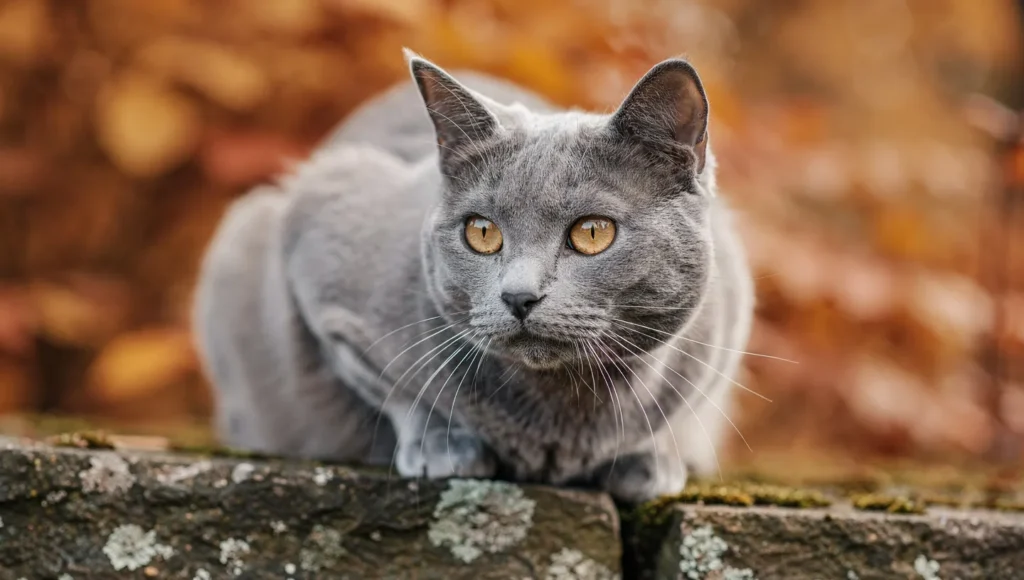
The Belly Trap: What That Adorable Exposed Tummy Really Means
Last Tuesday, Dave came over to share some marketing data. Luna was on the rug, flat on her back, fluffy white belly fully exposed, looking like a Renaissance painting of pure innocence.
Dave gasped. “She loves me! She wants a tummy rub!”
Before I could say anything, he reached down.
In 0.2 seconds, Luna became a furry bear trap. Four paws locked. Teeth engaged. Dave learned — the hard way — that an exposed belly is one of the most misread signals in cat body language, and it’s almost never an invitation. It’s a display of trust and a warning at the same time. Translation: “I feel safe enough to show you my most vulnerable spot. Touch it and I’ll show you all my weapons.”
The belly truth, fast:
- An exposed belly = high trust signal 🟢 — she feels safe in her environment
- It is NOT a request for touch in most cases
- The exception: cats who specifically trained you to rub their belly through repeated positive reinforcement
- Read the full package first — tail relaxed? Eyes soft? Maybe try one gentle touch and read the response immediately
- Hard lashing tail + wide pupils + exposed belly = it’s a trap, walk away
Dave’s hand is mostly healed now. We don’t talk about it.
The Silent Cry: When Cat Body Language Is Screaming “I Need Help”
This is the section I genuinely wish someone had shown me earlier.
Sick cats don’t cry out. They go quiet. They hide. They stop doing the small normal things — and if you’re not watching closely, you miss it entirely until it becomes serious. According to the AVMA, cats instinctively mask pain and illness as a survival mechanism. Which means the signals are subtle, and you have to know what to look for.
Red flags that go beyond mood — these need a vet call:
- Hiding in unusual places for more than 24 hours
- Posture hunched with the head held low — not sleeping, just still
- Third eyelid (the pale inner lid) visible in one or both eyes
- Tail tucked tightly with no response to your voice
- Ears flat with no external trigger — no loud noise, no strangers, nothing
- Slow, shallow breathing with a tense abdomen
- Sudden change from green zone baseline to yellow/red for no clear reason
That last one is the most important. You know your cat’s normal. A sudden unexplained shift in their body language baseline is always worth paying attention to — even if you can’t identify a specific signal.
Our guide on how to tell if your cat is sick covers the full 10-signal checklist. And if your cat shows any breathing changes, cat respiratory infection symptoms is worth reading immediately.
The 3 AM Questions: Fast Answers to What Google Can’t Explain
My cat stares at the wall for minutes. Should I be worried?
Usually no. Cats hear and smell things we can’t — insects inside walls, ultrasonic sounds, distant animals. If it happens occasionally with relaxed body language, it’s just their senses doing their job. If it comes with a tense body, flattened ears, or happens constantly, mention it to your vet.
My cat slow-blinks at me but then walks away. Does that mean she hates me?
The opposite, actually. The slow blink is trust. The walking away is independence. She acknowledged you, communicated affection, and moved on with her day. That’s a healthy, secure cat. You should be flattered.
Why does my cat suddenly attack my feet for no reason?
There’s always a reason — you just missed the yellow zone signals leading up to it. Overstimulation, redirected predatory instinct, or understimulation (boredom). Check our guide on cat aggression signs for the full breakdown.
My cat’s tail puffs up while playing. Is that fear or excitement?
Read the ears. Ears forward + puffed tail = excited play mode 🟢. Ears sideways or back + puffed tail = genuinely startled or scared 🟡🔴. Same tail, completely different situations.
My cat follows me everywhere but won’t let me touch her. What’s going on?
She wants your presence, not your hands. Some cats are proximity-bonded rather than touch-bonded — they love you deeply but prefer to express it by being in the same room. It’s not rejection, it’s just her love language. For the full picture, our guide on why does my cat follow me everywhere explains it beautifully.
A Thank-You Note to the People Who Keep Me (and My Cats) Sane
I have to be honest with you.
This guide didn’t come from a textbook. It came from years of misreading Luna, embarrassing myself in front of Marcus, watching Dave get ambushed by an exposed belly, and making every single mistake I’ve described above — sometimes twice.
So before you go, I need to say something that I mean completely:
Thank you, Dr. Sami. The most patient veterinarian on the planet and the only person who answers his phone at 11 PM when I call because “Luna’s tail looked different and I can’t explain it.” He never laughs. He never sighs. He just asks the right questions and sends me back to bed with actual answers. This guide has his fingerprints all over it, even if he doesn’t know it.
Thank you, Marcus — for the TED Talks I didn’t ask for but desperately needed. For explaining the staring thing. For catching helicopter ears from across a room. For being the kind of friend who reads peer-reviewed feline behavior studies for fun and then calmly explains them to those of us who don’t.
And thank you, Dave. Your sacrifice was not in vain. Your finger healed. Luna is not sorry. But every person who reads this section and doesn’t reach for the belly is living proof that your pain had meaning.
Now it’s your turn.
I want to know: what’s the weirdest thing your cat does that you finally understand after reading this? Did something click about cat body language? Did you realize you’ve been accidentally staring your cat down for years like I did? Did you send this to someone who needed the belly trap warning before it was too late?
Drop it in the comments right now. I read every single one — and our little community of accidental cat servants genuinely loves hearing your stories.
And if someone you know is still out there misreading their cat’s signals, do them a favor and share this guide. Their fingers will thank you. 🐱👇