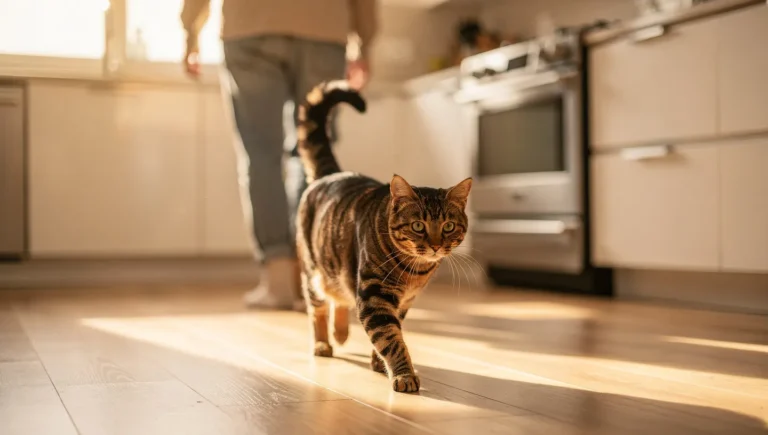

How to introduce two cats shouldn’t feel like a battle for territory in your own living room. If you’ve just brought home a new feline family member only to be met with sharp hisses, low growls, or a sudden “cold war” under the sofa, take a deep breath. You aren’t failing as a pet parent, and your cats aren’t “broken”—they are simply following their ancient instincts to protect their kingdom.
The good news? This is fixable. While the initial tension might make you feel like peace is a distant dream, most cats can learn to coexist, and many eventually become inseparable nap buddies. By following a structured, scent-first approach rather than rushing a face-to-face meeting, you can transform a high-stakes standoff into a harmonious household. Let’s break down the proven steps to turn furry strangers into lifelong companions.
Table of Contents
- 🐾 How to Make Two Cats Get Along: The Preparation Phase
- 💡 Expert Tip: The Rule of Patience
- Why Isolation Isn’t Punishment
- 👃 Phase 1: Scent Swapping and Pheromones
- The “Scent Swap” Technique
- 🧪 Using Synthetic Pheromones
- Site Swapping: The Territory Switch
- 🍽️ Phase 2: Feeding Through the Door
- Creating a Positive Association
- 💡 Expert Tip: Use “The Good Stuff”
- 🚩 Reading the Signals: Progress vs. Red Flags
- 🥊 How to Introduce Two Cats When One Is Aggressive
- The Power of Visual Barriers
- The “Stop & Restart” Method
- 🚫 What NOT to Do (The Golden Rule)
- 💡 Quick Summary: Handling Tension
- 🐈 Specific Scenarios: Adult Cats and Female Dynamics
- How to Introduce Two Adult Cats
- How to Get Two Female Cats to Get Along
- 💡 Expert Tip: The Reality Check
- 🧐 Is it Play or a Fight? Reading Body Language
- 📊 Comparison: Play vs. Real Aggression
- 🚩 Key Signals to Watch
- When Should You Intervene?
- 💡 Expert Tip: The “Cool Down” Rule
- 🏠 Managing Long-Term Territory Issues
- The Golden Rule: N+1
- Maximize Vertical Space
- 🏁 Conclusion: Your Journey to a Harmonious Home
🐾 How to Make Two Cats Get Along: The Preparation Phase
The biggest mistake most owners make is rushing the first meeting. To understand how to make two cats get along, you must first respect their territorial nature. Cats don’t see a new feline as a “friend” initially; they see an intruder stealing their resources.
Creating a “Base Camp” or a safe room is your first line of defense. This is a dedicated, closed-off space (like a guest bedroom or bathroom) where the new cat can adjust to the smells and sounds of your home without the pressure of a confrontation.
💡 Expert Tip: The Rule of Patience
Never rush the introduction. If you see signs of extreme stress, like hiding or refusing to eat, go back one step. A slow introduction takes days or weeks, but a bad first impression can take months to fix.
Why Isolation Isn’t Punishment
It’s natural to feel guilty about “locking up” your new kitty, but isolation is actually a gift. It allows the new arrival to build confidence while the resident cat realizes that their world isn’t ending. This period is crucial for managing stress-related behaviors that can occur during transitions.
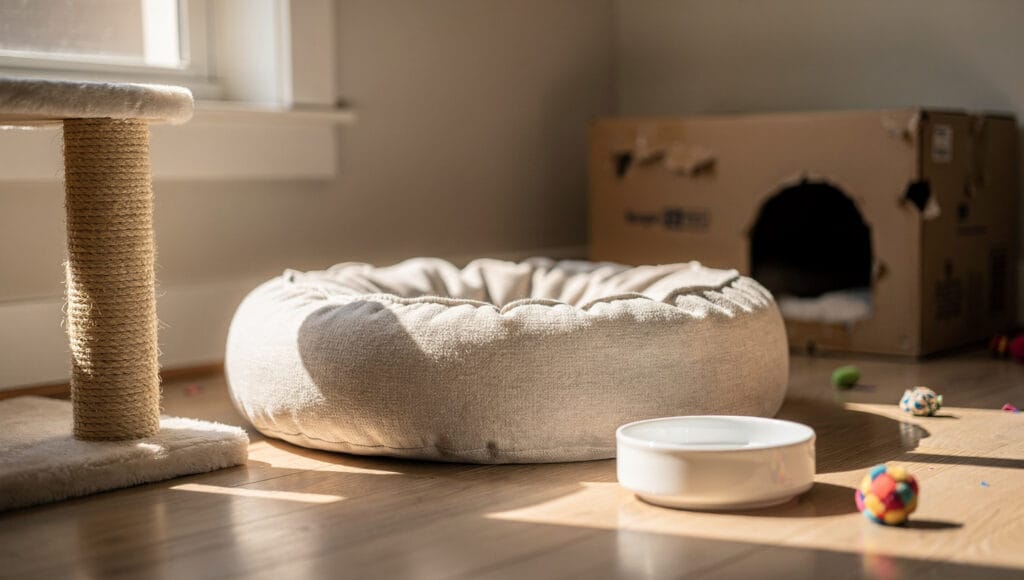
To set up a successful Safe Room, ensure it includes:
- Separate Resources: A dedicated litter box, food bowl, and water station.
- Vertical Space: A small cat tree or a cardboard box to help the new cat feel secure.
- Familiar Scents: An old t-shirt of yours to help them bond with your scent.
- Scratching Surfaces: Essential for scent marking and relieving anxiety.
👃 Phase 1: Scent Swapping and Pheromones
In the feline world, scent is a biological ID card. Before your cats ever lock eyes, they must have an “invisible handshake” through smell. This phase reduces the shock of a physical meeting and begins the process of creating a communal “family scent.”
The “Scent Swap” Technique
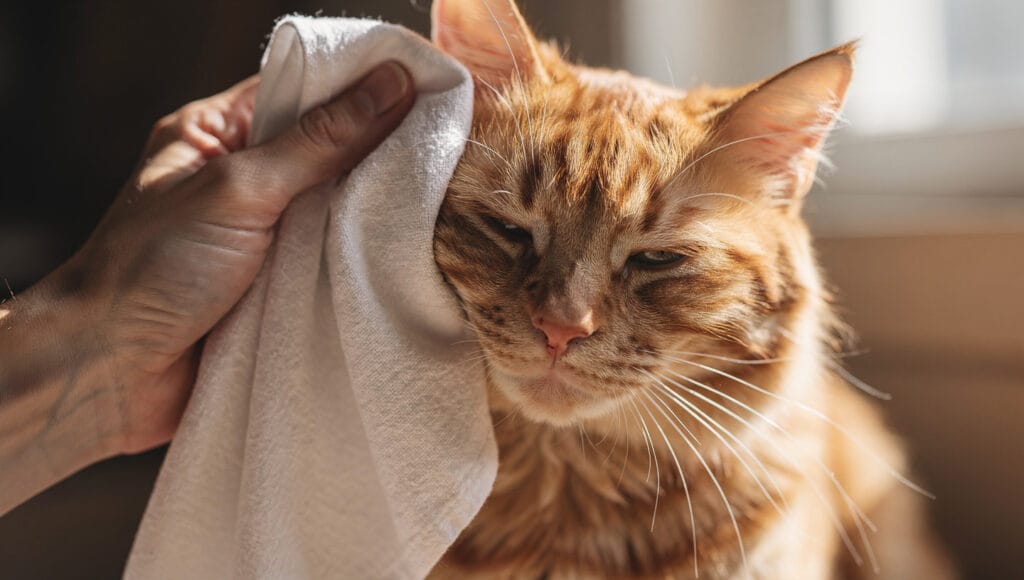
Start by rubbing a clean sock or small towel gently around the cheeks and chin of one cat (where their scent glands are most active). Then, place that scented item in the other cat’s area.
Watch their reaction closely:
- Positive/Neutral: If they sniff it and walk away or rub against it, they are accepting the scent.
- Negative: If they hiss or growl at the object, they aren’t ready. This is where understanding cat tail language becomes vital; a twitching tail or flattened ears mean you should slow down.
🧪 Using Synthetic Pheromones
Synthetic pheromones, like Feliway, can be a game-changer. These diffusers mimic the “happy markers” cats leave when they feel safe. While not a magic wand, they significantly lower the environmental tension, making it easier for an aggressive cat to stay calm during the introduction.
| Scent Swapping Method | How to Do It | Goal |
|---|---|---|
| The Sock Method | Rub cheeks of Cat A, give to Cat B. | Introduce facial pheromones safely. |
| Bedding Exchange | Swap their favorite blankets/beds. | Familiarize them with “sleeping” scents. |
| Site Swapping | Let them explore each other’s rooms (while separated). | Allow them to “map” the other’s territory. |
Site Swapping: The Territory Switch
Once both cats are calm with each other’s items, it’s time for a “territory swap.” Put your resident cat in the safe room and let the new cat explore the rest of the house. This allows the new cat to gain confidence in the larger space while the resident cat investigates the “Base Camp” smells. According to the American Association of Feline Practitioners, providing this environmental enrichment is key to reducing feline stress.
🍽️ Phase 2: Feeding Through the Door
The path to a cat’s heart is often through their stomach. By feeding both cats on opposite sides of a closed door, you are using “counter-conditioning.” This process teaches them to associate the scent and sound of the “intruder” with their favorite high-value meals.
Creating a Positive Association
Start by placing their food bowls several feet away from the door on both sides. If they eat calmly, move the bowls a few inches closer during the next feeding. The goal is to have them eating comfortably right against the door.
💡 Expert Tip: Use “The Good Stuff”
During this phase, don’t just use standard kibble. Use high-value treats like plain boiled chicken or a lickable treat. This makes the reward so enticing that they prioritize the food over their territorial anxiety. If you’re unsure about what’s safe, check our guide on what can cats eat for healthy reward ideas.
🚩 Reading the Signals: Progress vs. Red Flags
It is essential to monitor their behavior during these “door-side” meals. You are looking for a relaxed posture and a focused appetite.
Signs of Progress:
- Steady Eating: Both cats focus on their bowls without hesitating.
- Paw Play: Gentle pawing under the door (without claws) can be a sign of curiosity.
- Relaxed Ears: Ears are forward or neutral, not pinned back.
Signs of Danger (Back Up!):
- Refusing Food: If a cat won’t eat, they are too stressed. Move the bowl further back.
- Growling or Hissing: Verbal aggression means the proximity is too intense.
- Stalking the Door: If one cat sits staring intensely at the door gap instead of eating, they are still in “hunter” mode.
🥊 How to Introduce Two Cats When One Is Aggressive
It is terrifying to see your beloved pets growling or lunging, but knowing how to introduce two cats when one is aggressive is all about controlling the environment. In the feline world, aggression is usually a byproduct of fear and territorial insecurity. If things get heated, the “Slow and Steady” method needs an extra layer of protection: visual barriers.
The Power of Visual Barriers
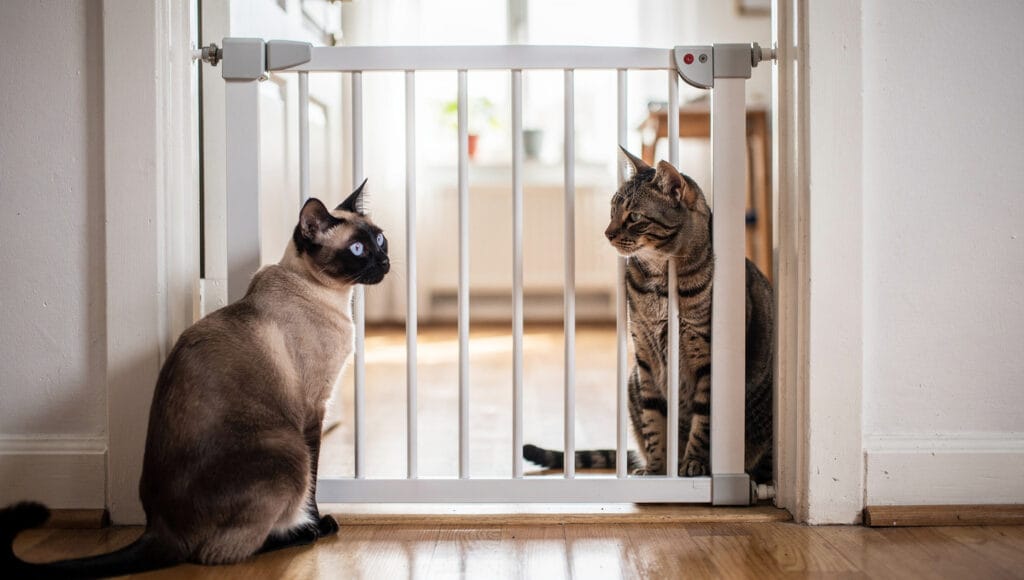
Once your cats can eat calmly behind a closed door, you need to introduce sight without the risk of physical contact. Using a baby gate, a screen door, or even a large piece of tall cardboard with small holes allows them to see each other safely.
- Controlled Exposure: Keep these sessions short (3-5 minutes).
- Positive Distraction: Use toys or treats during the visual meeting to keep their focus off each other.
- The “Safety Blanket” Technique: Keep a large towel nearby to quickly cover the gate or barrier if a cat starts to hiss or lunges, instantly ending the visual contact.
The “Stop & Restart” Method
If a session ends in a fight or extreme hissing, don’t panic. This is where the “Stop & Restart” method comes in.
- Immediately Separate: Move the cats back to their safe zones.
- Cooling Off Period: Give them 24 to 48 hours of zero contact (back to Phase 1).
- Analyze the Trigger: Was the bowl too close? Was the session too long?
- Re-introduce Slowly: Start again at a level where both cats felt 100% comfortable.
🚫 What NOT to Do (The Golden Rule)
Never, under any circumstances, punish an aggressive cat. Yelling, using water spray bottles, or physical discipline will only make the cat associate the other cat’s presence with “bad things happening.” This creates a deeper cycle of aggressive behavior that is much harder to break. Instead, reward the silence and the calm moments.
💡 Quick Summary: Handling Tension
If the fur is flying, you’ve moved too fast. There is no shame in going back to scent-swapping for a few more days. Success in cat introductions is measured in inches, not miles.
🐈 Specific Scenarios: Adult Cats and Female Dynamics
Every cat has a unique personality, but age and gender play massive roles in how they view a newcomer. While kittens usually accept anyone who wants to play, adult cats and females often require a more strategic, high-authority approach to introductions.
How to Introduce Two Adult Cats
Introducing adults is often a game of “Territorial Diplomacy.” Unlike kittens, an adult cat has spent years establishing their routine and “owning” their space.
- The Slower Pace: Expect this process to take twice as long. Adult cats are less flexible and more prone to stress-induced health issues.
- Focus on Tolerance, Not Friendship: Your initial goal shouldn’t be them cuddling; it should be them sharing a room without a standoff.
- The “Resident” Advantage: Always prioritize the feelings of your resident cat first to prevent them from feeling “displaced” in their own home.
How to Get Two Female Cats to Get Along
There is a common myth that female cats are “divas,” but the reality is that female felines are often the primary territory defenders in the wild. When learning how to get two female cats to get along, you have to manage their social hierarchy.
- Resource Abundance: Females are highly sensitive to “resource scarcity.” If there is only one favorite window perch or one scratching post, they will fight over it.
- Individual Attention: Ensure you spend one-on-one time with each female cat in separate rooms so they don’t feel they are competing for your affection.
- Temperament Matching: If you are introducing a high-energy Bengal cat to a calm female, you will need to provide extra play outlets for the high-energy cat so she doesn’t “pester” the other.
💡 Expert Tip: The Reality Check
It can take between 2 weeks to 6 months for adult cats to fully integrate. If they can eat in the same room and sleep a few feet apart after a month, you are winning! Don’t force a “best friend” narrative; let it happen organically.
🧐 Is it Play or a Fight? Reading Body Language
One of the most stressful moments for any owner learning how to introduce two cats is the first time they interact without a barrier. Is that rolling around a friendly wrestling match or a serious territorial dispute? Understanding the subtle nuances of cat tail language and vocalizations is the only way to know when to cheer them on and when to step in.
📊 Comparison: Play vs. Real Aggression
| Feature | Signs of Play | Signs of Real Fighting |
|---|---|---|
| Vocalization | Mostly silent or occasional short chirps. | Deep growling, loud hissing, or high-pitched screaming. |
| Claws | Claws are retracted (hidden). | Claws are out and aimed at the face or belly. |
| The Chase | Reciprocal; they take turns chasing each other. | One-sided; one cat is constantly pursuing a terrified victim. |
| Ears & Fur | Ears are forward or neutral; fur is flat. | Ears are pinned back; fur/tail is “puffed” (piloerection). |
| Belly Exposure | One cat may roll over to show their belly. | Both cats remain upright or crouched in a defensive stance. |
🚩 Key Signals to Watch
- The “Airplane” Ears: If ears are flattened against the head, the cat is in full defensive mode.
- The “Bottlebrush” Tail: A puffed-up tail indicates a high level of fear or aggression.
- Staring Contests: A prolonged, unblinking stare is a sign of a challenge in the feline world.
When Should You Intervene?
If you see fur flying, hear loud screaming, or notice one cat trying to hide while the other continues to attack, it’s time to intervene. Never use your bare hands to break up a cat fight, as this often leads to “redirected aggression” where the cat bites you by mistake. Instead, use a loud noise (clap your hands) or place a large piece of cardboard between them to break their line of sight.
💡 Expert Tip: The “Cool Down” Rule
If a play session turns into a minor spat, don’t just separate them and forget it. Give them a “time out” in separate rooms for at least 30 minutes to let their adrenaline levels return to normal before trying again.
🏠 Managing Long-Term Territory Issues
Congratulations! If your cats are sharing the same room without hissing, you’ve done the hard part. However, maintaining peace in a multi-cat home requires ongoing management of their environment. In the feline world, “sharing is caring” doesn’t exist—abundance does.
The Golden Rule: N+1
To prevent future territory disputes, always follow the N+1 Rule. This means you should have one more of every essential resource than you have cats.
- Litter Boxes: If you have 2 cats, you need 3 litter boxes in different locations.
- Feeding Stations: Separate bowls to prevent “resource guarding.”
- Water Fountains: Cats are more likely to drink if they don’t feel cornered.
Maximize Vertical Space
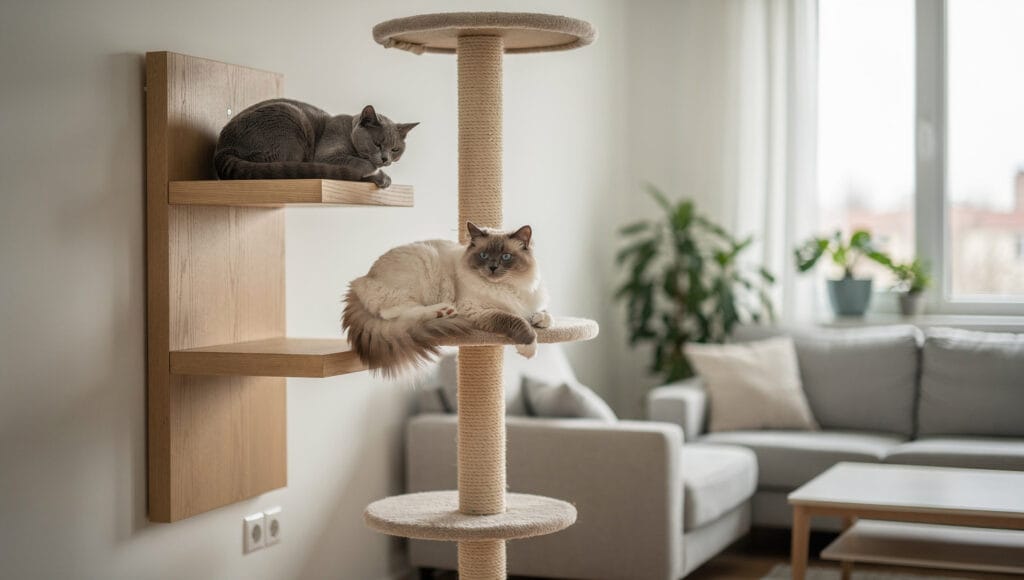
Cats live in a 3D world. When a cat feels stressed, their instinct is to go up. Adding cat trees, window perches, or wall-mounted shelves allows your cats to “bypass” each other without a ground-level confrontation. It effectively doubles your home’s square footage from a cat’s perspective.
🏁 Conclusion: Your Journey to a Harmonious Home
Learning how to introduce two cats is a marathon, not a sprint. There will be days of great progress and moments where you feel like you’ve taken two steps back. That is perfectly normal. By prioritizing scent, controlled feeding, and respecting their territorial boundaries, you are building a foundation of trust that will last a lifetime.
Be patient, stay observant, and celebrate the small wins—like the first time they sniff each other and walk away calmly. Before you know it, that initial “cold war” will be a distant memory, replaced by the soft sounds of two happy cats coexisting in their shared kingdom.