
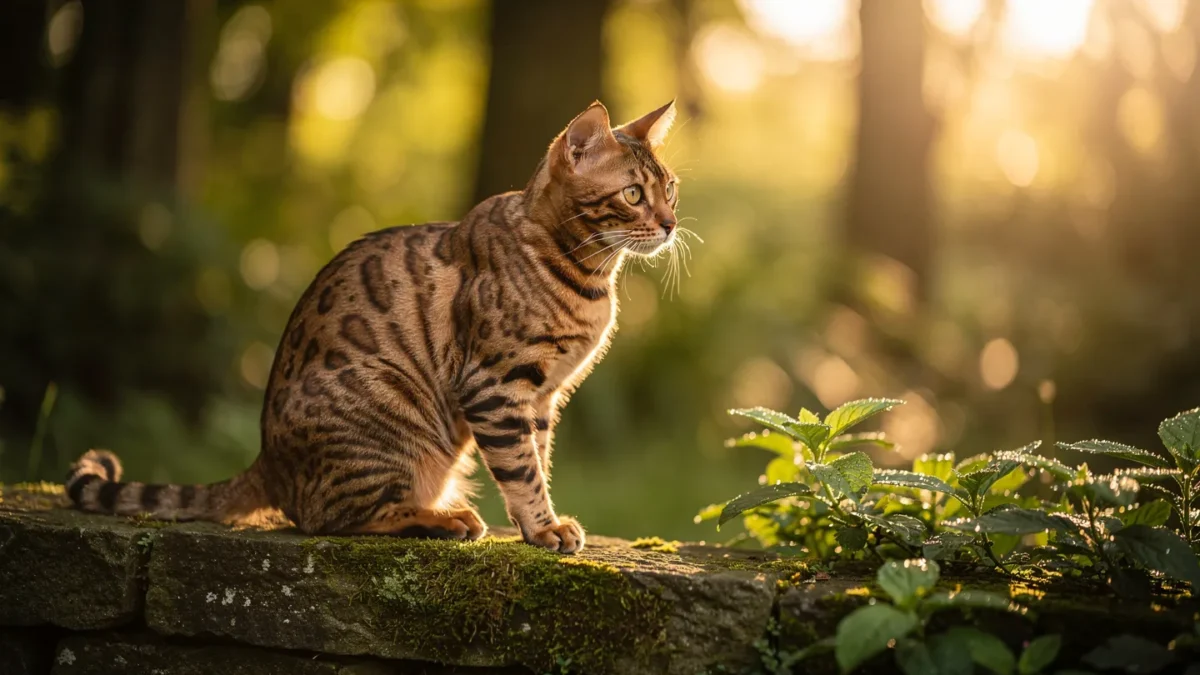
I’ll be honest with you — I didn’t do nearly enough research about Bengal cat behavior before bringing one home.
I saw a photo online. Spotted coat, wild eyes, looked exactly like a tiny leopard straight out of a National Geographic documentary. I thought: this is it. This is my cat.
I imagined him curled up in my lap, purring like a little engine while I watched TV.
My name is Luca. And I was so, so naive.
My friend Marcus — the one who reads everything before making any decision in life — looked at me like I’d just announced I was adopting a baby cheetah. “Luca,” he said, dead serious, “that’s not a cat. That’s a circus animal that escaped.
The energy alone will make you pay rent twice — once for the apartment, once for whatever he destroys.”
I laughed it off.
Then there was Dave. Good old Dave, who confidently told me:
“Just get him a ball of yarn, man. Cats love yarn.” The yarn lasted approximately three seconds before it was consumed entirely. Dave has not been seen since.
And then there was 4 AM on a Tuesday.
I was standing in my living room, staring up at my chandelier, where my Bengal — Kovu — was hanging upside down, watching me with the calm, calculating eyes of a predator. I called my friend Dr. Sami, a veterinarian and honestly the reason I haven’t completely lost my mind since getting this cat.
“Sami,” I whispered, “he’s on the chandelier. Is he going to eat me?”
There was a long pause. Then: “Go to sleep, Luca. He won’t eat you. But move the chandelier.”
If you’re here because you’re thinking about getting a Bengal — or you already have one and you’re questioning every life choice you’ve ever made — you’re in exactly the right place.
Quick note: Everything I share here is based on my personal experience with Kovu and research from sources I actually trust — like ASPCA and AVMA. This isn’t veterinary advice. If something seems off with your Bengal behaviorally or medically, please talk to your vet — not your friend Dave.

Table of Contents
- What Bengal Cat Behavior Actually Looks Like (vs. What Instagram Shows You)
- 5 Bengal Cat Personality Traits That Will Completely Change Your Life
- 1. The Over-Intelligence Nobody Warns You About
- 2. The Midnight Zoomies Are Real (And They Are Loud)
- 3. The Opera Singer Living in Your Home
- 4. The Water Obsession That Will Confuse You
- 5. Destructive Boredom — What Happens When a Bengal Is Left Alone
- 🟢🟡🔴 Is a Bengal Cat Right for Your Apartment?
- (An Honest Compatibility Scale)
- The Part Instagram Doesn’t Show You — Bengal Behavior Problems & Red Flags
- When “Energetic” Becomes Aggressive
- The Separation Anxiety Nobody Mentions at the Pet Store
- The Litter Box Warning Sign
- Red Flags That Mean: Call Your Vet
- Frequently Asked Questions About Bengal Cat Behavior
- Are Bengal cats aggressive?
- Can Bengal cats live in apartments?
- Do Bengal cats choose one person?
- Why does my Bengal cat follow me everywhere?
- Is a Bengal cat good for first-time cat owners?
- So… Is the Bengal Cat Worth It?
- (My Honest Answer After Three Years)
What Bengal Cat Behavior Actually Looks Like (vs. What Instagram Shows You)
Bengal cats are not your average domestic cat. That’s the short answer — and it’s the one that belongs in a featured snippet.
Bengal cats are a hybrid breed descended from the Asian Leopard Cat, which means their behavior is fundamentally wilder, more energetic, and more demanding than most domestic breeds. They require significant daily stimulation, interaction, and environmental enrichment to stay mentally balanced.
But let me give you the longer, more honest version.
On Instagram, Bengals look like this: draped elegantly across a white linen couch, golden light hitting their spots perfectly, maybe pawing gently at a feather toy while their owner sips coffee in peace.
In reality?
In reality, Kovu once figured out how to open the kitchen cabinet, locate a bag of treats on the second shelf, tear it open with surgical precision, and then sit next to the empty bag looking genuinely unbothered when I walked in at 7 AM.
This is not a cat that sits still and looks pretty. Bengal cat behavior is built around thinking, planning, and acting — constantly. That looks at your bookshelf and sees a climbing challenge.
According to PetMD, Bengal cats are considered one of the most active and intelligent domestic cat breeds — a direct result of their wild ancestry. They need more than a cozy bed and a food bowl. They need an environment that matches their energy.
Most people don’t realize this until after they’ve replaced their second set of curtains.
Here’s the thing — the behavior problems people report with Bengals aren’t really “problems.” They’re just what happens when a highly intelligent, high-energy animal doesn’t get what it needs. Understanding that changes everything.
5 Bengal Cat Personality Traits That Will Completely Change Your Life
I want to be upfront about something before we get into this.
When most websites list Bengal cat traits, they write things like: “Active. Intelligent. Curious. Loves water.”
Cool. Very helpful. Thanks.
What they don’t tell you is what Bengal cat behavior actually feels like at 6 AM on a Monday when you have a work meeting in an hour and your Bengal has decided that today is the day he reorganizes your entire desk.
So here’s my version — the one nobody writes.
1. The Over-Intelligence Nobody Warns You About
Bengals are genuinely smart. Not “oh how cute he figured out the toy” smart. I mean problem-solving, cause-and-effect understanding, watching you open doors and then doing it himself smart.
Kovu learned to open the bathroom door by watching me turn the handle.
Took him four days.
He also figured out the kitchen faucet.
I came home one afternoon to water running, Kovu sitting in the sink looking completely satisfied with himself, and a very confused houseplant that had somehow gotten a full watering.
Honestly? It’s impressive. It’s also exhausting.
The key thing to understand here is that Bengal cat behavior is driven by intelligence — and a cat who isn’t mentally stimulated will find stimulation — and you probably won’t enjoy what he chooses.
This is why puzzle feeders, rotating toys, and structured play sessions aren’t optional with Bengals — they’re survival tools. If you want to keep your Bengal’s mind busy in healthy ways, check out this guide on the best interactive cat toys — some of those kept Kovu occupied long enough for me to finish a meal in peace.
2. The Midnight Zoomies Are Real (And They Are Loud)
Most people get this wrong.
They think the zoomies are just a funny cat quirk — something that happens occasionally, lasts thirty seconds, and then everything goes back to normal.
With a Bengal? The zoomies are a lifestyle.
There’s a specific kind of chaos that happens around 11 PM in my apartment.
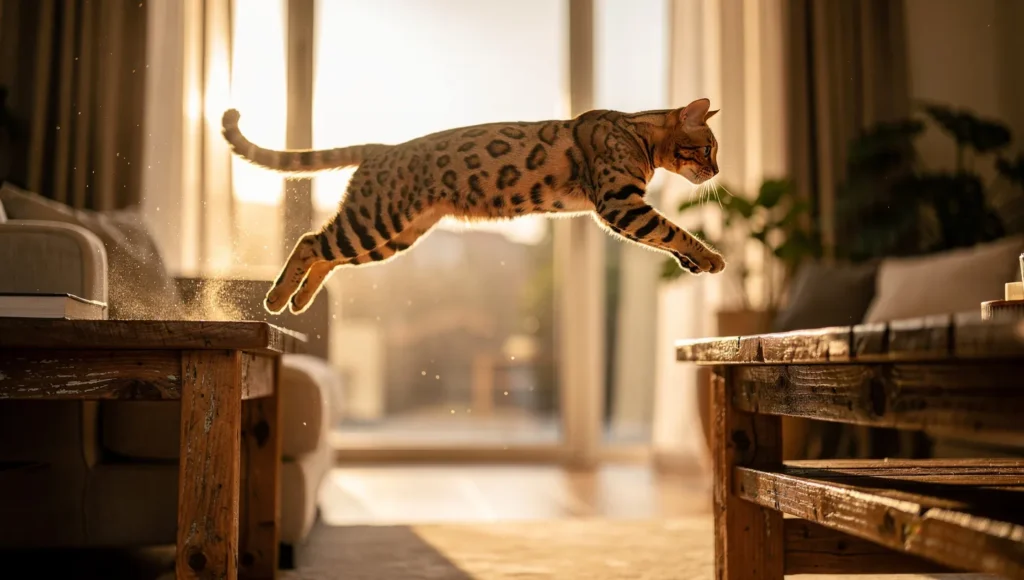
A switch flips somewhere inside Kovu’s brain, and suddenly he’s running full speed from the living room to the bedroom, launching off the bed, rebounding off the wall, landing on my bookshelf with zero grace and zero regret.
This is where things change — it’s not random.
Bengal cats are crepuscular, meaning they’re naturally most active at dawn and dusk. Their wild ancestors hunted during those hours, and that instinct doesn’t disappear just because they live in your apartment now.
The zoomies often happen after eating or after using the litter box — which is actually a fascinating behavioral and neurological response. If you’ve ever wondered why cats go absolutely feral after certain moments, this explanation of the post-poop zoomies will make a lot of sense.
The fix? Scheduled intense play sessions before bedtime.
A tired Bengal is a peaceful Bengal. A bored Bengal is your problem at midnight.
3. The Opera Singer Living in Your Home
Bengals are vocal.
But not in the way people mean when they say “oh my cat talks to me sometimes, it’s so cute!”
No.
Bengals communicate. Constantly.
With a range of sounds that includes chirps, trills, meows, and what I can only describe as a sound like a small child who has been told the pizza place is closed.
Kovu has specific sounds for:
I’m hungry, I’m bored, I want attention, I see a bird, I’m offended that you closed the bathroom door, and what I believe is simply: I have thoughts and you will hear them.
The 4 AM vocalizations — yes, that’s a real thing with Bengals.
If your Bengal is waking you up at night with sound, it’s almost always one of three things: unspent energy, understimulation during the day, or a territorial/anxiety response.
Understanding why cats vocalize at night completely changed how I handled Kovu’s late-night concerts. This breakdown of why cats meow at night was genuinely one of the most useful things I read in those early months.
4. The Water Obsession That Will Confuse You
The first time Kovu jumped into the bathtub while I was in it, I assumed it was an accident.
It was not an accident.
Bengals have a well-documented fascination with water that goes back to their wild ancestry — the Asian Leopard Cat is known to hunt near water sources, and that behavior carries through in domesticated Bengals.
Kovu will: sit in an empty sink and wait for me to turn the tap on, splash water out of his bowl before drinking it, attempt to join me in the shower at least three times a week, and once — just once — managed to turn the bathroom tap on by himself and then got bored and left it running.
This is important: if you’re thinking about bathing a Bengal, they actually handle water better than most cats. This stress-free bathing guide has some genuinely good tips for making the experience calm for both of you — though with a Bengal, honestly, they might be calmer than you.
5. Destructive Boredom — What Happens When a Bengal Is Left Alone
This is the one I wish someone had told me clearly before I got Kovu.
Bengals do not handle being alone well.
I don’t mean they get a little sad. I mean they dismantle things.
The first time I left Kovu alone for a full workday — about nine hours — I came home to find he had: pulled every book off the bottom shelf of my bookcase, figured out how to open the drawer in my nightstand, unrolled an entire roll of paper towels across the kitchen floor, and was sitting in the middle of it all, looking at me with an expression that said: you did this.
Bengals that don’t get enough stimulation and social interaction can develop real separation anxiety — not just “sad while you’re gone” but genuinely anxious behavior that escalates over time.
If you notice your Bengal becoming destructive, excessively vocal when you leave, or showing signs of stress when your routine changes — those are real behavioral signals worth addressing early. This 14-day plan for cat separation anxiety is one of the most practical resources I’ve found — and I say that as someone who genuinely needed it.
🟢🟡🔴 Is a Bengal Cat Right for Your Apartment?
(An Honest Compatibility Scale)
Let me give you the answer nobody gives you directly about Bengal cat behavior in small spaces:
A Bengal cat can live in an apartment — but only if that apartment is set up to meet their needs. Without vertical space, structured play, and daily interaction, apartment life becomes genuinely stressful for a Bengal.
Here’s what that actually looks like in practice:
| Living Situation | Bengal Compatibility | What You Need |
|---|---|---|
| Small apartment (under 600 sq ft) | 🔴 Challenging | Tall cat trees, daily intense play, possible second cat |
| Medium apartment (600–1000 sq ft) | 🟡 Manageable | Vertical space, puzzle feeders, 2x daily play sessions |
| Large apartment or house | 🟢 Good fit | Standard Bengal enrichment routine |
| House with outdoor access | 🟢 Excellent | Supervised outdoor time, harness training |
| Apartment + work from home | 🟢 Very good | Interaction throughout the day matters enormously |
| Apartment + 9-hour work days | 🔴 Difficult | Needs a companion animal or professional enrichment |
The single biggest mistake Bengal owners in apartments make is underestimating how much vertical space matters to this breed.
Bengals climb. They need to climb. It’s not a preference — it’s a behavioral and psychological need.
A well-designed cat tree isn’t a luxury item for a Bengal.
It’s essential infrastructure. This 2026 guide to the best cat trees covers exactly what to look for in terms of height, stability, and design for high-energy breeds like Bengals — including options that don’t make your apartment look like a pet store.
And if you’re still deciding whether a Bengal is the right fit for your lifestyle and living situation, this honest comparison of the best cat breeds for apartments might give you some useful perspective — including some calmer alternatives if Bengal energy feels like too much.
The Part Instagram Doesn’t Show You — Bengal Behavior Problems & Red Flags
Honestly, this is the section I wish had existed when I was researching Bengals.
Because here’s what happens: you search “Bengal cat behavior,” you read five articles that all say the same thing — active, intelligent, energetic, loves water — and you think you understand what you’re signing up for.
You don’t.
Nobody writes about the 11 PM moment when your Bengal locks eyes with you from across the room, and you can see him calculating whether the bookshelf or the kitchen counter is the better target tonight.
Nobody writes about the guilt of leaving for work
while he sits by the door making a sound
that can only be described as emotionally manipulative.
So let’s talk about the real stuff.
When “Energetic” Becomes Aggressive
Most Bengal aggression isn’t random. This is important.
When a Bengal swipes, bites, or becomes suddenly reactive,
it’s almost always one of these:
- Overstimulation — petting sessions that went three minutes too long
- Redirected predatory instinct — he was watching a bird, you walked by at the wrong moment
- Understimulation — he hasn’t had a proper play session in two days and your ankle just became prey
- Fear response — something in the environment changed and he hasn’t processed it yet
The key difference between a Bengal being “aggressive” and a Bengal being reactive is context.
A Bengal that swipes during play isn’t aggressive — he’s overstimulated and telling you to stop. A Bengal that attacks unprovoked, hisses constantly, or shows sudden personality changes?
That’s different. That’s worth a vet visit.
Sudden behavioral changes — especially increased aggression, hiding, or unusual vocalization — can sometimes signal that something medical is happening, not just behavioral. If you’re ever unsure whether what you’re seeing is behavioral or physical, these 10 signs your cat might be sick are worth knowing by heart — especially for a breed as expressive as the Bengal.
The Separation Anxiety Nobody Mentions at the Pet Store
Here’s the thing about Bengals and alone time: they’re not built for it.
This is a breed that bonds deeply — often choosing one person in the household as their primary human and following them everywhere.
And I mean everywhere.
Kovu has never once let me use the bathroom alone. In three years. Not once.
When that bond is disrupted — long work hours, travel, a change in routine — Bengals can develop real anxiety responses:
- Excessive vocalization when you leave
- Destructive behavior (the paper towel incident was just the beginning)
- Over-grooming or fur pulling in severe cases
- Refusing food while you’re away
- Urinating outside the litter box as a stress response
If you recognize any of these, the earlier you address them the better. This structured 14-day plan for separation anxiety is genuinely one of the most practical approaches I’ve seen — it’s behavioral, not medical, and it actually works if you’re consistent.
The Litter Box Warning Sign
Most people don’t connect litter box behavior to emotional state.
With Bengals, you should.
A Bengal who starts avoiding the litter box, going right next to it instead of inside it, or suddenly changing his habits — that’s communication, not spite.
It could be stress. It could be a physical issue. It could be that you moved the box to a location he finds unacceptable (and yes, they have opinions about this).
Litter box placement matters more than most people realize — especially for high-anxiety breeds like the Bengal. Getting this right eliminated one of Kovu’s most frustrating habits within about two weeks.
Red Flags That Mean: Call Your Vet
Not everything is a training problem. Some things need professional eyes.
🔴 Call your vet if you see:
- Sudden, unexplained aggression in a previously calm cat
- Hiding for more than 24 hours combined with not eating
- Vocalization that sounds like pain, not communication
- Repetitive behaviors (pacing, excessive grooming, head pressing)
- Any neurological-looking symptoms — tremors, loss of balance, glazed expression
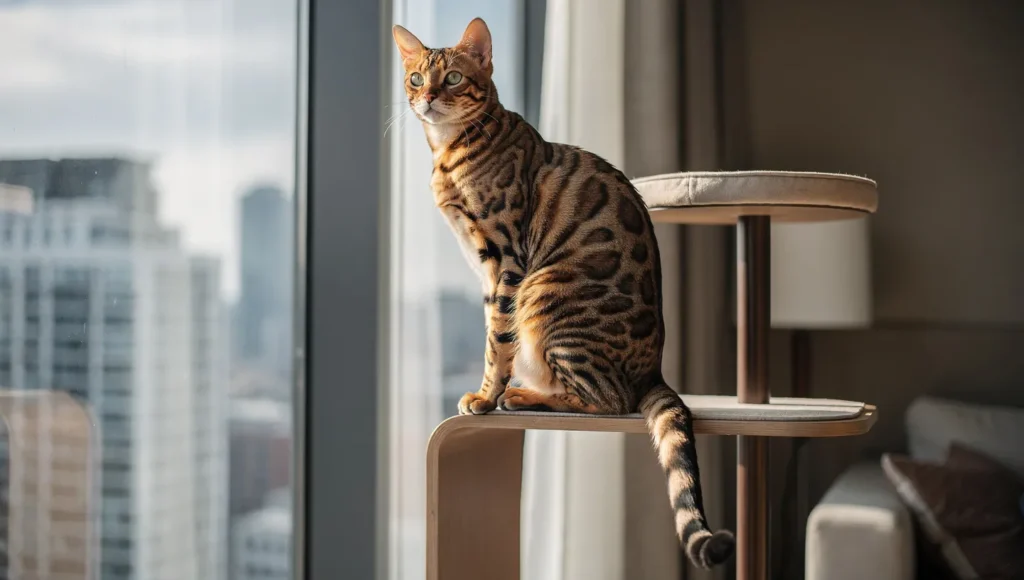
One advantage of Bengal cat behavior is their expressiveness — they show you when something is wrong, if you know how to read them.
Frequently Asked Questions About Bengal Cat Behavior
Are Bengal cats aggressive?
Not naturally — but they’re reactive.
Bengals respond strongly to overstimulation, boredom, and stress. Most “aggression” is actually redirected prey drive or overstimulation during play. True unprovoked aggression is uncommon and usually signals an underlying issue.
Can Bengal cats live in apartments?
Yes, but with conditions.
They need vertical space, daily intense play sessions, and ideally a companion animal if you’re away for long hours. A Bengal in a small, unstimulating apartment will let you know — loudly — that something needs to change.
Do Bengal cats choose one person?
Often, yes.
Bengals tend to bond most deeply with one primary person, following them throughout the home and seeking their attention specifically. They can be affectionate with others, but that one person gets the full Bengal experience.
Why does my Bengal cat follow me everywhere?
It’s a trust and bonding behavior — and with Bengals, it’s more intense than most breeds. They’re social hunters by instinct, and their person becomes part of their “pack.” There are actually nine documented reasons cats follow their owners — and with Bengals, most of them apply simultaneously.
Is a Bengal cat good for first-time cat owners?
Honestly? I’d say approach with caution.
Not because they’re impossible — they’re not — but because their needs are significantly higher than most people expect from a cat. If you’re considering your first cat and you love the Bengal look, this guide to the best breeds for beginners gives you a very honest comparison that might help you decide if you’re ready for the Bengal or want to start somewhere calmer.
So… Is the Bengal Cat Worth It?
(My Honest Answer After Three Years)
I’m going to tell you something Marcus told me about six months after I got Kovu.
We were sitting in my apartment. Kovu was asleep — genuinely, peacefully, completely asleep — curled against my leg like he’d been doing it his whole life. His spots were catching the light. He was making this low, steady purr that felt like it was coming from somewhere ancient.
Marcus looked at him for a long moment and said: “Okay. I get it now.”
That’s the Bengal experience in two words.
You will be exhausted. You will replace things.
You will have conversations with your veterinarian at hours that feel criminal. You will stand in your kitchen at midnight watching a spotted cat sprint figure-eights around your furniture and question every decision you’ve ever made.
And then he’ll climb into your lap — or more likely, position himself directly next to your head while you sleep, which is its own fascinating behavior — and you’ll forget every bit of it.
If you’ve ever wondered why cats choose to sleep next to your head, with Bengals it’s almost always about trust and security — and with a breed this independent and wild-natured, earning that trust feels like an actual achievement.
From my experience — and I say this as someone who called his vet crying about a chandelier — Bengals are worth it.
But only if you go in with honest expectations.
Not the Instagram Bengal. The real Bengal cat behavior — raw, wild, exhausting, and completely worth it.
The one that opens your fridge, sings opera at dawn, and somehow makes you feel like the luckiest person in the room when he decides you’re worth his time.
A genuine thank you to Marcus, who was right about everything and has never once said “I told you so” — which is honestly more impressive than anything the cat has done.
To Dave — who still believes cats eat yarn and has learned nothing from this experience — I appreciate your confidence.
And to Dr. Sami: I genuinely do not know what I would have done without you. Three years of 4 AM texts, zero complaints, infinite patience. If Kovu could talk, I think even he would say thank you.
Have a Bengal of your own? I want to hear about it — the chaos, the moments that made you laugh, the things nobody warned you about. Drop your story in the comments below. I read every single one, and honestly, your Bengal disaster stories make my day every time. Share this with someone who’s thinking about getting a Bengal — it might save their curtains.