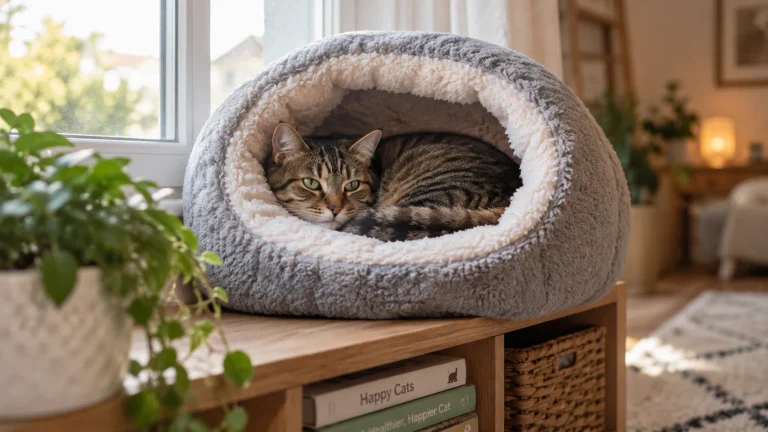


I’m going to be honest with you — when I was trying to figure out how to introduce two cats, I genuinely thought it would be like a Disney movie.
Luna (my first cat, a three-year-old tortoiseshell with the personality of a retired librarian) would sniff Biscuit, they’d touch noses, maybe there’d be soft background music, and by Tuesday they’d be sharing a blanket.
That is not what happened.
What happened was: Biscuit walked in, Luna screamed like I’d personally offended her ancestors, and then spent six days under my bed refusing to make eye contact with me. Not Biscuit. Me.
I called my friend Dave for advice. Dave has owned cats for fifteen years and once confidently told me that the best way to introduce two cats is to just “put them in a room together and let them sort it out.” Dave said, and I quote, “they’ll figure it out, man.”
They did not figure it out.
I then spent three days reading articles that were so dry and clinical I fell asleep twice — until Marcus, a guy in my cat owner Facebook group, dropped a link to a proper step-by-step guide and said “dude, read this before you ruin your cats forever.” Dramatic? Yes. Accurate? Also yes.
At 6 AM on day four, I called Dr. Sami — my vet — in a mild panic. He was very patient. He explained everything. And everything he told me is basically what you’re about to read.
Quick note before we dive in: this article is based on my personal experience and research from trusted sources like ASPCA and AVMA. It’s here to inform and guide — not to replace actual veterinary advice. If things escalate or you’re genuinely worried, please call your vet. Dr. Sami will understand.
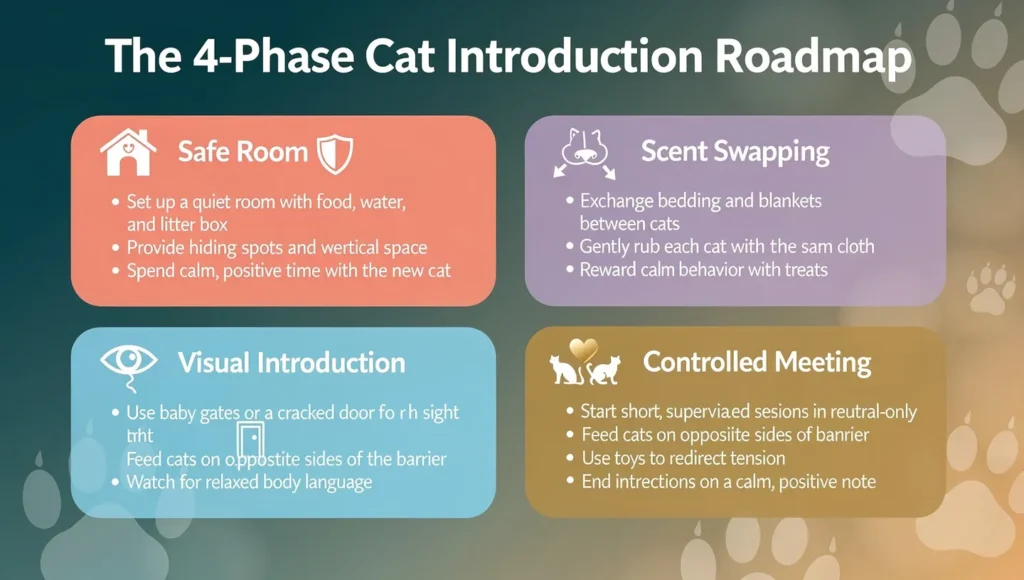
Table of Contents
- Why Most Attempts on How to Introduce Two Cats Fail (And It’s Not Your Fault)
- The Golden Rule: Stop Rushing Everything
- The Step-by-Step Roadmap: How to Make Two Cats Get Along
- Step 1: The Safe Room (Luna’s Kingdom)
- Step 2: Scent Swapping (The Sneaky Sock Trick)
- Step 3: Visual Introduction (The Baby Gate Method)
- Step 4: Controlled Meetings & Play Therapy
- 🟢🟡🔴 Are They Fighting or Playing? (The Real Progress Guide)
- Troubleshooting: What If They Suddenly Stop Getting Along?
- Frequently Asked Questions About How to Introduce Two Cats
- How long does it take for cats to get used to each other?
- Is hissing normal when introducing cats?
- Should I let my cats fight it out?
- What if my resident cat is very aggressive?
- Can cats that hate each other ever get along?
- One Last Thing
Why Most Attempts on How to Introduce Two Cats Fail (And It’s Not Your Fault)
Most cat introductions fail because of one simple mistake: treating cats like dogs.
Dogs are pack animals. They’re wired to accept new members. Cats? Cats are territorial solitary hunters who see a new cat in their home the same way you’d feel if a stranger just moved into your bedroom. Without asking. And started using your bathroom.
Here’s the thing — your resident cat isn’t being difficult. They’re being a cat.
The territorial stress is real. Your resident cat has spent months or years building a mental map of their home. Every corner, every sunny spot, every couch cushion has been claimed with invisible scent markers. A new cat doesn’t just disrupt that — it threatens the entire system.
Featured Snippet: How long does it take to introduce two cats?
A proper cat introduction typically takes 2 to 4 weeks, and in some cases up to 3 months. Rushing the process is the #1 reason introductions fail.
Now — the hissing. Parents, new cat owners, and Dave will all tell you that hissing means the cats hate each other and always will. That’s wrong.
Hissing during a first introduction is completely normal. It’s communication. It means: “I don’t know you yet and you’re in my space.” That’s very different from sustained aggressive behavior like lunging, screaming, or drawn-out physical fights.
Understanding that difference early on will save you a lot of 6 AM phone calls to your vet.
If you’re not sure what aggressive body language actually looks like versus stress or play, I’d really recommend checking out the full breakdown in Cat Aggression Signs — it covers exactly what signals to watch for before things escalate. And if you want to understand the bigger picture of what your cat is communicating, Cat Body Language is genuinely one of the most useful reads I’ve found.
Most people get this wrong because they expect silence to mean progress. It doesn’t. Progress sounds like two cats quietly existing in the same zip code without anyone losing their mind. And that takes time — more time than Disney ever showed us.
Honestly? That’s okay.
The Golden Rule: Stop Rushing Everything
The single biggest mistake people make when introducing two cats? They rush it.
I get it. You’re excited. The new cat is adorable. You want them to be best friends by the weekend. But here’s the thing — cats don’t work on your timeline. They work on their timeline. And their timeline is slower than you think.
Rushing the process when learning how to introduce two cats doesn’t just slow things down. It can permanently damage their relationship before it even starts. The resident cat associates the new cat with stress, panic, and invaded territory — and that association sticks.
Featured Snippet: How long does it take for two cats to get along?
Most cats need 2 to 4 weeks of slow, structured introduction before they’re comfortable sharing space. Some cats — especially older or more territorial ones — may need up to 3 months. Patience isn’t optional. It’s the whole strategy.
Here’s a realistic timeline that actually worked for me:
| Timeframe | What’s Happening | What You Should Do |
|---|---|---|
| Days 1–3 | New cat in safe room, resident cat aware of new smell | Separate completely, no visual contact |
| Days 4–7 | Scent swapping begins | Exchange bedding, feed on opposite sides of door |
| Week 2 | First visual contact | Baby gate or cracked door — supervised only |
| Weeks 3–4 | Short, controlled shared sessions | Neutral space, toys, treats — stay present |
| Month 1+ | Gradual unsupervised time | Watch for stress signals, never force interaction |
Personally, I tried to skip from Day 3 straight to Week 3 because Biscuit seemed calm and I was impatient. Luna reminded me — loudly, at 2 AM — that this was a terrible idea.
This is where things change: the owners who succeed aren’t the ones with the friendliest cats. They’re the ones who commit to being boring and consistent for four weeks straight. No shortcuts. No “let’s just see what happens.”
Dr. Sami told me something that stuck with me: “Every day you rush, you add a week to the process.” I don’t know if that’s scientifically precise, but it felt accurate when Luna was still hissing at the hallway on day ten.
The Step-by-Step Roadmap: How to Make Two Cats Get Along
This is the part that actually matters. The exact roadmap for how to introduce two cats involves four phases. Each one builds on the last.
Step 1: The Safe Room (Luna’s Kingdom)
Before your new cat even sets a paw in your home, you need a dedicated room set up and ready.
This isn’t just a holding area. It’s the new cat’s entire world for the first few days — and it needs to feel safe, not like a waiting room.
When Biscuit arrived, I set up the spare bedroom with everything he needed: litter box, water, food, a few hiding spots, and one of my old t-shirts for familiar scent. The door stayed closed. Luna couldn’t see him. She could smell him — and trust me, she had opinions about that — but there was no visual threat yet.
This phase does two things simultaneously. It lets the new cat decompress from the stress of a new environment. And it lets your resident cat process the new scent without feeling ambushed.
Cats feel most threatened when they have no escape route. A closed door gives both cats a psychological boundary — and boundaries, weirdly, are what make cats feel safe enough to eventually lower their guard.
If your new cat is hiding a lot in this phase, that’s completely normal. For a deeper look at why cats hide and what it means, Why Do Cats Hide breaks it down really well.
The safe room phase should last a minimum of 3 full days — even if the new cat seems completely relaxed. Even if your resident cat seems unbothered. Don’t skip it.
Step 2: Scent Swapping (The Sneaky Sock Trick)
Here’s where things get interesting — and where Dave’s second piece of advice almost derailed everything.
Dave suggested I “just rub a towel on one cat and put it near the other.” Which is… technically correct? But also missing approximately seventy percent of the actual method.
Scent swapping is the real foundation of a successful introduction. Cats recognize each other primarily through smell — not sight, not sound. If you can make the new cat’s scent feel familiar and non-threatening before any face-to-face meeting, you’ve already done half the work.
Here’s how to do it properly:
- Take a soft sock or small cloth and gently rub it on one cat’s cheeks and chin (where scent glands are)
- Place it near — not under — the other cat’s food bowl
- Let them investigate on their own terms. Don’t force it.
- Rotate every day or two, gradually moving the scent item closer to their resting spots
- After a few days, swap their bedding entirely
The goal isn’t for them to love the smell immediately. The goal is for it to become normal. Familiar. Not alarming.
Biscuit sniffed Luna’s blanket for about forty-five seconds on day one, then walked away completely unbothered. Luna sniffed Biscuit’s sock, sat back, and stared at the wall for ten minutes like she was processing an existential crisis. Both reactions are fine.
Give this phase at least 4 to 5 days before moving on.
Step 3: Visual Introduction (The Baby Gate Method)
This is the first time your cats will actually see each other — and mastering how to introduce two cats visually at this moment matters a lot.
Do not open the door and hope for the best. (That’s the Dave method. We’ve established how that goes.)
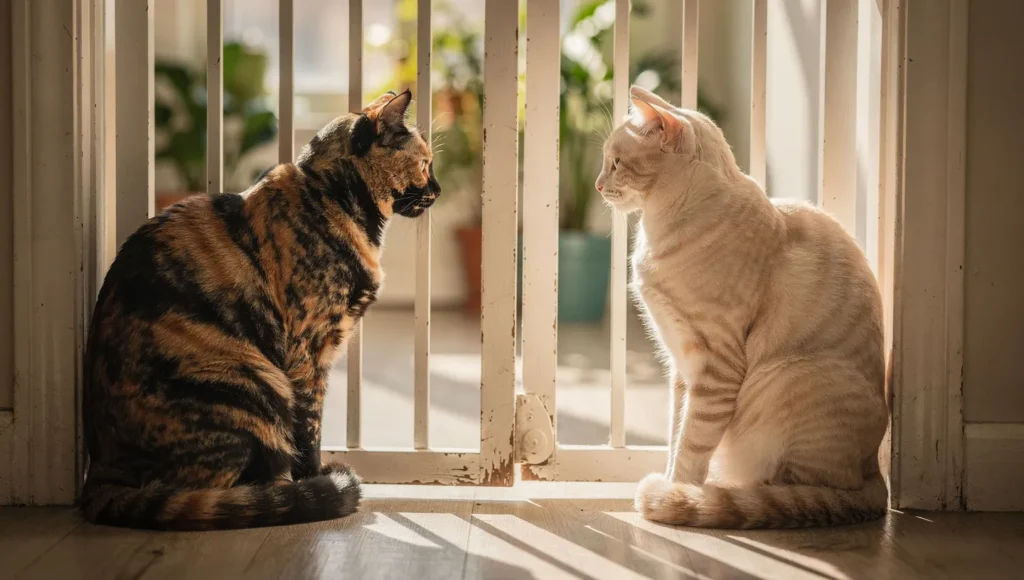
The cleanest approach is a baby gate in the safe room doorway, or simply cracking the door open an inch or two — just enough for both cats to see each other, but not enough for anyone to cross over.
What you’re watching for:
- Relaxed posture, casual sniffing → Great sign. Let it continue.
- Stiff body, wide pupils, puffed tail → Too much too soon. Close the door, try again tomorrow.
- Hissing from a distance → Normal at this stage. Don’t intervene unless it escalates.
- One cat walking away unbothered → Honestly, ideal. No drama = progress.
Keep these sessions short. Five to ten minutes maximum, two or three times a day. End on a calm note — even if nothing dramatic happened. Ending before stress peaks is how you build positive associations.
I made the mistake of letting the first visual session go too long because “they seemed fine.” By minute fifteen, Luna had entered what I can only describe as full supervillain mode. We went back to the closed door for two more days.
Less is more. Genuinely.
Step 4: Controlled Meetings & Play Therapy
Once both cats are consistently calm during visual sessions — no puffed tails, no screaming, no existential wall-staring — you’re ready for the first shared space meeting.
Choose a neutral room. Not Luna’s favorite spot. Not Biscuit’s safe room. Somewhere neither cat has fully claimed yet.
Bring out the good stuff: a wand toy, some high-value treats, and your full attention. The goal of this session isn’t for them to become friends. It’s for them to associate each other’s presence with good things.
Play with both cats simultaneously if possible — one wand toy each, or take turns. Treats scattered on the floor work well because both cats are focused on the food, not on each other. That parallel activity, where they’re near each other but not interacting directly, is exactly where you want to be.
Keep sessions under fifteen minutes. Watch body language the entire time. The moment anyone gets tense, end the session calmly and separate them.
For toy ideas that actually engage cats during these sessions, Best Interactive Cat Toys has solid options — especially wand toys and puzzle feeders. And if you’re thinking about adding vertical space to reduce territorial tension, Best Cat Trees is worth a look. Vertical territory genuinely helps.
Repeat these sessions daily, gradually extending the time as both cats stay relaxed. Progress will feel slow. That’s normal. You’re not looking for a breakthrough moment — you’re building a new normal, one calm session at a time.
🟢🟡🔴 Are They Fighting or Playing? (The Real Progress Guide)
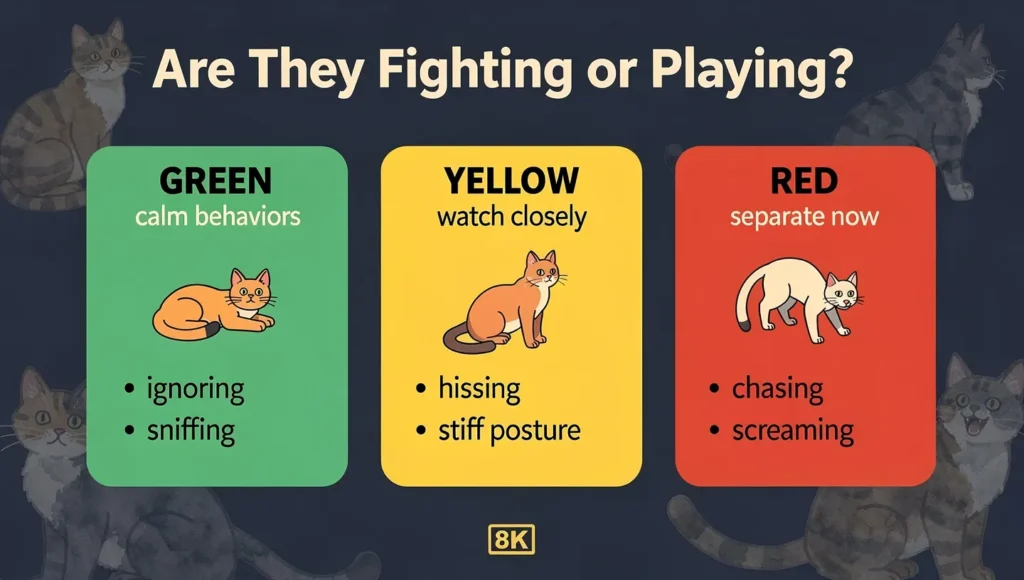
This is the question that kept me up at night. Hissing doesn’t always mean failure —
but not all hissing is equal. Here’s a simple guide I wish someone had handed me on day one:
| Behavior | What It Means | What To Do |
|---|---|---|
| Ignoring each other | 🟢 Excellent progress | Let it be |
| Sniffing from a distance | 🟢 Curiosity, not threat | Stay calm, don’t intervene |
| Light hissing, then walking away | 🟡 Normal boundary-setting | Monitor, don’t panic |
| Puffed tail, stiff body | 🟡 Stress building | End the session early |
| Chasing with no breaks | 🔴 Escalating aggression | Separate immediately |
| Screaming, biting, drawing blood | 🔴 Real fight | Separate + reset to Step 1 |
The difference between play and aggression usually comes down to breaks and body language. Playing cats take turns. Aggressive cats don’t stop.
For a deeper read on reading the signals before they escalate, Cat Posture Meaning and Cat Ear Position Meaning are two of the most practical guides I’ve bookmarked.
Troubleshooting: What If They Suddenly Stop Getting Along?
Sometimes two cats are doing great — then one vet visit, one rearranged piece of furniture, one bad afternoon — and suddenly you’re back to hissing at the hallway.
This is called redirected aggression, and it’s more common than people think.
What to do:
- Separate them immediately — no punishment, just a calm reset
- Go back to scent swapping for 2 to 3 days
- Reintroduce visual contact before shared space again
- Check for underlying stress triggers: new smells, schedule changes, illness
If the aggression feels sudden and out of character, it’s worth a vet call.
Pain and illness can cause behavioral shifts that look exactly like social conflict. The full breakdown in Cat Separation Anxiety covers a lot of the behavioral resets that apply here too.
According to the ASPCA, reintroduction after a conflict should always start from the last successful phase — not from zero, but not from where you left off either. Trust the process.
Frequently Asked Questions About How to Introduce Two Cats
How long does it take for cats to get used to each other?
Anywhere from 2 weeks to 3 months. Every cat is different. The slower you go, the faster it actually works. Counterintuitive but true.
Is hissing normal when introducing cats?
Yes — completely. Hissing is communication, not a verdict. It usually means “I don’t know you yet.” Give it time.
Should I let my cats fight it out?
No. Letting cats “sort it out” through sustained fighting creates lasting fear and aggression.
Always separate and reset. The Jackson Galaxy method is built entirely on preventing escalation, not allowing it.
What if my resident cat is very aggressive?
Slow everything down and go back to scent swapping. Some cats need 6 to 8 weeks before any visual contact. If aggression persists, a vet or a feline behaviorist is the right next call — not more patience alone.
Can cats that hate each other ever get along?
Often, yes — but “get along” might look like peaceful coexistence, not cuddles.
That’s a completely valid outcome. Not every cat becomes a best friend. Mutual tolerance with zero conflict is genuinely a win.

One Last Thing
About three months after that chaotic first week, I walked into the living room and found Luna and Biscuit asleep on the same couch. Not touching. About eight inches apart. Luna had one eye half open like she was making sure I noticed and didn’t make it weird.
I made it weird. I took seventeen photos.
If you’ve ever wondered why cats sometimes end up sleeping near the people (or other cats) they’ve slowly decided to trust, Why Does My Cat Sleep Next to My Head is a genuinely sweet read.
Dave still thinks he gave good advice. Marcus saved my sanity. Dr. Sami deserves a fruit basket.
And you — give it time. Go slow. Trust the process. Your cats will get there. Probably when you least expect it, and definitely when you’re not watching.
Drop a comment below and tell me where you are in the process. I read every single one.