
I still remember the morning I walked over to Mochi’s litter box and just… stopped.
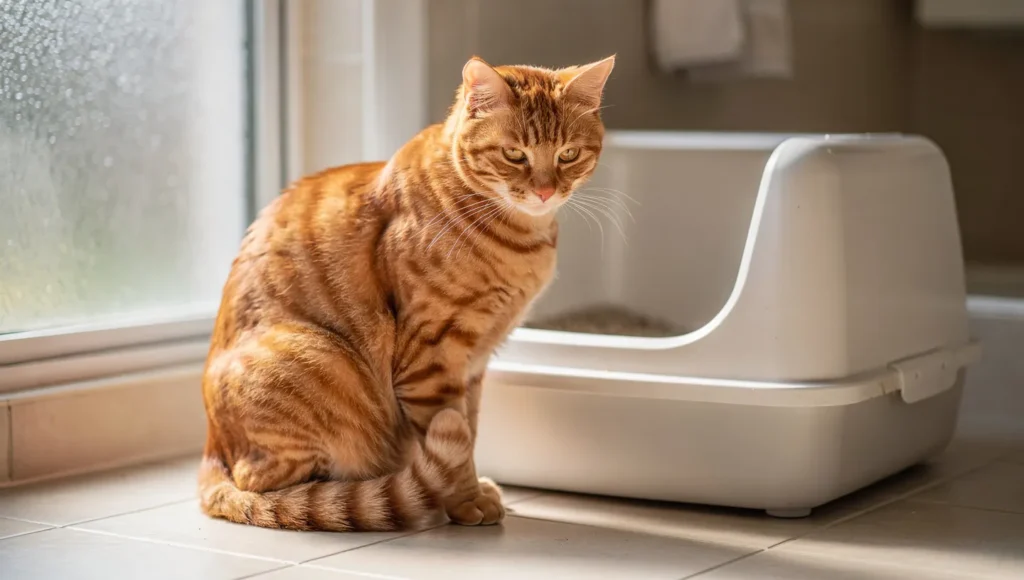
Something was clearly wrong. The smell hit me first, then I saw it. My first instinct? Full panic mode. I grabbed my phone and started googling everything at once.
But here’s what I wish someone had told me that morning: in most cases, it’s not as serious as it looks.
This guide will walk you through the real reasons your cat might have diarrhea, what you can do at home, and — most importantly — the exact signs that mean you need to act fast.
Quick note: This article is based on personal experience and research from trusted sources. It’s for informational purposes only and isn’t a substitute for professional veterinary advice. If your cat seems unwell or symptoms persist, please consult your vet.
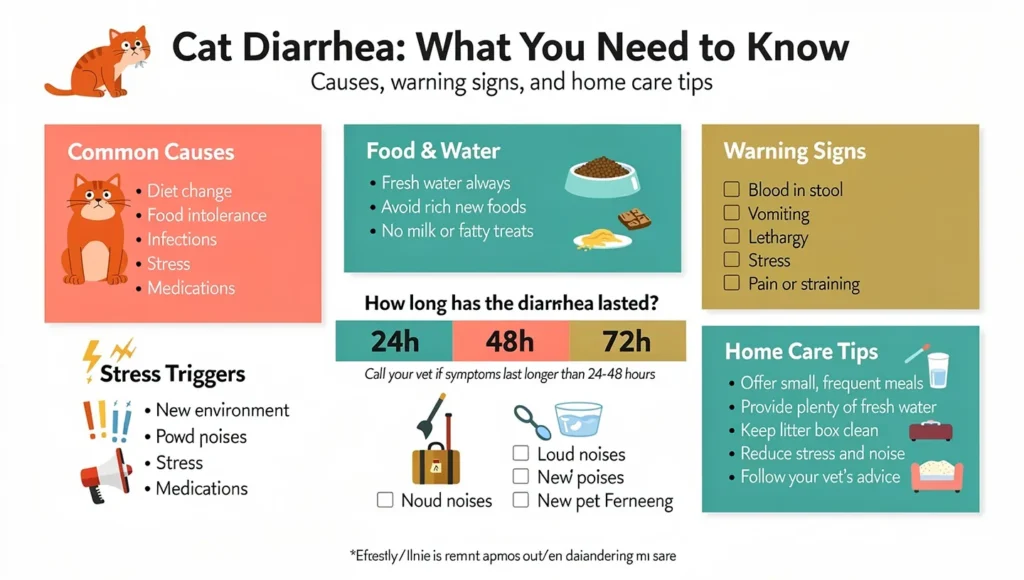
Table of Contents
- Quick Answer: Why Does My Cat Have Diarrhea?
- Why Does My Cat Have Diarrhea? The Most Common Reasons
- 1. Sudden Food Change
- 2. Eating Something They Shouldn’t Have
- 3. Stress and Environmental Changes
- 4. Food Sensitivity or Intolerance
- 5. Parasites or Infection
- Is Your Cat’s Diarrhea Serious or Not? (Simple Way to Tell)
- Signs It’s Probably Mild
- Signs You Should Actually Worry
- How Long Should Cat Diarrhea Last?
- What I Actually Do When My Cat Has Diarrhea (Step-by-Step)
- Step 1: Don’t Panic (Seriously)
- Step 2: Make Sure Water Is Always Available
- Step 3: Simplify Their Food
- Step 4: Give It Time
- Step 5: Transition Back Slowly
- What to Feed a Cat With Diarrhea
- Diarrhea and Vomiting Together — What Does That Mean?
- 5 Mistakes That Make Cat Diarrhea Worse
- ❓ Frequently Asked Questions About Cat Diarrhea
- Why does my cat have diarrhea all of a sudden?
- Can cat diarrhea go away on its own?
- How long is too long for cat diarrhea?
- Is cat diarrhea contagious to other pets?
- Can stress cause diarrhea in cats?
- Why does my indoor cat have diarrhea?
- What does it mean if my cat has diarrhea but is eating normally?
- One Last Thing: What Your Cat Is Trying to Tell You
Quick Answer: Why Does My Cat Have Diarrhea?
Cat diarrhea is usually caused by a sudden diet change, stress, food sensitivity, or something your cat ate that didn’t agree with them. In most mild cases, it clears up on its own within 24 to 48 hours — but if it lasts longer or comes with vomiting, blood, or low energy, it’s time to pay closer attention.
Why Does My Cat Have Diarrhea? The Most Common Reasons
Here’s the thing — cat diarrhea isn’t one-size-fits-all. There are a handful of causes that show up way more often than others, and once you understand them, things start to make a lot more sense.
1. Sudden Food Change
This is probably the number one culprit.
Cats have surprisingly sensitive digestive systems, and switching their food too quickly — even to something healthier — can throw everything off balance. I made this mistake once. Switched Mochi’s food in a single day because I thought the new brand was better. By the next morning, I had my answer.
The rule of thumb? Transition over 7 to 10 days, mixing the old and new food gradually. If you’re in the middle of switching right now, this guide on how to switch cat food safely is exactly what you need.
2. Eating Something They Shouldn’t Have
Cats are curious. Wonderfully, frustratingly curious.
A piece of spoiled food, something off the floor, a plant, a bug — it doesn’t take much. If your cat got into something unusual in the last 24 hours, that’s probably your answer right there.
This is also why knowing what cats can and can’t eat is genuinely useful, not just trivia.
3. Stress and Environmental Changes
Most people get this wrong — they focus entirely on food and completely forget about stress.
Moving to a new home, a new pet, a new person in the house, even rearranging the furniture — all of these can trigger digestive upset in cats. Their gut is surprisingly connected to their emotional state.
If your cat’s environment changed recently and everything else seems fine, stress is a very real possibility.
4. Food Sensitivity or Intolerance
Some cats simply don’t tolerate certain proteins or ingredients well. Chicken, fish, grains, dairy — any of these can cause ongoing loose stools if your cat’s system just doesn’t agree with them.
This is different from a sudden reaction. Food sensitivity tends to show up consistently, often tied to a specific food they eat regularly. Understanding what cats actually need in their diet can help you identify patterns you might have missed.
5. Parasites or Infection
This one’s less common in indoor cats, but it happens.
Giardia, roundworms, and certain bacterial infections can all cause diarrhea — sometimes with no other obvious symptoms. If your cat goes outside, had contact with other animals, or if the diarrhea just won’t go away, this is worth considering.
Honestly, this is the scenario where a vet visit stops being optional.
Is Your Cat’s Diarrhea Serious or Not? (Simple Way to Tell)
This is where things change.
Because the difference between “wait and watch” and “call the vet now” comes down to a few specific details — and most people either overreact or (more dangerously) underreact.
Signs It’s Probably Mild
Your cat is likely fine for now if:
- They’re still eating and drinking normally
- They’re active and playful as usual
- The diarrhea is soft but not watery
- It happened once or twice, not continuously
- No blood, no mucus, no unusual color
Personally, when I see this combination, I take a breath and go into observation mode. Not ignore mode — observation mode. There’s a difference.
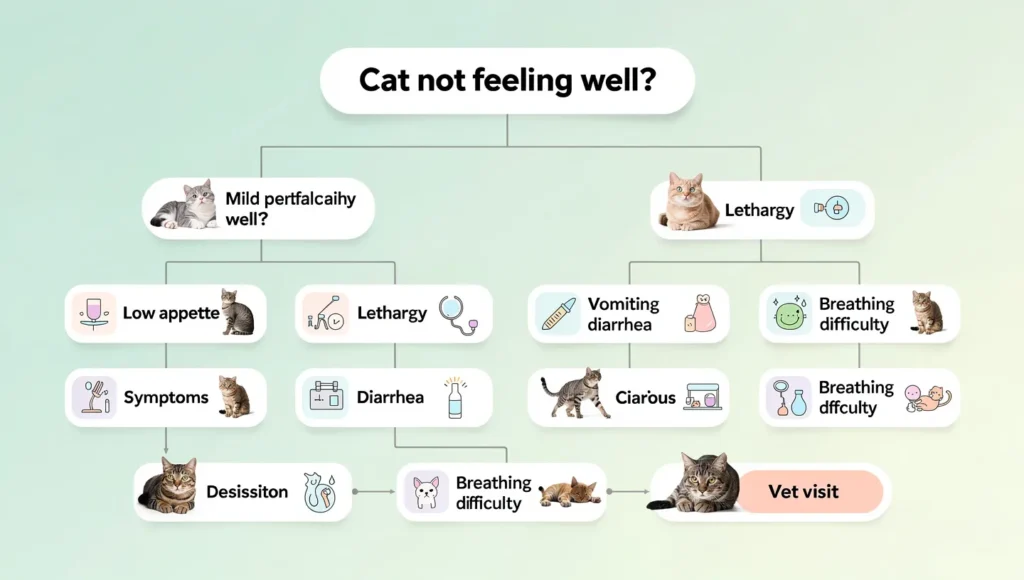
Signs You Should Actually Worry
Pay close attention if you notice:
- Diarrhea lasting more than 48 hours
- Watery or explosive diarrhea
- Blood or dark color in the stool
- Vomiting at the same time
- Your cat seems tired, weak, or withdrawn
- Loss of appetite for more than a day
- Signs of dehydration (dry gums, sunken eyes, skin that doesn’t bounce back)
If you’re seeing two or more of these together, don’t wait. These are the signs covered in detail in how to tell if your cat is sick — and they matter.
How Long Should Cat Diarrhea Last?
And this is important.
A lot of people don’t know there’s actually a rough timeline for this — and knowing it can save you both unnecessary panic and dangerous delay.
| Timeframe | What It Usually Means | What To Do |
|---|---|---|
| Under 24 hours | Very likely mild and temporary | Monitor, keep hydrated |
| 24–48 hours | Still possibly minor, but worth watching | Bland diet, watch for red flags |
| 48–72 hours | Starting to be a concern | Consider calling your vet |
| 72+ hours | Needs attention | Vet visit, don’t wait longer |
Most mild cases — the food change, the stress reaction, the random thing they ate — resolve within that first 24 to 48 hour window. If it’s going past that, something else might be going on.
What I Actually Do When My Cat Has Diarrhea (Step-by-Step)
From my experience, here’s the honest version of what actually helps:
Step 1: Don’t Panic (Seriously)
Your cat can feel your energy. Stay calm, observe, and give it a little time before you spiral.
Step 2: Make Sure Water Is Always Available
This is the most critical step and the one people forget most.
Diarrhea dehydrates cats fast — faster than most owners realize. Make sure fresh water is accessible at all times. If your cat isn’t drinking on their own, that’s a red flag worth noting.
For cats who are already picky about water, this guide on cat hydration has some genuinely practical tricks that worked for me.
Step 3: Simplify Their Food
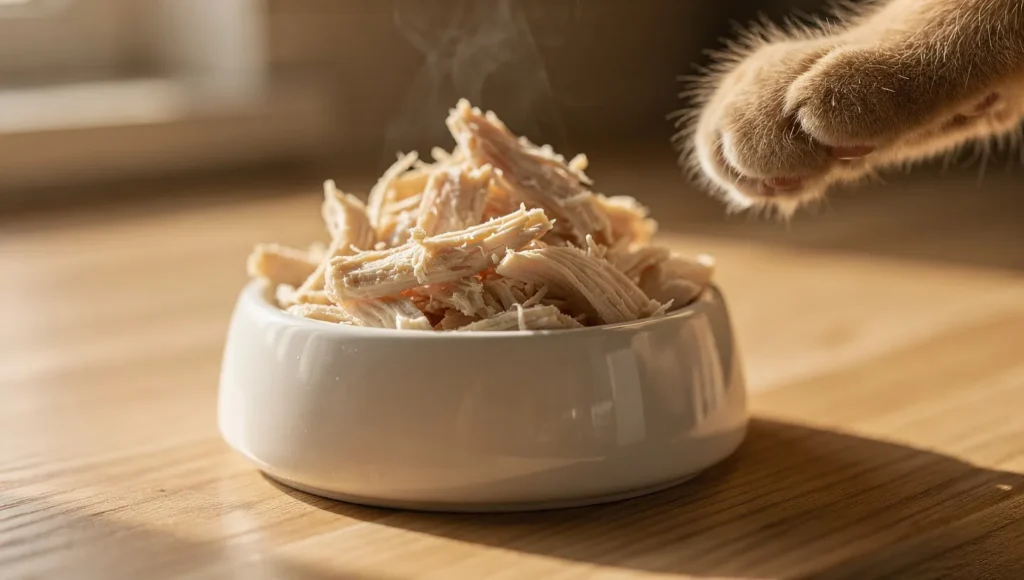
Switch to something easy on the stomach. Plain boiled chicken with no seasoning, or a simple wet food with minimal ingredients.
No treats, no rich food, nothing new.
Step 4: Give It Time
Don’t keep changing things every few hours. Pick an approach, stick with it for 24 hours, and observe. Constant changes just make it harder to know what’s working.
Step 5: Transition Back Slowly
Once things settle, don’t rush back to normal food.
Go slow. Mix old and new. Give the gut time to recover.
What to Feed a Cat With Diarrhea
Simple is better. Always.
✅ Safe options:
- Plain boiled chicken (no salt, no seasoning)
- Plain boiled white rice (small amount mixed with protein)
- High-quality wet food with simple ingredients
- Bone broth made specifically for cats (no onion, no garlic)
❌ Avoid:
- Dairy products of any kind
- Fatty or rich foods
- Treats and snacks
- Anything new you haven’t given them before
One thing I learned the hard way: I once gave Mochi a little bit of cheese thinking it would help settle her stomach. I have no idea why I thought that. It made everything significantly worse.
Don’t do that.
According to ASPCA and general veterinary guidance, dairy is poorly tolerated by most adult cats — their digestive systems simply aren’t built for it after kittenhood.
Diarrhea and Vomiting Together — What Does That Mean?
If your cat has both diarrhea and vomiting at the same time, that’s a different situation.
It usually means the digestive system is under more significant stress — whether from something they ate, an infection, or something systemic. The combination also increases the risk of dehydration much faster than either symptom alone.
This isn’t automatically an emergency, but it does move up the urgency level. Don’t wait 72 hours in this case — 24 to 48 hours is your window.
For more context on what vomiting after eating can mean on its own, this breakdown is worth reading alongside this one.
5 Mistakes That Make Cat Diarrhea Worse
Most people get this wrong — not because they don’t care, but because the instinct is to do something. Here’s what to avoid:
1. Switching food again immediately
Your gut reaction might be “maybe it’s the food, let me change it.” But switching again just adds more disruption to an already upset stomach.
2. Giving dairy
Milk, cheese, yogurt — it feels comforting to offer, but most cats can’t digest lactose properly. It will make things worse. Every time.
3. Ignoring hydration
This is the quiet danger. People focus on the food and forget the water. Dehydration from diarrhea can become serious quickly, especially in older cats or kittens.
4. Over-medicating at home
Never give your cat human medications — not Pepto-Bismol, not Imodium, nothing. What’s safe for humans can be toxic for cats.
5. Waiting too long
On the flip side — if you’re past the 72-hour mark, or you’re seeing blood, or your cat just doesn’t seem like themselves, don’t keep waiting. Trust your instincts.
❓ Frequently Asked Questions About Cat Diarrhea
Why does my cat have diarrhea all of a sudden?
Usually it comes down to three things: a sudden food change, stress from something in their environment, or eating something that didn’t agree with them. Most sudden cases are mild and temporary.
Can cat diarrhea go away on its own?
Yes, in many mild cases it resolves within 24 to 48 hours without any treatment. Just make sure they stay hydrated and keep their food simple.
How long is too long for cat diarrhea?
Anything past 48 to 72 hours deserves attention. If it hits the 72-hour mark — or sooner if there’s blood, vomiting, or low energy — contact your vet.
Is cat diarrhea contagious to other pets?
It depends on the cause. If it’s from stress or food, no. But if it’s from a parasite or bacterial infection, yes — it can spread to other pets in the home.
Can stress cause diarrhea in cats?
Absolutely. Cats are much more sensitive to environmental changes than most people realize. A new pet, a move, even a shift in your schedule can upset their digestive system.
Why does my indoor cat have diarrhea?
Indoor cats aren’t immune. The most common reasons are food changes, stress, sensitivity to an ingredient in their regular food, or occasionally parasites picked up from contaminated surfaces or prey.
What does it mean if my cat has diarrhea but is eating normally?
It’s usually a good sign. If your cat is eating, drinking, and acting like themselves — just with looser stools — it’s likely a mild digestive issue. Still worth monitoring, but less urgent.
One Last Thing: What Your Cat Is Trying to Tell You
If there’s one thing I want you to take from all of this, it’s this:
You know your cat better than anyone.
Most cases of diarrhea are temporary, manageable, and not worth a full panic spiral. But that calm observation? That’s not the same as ignoring it.
Watch. Note the details. Trust what you know about your cat’s normal behavior — because that’s honestly your best diagnostic tool.
And when something feels off beyond the usual? Don’t wait for permission to call the vet.