
You’re standing in the cat food aisle, holding a can of Fancy Feast. Your cat acts like it’s pure gold, but that random comment you read at 2 a.m. on Reddit claims it’s “junk food.” Now you’re staring at the label, questioning all your life choices as a cat parent. Is it actually bad, or are pet owners just overcomplicating things again?
Here’s the quick truth: Fancy Feast isn’t a single recipe—it’s a whole universe of pâtés, gravies, and dry kibble. Whether it’s healthy comes down to the exact can you pop open. In this guide, backed by veterinary nutrition standards (and zero brand bias), we’ll break down the ingredients, compare the 3 main formats, and clear up the internet myths once and for all.
This article is based on research into trusted veterinary and nutrition sources, not personal veterinary experience — it’s for general information and doesn’t replace advice from your own vet.
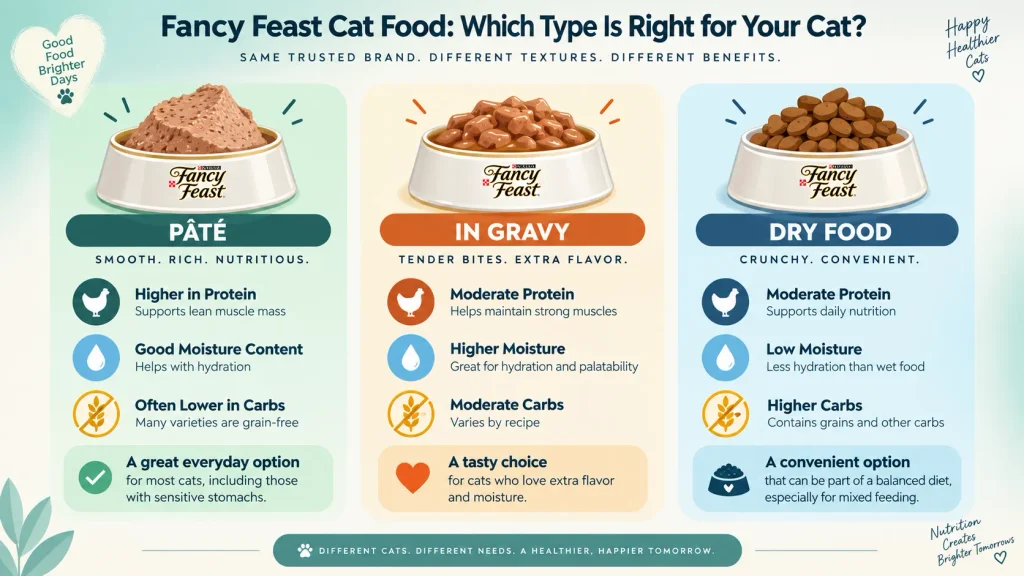
Table of Contents
- Is Fancy Feast Healthy for Cats? The Short Answer
- When Fancy Feast Tends to Work Well
- When a Recipe May Not Be the Right Fit
- Fancy Feast by Recipe Type: Pâté vs. Gravy vs. Dry
- Classic Pâté — The One Most Owners (and Vets) Point To
- Gravy Recipes — Where Most of the Concern Concentrates
- Dry Fancy Feast — The Moisture Trade-Off
- What Is Fancy Feast Actually Made Of?
- Protein Sources
- Carbohydrates and Fillers
- What “Meat By-Products” Actually Means
- What an Ingredient List Can — and Can’t — Tell You
- Why Do Some People Say Fancy Feast Is Bad for Cats?
- Can One Cat’s Bad Experience Be Blamed on the Whole Brand?
- What Owners Actually Report — the Honest, Messy Picture
- Can Cats Eat Fancy Feast Every Day?
- The AAFCO Statement Is Your Real Answer Here
- Why Recipe Variety Can Help
- When Daily Feeding Needs a Vet’s Input
- Is Fancy Feast Good for Kittens, Seniors, or Cats With Special Needs?
- Kittens Need More Than the Adult Formulas Provide
- Senior Cats: Hydration Matters More Than Ever
- Sensitive Stomachs: The Pâté Pattern Holds Here Too
- Urinary Health: Support, Not Treatment
- How to Choose the Right Fancy Feast Recipe for Your Cat
- Pros and Cons of Fancy Feast
- Quick Answers Owners Keep Asking
- Is Fancy Feast good for cats?
- Can a cat eat Fancy Feast every day?
- Is Fancy Feast wet food healthier than the dry version?
- Is Fancy Feast good for kittens?
- Is Fancy Feast in gravy good for cats?
- Why do some people say Fancy Feast is bad for cats?
- So, Should Fancy Feast Stay in Your Cart?
Is Fancy Feast Healthy for Cats? The Short Answer
Many Fancy Feast recipes can be a genuinely solid choice for cats, especially the Classic Pâté line — but “Fancy Feast” isn’t one product, so a blanket yes-or-no answer would be misleading.
When Fancy Feast Tends to Work Well
- The recipe carries a complete-and-balanced nutritional statement
- It’s a Pâté variety, which tends to run higher in protein and lower in carbs
- Your cat has no known sensitivities to specific ingredients
- You’re feeding it as part of, or all of, a varied wet-food routine
When a Recipe May Not Be the Right Fit
- Your cat has a diagnosed condition (kidney disease, diabetes) that needs a specific therapeutic diet
- You’re relying heavily on the gravy-based lines, which draw more consistent complaints from owners
- Your cat has shown a sensitivity to a particular ingredient in the past
Honestly, most of the “Fancy Feast is bad” noise online isn’t wrong about every can — it’s just talking about the wrong can.
Fancy Feast by Recipe Type: Pâté vs. Gravy vs. Dry
Here’s where most reviews get lazy: they judge the whole Fancy Feast lineup off one recipe. The three main formats aren’t nutritionally interchangeable, and owners who’ve tried multiple lines consistently notice the difference.
Classic Pâté — The One Most Owners (and Vets) Point To
Across cat-owner communities, the Pâté line comes up again and again as the safer bet. It tends to be higher in protein, lower in carbohydrates, and — in several of the Classic varieties — close to grain-free. Multiple longtime owners report feeding it for years, including to cats with sensitive stomachs or diabetes, without issue. ( Fancy Feast Classic Pâté).
Gravy Recipes — Where Most of the Concern Concentrates
This is the format that shows up most often in complaint threads. Gravy-based recipes typically rely on thickeners like carrageenan to get that saucy texture, and some owners report their cats doing noticeably worse on gravy lines than on pâté — more soft stool, less enthusiasm, or a vet recommendation to avoid them specifically. That doesn’t mean every gravy can is a problem, but it’s the format worth watching most closely.
Dry Fancy Feast — The Moisture Trade-Off
Dry food, by definition, skips the hydration benefit that makes wet food appealing for cats in the first place. Fancy Feast’s dry recipes also tend to lean more heavily on grains as a base ingredient than the wet lines do. It’s not automatically “bad,” but if hydration or urinary health is a priority for your cat, dry isn’t where Fancy Feast shines.
If maintaining proper water intake is a concern, check out our guide on how to keep your cat hydrated. For a deeper look at how wet and dry formats compare overall, our wet vs. dry cat food guide breaks that down in more detail.
| Format | Typical Protein/Carb Profile | Common Owner-Reported Concerns | Best Suited For |
|---|---|---|---|
| Classic Pâté | Higher protein, lower carb | Fewest complaints; occasional by-product concerns | Everyday feeding, sensitive stomachs |
| Gravy | Moderate protein, added thickeners | Soft stool, texture-related tolerance issues | Occasional variety, not a daily staple |
| Dry | Lower moisture, higher grain content | Low hydration, less appropriate for urinary-focused diets | Topping up, not primary hydration source |
What Is Fancy Feast Actually Made Of?
Fancy Feast’s ingredient list looks different depending on the recipe, but a few patterns hold across most of the lineup.
Protein Sources
Most recipes lead with animal proteins — chicken, turkey, beef, or fish, depending on the flavor — though the exact ranking on the label varies by can.
Carbohydrates and Fillers
This is where the Pâté and Dry lines diverge most. Pâté recipes generally keep carbs minimal; dry recipes lean on grains like wheat, corn, and rice as a structural base, which is the detail most dry-food critiques (including the more negative third-party reviews out there) zero in on.
What “Meat By-Products” Actually Means
This phrase gets a lot of heat online, but it doesn’t automatically mean low quality. By-products are non-muscle animal parts — organs, for instance — that are often more nutrient-dense than muscle meat, not less. The real question isn’t whether by-products are present; it’s whether the overall recipe meets a complete-and-balanced nutrition standard.
What an Ingredient List Can — and Can’t — Tell You
An ingredient list shows you what’s in the can, not how it performs nutritionally as a whole. A recipe can have a slightly awkward-looking ingredient order and still meet full nutritional adequacy — and vice versa. If you want to get better at reading past the marketing language on any cat food label, our guide to reading cat food labels walks through exactly what to check.
Why Do Some People Say Fancy Feast Is Bad for Cats?
The short version: most of the criticism targets specific formats or ingredients, not the entire brand — and treating one bad can as a verdict on all of them isn’t quite fair.
The recurring concerns, in order of how often they come up:
- Grains and carbohydrate content — mostly a dry-food critique, less relevant to Pâté
- Meat by-products — a labeling concern more than a safety one, as covered above
- Artificial flavors and colors — present in some recipes, absent in others (the newer “Gourmet Naturals” line was created specifically to address this)
- “Low-quality ingredients” claims — often based on price positioning rather than actual nutrient testing
- Individual cat reactions — some cats genuinely don’t tolerate certain recipes well, which is true of any brand
Can One Cat’s Bad Experience Be Blamed on the Whole Brand?
Not really — at least not fairly. A cat getting sick after eating a specific food is worth taking seriously and mentioning to your vet, but it doesn’t establish that the brand or recipe caused it. Anecdotal reports are useful as a prompt to investigate, not as proof on their own.
What Owners Actually Report — the Honest, Messy Picture
Here’s the thing: real owner comments on this topic don’t agree with each other. Plenty of long-term Fancy Feast feeders report cats living well into their late teens and twenties with no issues. Others describe cats developing digestive upset, refusing food after a recipe change, or switching brands entirely on a vet’s advice.
Both sets of experiences are real. The pattern worth noticing is that most of the negative reports cluster around gravy recipes and dry food, while most of the long-term-success stories mention Pâté specifically — which lines up with the ingredient differences above.
Can Cats Eat Fancy Feast Every Day?
Yes — as long as the specific recipe carries a complete-and-balanced statement, daily feeding is generally fine.
The AAFCO Statement Is Your Real Answer Here
Every complete-and-balanced pet food is required to carry a nutritional adequacy statement on the label, based on standards set by the Association of American Feed Control Officials. If a can says it meets AAFCO profiles for “all life stages” or “adult maintenance,” it’s formulated to be a full diet on its own — not just a topper or treat.
Why Recipe Variety Can Help
Rotating between a few complete-and-balanced recipes — rather than feeding the exact same flavor every single day — is a reasonable habit for most cats. It’s less about any one ingredient being risky and more about not over-relying on a single narrow nutrient profile long-term.
When Daily Feeding Needs a Vet’s Input
If your cat has a diagnosed condition like kidney disease, diabetes, or a history of urinary crystals, “complete and balanced for healthy cats” doesn’t necessarily mean appropriate for your cat’s specific case. That’s a conversation for your vet, not a label claim.
Is Fancy Feast Good for Kittens, Seniors, or Cats With Special Needs?
Kittens Need More Than the Adult Formulas Provide
Kittens have higher protein, fat, and calorie needs than adult cats, and not every Fancy Feast recipe is formulated for growth. Look specifically for a label stating it meets AAFCO standards for “growth” or “all life stages” — an adult-maintenance-only recipe isn’t a substitute. For a full breakdown of how much and how often kittens actually need to eat, our kitten feeding guide covers the specifics by age.
Senior Cats: Hydration Matters More Than Ever
Older cats are more prone to dehydration and reduced kidney function, which is exactly where wet food’s higher moisture content earns its keep. Fancy Feast’s wet lines can support that need well, though calorie needs often shift with age too — something worth tracking rather than assuming. Our senior cat hydration and diet guide goes deeper into what changes as cats get older.
Sensitive Stomachs: The Pâté Pattern Holds Here Too
This is where the format differences show up most clearly in real owner reports. Cats with digestive sensitivity tend to do better on the simpler Pâté formulas than on gravy-heavy recipes, likely due to the added thickeners in gravy. If your cat is dealing with ongoing digestive upset regardless of food switch, that’s worth ruling out with a vet rather than food-hopping — our guide to cat diarrhea causes and treatment can help you figure out what’s actually going on.
Urinary Health: Support, Not Treatment
Wet food’s moisture content genuinely helps with urinary health in general, since more water intake means more dilute urine — one reason vets often recommend wet food over dry for cats prone to urinary issues.
But regular Fancy Feast is not a therapeutic urinary diet, and it won’t treat an existing condition like crystals or a UTI. For general hydration strategy, our cat hydration guide is a useful next read; for anything beyond general support, that’s a vet visit, not a food swap.
How to Choose the Right Fancy Feast Recipe for Your Cat
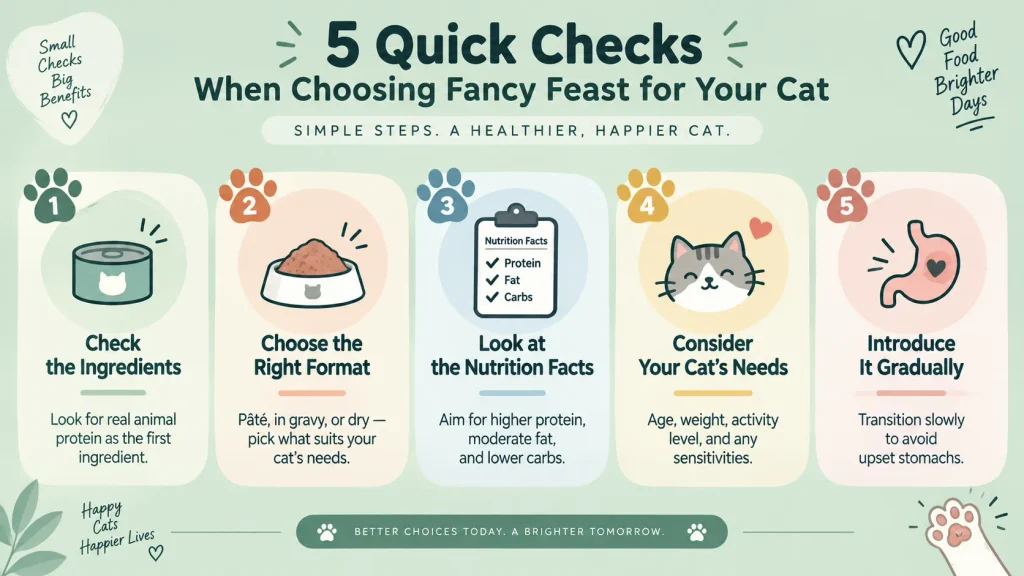
- Check the life stage — kitten, adult maintenance, or all life stages
- Look for the AAFCO complete-and-balanced statement — not every product line carries it
- Default to Pâté when possible — it’s the format with the most consistent track record
- Factor in your cat’s known sensitivities — if gravy has caused issues before, skip it
- Loop in your vet for any diagnosed condition — general guidance doesn’t override individual medical needs
Pros and Cons of Fancy Feast
| Pros | Cons |
|---|---|
| Widely available and budget-friendly | Nutritional quality varies significantly by recipe |
| Classic Pâté line is high-protein and low-carb | Gravy recipes draw the most owner complaints |
| No recall history to date | Dry food leans heavily on grain fillers |
| Wide flavor range most cats find palatable | Not a substitute for a therapeutic diet if your cat has a diagnosed condition |
Quick Answers Owners Keep Asking
Is Fancy Feast good for cats?
Many recipes are, particularly the Classic Pâté line — but it depends on the specific can, not the brand as a whole.
Can a cat eat Fancy Feast every day?
Yes, if the recipe carries a complete-and-balanced statement for your cat’s life stage.
Is Fancy Feast wet food healthier than the dry version?
Generally, yes — the wet lines offer more moisture and, in the Pâté format, a leaner carb profile than the dry kibble.
Is Fancy Feast good for kittens?
Only the recipes labeled for growth or all life stages — adult-maintenance formulas aren’t a full substitute.
Is Fancy Feast in gravy good for cats?
It can be, but it’s the format most associated with digestive complaints, so it’s better treated as an occasional addition than a daily staple.
Why do some people say Fancy Feast is bad for cats?
Most criticism targets specific formats — grains in the dry line, thickeners in the gravy line — rather than the brand overall.
So, Should Fancy Feast Stay in Your Cart?
Fancy Feast isn’t a toxic villain, nor is it a luxury gourmet feast served on a silver platter. It’s an accessible, nutritionally complete option—especially if you stick to the high-protein, grain-free Classic Pâté line and treat the heavy gravies as an occasional side dish.
At the end of the day, the best cat food is the one that fits your budget, satisfies your vet’s standards, and doesn’t get turned down by your tiny furry dictator.
Now over to you: Does your cat run like a maniac when they hear a Fancy Feast can pop open, or do they give you that cold, judgmental stare? Let us know your cat’s favorite flavor in the comments below!