

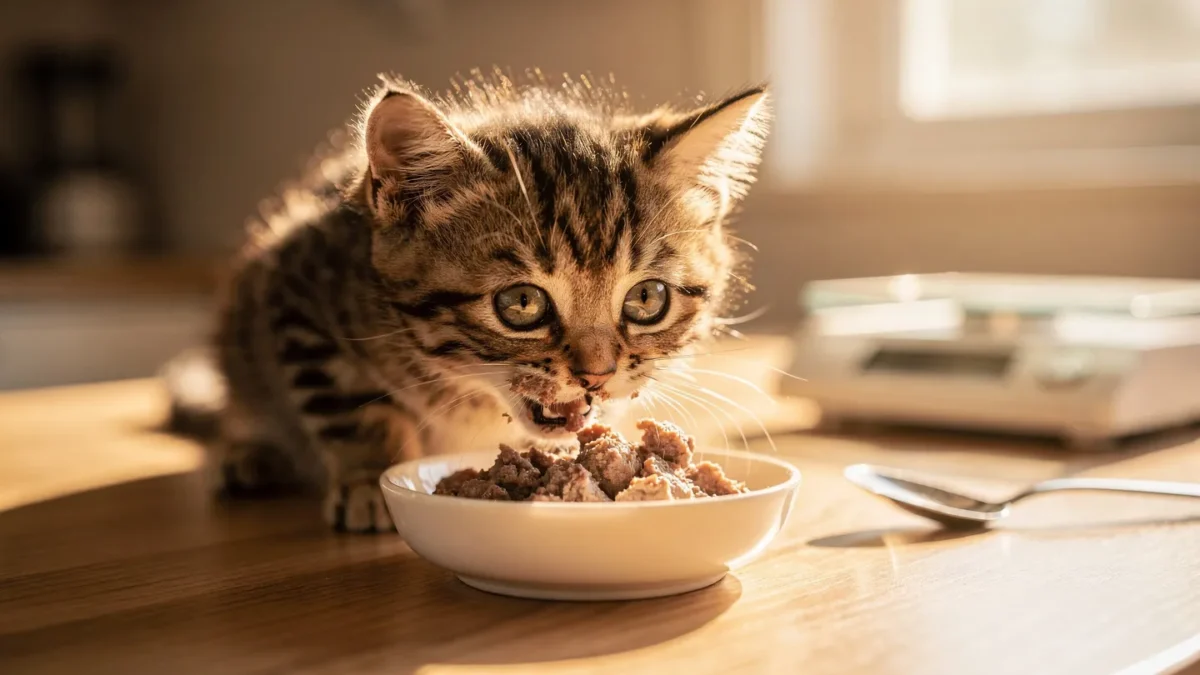
My friend texted me in a panic at 11 PM: “How much am I supposed to feed this thing?! She just stares at the empty bowl and cries but I already gave her what the bag said.”
I get it. I’ve been there. That little face looking up at you like you’re personally responsible for world hunger — it’s a lot of pressure.
Here’s the thing though: the amount printed on the bag? It’s almost always too much. Pet food companies have a financial incentive to make you go through food faster. And most generic charts online were written for a hypothetical “average” kitten that doesn’t actually exist.
This guide is different. If you’re struggling to figure out exactly how much to feed a kitten, I’m going to give you real numbers based on your kitten’s actual age and weight — not vague scoops and guesses.
Quick note before we dive in: everything here is based on personal experience raising kittens and research from trusted sources like AAFCO and PetMD. It’s meant to inform, not replace advice from your vet — especially if your kitten has health issues.
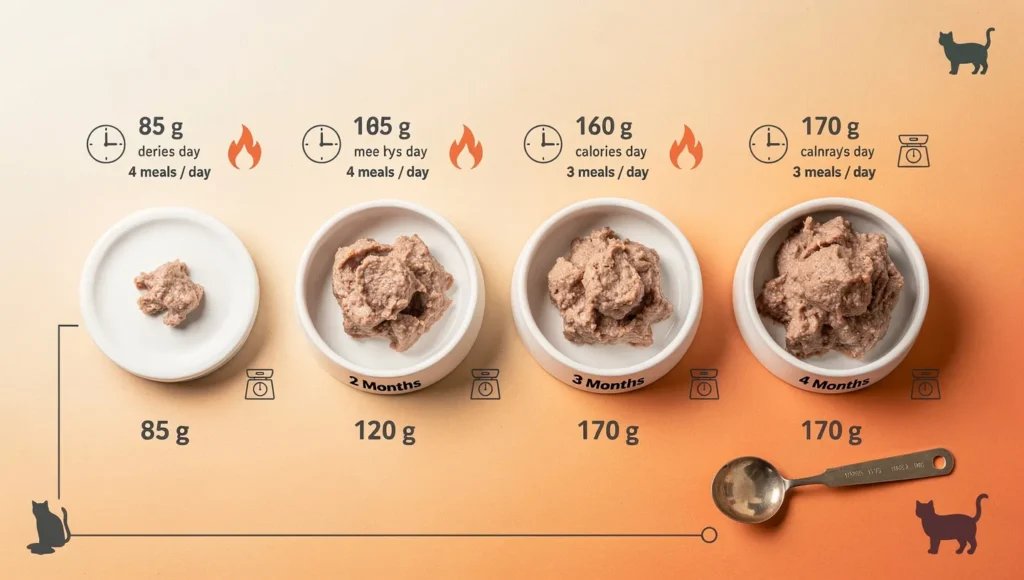
Table of Contents
- Use This Calculator First (Takes 10 Seconds)
- Quick Answer: How Much to Feed a Kitten by Age
- Complete Kitten Feeding Chart by Age (With Calories)
- How Much to Feed a Kitten by Month (The Real Breakdown)
- How Much to Feed a 2-Month-Old Kitten
- How Much to Feed a 3-Month-Old Kitten
- How Much to Feed a 4-Month-Old Kitten
- How Much to Feed a 6-Month-Old Kitten
- How Much Wet Food to Feed a Kitten (And Why It Matters More Than You Think)
- How Many Calories Does a Kitten Need Per Day?
- How Often to Feed a Kitten (Meal Frequency by Age)
- 5 Signs You’re Feeding Your Kitten Correctly (And 3 Red Flags)
- Common Kitten Feeding Mistakes (Most Owners Make at Least 2)
- Frequently Asked Questions
- What is the 3-3-3 rule for kittens?
- How much should I feed my indoor kitten?
- Is 2 cans of wet food a day enough for a kitten?
- How do I know if my kitten is overfed?
- How much wet food does a kitten need per day?
- One Last Thing Before You Go
Use This Calculator First (Takes 10 Seconds)
Before anything else — plug in your kitten’s age and weight. This calculator uses the
RER (Resting Energy Requirement) formula, the same baseline vets use to estimate daily caloric needs. It’ll give you a personalized starting point in seconds.
[INTERACTIVE CALCULATOR — see below]
Don’t have a scale? That’s okay. Keep reading — the chart in the next section has ranges for every age.
Quick Answer: How Much to Feed a Kitten by Age
How much to feed a kitten depends mainly on age and weight. Here’s the short version:
| Age | Daily Wet Food | Daily Dry Food | Meals/Day |
|---|---|---|---|
| 2 months (8 weeks) | 3–4 oz (85–115g) | 1–2 tbsp (8–15g) | 4 meals |
| 3 months | 4–5 oz (115–140g) | 2–3 tbsp (15–25g) | 4 meals |
| 4 months | 5–6 oz (140–170g) | 3–4 tbsp (25–30g) | 3 meals |
| 6 months | 6–8 oz (170–225g) | 4–5 tbsp (30–40g) | 3 meals |
These are starting points. Scroll down for the full chart with calories included — that’s where things get really precise.
Complete Kitten Feeding Chart by Age (With Calories)
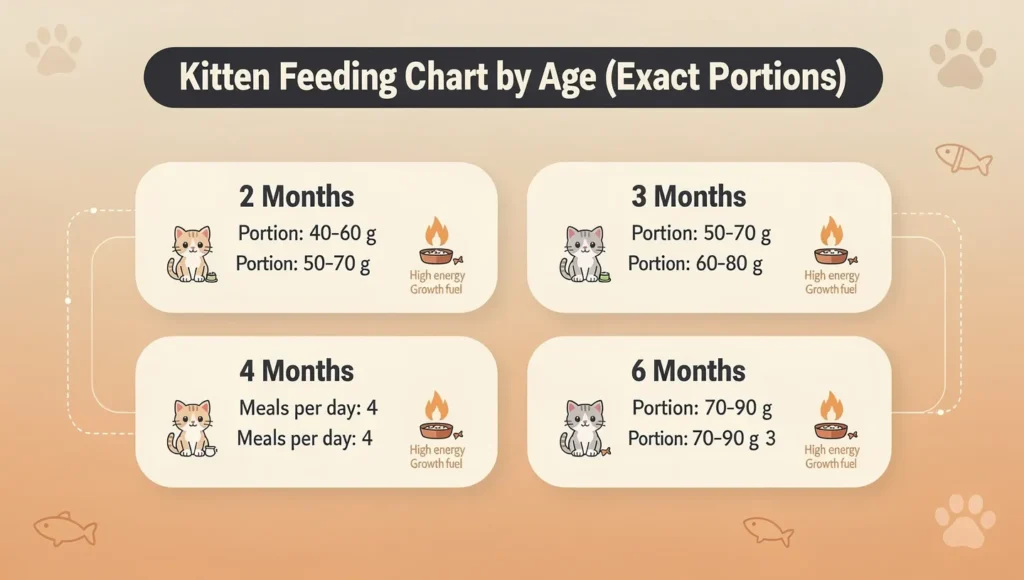
This is the chart I wish I had when I first started. Every number here is based on AAFCO kitten nutritional standards — adjusted for real-world feeding, not lab conditions.
| Age | Avg Weight | Daily Calories | Wet Food (70%) | Dry Food (30%) | Meals/Day |
|---|---|---|---|---|---|
| 4–5 weeks | 450–550g | 180–220 kcal | 2.5–3 oz (70–85g) | Minimal | 5 |
| 6–7 weeks | 650–850g | 260–340 kcal | 3–4 oz (85–115g) | 1 tbsp (8g) | 4–5 |
| 8–9 weeks | 900–1,200g | 360–480 kcal | 3–4.5 oz (85–128g) | 2 tbsp (15g) | 4 |
| 10–11 weeks | 1,200–1,500g | 480–600 kcal | 4–5 oz (115–140g) | 2–3 tbsp (15–25g) | 4 |
| 3 months | 1,500–2,000g | 600–800 kcal | 5–6 oz (140–170g) | 3–4 tbsp (25–30g) | 3–4 |
| 4 months | 2,000–2,500g | 800–1,000 kcal | 6–7 oz (170–200g) | 4–5 tbsp (30–40g) | 3 |
| 5 months | 2,500–3,200g | 1,000–1,280 kcal | 7–8 oz (200–225g) | 5–6 tbsp (40–50g) | 3 |
| 6 months | 3,200–4,000g | 1,280–1,600 kcal | 7–8.5 oz (200–240g) | 5–6 tbsp (40–50g) | 2–3 |
| 7–9 months | 4,000–4,800g | 1,200–1,440 kcal | 6.5–8 oz (185–225g) | 4–5 tbsp (30–40g) | 2–3 |
| 10–12 months | 4,500–5,500g | 900–1,320 kcal | 6–7.5 oz (170–215g) | 3–5 tbsp (25–40g) | 2 |
Wet food amounts based on ~90 kcal per 3 oz can. Check your brand’s label and adjust. Calories decrease after 7 months — that’s normal and intentional as growth slows down.
How Much to Feed a Kitten by Month (The Real Breakdown)
Most online guides give you one number for “8–12 weeks” and call it a day. But a kitten at 8 weeks and a kitten at 11 weeks are completely different animals in terms of caloric needs. Let me break it down properly.
How Much to Feed a 2-Month-Old Kitten
A healthy 2-month-old kitten weighs between 900g and 1.2kg (about 2–2.6 lbs).
Daily target: 360–480 calories, split across 4 meals.
In practical terms:
- Wet food: 3–4.5 oz (85–128g) per day
- Dry food: about 2 tablespoons (15g) per day
- Meals: 4 times a day, spaced about 4–5 hours apart
This age is peak growth. I weigh kittens every 3 days at this stage — a healthy 2-month-old should gain roughly 100g (3.5 oz) per week. If yours isn’t hitting that, bump calories up 20% and monitor for 48 hours.
One more thing: their stomachs at this age are genuinely tiny — about the size of a walnut. Four meals isn’t optional, it’s the only way they can physically eat enough in a day.
How Much to Feed a 3-Month-Old Kitten
At 3 months, your kitten weighs around 1.5–2kg (3.3–4.4 lbs) and is probably climbing everything in your house.
Daily target: 600–800 calories.
- Wet food: 5–6 oz (140–170g) per day
- Dry food: 3–4 tablespoons (25–30g) per day
- Meals: 3–4 times a day
This is the age where you might notice them getting “picky” — refusing food they liked last week, holding out for something better. Honestly? Don’t give in. Stay consistent with scheduled meals and they’ll eat when they’re hungry.
Most people get this wrong. They add treat toppers or switch flavors every few days, and end up with a cat who will only eat one specific brand of one specific flavor for the rest of its life.
How Much to Feed a 4-Month-Old Kitten
Four months is when things start to stabilize a little. Weight: 2–2.5kg (4.4–5.5 lbs).
Daily target: 800–1,000 calories.
- Wet food: 6–7 oz (170–200g) per day
- Dry food: 4–5 tablespoons (30–40g) per day
- Meals: 3 times a day
You can comfortably drop to 3 meals now — breakfast, late afternoon, and evening. Their blood sugar regulation is more stable, so the every-4-hours thing is less critical.
Gender differences start showing up here too. Male kittens often eat 15–20% more than females of the same age. If you have a boy and a girl from the same litter, don’t compare their portions — they genuinely have different needs.
How Much to Feed a 6-Month-Old Kitten
Six months is the halfway point to adulthood. Weight: 3.2–4kg (7–8.8 lbs).
Daily target: 1,280–1,600 calories.
- Wet food: 7–8.5 oz (200–240g) per day
- Dry food: 5–6 tablespoons (40–50g) per day
- Meals: 2–3 times a day
Here’s where a lot of owners slip up: growth starts slowing down around 6–7 months, but most people keep feeding the same amounts. That’s how “pudgy kitten syndrome” happens. Start doing the Eye Test weekly at this point (more on that below).
You can learn more about transitioning to adult food at the right time in our guide to switching cat food safely.
How Much Wet Food to Feed a Kitten (And Why It Matters More Than You Think)
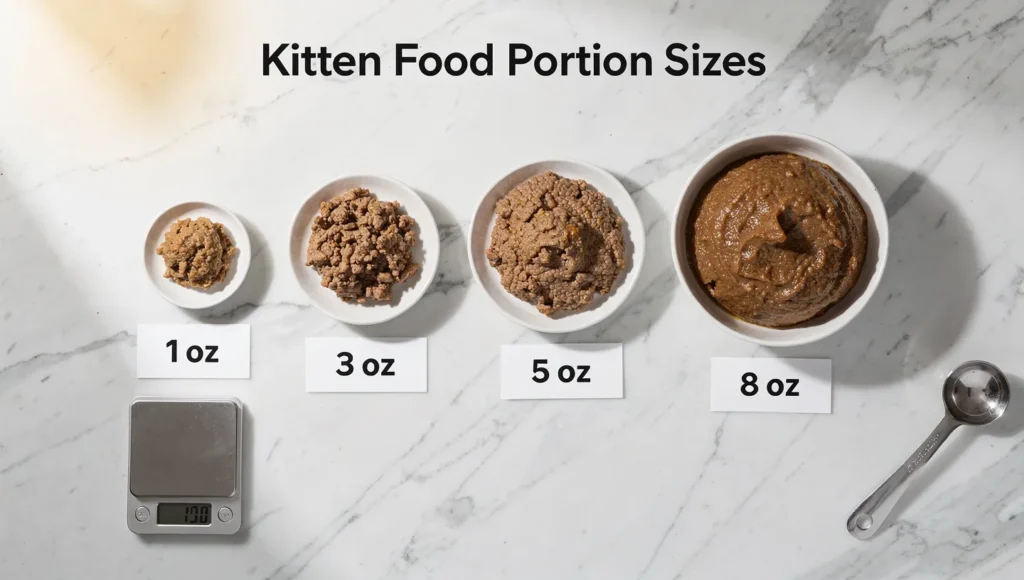
A common question I get is how much to feed a kitten when using only canned food, and the truth is, wet food isn’t just a preference—it’s a necessity. Wet food isn’t just a preference thing — for kittens, it’s closer to a necessity.
Cats evolved in desert environments where they got most of their hydration from prey. A mouse is roughly 70% water. Dry kibble? About 10%. That gap is massive, and most kittens won’t compensate by drinking more water from a bowl — they just run slightly dehydrated all the time.
From my experience, kittens fed primarily wet food have better energy levels, fewer litter box issues, and tend to maintain healthier weights long-term. The difference is noticeable within a few weeks.
Here’s a simple breakdown by age:
| Age | Wet Food Per Day | Notes |
|---|---|---|
| 2 months | 3–4.5 oz (85–128g) | Split into 4 meals |
| 3 months | 5–6 oz (140–170g) | 3–4 meals |
| 4 months | 6–7 oz (170–200g) | 3 meals |
| 6 months | 7–8.5 oz (200–240g) | 2–3 meals |
Personally, I aim for 70% wet food and 30% dry — wet food for nutrition and hydration, dry kibble for convenience and a bit of dental benefit.
One practical tip: warm the wet food to room temperature before serving. Cold food straight from the fridge smells less appealing to cats, and a lot of “picky eating” problems disappear when you just let it sit out for 10 minutes. We go deeper on this in our guide to warming wet cat food safely.
How Many Calories Does a Kitten Need Per Day?
This is the section most guides on how much to feed a kitten skip, but understanding calories is actually the most important part.
Vague measurements like “half a cup” or “one can” are useless without knowing the calorie density of the specific food you’re using. Two different brands of kitten wet food can vary by 40 calories per can. That adds up fast.
Here’s the formula vets use — it’s called the RER (Resting Energy Requirement):
RER = 70 × (body weight in kg)^0.75
Then multiply by a growth factor:
- Kittens 8 weeks – 4 months: RER × 2.5
- Kittens 4–6 months: RER × 2.0
- Kittens 6–12 months: RER × 1.6 (gradually decreasing)
Example for a 3-month-old kitten weighing 1.8kg:
RER = 70 × (1.8)^0.75 = 70 × 1.56 = 109 kcal
Daily need = 109 × 2.5 = 273 kcal
Wait — that seems low compared to the chart above, right?
That’s because RER is the floor, not the ceiling. Active, playful kittens running around your house all day burn significantly more. The chart values account for typical activity levels. Use RER as your minimum and the chart as your target range.
Now here’s how to apply this to your specific food:
- Check the label for kcal per oz (or per 100g)
- Divide your kitten’s daily calorie target by that number
- That’s how many oz (or grams) to feed per day
Example: Your 3-month kitten needs 700 kcal/day. Your wet food has 30 kcal/oz. 700 ÷ 30 = 23.3 oz per day — split across 3–4 meals.
This is why a $12 kitchen scale is genuinely one of the best investments you can make for your kitten’s health. Eyeballing portions leads to 30–40% errors more often than people realize.
If you want to understand how nutrition labels work more broadly, our cat food label guide breaks it all down step by step.
How Often to Feed a Kitten (Meal Frequency by Age)
Meal timing matters almost as much as the amount. Kittens can’t regulate blood sugar the way adult cats can — skip meals and you risk hypoglycemia, which in young kittens shows up as sudden lethargy and weakness.
Here’s where I land on meal frequency:
4–8 weeks: 5 meals a day, every 3–4 hours.
Their stomachs are walnut-sized. There’s no other way to get enough calories in.
8–12 weeks: 4 meals a day.
This is peak growth velocity. Missing a meal at this stage is more impactful than missing one at 6 months. Set phone alarms if you need to.
3–6 months: 3 meals a day.
Breakfast, late afternoon, evening. Stomach capacity has grown enough that 3 solid meals covers their needs comfortably.
6–12 months: 2–3 meals a day.
Start moving toward the adult schedule. Most cats do fine with morning and evening meals once they’re past 6 months.
One rule I don’t bend on: no free-feeding dry food.
Leaving kibble out all day teaches kittens to graze instead of eat — and creates adult cats who are constantly hungry, prone to obesity, and nearly impossible to portion-control. Scheduled meals from day one prevents all of that.
5 Signs You’re Feeding Your Kitten Correctly (And 3 Red Flags)
This is where things get practical.
Signs you’re on track:
- Steady weight gain — roughly 100g per week from 8–16 weeks
- Clean, consistent litter box usage (digestion reflects nutrition quality)
- Alert, playful energy between meals — not lethargic, not frantic
- Coat is soft and not dull or flaky
- Finishes meals within 20 minutes without leaving significant amounts
The Eye Test (what you’re looking for visually):
Stand above your kitten and look down. You should see:
- A slight waist definition behind the ribs
- No prominent hip bones or visible spine
- A small amount of belly — but not round and pendulous
Run your fingers along their sides. You should feel ribs easily with light pressure, but not see them from across the room. If you can’t feel ribs at all, they’re likely overfed. If you see the spine clearly, they need more.
This is the same assessment your vet uses — it’s called a Body Condition Score, and it’s more reliable than weight alone because breed size varies so much. A healthy 5-month Maine Coon will weigh twice as much as a healthy 5-month Siamese — but both should pass the Eye Test.
Red flags that need attention:
If your kitten refuses food for more than 24 hours or shows signs of lethargy, don’t wait. According to ASPCA’s cat nutrition guidelines, sudden appetite loss in kittens always warrants a vet consultation.
- Refusing food for more than one meal in a row — this is never normal in a healthy growing kitten. Check for other symptoms and call your vet if it continues past 24 hours. We have a full breakdown of warning signs in our guide on how to tell if your cat is sick.
- Vomiting after eating more than twice a week — occasional vomiting can happen
if they eat too fast. Frequent vomiting points to food intolerance, parasites, or
eating too quickly. Slow feeder bowls solve the speed issue. - Rapid weight gain after 6 months — growth slows dramatically in the second
half of the first year. If your kitten is gaining weight fast past 6 months, you
likely haven’t adjusted portions down to match the reduced caloric needs.
Common Kitten Feeding Mistakes (Most Owners Make at Least 2)
This is where things change.
Most people trying to calculate how much to feed a kitten start with good intentions but still get it wrong because the advice on food bags is often misleading — not because they’re careless, but because the common advice is genuinely misleading.
Mistake 1: Following the bag instructions literally
Bag instructions are calculated for a “typical” kitten at maintenance weight. They don’t account for your kitten’s actual size, activity level, or growth phase. Use them as a rough reference, not gospel.
Mistake 2: Free-feeding dry food “so they don’t go hungry”
This is the fastest route to an obese adult cat. Scheduled meals let you monitor intake, catch appetite changes early, and teach healthy eating rhythms that last a lifetime.
Mistake 3: Using adult cat food because “it’s what you had”
Adult formulas have significantly less protein and fat than kitten food. Feeding adult food during growth phases can genuinely stunt development. Check for the AAFCO statement on the label: it should say “formulated for growth” or “all life stages.” More on how to evaluate food quality in our guide to the best cat food for indoor cats.
Mistake 4: Switching foods abruptly
New food = digestive chaos if you do it overnight. Use a 7-day transition: 25% new food mixed with 75% old, increasing gradually. Our cat food transition guide has a day-by-day schedule if you need one.
Mistake 5: Adding treat toppers when they get picky
I learned this one the hard way. The moment you start enhancing meals to convince a picky kitten to eat, you’ve trained them to hold out for better food. They’re not starving — they’re negotiating. Stay consistent. They’ll eat when they’re hungry.

Frequently Asked Questions
What is the 3-3-3 rule for kittens?
The 3-3-3 rule refers to the adjustment timeline for newly adopted kittens: 3 days to decompress, 3 weeks to settle into routine, and 3 months to fully feel at home. It’s not a feeding rule specifically — but it does affect appetite. A kitten in the first 3 days might eat less than normal, and that’s okay. We cover this in detail in our new cat first night guide.
How much should I feed my indoor kitten?
Same as the chart above, but watch the portion creep. Indoor kittens burn fewer calories than outdoor ones — no hunting, less running. If your kitten seems to be gaining weight faster than expected, reduce daily portions by about 10% and increase play sessions. Two 15-minute interactive play sessions a day makes a real difference.
Is 2 cans of wet food a day enough for a kitten?
Depends entirely on can size and calorie density. A standard 3 oz can at ~90 kcal means 2 cans = 180 kcal — that’s only enough for a very young kitten (4–6 weeks). Most kittens over 3 months need the equivalent of 4–8 cans per day. Always check kcal per can and compare to your kitten’s daily calorie target.
How do I know if my kitten is overfed?
Do the Eye Test above. Also watch for: a visibly rounded belly that stays round even after digestion (not just the post-meal fullness), difficulty jumping or playing, and consistently leaving food in the bowl while still appearing to beg. If in doubt, your vet can do a Body Condition Score assessment in about 30 seconds at any checkup.
How much wet food does a kitten need per day?
Between 3 oz at 2 months and 8.5 oz at 6 months — see the wet food table earlier in this guide. The most accurate method is to calculate based on your kitten’s weight and your food’s calorie density, rather than using a fixed ounce amount.
One Last Thing Before You Go
You don’t need to be perfect at this. Seriously.
Ultimately, mastering how much to feed a kitten isn’t about hitting an exact calorie count every single day. The kittens that grow up healthy aren’t raised by owners who hit exact calorie counts every single day. They’re raised by owners who pay attention — who notice when something’s off, who weigh their kitten every week or two, and who adjust when needed.
Get a kitchen scale. Set meal alarms for the first month. Do the Eye Test weekly after 4 months. That’s genuinely most of it.
The rest you’ll figure out as you go — your kitten will tell you what they need if you’re watching.


Awesome! Its genuinely amazing piece of writing, I have got much clear idea regarding from this piece of writing.
So glad it helped, Kristen! Getting those portions right is always a bit of a puzzle when they’re growing so fast. Honestly, I remember being so worried about overfeeding my own cats back in the day. If you have any specific questions about your kitten’s routine, just let me know!
Best, Hicham Ennajar.