


A few months ago, I watched a cat owner stand in the pet-food aisle for what felt like half an hour.
He picked up a bag of Royal Canin, turned it around, read the ingredients, put it back, picked it up again… and then pulled out his phone to search:
“Is Royal Canin actually good for cats?”
Honestly, I couldn’t blame him.
There was corn. There were ingredients he couldn’t pronounce. The price wasn’t exactly helping either. And then there was the big question sitting in the back of his mind:
“If this food is so good, why does everyone on the internet seem to have a different opinion?”
Meanwhile, his cat was probably sitting at home thinking, “Human, please stop reading the bag and bring me dinner.” 😸
And that’s exactly why I decided to take a closer look at Royal Canin.
Not to blindly praise it. Not to attack it because of one ingredient on the label. And definitely not to pretend that one cat food can magically be perfect for every cat.
I wanted to answer the simple question most cat owners actually care about:
Is Royal Canin a Good Cat Food? And is it really worth buying for your cat?
So let’s forget the marketing for a moment and look at what actually matters — the nutrition, ingredients, different formulas, wet vs. dry food, what veterinarians say, the price, and the situations where Royal Canin may or may not make sense.
This article is based on personal-style research, product comparisons, and information from trusted sources. It’s for general information only and isn’t a substitute for advice from your veterinarian, especially if your cat has a medical condition.
And before we get into it, one small request.
If you’ve fed your cat Royal Canin, tell us what happened. Did your cat love it? Refuse to touch it? Did you notice a difference after switching? Your experience could be incredibly useful to another cat owner who is standing in that same pet-food aisle right now, staring at the bag and wondering what on earth to buy.
And if you know another cat lover who is asking the same question, share this article with them. Maybe it’ll save them 30 minutes of staring at a bag of cat food.
May we all survive our cats’ very strong opinions about dinner. 😹❤️
Table of Contents
- Is Royal Canin a Good Cat Food?
- Why Is Royal Canin So Popular?
- What About the Ingredients?
- The Protein Question
- Dry vs. Wet Royal Canin
- Dry food
- Wet food
- Is Royal Canin Good for Kittens?
- Why Do Some Vets Recommend Royal Canin?
- What About Royal Canin Veterinary Diets?
- Is Royal Canin Worth the Money?
- What I Would Look At Before Buying It
- What If My Cat Doesn’t Like Royal Canin?
- My Biggest Takeaway
- Common Questions About Royal Canin
- Is Royal Canin a Good Cat Food?
- Do vets really recommend Royal Canin?
- Is Royal Canin better than cheaper cat food?
- Is Royal Canin dry food okay?
- Is Royal Canin wet food better than dry?
- Is Royal Canin good for kittens?
- Should I switch my cat to Royal Canin?
- So, Is Royal Canin a Good Cat Food?
Is Royal Canin a Good Cat Food?
Yes, Royal Canin can be a good choice for many cats, but I wouldn’t judge the entire brand as simply “good” or “bad.” The specific formula, your cat’s life stage, health needs, preferences, and your budget all matter.
That’s really the answer. If you’re asking, “Is Royal Canin a Good Cat Food?”, the better way to think about it is to look at the specific formula rather than judge the entire brand at once.
Royal Canin makes a huge range of foods. There are everyday formulas, kitten foods, indoor-cat formulas, breed-specific recipes, wet foods, and veterinary diets designed for particular health needs.
So comparing one Royal Canin formula with another can be a bit like comparing apples to… well, catnip.
Here’s the thing: a food should be judged by its overall nutritional profile and intended use, not just by whether the first ingredient sounds impressive on paper.
PetMD points out that one useful thing to check on a cat-food label is the AAFCO nutritional adequacy statement, which confirms the food is complete and balanced for the appropriate life stage.
Most people get this wrong. They read “Is Royal Canin good?” as a yes-or-no question, when the real question should be: is this specific Royal Canin formula good for my cat?
Why Is Royal Canin So Popular?
There’s a reason you see this brand practically everywhere, from small pet shops to big-box stores.
Royal Canin has built its reputation around formulas designed for different life stages, lifestyles, breeds, and nutritional needs. Some of its products are also used as veterinary diets.
That specialization is probably one of the biggest reasons people trust the brand in the first place.
For example, you can find formulas aimed at:
- Kittens
- Adult cats
- Indoor cats
- Senior cats
- Hairball management
- Digestive support
- Urinary care
- Weight management
- Certain breed types
- Veterinary nutritional needs
That doesn’t automatically make every formula perfect. But it does mean the brand is doing something more complicated than just putting “chicken flavor” on a bag and calling it a day.
What About the Ingredients?
An ingredient list matters, but it doesn’t tell you everything about the nutritional value of the finished food — and that’s where a lot of cat owners get stuck.
If you look at some Royal Canin ingredient lists, you may notice things like corn, wheat, rice, or various plant-derived ingredients. For some cat owners, that’s an immediate red flag.
Personally, I think this is where people sometimes make up their minds too quickly.
Cats need specific nutrients, including protein, fat, vitamins, minerals, and taurine. ASPCA notes that taurine is an essential amino acid for cats, and that a properly balanced commercial diet should supply the nutrients cats need at their particular life stage.
So if you’re wondering, “Is Royal Canin a Good Cat Food?”, don’t stop at one ingredient on the label.
Instead of asking only:
“Does this food contain corn?”
I’d also ask:
- Is it nutritionally complete?
- Is it appropriate for my cat’s life stage?
- How much protein and fat does it provide?
- How many calories are in the food?
- Does my cat actually eat it well?
- Does the formula fit my cat’s individual needs?
- Is the price reasonable for what I’m getting?
That’s a much better way to look at cat food. Honestly, it’s the approach I wish more people used before they judge a bag by its ingredient panel alone.
The Protein Question
Cats have specific nutritional requirements, and protein sits near the top of that list.
PetMD explains that adult cats have higher protein requirements than dogs or humans, and that protein is one of the major nutrients to evaluate when comparing cat foods.
But don’t make the mistake of glancing at one percentage on the front of a bag and declaring a winner.
Dry and wet foods contain very different amounts of water, so comparing them side by side on protein percentage alone can be misleading.
The big picture matters more than one number.
Dry vs. Wet Royal Canin
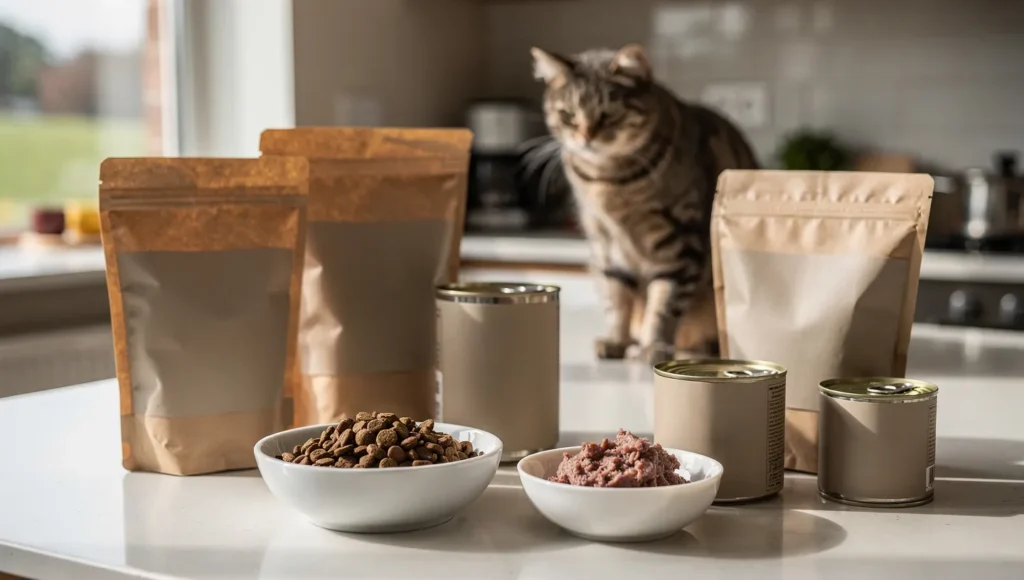
Neither dry nor wet Royal Canin is automatically “better” — it depends on your cat’s hydration habits, preferences, and your daily routine.
This is another area where I wouldn’t pick a winner for everyone. It’s also part of the answer to “Is Royal Canin a Good Cat Food?” because the specific type of food you choose can matter just as much as the brand itself.
Dry food is convenient, easy to store, and usually cheaper per serving. Wet food contains substantially more moisture, which can be useful for cats that don’t drink much on their own.
PetMD notes that wet food is generally higher in moisture and can provide lower-carbohydrate nutrition compared with dry food.
Dry food
Royal Canin dry formulas can make sense if:
- Your cat prefers kibble
- Convenience matters to your routine
- You need easy portioning
- You’re using a formula designed for a particular life stage or need
The downside? Dry food contains much less water than canned food, so hydration has to come from somewhere else — usually the water bowl.
Wet food
Wet Royal Canin formulas can be useful when:
- Your cat loves canned food
- You want to increase moisture intake through food
- You’re trying to make meals more appealing
- A particular wet formula fits your cat’s needs
And yes, some cats will act like wet food is the greatest invention in human history. Others will sniff it once and walk away like you’ve personally offended them.
Cats are funny like that.
If you’re still trying to decide between the two, our full wet vs. dry comparison breaks it down in more detail.
Is Royal Canin Good for Kittens?
Royal Canin makes kitten formulas designed specifically for growth, so the real question isn’t “is Royal Canin good for kittens,” but whether the specific product is labeled as nutritionally appropriate for that stage.
Kittens aren’t tiny adult cats. Their nutritional needs are different while they’re growing, which is exactly why kitten-specific food matters so much during those first months.
PetMD lists Royal Canin among the major brands offering kitten diets, and recommends checking for an appropriate AAFCO nutritional adequacy statement before buying.
If you’re feeding a kitten, I’d pay close attention to:
- The life-stage statement
- Calorie density
- Protein and fat levels
- Feeding instructions
- Wet vs. dry preferences
- Whether your kitten is growing at a normal pace
And this is important: if your kitten has a health problem, that’s not the moment to start experimenting on your own. Ask your veterinarian about the appropriate diet first.
If you want to go deeper on portions and label-reading before choosing a kitten formula, our guides on high-quality canned kitten food and reading cat food labels are worth checking out.

Why Do Some Vets Recommend Royal Canin?
Veterinarians don’t recommend a food simply because the ingredient list looks appealing. They tend to consider the nutritional formulation, quality control, clinical evidence, and whether the food fits that specific cat’s needs.
This is probably the question that causes the most confusion online.
The AVMA’s educational materials emphasize the importance of nutritional assessments and personalized dietary recommendations as part of routine veterinary care.
And PetMD’s current vet-reviewed cat-food coverage lists Royal Canin among the brands commonly recommended by veterinary professionals. (Source)
That doesn’t mean:
“Every Royal Canin product is automatically the best food for every cat.”
Not even close.
It means there can be legitimate, individualized reasons behind a specific recommendation. This distinction is easy to miss when you’re scrolling through Reddit threads at midnight trying to decide what to buy tomorrow.
What About Royal Canin Veterinary Diets?
Royal Canin’s veterinary diets are a completely different category from its regular formulas, and they shouldn’t be treated the same way.
This is where you really shouldn’t lump every Royal Canin bag into one bucket.
Veterinary diets are designed for specific therapeutic purposes. Some are used for cats managing particular health conditions, and some may require veterinary guidance or authorization to use properly.
PetMD, for example, discusses Royal Canin veterinary formulas related to digestive support and hydrolyzed-protein diets used in certain food-sensitivity situations.
I wouldn’t choose a veterinary diet just because someone online said it worked for their cat.
Your neighbor’s cat and your cat are not the same cat.
If a vet recommends a therapeutic formula, follow the specific guidance you’re given rather than treating it like an ordinary supermarket food you can swap in and out.
Is Royal Canin Worth the Money?
Price alone doesn’t tell you whether a cat food is good — what matters is whether the specific formula meets your cat’s needs, whether your cat actually eats it, and whether the cost fits your budget long-term.
This one is much more personal than the others.
Royal Canin isn’t usually the food I’d point to if someone’s only goal is “give me the cheapest bag possible.” But price alone doesn’t determine quality either.
PetMD’s current vet-reviewed guidance also points out that a higher price tag doesn’t automatically mean better nutrition. (Source)
For me, that’s also the real answer to “Is Royal Canin a Good Cat Food?”
Does this particular formula give my cat appropriate nutrition, does my cat eat it happily, and does the price make sense for my household?
If yes, paying a bit more may be perfectly reasonable. If another nutritionally appropriate food works just as well and costs less, that’s worth considering too.
There’s no prize for having the most expensive bag of kibble in the pantry. If budget is a real concern, our guide to feeding your cat well without emptying your wallet covers some practical alternatives.
What I Would Look At Before Buying It
If you’re standing in the pet-food aisle staring at a Royal Canin bag, here’s how I’d keep it simple.
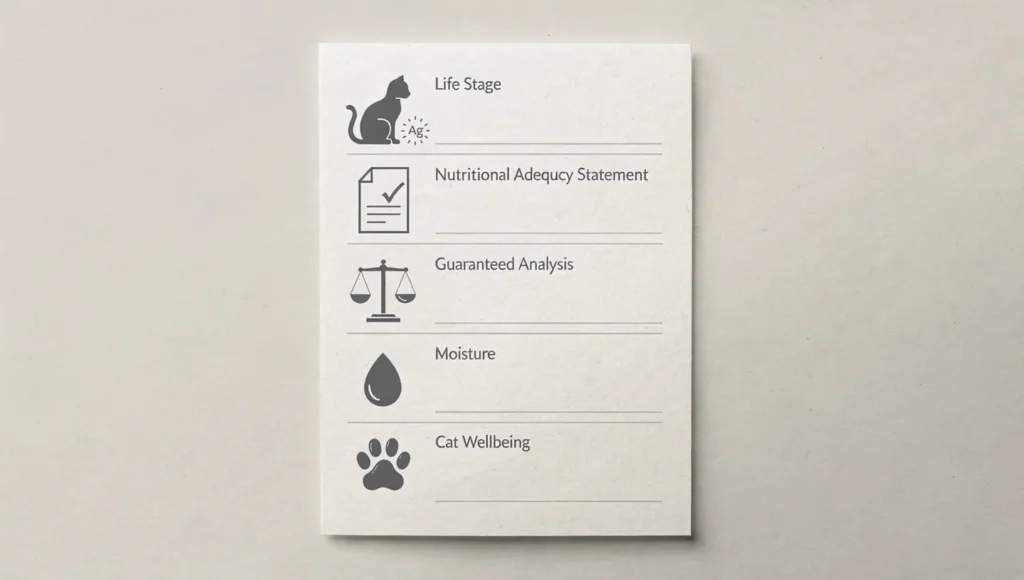
1. Check the life stage — Make sure it’s designed for your cat’s age and stage of life.
2. Read the nutritional adequacy statement — Don’t skip the tiny print. It’s often more useful than the marketing words on the front of the package.
3. Look at the guaranteed analysis — Check protein, fat, fiber, and moisture.
4. Consider wet food — If your cat doesn’t drink much on their own, adding moisture-rich food to the mix may be worth discussing.
5. Watch your cat — This sounds obvious, but it’s important. Does your cat eat the food? Does their weight stay appropriate? Do they seem comfortable after meals?
Food isn’t just about what’s printed on the bag. It’s also about the cat actually eating it and doing well on it.
What If My Cat Doesn’t Like Royal Canin?
Don’t force it just because the brand has a good reputation — a nutritionally appropriate food your cat refuses to eat isn’t doing anyone any good.
Cats can be surprisingly stubborn about food changes.
If you’re switching foods, PetMD recommends transitioning gradually over about seven to 10 days rather than changing everything overnight.
A simple approach: slowly increase the new food while decreasing the old one over that period. Our step-by-step guide to switching cat food safely walks through the full timeline if you want more detail.
And if your cat develops persistent vomiting, diarrhea, refuses food entirely, or just seems off, that’s not the moment to play amateur nutritionist. Talk to your veterinarian.
My Biggest Takeaway
Here’s the thing I kept coming back to while researching all of this.
I actually remember a friend of mine, Marcus, going through exactly this dilemma with his cat a while back. He’d read one bad review online and nearly switched foods overnight, cold turkey, no transition, nothing. His cat was not thrilled about it, and neither was his carpet. Lesson learned the hard way.
I wouldn’t call Royal Canin universally “the best” cat food, but I also wouldn’t dismiss it because of a few ingredients on the label.
There are formulas that make real sense for particular cats. There are also situations where another food may be a better fit.
The smartest approach is to stop treating cat food like a popularity contest.
Royal Canin vs. Brand X. Natural vs. processed. Grain vs. grain-free. Expensive vs. cheap.
Those arguments can go on forever on the internet.
Your cat doesn’t care who won the argument. Your cat needs an appropriate, complete diet that fits their individual needs — nothing more dramatic than that.
Common Questions About Royal Canin
Is Royal Canin a Good Cat Food?
It can be. Many Royal Canin formulas are designed to provide complete and balanced nutrition for specific life stages or needs. The important part is choosing the right formula rather than judging the whole brand as one product.
Do vets really recommend Royal Canin?
Yes, some veterinarians recommend Royal Canin, including specific veterinary diets. But that recommendation depends on the individual cat and the exact formula, not just the brand name.
Is Royal Canin better than cheaper cat food?
Not automatically. A higher price doesn’t guarantee better nutrition. Compare the actual formula, nutritional adequacy, life-stage suitability, calorie content, and your own cat’s needs
Is Royal Canin dry food okay?
It can be a solid option when the specific formula is nutritionally complete and suitable for your cat. Just remember dry food has much less moisture than canned food, so your cat’s overall hydration still matters.
Is Royal Canin wet food better than dry?
Not necessarily. Wet food offers more moisture, while dry food is convenient and easier to portion and store. Plenty of owners use a mix of both.
Is Royal Canin good for kittens?
Royal Canin makes kitten-specific formulas designed for growth. Look for a nutritional adequacy statement appropriate for kittens, and choose based on your kitten’s individual needs.
Should I switch my cat to Royal Canin?
There’s no universal reason every cat should switch. If you’re considering a change, do it gradually and factor in your cat’s age, health, weight, preferences, and current diet.
So, Is Royal Canin a Good Cat Food?
If you came here hoping for a dramatic “YES!” or “NO!”, sorry to disappoint. Is Royal Canin a Good Cat Food? For many cats, it can be — but the right answer depends on the specific formula, your cat’s needs, and what works for your household.
Real life with cats rarely works that neatly.
Royal Canin can be a perfectly reasonable choice for many cats. It also isn’t the only good option out there, and that’s okay.
What matters most is finding a food that’s nutritionally appropriate, suitable for your cat’s life stage and needs, affordable enough for you to keep buying consistently, and — perhaps most importantly — something your cat will actually eat without side-eyeing you first.
And if you’ve ever bought an expensive bag of cat food only to watch your cat sniff it once and walk away like you’ve deeply betrayed them… yeah. You’re definitely not alone.
So tell me: what’s your Royal Canin story? Did it work out? Did it not? Drop it in the comments below — someone standing in that pet-food aisle right now, phone in hand, could really use your two cents.
And hey, thanks for reading this far. If this helped even a little, sharing it with another cat owner might just save them from their own 30-minute staring contest with a bag of kibble. ❤️