
Why do cats purr is a question that naturally comes to mind when your cat curls up on your lap.
Their body softens. Eyes drift half-closed. And then it starts—the gentle, steady vibration beneath your hand.
That quiet rumble feels like comfort. Like trust. Like love. We usually smile and think, “My cat is happy.” And most of the time, that’s true.
But here’s the mystery most cat owners never hear about: What if purring isn’t just an expression of love… but a biological superpower?
Behind that soothing sound lies something extraordinary. A built-in system tied to bonding, survival, and even healing.
Before we explore the science, we need to start where purring begins—with safety, connection, and happiness.
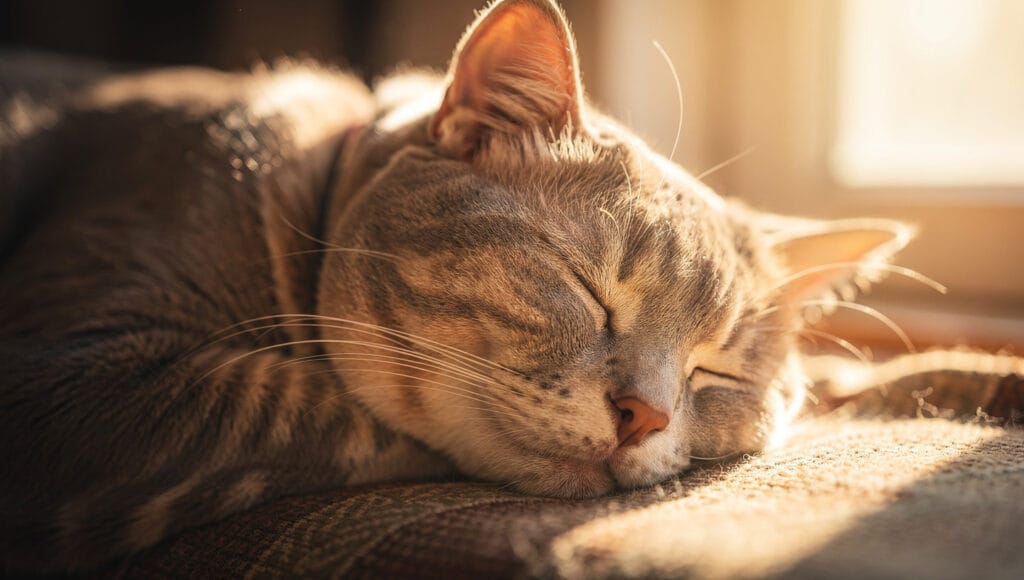
Sleeping cat purring peacefully, showing why do cats purr when they feel safe and relaxed
Table of Contents
- 🐾 Why Do Cats Purr When They’re Happy?
- ✨ The Body Language of a Happy Purr
- 📢 Not All Purrs Mean the Same Thing
- ⚠️ When Happiness Turns Into “Too Much”
- 🧬 The Science Behind Cat Purring (Healing Frequency Explained)
- 🎯 The Frequency That Does the Work
- 📊 How Vibration Helps the Body Heal
- 🚀 Not Just a Cat Thing
- 🩺 Do Cats Purr When They Are in Pain? (The Purring Paradox)
- 💊 Purring as a Natural Painkiller
- 📋 When Cats Use Purring to Cope
- 🚩 When Purring Should Worry You
- 🔍 Is It Pain or Happiness? Context Keys
- ❓ Frequently Asked Questions About Cat Purring
- ❤️ The Bond Beyond Words
🐾 Why Do Cats Purr When They’re Happy?
The simplest answer to why do cats purr is also the most beautiful one: Purring means “I feel safe with you.”
(Why does my cat purr when I pet him?)
For cats, purring is emotional language. Long before kittens can see or hear clearly, they can purr.
Newborn kittens use purring to tell their mother, “I’m okay.” The mother purrs back, reassuring them, “You’re safe. I’m here.”
That bond never disappears. When your adult cat purrs while you pet them, they’re tapping into that same instinct. It’s not just pleasure—it’s trust.
Expert Tip: Always look at the eyes! If a cat is purring with half-closed eyes, it’s a sign of absolute peak emotional security.
✨ The Body Language of a Happy Purr
A relaxed, happy purr rarely comes alone. Look for these signs:
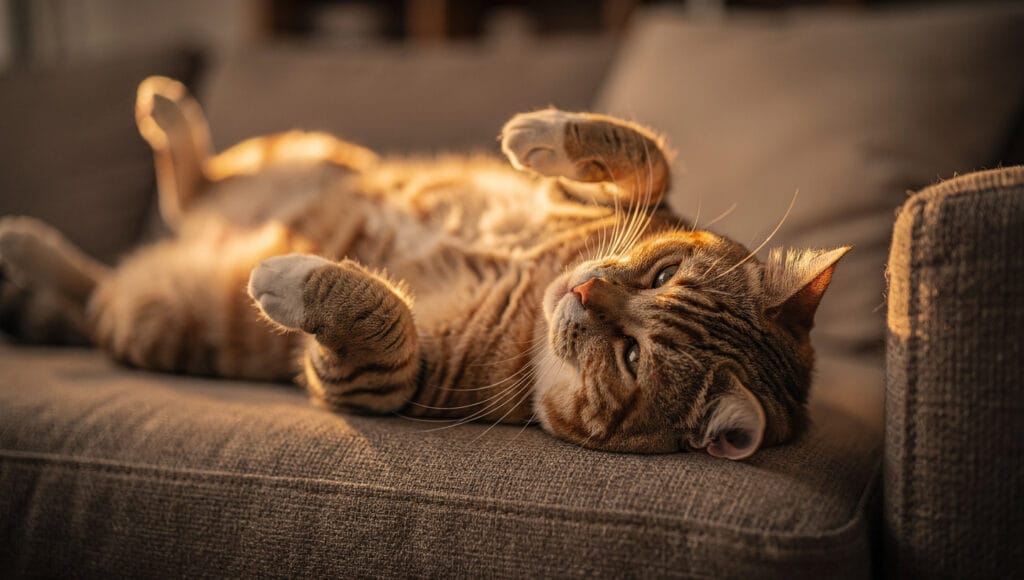
Relaxed cat body language while purring, a sign of happiness and emotional comfort.
- Eye Contact: Half-closed, sleepy eyes or slow blinking.
- Posture: Soft, loose body posture and tail resting calmly.
- Movement: Kneading with their paws (“making biscuits”).
This combination is your cat’s way of saying: “All is well. I don’t need to be on guard.”
📢 Not All Purrs Mean the Same Thing
Cats are smart communicators. Sometimes, a purr isn’t about affection—it’s a request.
Here’s a simple way to tell the difference between a happy purr and a demanding one:
| Feature | Relaxed Purr (Happiness) | Demanding Purr (Needs Something) |
|---|---|---|
| Rhythm | Slow, steady rhythm | Louder, more urgent sound |
| Body | Loose body, kneading paws | Stiff posture, pacing |
| Eyes | Eyes half-closed | Eyes wide, focused on you |
| Context | Happens during petting | Often near food time |
Both are normal. But only one means deep emotional comfort.
⚠️ When Happiness Turns Into “Too Much”
Here’s something many cat parents find confusing. Sometimes, a cat is purring… and suddenly—nip.
This doesn’t mean your cat turned aggressive or stopped loving you. Cats can become overstimulated during petting.
Their nervous system gets overwhelmed, even while they’re enjoying the attention. A purr can continue right up until that moment.
If this sounds familiar, it’s important to understand the warning signs and why it happens. We break this behavior down in detail here: Why Does My Cat Bite Me?. Learning to read these signals protects both the bond and your fingers.
🧬 The Science Behind Cat Purring (Healing Frequency Explained)
At first, this sounds like science fiction. A soft sound that can heal bones and reduce pain?
But it’s real biology—and researchers have been studying it for years. Cats don’t purr at random.
Their purr happens at a very specific vibration range, known as the cat purring healing frequency.
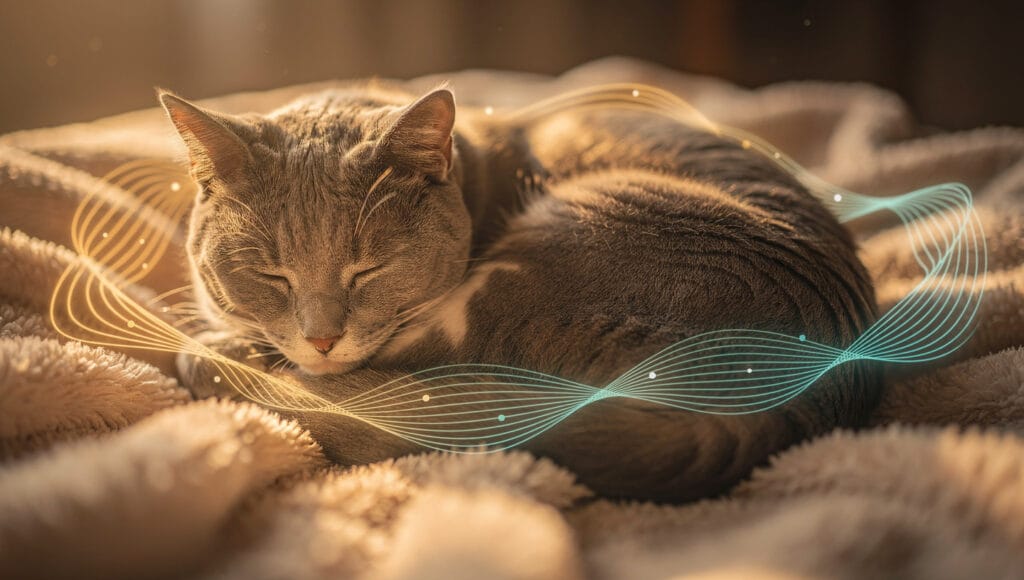
Cat purring healing frequency illustration showing vibration and self-healing benefits.
🎯 The Frequency That Does the Work
When a cat purrs, the sound vibrates between 20 and 140 Hertz (Hz).
This range isn’t accidental. According to the Cornell Feline Health Center, low-frequency vibrations in this exact range are known to help the body repair itself.
Cats produce it naturally, without machines, pills, or effort. Think of it like a gentle internal massage—one that reaches bones, muscles, and tissues.
📊 How Vibration Helps the Body Heal
Scientists believe this vibration triggers physical changes inside the body. Here’s what that frequency range can do:
- Increases bone density: Stimulates bone cells, helping maintain strength and reducing the risk of bone loss.
- Reduces pain and swelling: May calm inflammation and stimulate blood flow, lowering pain signals.
- Repairs muscles and tendons: Gentle oscillation supports tissue regeneration after strain.
What makes this remarkable is when cats use it. Cats rest. A lot. And while resting usually weakens bones in other animals, cats seem protected.
Since cats spend so much time resting and sleeping, they need a way to keep their bones strong without constant exercise.
This may explain why cats often sleep and purr at the same time—a behavior closely linked to their recovery cycle. We explore that deep connection between rest and repair in Why Do Cats Sleep So Much?.
🚀 Not Just a Cat Thing
To add even more credibility, humans are already copying this idea.
NASA and medical researchers use vibration therapy to help astronauts prevent bone loss in space, where gravity is too weak to stress the skeleton naturally.
Different species. Same solution. Cats didn’t invent the science—we discovered it late. And they’ve been using it their whole lives.
🩺 Do Cats Purr When They Are in Pain? (The Purring Paradox)
This is the part that surprises most cat owners. Yes—cats do purr when they are in pain.
Understanding this is critical, because it can prevent dangerous misunderstandings. So, do cats purr when they are in pain? The answer is yes, and the reason is deeply biological.
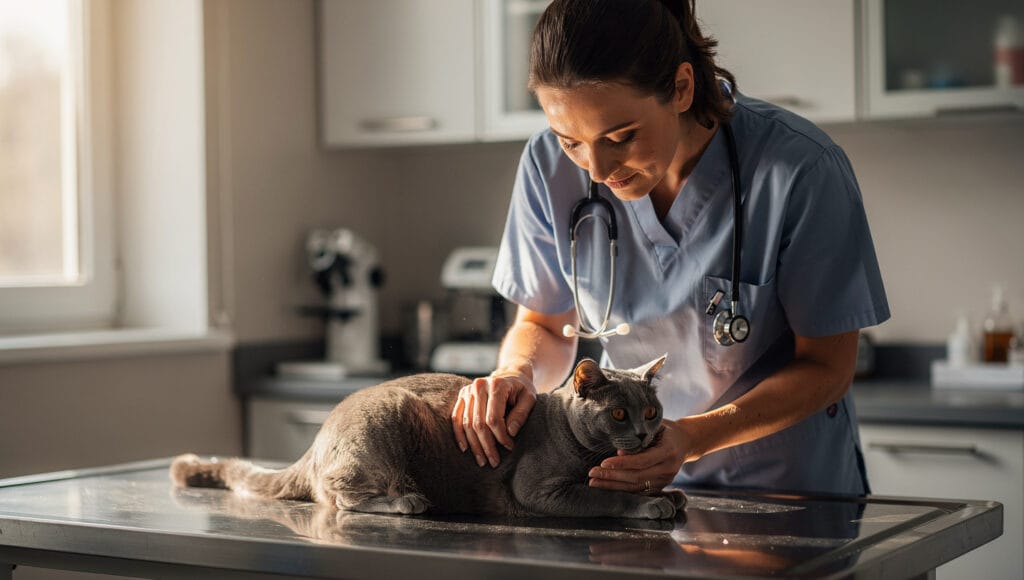
Veterinarian examining a cat, explaining do cats purr when they are in pain.
💊 Purring as a Natural Painkiller
When a cat purrs, their brain signals the release of endorphins. According to WebMD Pets, these are the body’s natural painkillers.
In other words, purring isn’t always about happiness. Sometimes, it’s a form of self-soothing. Think of it like a human who laughs nervously or takes deep breaths to calm anxiety.
The body is trying to regain control. Cats do the same thing—but through vibration.
📋 When Cats Use Purring to Cope
Veterinarians commonly observe purring in situations that have nothing to do with pleasure:
- Labor: During childbirth.
- Injury: After serious injuries or when extremely weak.
- Nausea: When they feel sick or near death.
In these moments, purring helps calm the nervous system and dull pain. It’s comfort, not joy.
🚩 When Purring Should Worry You
This is where context matters more than the sound itself. For example, a cat that is purring but has just thrown up may be trying to soothe a stomach ache.
If you notice vomiting, appetite loss, or lethargy alongside purring, that’s a red flag. You can learn more about this specific situation in Why does my cat throw up after eating?.
Purring should never override other warning signs.
🔍 Is It Pain or Happiness? Context Keys
Likely Happiness: Ears facing forward, whiskers relaxed, body loose, normal appetite.
Possible Pain or Distress: Ears pinned back, hiding, lack of appetite, hunched posture.
If something feels “off,” trust that instinct. Why do cats purr is powerful—but it’s not always good news.
❓ Frequently Asked Questions About Cat Purring
Can cat purring actually heal humans?
Not in a medical sense—but it has therapeutic effects. Studies show interacting with cats can lower blood pressure and stress hormones.
Why does my cat never purr?
Some cats are simply quiet personalities. If your cat is eating and acting normally, a lack of purring is nothing to worry about.
Do lions and tigers purr?
No. Big cats roar, but they can’t purr. Smaller cats can purr but can’t roar. It’s a trade-off in vocal cord structure.
❤️ The Bond Beyond Words
A cat’s purr is never just background noise. It’s a survival tool that protects bones and muscles.
It is a calming mechanism during pain and fear. And a quiet message that says, “I trust you.”
When your cat curls up beside you and that soft vibration begins, you’re hearing something ancient and powerful—part biology, part emotion, part love.
So the next time your cat purrs, don’t just listen. Pause. Feel it. And maybe pull them a little closer.