

If you ever wonder why do cats purr, my sister Nadia is the kind of mom who brings antibacterial wipes to a playground to find out. So when she brought her seven-year-old son, Sami, to my apartment — back when I first got my cat,
Luna — I was already a little on edge.
Luna, a sweet but unpredictable rescue, was lying on the rug doing absolutely nothing
suspicious. Sami approached her slowly, sat down cross-legged, and started gently stroking
her back. Within seconds, Luna started… vibrating. It wasn’t just a sound. It was a deep,
rhythmic rumble that seemed to shake her tiny ribs from the inside out.
Sami froze. He pulled his hand back. Then he looked up at me with the kind of wide, panicked
eyes that only a seven-year-old can pull off and asked:
“Uncle Hicham… is Luna’s engine broken? Is she going to explode?”
Now, here’s the thing — this was years ago, and I was completely new to cat ownership. I had
decent knowledge of HTML and zero knowledge of feline physiology. So I looked at Sami,
completely straight-faced, and said:
“No buddy. She just ate too fast. That’s her stomach processing the kibble.”
Sami looked skeptical. Luna looked insulted.
But the question stuck with me. A few days later, over coffee with my close friend Dr. Karim — a practicing veterinarian — I casually mentioned my “stomach kibble engine” theory.
Karim nearly choked on his espresso.
He laughed so hard the people at the next table started staring. Then, wiping his eyes, he said: “Hicham. Please tell me you didn’t actually say that to a child. That ‘engine’ is a purr. And it has less to do with digestion and more to do with a complex neurological mechanism that science is still trying to fully map out.”
That embarrassing afternoon changed everything for me. It sent me down a rabbit hole of feline behavior research that eventually led to this site — and to this article. And honestly? I’m glad Sami asked.
A quick note before we dive in: Everything I share here is based on personal experience raising cats, years of conversations with vets like Dr. Karim, and research from trusted sources like ASPCA and AVMA. This article is for informational purposes only and isn’t a substitute for professional veterinary advice. If something feels off with your cat, please reach out to your vet.
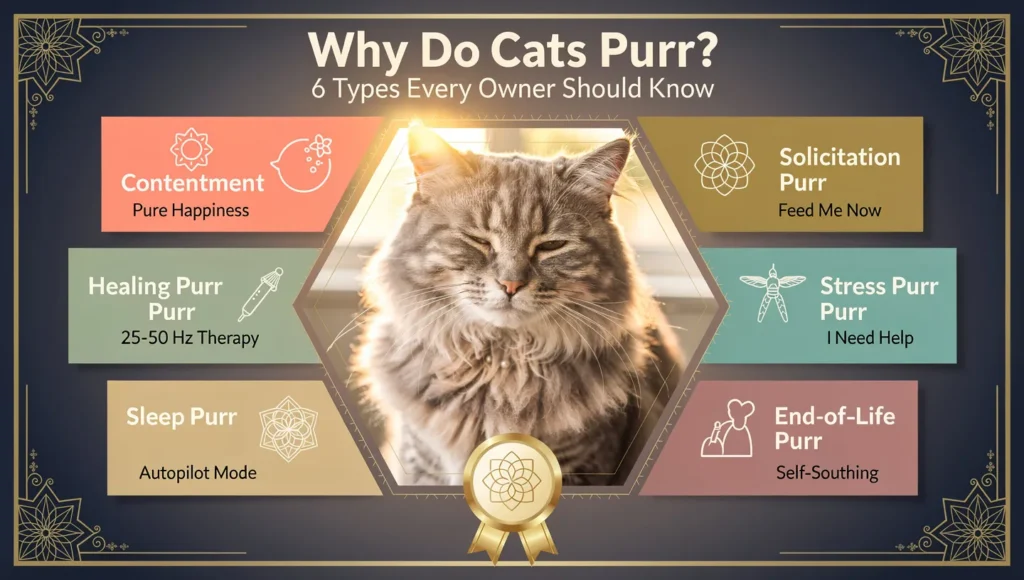
Table of Contents
- So, Why Do Cats Purr? (The Real Answer)
- How Does the Purring Mechanism Actually Work?
- Not All Purrs Mean the Same Thing
- The Contentment Purr — The One Everyone Knows
- The Solicitation Purr — The Manipulative One
- The Stress or Pain Purr — The One Most Owners Miss
- The Purring While Dying — A Difficult Truth Worth Knowing
- The Healing Frequency — Is It Real?
- Why Do Cats Purr and Knead at the Same Time?
- Cat Purring and Its Effect on Humans
- When Purring Is a Red Flag
- Here Are the Quick Answers to Questions Most New Cat Owners Ask
- Why do cats purr loudly?
- Why do cats purr when they sleep?
- Why do cats purr when you pet them?
- Do cats purr on purpose?
- Can cats purr and meow at the same time?
- One Last Thing — From Me, Dr. Karim, and Sami
So, Why Do Cats Purr? (The Real Answer)
Cats purr because of a rapid, rhythmic movement of the muscles in their larynx — the voice box — that causes the glottis (the part of the larynx that surrounds the vocal cords) to open and close during both inhalation and exhalation. That creates the continuous vibration we hear as a purr.
Here’s what makes it fascinating: cats purr at frequencies between 25 and 150 Hz. And according to research, that specific frequency range isn’t random. It overlaps with the range that’s been linked to promoting bone density, muscle repair, and even pain relief in both animals and humans.
So no, Sami — it’s not a broken engine. It’s something far more impressive.
Honestly, when Dr. Karim first explained this to me, I sat there quietly for a solid ten seconds. Because I’d been living with Luna for months, listening to this sound every single night, and I had no idea I was essentially being treated to a built-in healing machine.
Most people think purring just means “happy cat.” That’s the easy answer — and it’s sometimes true. But the full picture is a lot more layered than that.
How Does the Purring Mechanism Actually Work?
The process starts in the brain. A repetitive neural oscillator sends signals to the laryngeal muscles, causing them to dilate and constrict the glottis rhythmically — roughly 25 to 50 times per second.
This happens during both breathing in and breathing out, explaining clinically why do cats purr in such a smooth, continuous rumble unlike most other animal vocalizations.
What’s interesting is that domestic cats are actually unique in this. According to the Library of Congress, big cats like lions and tigers can roar but cannot purr continuously the way domestic cats can. The ability to purr on both the inhale and exhale is, in the animal kingdom, kind of a superpower.
And it’s one most of us walk past every day without thinking twice about.
Not All Purrs Mean the Same Thing
This is where things get really interesting — and where most articles completely drop the ball.
Because if you’ve spent any real time with a cat, you already know that not every purr feels the same. There’s the lazy, melted-into-the-couch purr. There’s the 5 AM “feed me or I will destroy everything you love” purr. And then there’s the one that makes your stomach drop a little — the purr you hear when something might actually be wrong.
Learning to tell them apart changed the way I interact with Luna completely.
The Contentment Purr — The One Everyone Knows
This is the classic. Your cat is curled up in your lap, eyes half-closed, body completely relaxed. The purr is low, steady, and rhythmic. No tension in the tail. No flattened ears. Just pure, unbothered comfort.
When Luna does this — usually about twenty minutes after I’ve settled onto the couch — I genuinely feel like I’ve done something right that day. It’s her version of saying “yeah, this is good. Don’t move.”
According to PetMD, this type of purring is associated with the release of endorphins in cats — essentially, they’re self-soothing through sound. It’s not just communication directed at you. It’s also something they’re doing for themselves.
The Solicitation Purr — The Manipulative One
Personally, this is my least favorite purr. And I say that with love.
The solicitation purr is what cats use when they want something — usually food, but sometimes attention. What makes it different from a regular purr is that it has a subtle, embedded cry-like tone layered inside it. Almost like a baby’s cry, frequency-wise.
Researchers at the University of Sussex actually studied this and found that humans — even people who don’t own cats — instinctively rate this purr as more urgent and harder to ignore than a regular purr. We’re basically wired to respond to it.
Luna figured this out embarrassingly fast. By week two of living together, she had a perfectly timed solicitation purr she deployed at exactly 6:47 AM every morning. I held out for maybe three days before completely surrendering.
If your cat is meowing at night and purring at the same time near their food bowl — that’s almost certainly a solicitation purr.
You’ve been played. Welcome to the club.
The Stress or Pain Purr — The One Most Owners Miss
Here’s the thing most people get completely wrong about purring: a purring cat is not always a happy cat.
This surprised me too when Dr. Karim first brought it up. Cats also purr when they’re anxious, stressed, injured, or in pain. It’s thought to be a self-regulation mechanism — the same way a human might hum quietly to themselves when they’re nervous or overwhelmed.
The difference in the sound is subtle but real:
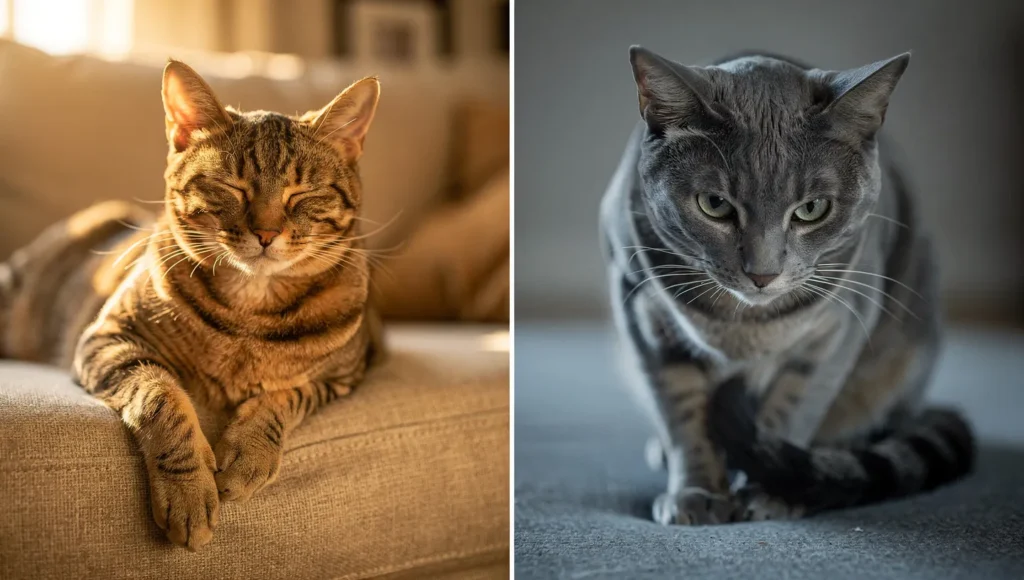
- The stress purr tends to be less rhythmic, sometimes slightly broken
- It often comes with other body language signals — flattened ears, tucked tail, dilated
pupils, or a tense, crouched posture - The cat may be purring while hiding, which is a significant sign
I learned this the hard way when Luna had a mild stomach issue a couple of years ago. She was purring the whole time she was curled under the bed — and I assumed she was just being introverted. She wasn’t. She was uncomfortable and self-soothing.
If you notice your cat purring but their body language seems off — tail tucked, ears back, avoiding eye contact — take it seriously. A purr alone doesn’t mean everything’s fine.
The Purring While Dying — A Difficult Truth Worth Knowing
This one is hard to talk about. But I think it’s important, because it catches a lot of owners completely off guard.
Cats sometimes purr in their final hours — even when they are clearly unwell, in pain, or actively dying. It’s one of the more heartbreaking things to witness, because your instinct is to hear the purr and feel reassured. She’s purring, so she must be okay.
She might not be okay.
Veterinary behaviorists believe this end-of-life purring serves the same self-soothing function as the stress purr — it’s the cat’s nervous system attempting to regulate itself under extreme physical distress. Some also theorize it may be a deeply ingrained survival mechanism: in the wild, showing vulnerability is dangerous, so cats mask pain through behaviors like purring.
If your cat is purring but also showing signs like:
- Labored or irregular breathing
- Complete loss of appetite for more than 24 hours
- Inability to stand or move normally
- Extreme lethargy with no response to stimulation
- Hiding in unusual places
…please don’t let the purring reassure you into waiting. These are signs that need immediate veterinary attention. You can read more about what to watch for in our guide on how to tell if your cat is sick.
And this is important: knowing this distinction could genuinely make a difference for your cat.
The Healing Frequency — Is It Real?
Short answer: yes, and the science backs it up.
Cat purrs vibrate at 25–50 Hz — a range that research has linked to:
- Bone density improvement and fracture healing
- Muscle repair after injury
- Reduced inflammation and pain relief
- Lower cortisol levels (the stress hormone) in nearby humans
A study referenced by Scientific American suggests that exposure to these frequencies may actually promote healing in both cats and the humans around them. It’s not magic — it’s just physics working quietly in your living room.
Personally, after a rough week, there’s nothing quite like Luna settling on my chest and just… running that engine. Dr. Karim calls it “free ultrasound therapy.” I’m inclined to agree.
Why Do Cats Purr and Knead at the Same Time?
To understand why do cats purr and knead at the same time, we have to realize that both behaviors come from the same emotional place: deep comfort and safety.
Kneading is a behavior cats develop as kittens while nursing — it stimulates milk flow.
Purring often accompanies it because both are rooted in that early feeling of warmth and security. When your adult cat kneads your lap and purrs simultaneously, they’re essentially regressing to their happiest memory.
- Purring alone = contentment
- Kneading alone = habit or marking territory
- Both together = full emotional trust mode
If Luna does both at once, I know she’s completely at ease. It doesn’t happen every day — which makes it feel like something worth noticing when it does.
Want to understand the kneading side more deeply? We have a full breakdown in our guide on why cats knead.
Cat Purring and Its Effect on Humans
When looking into why do cats purr, this specific health benefit for humans surprised me more than anything else I learned.
Studies suggest that living with a purring cat can:
- Lower blood pressure measurably over time
- Reduce the risk of heart attack by up to 40% (per a University of Minnesota study)
- Decrease anxiety and stress responses
- Improve sleep quality — yes, even if they’re purring on you at 2 AM
The vibration frequency does something to the human nervous system that we’re still fully mapping out. What we do know is that the effect is real, consistent, and costs absolutely nothing.
If you’ve ever felt inexplicably calmer after sitting with your cat for twenty minutes — that’s not placebo. That’s biology.
When Purring Is a Red Flag
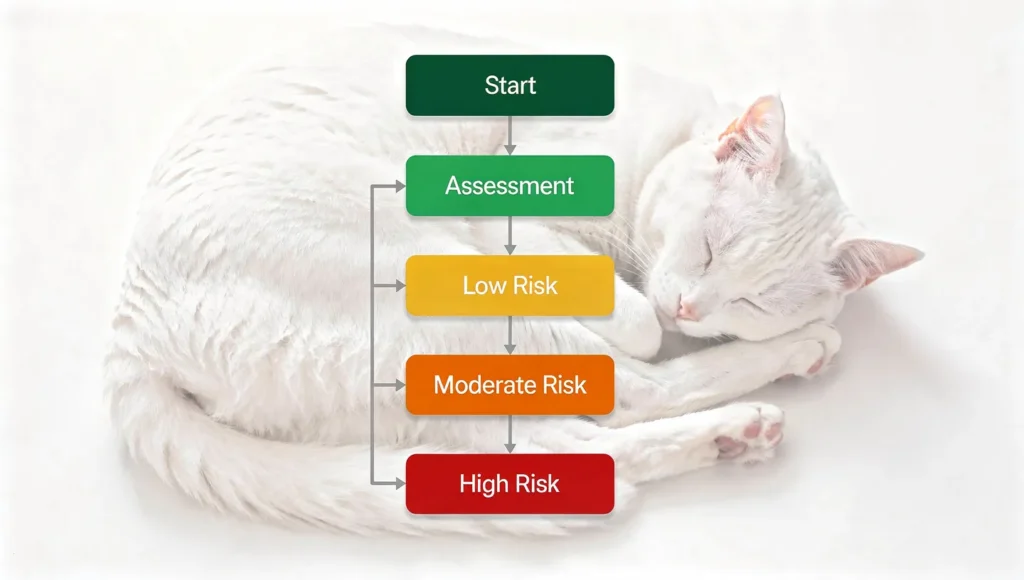
Most purring is completely normal. But contact your vet if the purring comes with:
| Signal | What It May Mean |
|---|---|
| Hiding + purring | Pain or illness — not contentment |
| Purring + no appetite (24h+) | Possible infection or internal issue |
| Labored breathing + purring | Respiratory distress — urgent |
| Sudden loud purring (senior cat) | Hyperthyroidism or hypertension |
| Purring + excessive grooming | Anxiety or skin irritation |
For a full breakdown of warning signs, check our guide on how to tell if your cat is sick and our article on cat respiratory infection symptoms.
Here Are the Quick Answers to Questions Most New Cat Owners Ask
Why do cats purr loudly?
When trying to decode why do cats purr at such a high volume, remember that louder purring usually means stronger emotion — either deep contentment or higher stress.
Why do cats purr when they sleep?
It’s essentially the feline version of sleep-talking. They’re relaxed enough to let the
neurological pattern run on autopilot. Completely normal — and honestly adorable.
Why do cats purr when you pet them?
Because petting triggers the same neural response as social bonding. You’re not just
scratching fur — you’re activating a comfort mechanism that goes back to kittenhood.
Do cats purr on purpose?
Not entirely. The base mechanism is involuntary (like breathing), but cats do seem to
modulate the type of purr intentionally — especially the solicitation purr.
Can cats purr and meow at the same time?
Not simultaneously — the mechanics don’t allow it. But they can switch between the two
very rapidly, which is why it sometimes sounds like they’re doing both at once.
One Last Thing — From Me, Dr. Karim, and Sami
So, Sami — if you ever read this: you were seven years old, and you asked a better question
than most adults think to ask. Luna’s engine wasn’t broken. It never was. It was doing
something remarkable, and you’re the reason I actually went and found out what.
Dr. Karim, thanks for not letting me stay wrong about the kibble theory. And for the decade
of patient explanations over increasingly expensive coffees.
And to every new cat owner reading this — I get it. Cats are confusing. Their signals are
subtle, their moods are layered, and sometimes the thing that looks like happiness is
actually a cry for help. The purr is a perfect example of that.
Pay attention to the whole picture. The sound, the posture, the context.
And if you’ve got a story about the first time you really heard your cat’s purr — I mean
actually understood what it was telling you — drop it in the comments. I read every single
one. So does Dr. Karim, occasionally, when he’s not busy laughing at my old theories.
You’re not alone in figuring this out. None of us were born knowing this stuff.
Welcome to the club.

I am sure this article has touched all the internet users,
its really really pleasant post.
Thank you so much!
Really glad you enjoyed the article — cat purrs are even more fascinating once you start paying attention to them!