
If you are currently worried about cat chin blackheads, you are not alone; I remember the day I became a “cat hypochondriac” because of them.
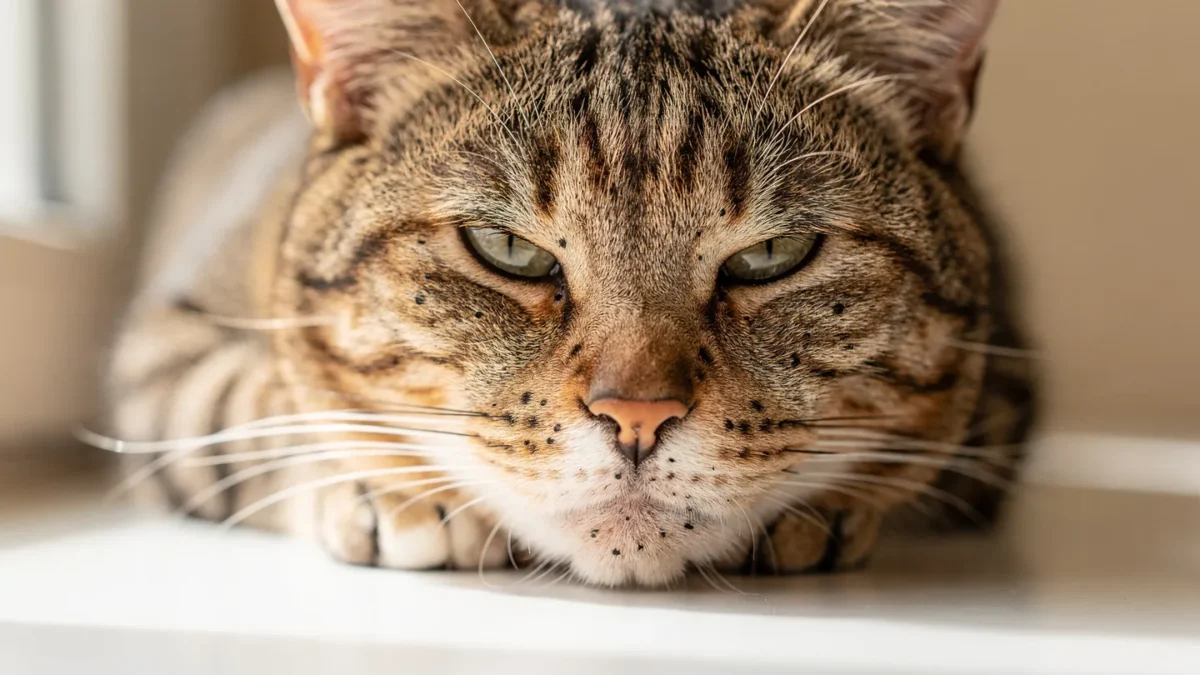
I had just settled into my routine with Luna, and we were officially best friends. Then, one Tuesday evening while we were cuddling, I noticed something strange: tiny, dark, dirt-like specks clustered right under her chin.
My heart did a somersault. Is it fleas? Is it a rash? Is she dying?
I immediately grabbed my phone and called my friend Dr. Karim. I probably sounded like a frantic parent whose kid had just grown a second head. “Karim, you won’t believe it! Luna’s chin is… it’s covered in black dots! Do I need a hazmat suit? Should I quarantine the living room?”
There was a long silence on the other end, followed by a very calm, stifled chuckle. “Hicham, relax. Before you burn your house down, take a deep breath. It’s likely just cat chin acne. Yes, cats get acne. And no, it’s not the end of the world.”
The next day, I took Luna to his clinic. As he gently cleaned her chin, he explained that this is one of the most common things owners face, yet it sends almost everyone into a panic. When I got to the office that morning, I casually mentioned it to my colleagues, Sarah and Mark.
“Oh, you mean the ‘dirty chin’ phase?” Sarah laughed, coffee in hand. “My cat had that last year, and I tried to wash it off with a toothbrush like I was scrubbing a tile floor.
My cat didn’t talk to me for three days.” Mark just stared at me, deadpan: “Wait, you’re telling me my cat isn’t just a messy eater? I thought he was just doing ‘fashionable chin spots’.”
I realized then that I wasn’t alone in this panic. We’ve all been there — trying to figure out why our perfectly groomed felines suddenly decided to sprout blackheads.
So, if you’re reading this because you’re currently staring at your cat’s chin with a magnifying glass, breathe. You’re in the right place. Let’s figure out what’s actually happening under that chin and how to get it cleared up — without the panic.
A quick note before we dive in: Everything I share here is based on my personal experience with Luna and research from trusted sources like
ASPCA and PetMD.
This article is for informational purposes only and is not a substitute for professional veterinary advice. If your cat’s chin looks angry, swollen, or infected — please call your vet. Better safe than sorry.
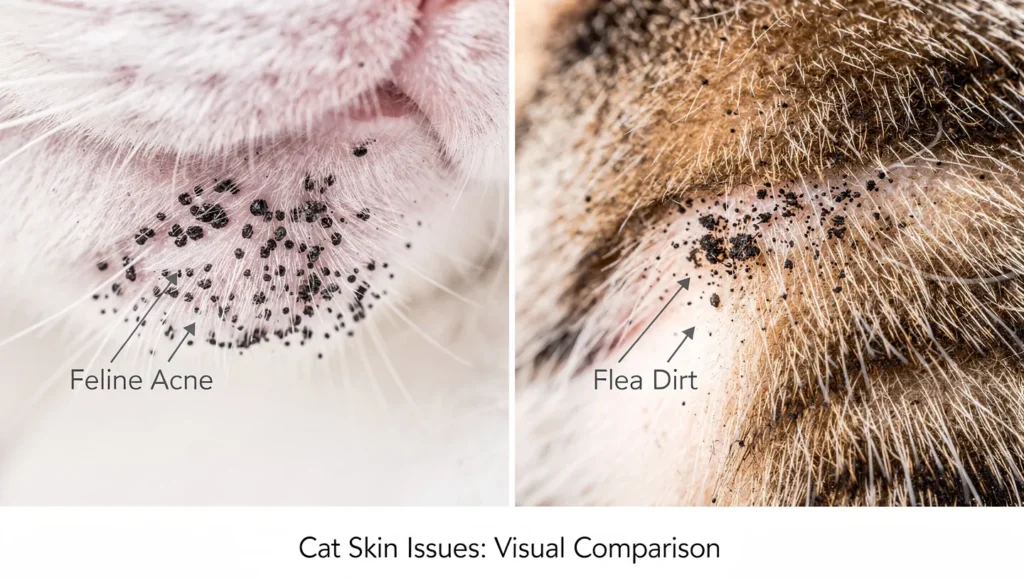
Table of Contents
- So… What Exactly Are Those Black Dots? (The Quick Answer)
- Is It Actually Acne — Or Something Else?
- Why Does This Even Happen? The Real Causes
- The Plastic Bowl Problem
- Poor Chin Grooming + Naturally Oily Skin
- Stress, Allergies & Hormonal Changes
- The 4 Stages of Cat Chin Acne (Know Where You Are)
- How to Treat Cat Chin Blackheads at Home (Step-by-Step)
- Step 1 — Switch the Bowl First (Do This Today)
- Step 2 — The Warm Compress Method
- Step 3 — Safe Cleaning Options
- ⚠️ What NOT to Do (Please Read This)
- What Actually Worked for Luna
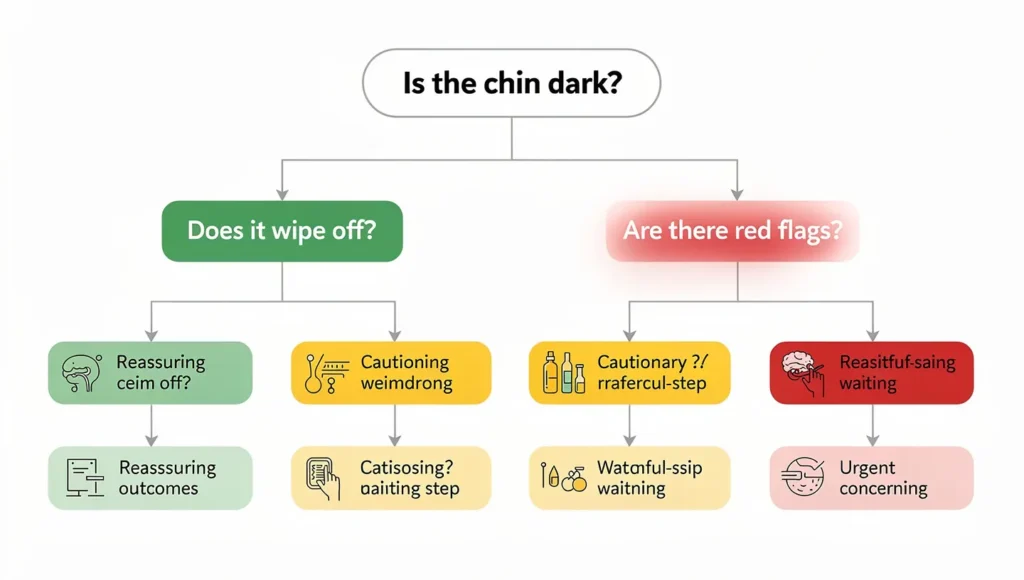
- When Should You See a Vet? (Decision Framework)
- The 5 Red Flags to Watch For
- How to Prevent Cat Chin Blackheads from Coming Back
- Quick Answers to Common Questions
- Can I squeeze my cat’s blackheads?
- Do plastic bowls really cause cat acne?
- Are cat chin blackheads contagious to other cats or humans?
- How long does it take to clear up?
- Can indoor cats get feline acne?
- Is feline acne painful?
- A Special Thanks to Dr. Karim and the Felina Community
So… What Exactly Are Those Black Dots? (The Quick Answer)
Cat chin blackheads are tiny clogged hair follicles — essentially the same thing as human blackheads, just on your cat’s chin. In most cases, they’re a mild form of feline acne, a common skin condition that shows up as dark specks, small bumps, or crusty patches right under the chin or around the lower lip area.
The good news? Most cases are completely harmless and respond well to simple at-home care.
Is It Actually Acne — Or Something Else?
Here’s the thing — not every dark speck under your cat’s chin is acne.
Before you start any treatment, it’s worth ruling out a few other common culprits. I learned this the hard way when I almost treated Luna for acne before Dr. Karim pointed out that what I thought were blackheads near her collar were actually just dried food residue.
| What You See | What It Might Be | Key Difference |
|---|---|---|
| Black/dark specks, slightly raised | Feline Acne | Attached to skin, won’t wipe off easily |
| Tiny black dots that crumble | Flea Dirt | Turns reddish-brown when wet (it’s digested blood) |
| Dark debris deep in the fur | Ear Mites spread | Usually accompanied by scratching and head shaking |
| Brown/tan crusty patches | Dried Food Residue | Soft, wipes off completely with a damp cloth |
Honestly, the flea dirt test is one of the most useful things I’ve learned:
just dab a wet cotton ball on the specks. If it turns rust-red, that’s flea dirt — and you’ve got a different problem on your hands. If it stays dark and won’t budge, you’re most likely dealing with feline acne.
Why Does This Even Happen? The Real Causes
Cat chin blackheads happen when the sebaceous glands — the ones that produce natural skin oils — get overactive or blocked. The chin area is especially prone to cat chin blackheads because cats can’t easily groom that spot themselves.
Think about it: have you ever watched your cat try to lick its own chin?
Exactly. It’s basically an unreachable zone.
The Plastic Bowl Problem
This is the big one. And most owners have no idea.
If your cat eats or drinks from a plastic bowl, that bowl might be silently contributing to the problem. Plastic scratches easily — even bowls that look perfectly smooth have microscopic grooves on the surface. Those tiny scratches are impossible to clean properly, no matter how hard you scrub.
The Biofilm Factor
Here’s something most articles don’t mention: those microscopic scratches
become a breeding ground for biofilm — a thin, sticky layer of bacteria
that clings to the surface of the plastic. Every time your cat dips its chin into that bowl, it’s pressing against this invisible bacterial layer. Over time, the bacteria transfers to the chin skin, clogs the follicles, and — you guessed it — acne.
This is why switching to stainless steel or ceramic bowls is almost always the first recommendation from vets. It’s not just a preference thing. It’s biology.
Personally, the week I switched Luna’s bowl was the week her chin started visibly clearing up. Coincidence? Dr. Karim would say absolutely not.
Poor Chin Grooming + Naturally Oily Skin
Some cats are just born with oilier skin than others — certain breeds like Persians and Rex cats tend to be more prone to it. Add the fact that the chin is nearly impossible for a cat to self-groom, and you’ve got oil buildup that has nowhere to go.
Stress, Allergies & Hormonal Changes
This one surprised me. Stress can actually trigger or worsen feline acne —
similar to how humans break out before a big event. If you’ve recently moved, added a new pet, or changed your cat’s routine significantly, that stress can show up on the skin. Allergies — both food-related and environmental — are also common triggers worth considering. If you notice the acne flaring up seasonally or after a food change, it’s worth mentioning to your vet.
You might also want to pay attention to other subtle changes in your cat’s body language around the same time — stress rarely shows up in just one place.
The 4 Stages of Cat Chin Acne (Know Where You Are)
This is important. Not all cat chin blackheads are equal, and knowing what stage you’re dealing with determines what kind of care is actually needed.
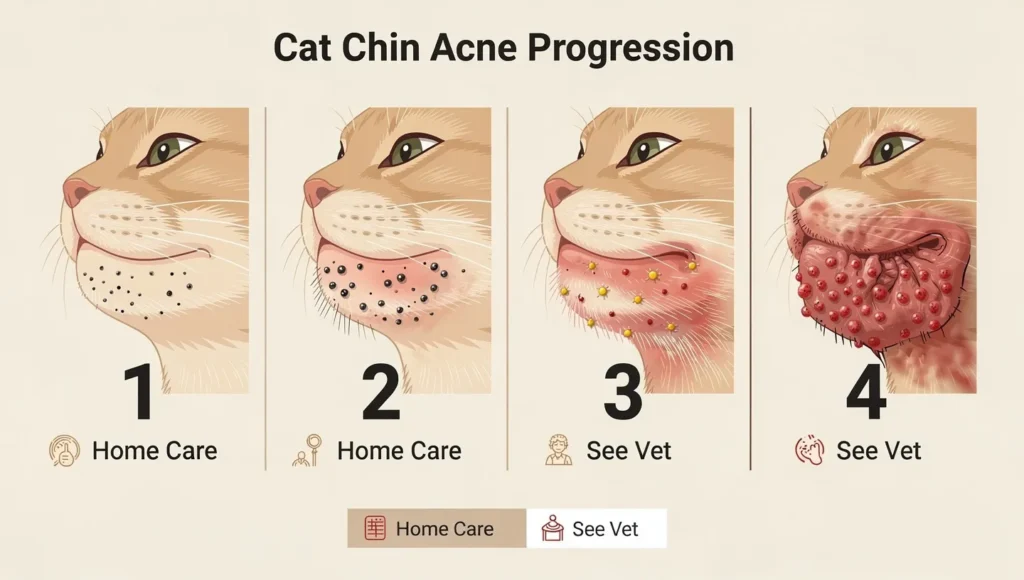
Stage 1 — Mild Comedones: Small black or dark brown specks. No swelling, no redness. Cat shows no discomfort. This is the most common stage, and most owners catch it here.
Stage 2 — Early Papules: The specks are slightly raised and the skin
around them may look a little irritated. Your cat might scratch the area occasionally but isn’t bothered much.
Stage 3 — Pustules & Inflammation: The bumps are now clearly inflamed, possibly with some pus. The chin area may look swollen or feel warm. This is where home care alone may not be enough.
Stage 4 — Severe Infection: Significant swelling, open sores, crusting, and visible pain when touched. Fur may be falling out in that area. This needs veterinary attention — full stop.
Most cats I’ve heard about (including Luna) start and stay at Stage 1 or 2 of cat chin blackheads if caught early. The goal is to keep it there.
How to Treat Cat Chin Blackheads at Home (Step-by-Step)
For mild Stage 1 or Stage 2 cases, most cats respond really well to simple at-home care. You don’t need fancy products or a medicine cabinet full of supplies. What you need is consistency and a little patience.
Step 1 — Switch the Bowl First (Do This Today)
Before anything else — before the wipes, before the warm compress, or trying to remove cat chin blackheads — change the bowl.
This is where things change for most cats. Swap any plastic bowl for stainless steel or ceramic, wash it daily with hot water and dish soap, and let it dry completely before refilling. A shallow, wide bowl also helps because it reduces the amount of chin contact with the sides.
From my experience, this single change made the biggest visible difference with Luna. Everything else is supportive — this is the root fix.
Step 2 — The Warm Compress Method
Once a day, take a clean cloth or cotton pad soaked in warm (not hot) water and hold it gently against your cat’s chin for about 30 seconds.
This softens the blocked follicles and makes the skin easier to clean without forcing anything. Think of it less like “treatment” and more like prep work. It also gets your cat comfortable with you touching that area — which matters a lot when you move to Step 3.
Luna actually started leaning into the warm compress after a few days. I think she just liked the warmth. Whatever works.
Step 3 — Safe Cleaning Options
After the warm compress, gently wipe the area with one of these vet-approved options:
- Chlorhexidine wipes (2% or less): The gold standard for mild feline
acne. Antibacterial, gentle, and widely available. Use once daily — not more. - Witch hazel (alcohol-free formula only): A gentler option for very
mild cases. Apply with a cotton ball, one swipe, no rubbing. - Diluted chlorhexidine solution: About a capful in a small bowl of
warm water. Dab gently with a soft cloth.
That’s really it. No scrubbing. No squeezing. One gentle wipe, once a day.
⚠️ What NOT to Do (Please Read This)
Most people get this wrong. And some of these mistakes can genuinely hurt your cat.
Do NOT use hydrogen peroxide. I can’t stress this enough. It might seem
like a logical choice — it cleans wounds, right? But hydrogen peroxide is caustic to cat skin. It kills healthy tissue along with bacteria, delays healing, and can cause chemical burns with repeated use. Dr. Karim told me he sees this mistake regularly, and it always makes a mild case significantly worse.
Do NOT squeeze or pop the blackheads. I know. The urge is real. But squeezing pushes the bacteria deeper into the follicle, risks infection, and can cause scarring. Your cat also won’t appreciate it — and you might lose a finger.
Do NOT use human acne products — benzoyl peroxide washes, salicylic acid pads, or anything marketed for human skin. These concentrations are too strong for cats and can be toxic if licked.
Do NOT use alcohol-based wipes. They dry out the skin, irritate the follicles, and make things worse within days.
This is where things change — switching from “I’m fixing this fast” to “I’m being consistent and gentle” is what actually works.
What Actually Worked for Luna
After Dr. Karim’s advice, here’s the exact routine I followed:
- Switched to a ceramic bowl immediately
- Warm compress every evening for about 30 seconds
- Chlorhexidine wipe once daily, very gently
- Checked her chin every few days under good light
Within about two weeks, the blackheads had visibly reduced. By week three, her chin looked completely normal. No prescription needed, no drama — just consistency.
Most mild cases improve within 2–3 weeks once the root cause (usually the bowl) is addressed and gentle cleaning starts. If you’re not seeing any improvement after two weeks, that’s when it’s worth calling your vet.
When Should You See a Vet? (Decision Framework)
Honestly, most cat chin blackheads don’t need a vet visit. But some do — and knowing the difference matters.
| Situation | What to Do |
|---|---|
| Mild dark specks, no swelling, cat unbothered | Home care — monitor daily |
| Slight redness or occasional scratching | Home care — add chlorhexidine wipes |
| Visible swelling or warmth in chin area | Call your vet within 24–48 hours |
| Pus, open sores, or bleeding | Vet visit — same day if possible |
| Fur loss around the chin | Vet visit — could indicate secondary infection |
| Cat stops eating or seems in pain | Emergency vet — don’t wait |
| No improvement after 2–3 weeks of home care | Schedule a vet appointment |
The 5 Red Flags to Watch For
These are the signs that tell you home care isn’t enough:
- Swelling that’s growing — not just redness, but actual puffiness spreading beyond the chin
- Discharge or pus — any yellow, green, or bloody fluid
- Your cat flinching or pulling away when you touch the chin (pain signal)
- Fur falling out in patches around the affected area
- Sudden behavior changes — hiding more, eating less, or seeming
generally “off”
If you notice any combination of these alongside the blackheads, please don’t wait. These could point to a secondary bacterial infection that needs antibiotics — something no warm compress will fix.
It’s also worth knowing that sudden changes in your cat’s skin can sometimes be one of the early signs your cat isn’t feeling well, even when the cause seems localized.
How to Prevent Cat Chin Blackheads from Coming Back
Once you’ve cleared it up, the goal is simple: keep it from coming back.
And it’s actually not that complicated.
Upgrade the bowl permanently. Stainless steel or ceramic, washed daily.
This alone prevents the majority of recurring cases. If you’re already doing this and still seeing flare-ups, look at the water bowl too — biofilm builds up there just as easily.
Do a weekly chin check. It takes about ten seconds. During your regular cuddle time, just run a finger gently under your cat’s chin and feel for any bumps or rough patches. Catching Stage 1 early means you never have to deal with Stage 3.
Support hydration and skin health. Dry skin produces more oil as a compensation mechanism, which clogs follicles faster. Keeping your cat well-hydrated — whether through wet food, a water fountain, or both — genuinely supports healthier skin. If you’re not sure your cat is drinking enough, the complete cat hydration guide covers everything from warning signs to practical tricks for stubborn drinkers.
Watch for food triggers. If you notice the acne returning shortly after a food change, it might be worth investigating a food sensitivity.
A simple elimination approach — one protein source at a time — can help identify the culprit without needing expensive allergy testing right away.
Reduce stress where you can. Easier said than done, I know. But if your cat’s acne keeps flaring up during periods of change — new pets, moving furniture, schedule shifts — stress is likely a contributing factor.
You can learn a lot about how your cat is feeling just by reading their body language signals during these transitions.
Quick Answers to Common Questions
Can I squeeze my cat’s blackheads?
No — and I mean this firmly. Squeezing pushes bacteria deeper into the follicle, increases infection risk, and can cause permanent scarring. As satisfying as it might look, don’t do it.
Do plastic bowls really cause cat acne?
They’re one of the most common contributing factors, yes. The microscopic scratches in plastic harbor bacteria (biofilm) that transfers to your cat’s chin repeatedly. Switching to stainless steel or ceramic is almost always the first recommendation — and it works.
Are cat chin blackheads contagious to other cats or humans?
No. Feline acne is not contagious. It’s a skin condition related to individual sebaceous gland activity, not a transmissible infection. Your other cats are safe, and so are you.
How long does it take to clear up?
Most mild cases improve noticeably within 2–3 weeks with consistent home care. Moderate cases may take 4–6 weeks. Severe or infected cases require veterinary treatment and may take longer depending on what’s prescribed.
Can indoor cats get feline acne?
Absolutely — in fact, indoor cats may be more prone to it because they’re more likely to eat from plastic bowls and have less varied activity levels. Being indoors doesn’t protect against this at all.
Is feline acne painful?
Mild acne (Stage 1–2) generally causes little to no discomfort. Your cat may occasionally scratch the area but otherwise won’t seem bothered. Moderate to severe cases — especially with inflammation or infection — can be genuinely uncomfortable and need proper treatment.
A Special Thanks to Dr. Karim and the Felina Community
Before I go, I want to say a huge thank you to Dr. Karim. His patience with my “emergency” calls — and his genuine dedication to animal welfare — has been the foundation of everything I write for you here. He truly cares about every cat that walks into his clinic, and it’s that level of professional care that I strive to bring to every guide on Felina Care Hub.
Now, it’s your turn!
I know you have your own stories about the infamous “blackhead phase.”
Did you have a “toothbrush moment” like Sarah? Or did you panic and call your vet at midnight like I did?
Drop your experiences in the comments below! I read every single comment, and I genuinely look forward to hearing how you handled this. Your tips might be exactly what another worried owner needs to read today to stop the panic.
If this guide helped you clear up your cat’s chin, please share it with
a friend or in your favorite cat group. Let’s make sure no more new owners
have to lose sleep over a few tiny black dots!