


Recognizing the early symptoms of worms in cats is something every owner thinks they’ll do easily—until it actually happens. For me, it started with a pretty normal Saturday afternoon.
Ben and I were sitting at our usual spot — a quiet corner table at this little café near his clinic — talking about nothing important. Kids, work, the usual. Then he asked about my cats. Specifically, he asked how Clover was doing.
I told him she seemed fine. Maybe a little less playful lately, but nothing alarming. Then I mentioned something almost as an afterthought: I’d noticed a tiny white speck in her litter box a few days ago. Thought it was maybe just something in her food.
Ben set his coffee down.
“How small? Like a grain of rice?”
I said yeah, pretty much.
He leaned forward. “That’s not food.”
That was the beginning of a two-hour conversation that honestly changed the way I look at my cats’ health. Ben — Dr. Ben, if we’re being formal — has been a practicing vet for over a decade, and he has this gift of explaining scary things in a way that doesn’t make you panic. He walked me through everything: what the signs actually look like, why so many cat owners miss them, and when it’s time to stop waiting and call a vet.
I took notes. And then I went home and did more research to fill in the gaps.
This article is basically me sharing everything I learned that afternoon — organized, fact-checked, and written for real cat owners who just want straight answers.
Quick note before we dive in: everything here is based on my personal experience as a cat owner, that conversation with Ben, and research from trusted veterinary sources. It’s meant to inform, not replace professional advice. If you’re genuinely worried about your cat, please reach out to your vet — that’s always the right call.
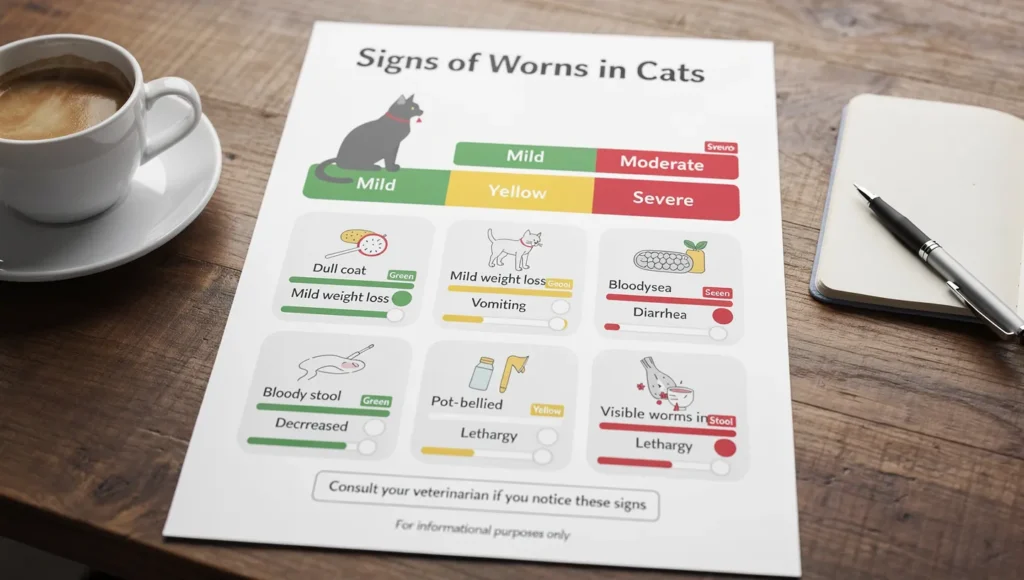
Table of Contents
- First, What Even Are Cat Worms? (A Quick Breakdown)
- The 5 Types You Actually Need to Know
- Symptoms of Worms in Cats — Ranked by Severity
- 🟢 Early Signs — Easy to Miss
- 🟡 Mid-Stage Signs — Time to Pay Attention
- 🔴 Serious Red Flags — Contact Your Vet Immediately
- Why Some Cats Show Zero Symptoms (This Scared Me)
- Can Indoor Cats Really Get Worms?
- What Do Cat Worms Actually Look Like?
- The Decision Framework — When Is It a Vet Emergency?
- What Happens If Worms Go Untreated?
- Can Humans Get Worms From Their Cat?
- Preventing Reinfection After Treatment
- Quick Answers to Common Concerns
- How do you know if a cat has worms?
- What do worms in cat poop look like?
- Can indoor cats get worms?
- How long can a cat live with worms untreated?
- How does a cat feel when it has worms?
- One Last Thing — From Me, Ben, and the Whole Table
First, What Even Are Cat Worms? (A Quick Breakdown)
Most people hear about the symptoms of worms in cats and picture one thing. But there are actually several different types of parasites that can infect cats — and they don’t all look the same, spread the same way, or cause the same problems.
Ben explained it to me like this: “Think of them as different neighborhoods of the same bad city. Some are annoying, some are dangerous, and some you don’t even know are there until they’ve been living rent-free for months.”
Here’s a quick overview of the five types that matter most for cat owners:
The 5 Types You Actually Need to Know
| Type | What It Looks Like | How Cats Get It | Risk Level |
|---|---|---|---|
| Roundworms | Long, pale, spaghetti-like | Contaminated soil, infected prey, mother’s milk | 🟡 Moderate |
| Tapeworms | Flat segments, rice-grain sized | Swallowing infected fleas, eating raw prey | 🟡 Moderate |
| Hookworms | Tiny, thread-like (usually invisible) | Skin contact with contaminated soil, ingestion | 🔴 High (causes blood loss) |
| Lungworms | Very small, rarely seen | Eating infected snails, slugs, or birds | 🔴 High (affects breathing) |
| Heartworms | Can’t see them — live in heart/lungs | Mosquito bites | 🔴 Very High (potentially fatal) |
The good news? Most cases involve roundworms or tapeworms — the more manageable types. The trickier ones, like lungworms and heartworms, are less common but worth knowing about.
Symptoms of Worms in Cats — Ranked by Severity
The most straightforward answer: symptoms of worms in cats range from subtle coat changes and occasional vomiting in early stages, to visible worms in stool, blood, pale gums, or breathing difficulty in serious cases. The earlier you catch them, the easier they are to treat.
Here’s the thing most cat owners don’t realize — worm symptoms don’t always show up the way you’d expect. There’s no single “this is definitely worms” sign. It’s usually a pattern of small, easy-to-dismiss things.
Ben was actually a little frustrated about this when we talked. He said a lot of owners come in late — not because they ignored their cat, but because each individual symptom seemed explainable on its own.
“A cat that’s vomiting once a week? Owners assume it’s hairballs. A cat that’s a little thinner? Maybe she’s just being picky. But put those two things together over a few weeks, and that’s a different conversation.”
So let’s break it down properly.
🟢 Early Signs — Easy to Miss
These are the ones that get dismissed most often. And honestly? I get it. Any one of them alone doesn’t scream emergency.
- Dull or rough coat — A healthy cat’s fur has a natural sheen. If it starts looking flat or coarse without an obvious reason, that’s worth noting.
- Mild, occasional vomiting — Once in a while, cats vomit. But if it’s happening regularly (say, more than once or twice a week), don’t write it off as hairballs automatically. More on that in a second.
- Slight decrease in appetite — Not refusing food entirely, just… less interested than usual.
- Low-grade lethargy — A little less playful, a little more “eh.” Easy to chalk up to a lazy day.
One thing Ben mentioned that I thought was really useful: if your cat is vomiting and you’re not sure whether it’s hairballs or something else, look at what comes up. Hairball vomit usually contains an actual cylindrical clump of hair. Worm-related vomiting tends to be liquid or food-based — and in some cases, you might actually see worms in it. Roundworms can look like pale, cooked spaghetti. Not a fun thing to find, but an important one.
🟡 Mid-Stage Signs — Time to Pay Attention
These are the symptoms that pushed me to actually ask Ben directly. Something felt off, even if I couldn’t name it.
- Visible weight loss — Not just “she seems a little slimmer.” Actual, noticeable weight loss over a few weeks.
- Bloated or pot-bellied appearance — More common in kittens than adult cats, but it can happen at any age. The belly looks distended even if the cat isn’t eating more.
- Diarrhea or chronically soft stools — If this is happening regularly, it’s a sign the digestive system is under stress. Related: if you’ve noticed your cat dealing with frequent stomach issues, worms are absolutely worth ruling out.
- Scooting — Dragging the back end across the floor. Looks ridiculous, but it’s actually a sign of irritation around the rear — often from tapeworm segments.
- Increased appetite with no weight gain — The worms are essentially eating before your cat does.
🔴 Serious Red Flags — Contact Your Vet Immediately
These are the most critical symptoms of worms in cats where you don’t wait and see.
- Worms visible in stool or vomit — This one removes all doubt. Tapeworm segments look like small grains of rice (fresh ones may even move slightly). Roundworms look like pale noodles. If you see either, call your vet today.
- Blood in stool — Dark, tarry stool or visible red blood. This can indicate hookworm infection, which causes internal blood loss.
- Pale or white gums — A sign of anemia, often linked to severe hookworm infections. Check by pressing gently on the gum — it should return to pink within two seconds.
- Coughing or breathing difficulty — This points specifically toward lungworms or heartworms. If your cat is coughing regularly and you can’t explain why, don’t wait.
- Sudden collapse or seizures — Rare, but can happen in very severe or advanced cases. This is an emergency.
If you’re unsure whether what you’re seeing qualifies as a red flag, this guide on how to tell if your cat is sick has a useful checklist that pairs well with this one.

Why Some Cats Show Zero Symptoms (This Scared Me)
This is the part that genuinely surprised me when Ben brought it up.
Some cats — especially healthy adult cats with strong immune systems — can carry worms for weeks or even months with no obvious signs at all. The parasites are there, doing damage quietly, while the cat acts completely normal.
My friend Layla found this out the hard way. Her cat Maya seemed perfectly fine — eating well, playing, no vomiting. Routine vet visit, fecal exam, and there they were: roundworms. She had no idea.
Here’s what Ben told me that I keep thinking about:
“A negative fecal test doesn’t always mean no worms. If the sample is taken between egg-shedding cycles, the results can come back clean even when the cat is infected. That’s why symptoms and context matter just as much as lab results.”
That’s the kind of thing you don’t read on most pet websites — and it’s exactly why regular vet checkups matter even when everything looks fine.
Can Indoor Cats Really Get Worms?
Short answer: Yes. Absolutely.
This is probably the most common misconception Ben hears. People assume indoor cats are safe from the common symptoms of worms in cats, but they’re not fully protected. They’re not fully protected.
Here’s how worms sneak in:
- Fleas — The #1 route for tapeworms. One flea swallowed during grooming is enough. And fleas can enter your home on shoes, clothing, or other pets. This is exactly why flea prevention matters even for cats that never go outside.
- Your shoes — Roundworm eggs can hitch a ride on the soles of your shoes from contaminated outdoor soil.
- Insects — A moth or cricket that wanders inside and gets caught and eaten can carry larvae.
- Raw or undercooked food — If you feed raw, the risk is real without proper sourcing and handling.
Bottom line: “indoor cat” doesn’t mean “zero risk.” It means lower risk — and that’s still worth managing.
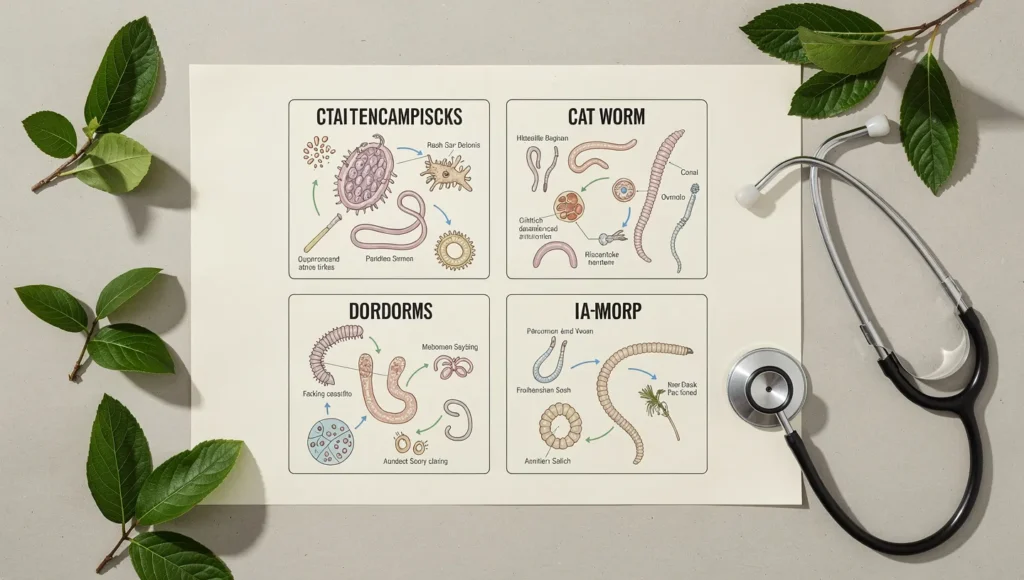
What Do Cat Worms Actually Look Like?
Here’s a quick visual reference, because this question comes up constantly:
- Roundworms — Pale white or tan, spaghetti-like, 3–5 inches long. Usually seen in vomit more than stool.
- Tapeworms — Flat, segmented. Individual segments look like grains of rice or sesame seeds. May appear near the tail or in dried form around the litter box.
- Hookworms — Tiny and thread-like, rarely visible to the naked eye. You likely won’t see these at all.
- Lungworms/Heartworms — Not visible externally. Diagnosed through vet testing only.
If you notice anything rice-grain sized near your cat’s rear end or in the litter box — that’s a tapeworm segment. Don’t second-guess it. Call your vet.
The Decision Framework — When Is It a Vet Emergency?
One symptom, mild, no other signs → Monitor for 24–48 hours
Two or more symptoms together → Call your vet today
Visible worms / blood in stool / pale gums → Go in immediately
Breathing difficulty / collapse → Emergency visit — don’t wait
If your cat has suddenly stopped eating alongside any of the above, that adds urgency. Here’s a full breakdown of what it means when a cat won’t eat — worth reading alongside this.
What Happens If Worms Go Untreated?
This isn’t about scaring you. It’s just the reality of what happens when the problem gets ignored:
- Week 1–2: Gradual weight loss, dull coat, inconsistent digestion
- Week 3–4: Noticeable muscle wasting, persistent diarrhea, anemia beginning (especially with hookworms)
- Beyond that: Organ stress, severe malnutrition, immune suppression — and in kittens or senior cats, it can become life-threatening faster than you’d expect
The good news: most cases are very treatable when caught early. A simple dewormer prescribed by your vet can clear many types within days. The damage comes from waiting.
Can Humans Get Worms From Their Cat?
Technically, yes — but context matters a lot here.
Some cat worms are zoonotic, meaning they can transfer to humans. Roundworms and hookworms are the main ones. The risk is real but manageable with basic hygiene:
- Always wash your hands after cleaning the litter box
- Keep the litter box clean — placement and maintenance matter more than most people think
- Don’t let children play in areas where cats defecate outdoors
- Treat your cat promptly when worms are confirmed
According to the ASPCA, regular deworming and fecal exams are the most effective way to reduce zoonotic risk for the whole household.
Preventing Reinfection After Treatment
Treating worms once isn’t always the end of it. Reinfection is common — especially if the root cause isn’t addressed.
- Treat fleas at the same time — If tapeworms are the issue, fleas are almost always involved. Treating one without the other is a temporary fix at best.
- Clean the litter box thoroughly — Worm eggs can survive in the environment. Scoop daily, disinfect weekly.
- Follow up with a second fecal test — Usually recommended 2–4 weeks after treatment to confirm the infection cleared.
- Ask your vet about a deworming schedule — Some cats benefit from routine treatment, especially those with outdoor access or flea exposure.
Supporting gut recovery matters too — bone broth and proper hydration can help a cat bounce back faster after a worm infection. For hydration specifically, this guide has practical strategies that actually work.
Quick Answers to Common Concerns
How do you know if a cat has worms?
Look for a combination of: weight loss, vomiting, diarrhea, bloated belly, dull coat, or visible worm segments near the tail or in the litter box. A fecal exam from your vet confirms it
What do worms in cat poop look like?
Tapeworm segments look like grains of rice — sometimes still moving when fresh. Roundworms look like pale spaghetti. Hookworms are too small to see.
Can indoor cats get worms?
Yes. Fleas, contaminated shoes, insects, and raw food can all bring parasites into a home. Indoor cats have lower risk, not zero risk.
How long can a cat live with worms untreated?
It depends on the type and severity. Mild roundworm infections may cause gradual decline over months. Hookworm or heartworm infections can become dangerous much faster — particularly in kittens or older cats.
How does a cat feel when it has worms?
Likely uncomfortable, low-energy, and possibly nauseous. They can’t tell us, but behavior changes — hiding more, eating less, being less playful — are often the first clues something is off. Check this guide on respiratory infection symptoms too, since some signs overlap.
For a broader look at warning signs across health issues, Cornell Feline Health Center has a solid overview worth bookmarking.
One Last Thing — From Me, Ben, and the Whole Table
That Saturday at the café ended with Ben drawing a little diagram on a napkin — his way of explaining the worm lifecycle. My friend Nora, who’d joined us by then, immediately pulled out her phone to check her cat’s last vet visit. Our friend James, who has two kittens, went quiet for a minute and then said, “I think I need to make an appointment.”
That’s kind of the point, right?
Not panic. Just awareness about the symptoms of worms in cats.
I’m genuinely grateful to Ben for breaking this down in a way that didn’t make me feel like a bad cat owner — just an informed one. And to Nora and James for reminding me that most of us are figuring this out together.
If this helped you, share it with someone who just got a cat, or someone who’s never thought twice about this stuff. The more cat owners know, the better off our cats are.
And if you have a story — maybe you caught something early, or missed something you wish you hadn’t — I’d genuinely love to read it. Drop it in the comments below. We read every single one.
— Written with help from a very patient vet friend and one very suspicious litter box discovery.


This post is worth everyone’s attention. When can I find out more?
Thank you so much, Berry — that genuinely means a lot to hear.
I’m actually working on more in-depth cat health and behavior guides right now, so there’s definitely more coming soon. In the meantime, feel free to explore the other articles on the site — especially the guides about cat diarrhea, UTI signs, and respiratory infections, since many symptoms can sometimes overlap.
Really appreciate you taking the time to read and comment!