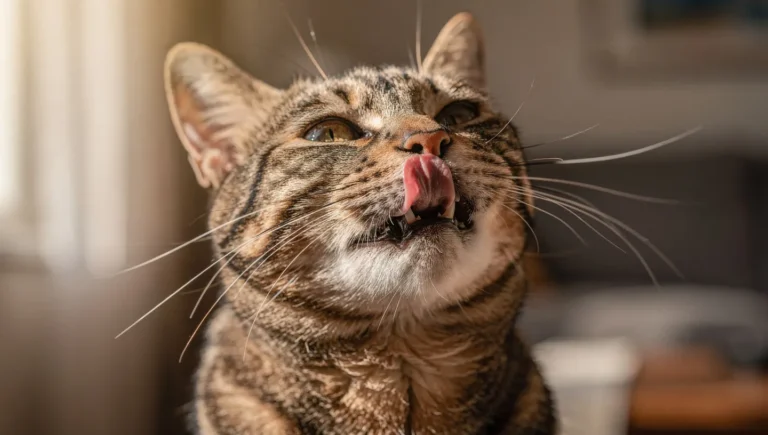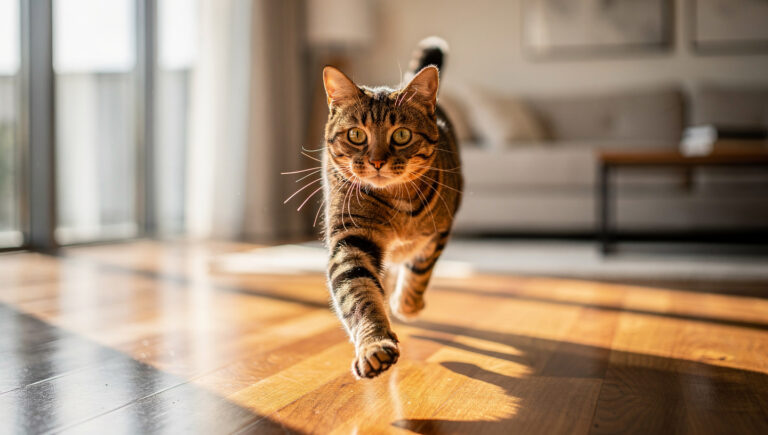

You’re sitting by the window with your morning coffee, and your cat suddenly makes this strange, rapid clicking sound — halfway between a bird and a broken meow. You freeze. What was that?
Cat chirping meaning is simpler than you’d think: it’s a short, high-pitched, stuttering sound cats make when they’re excited, intensely focused, or trying to communicate — most often triggered by birds, movement outside, or direct interaction with their favorite human.
It’s one of the most misunderstood sounds in a cat’s vocabulary. And once you understand it, you’ll never hear it the same way again.
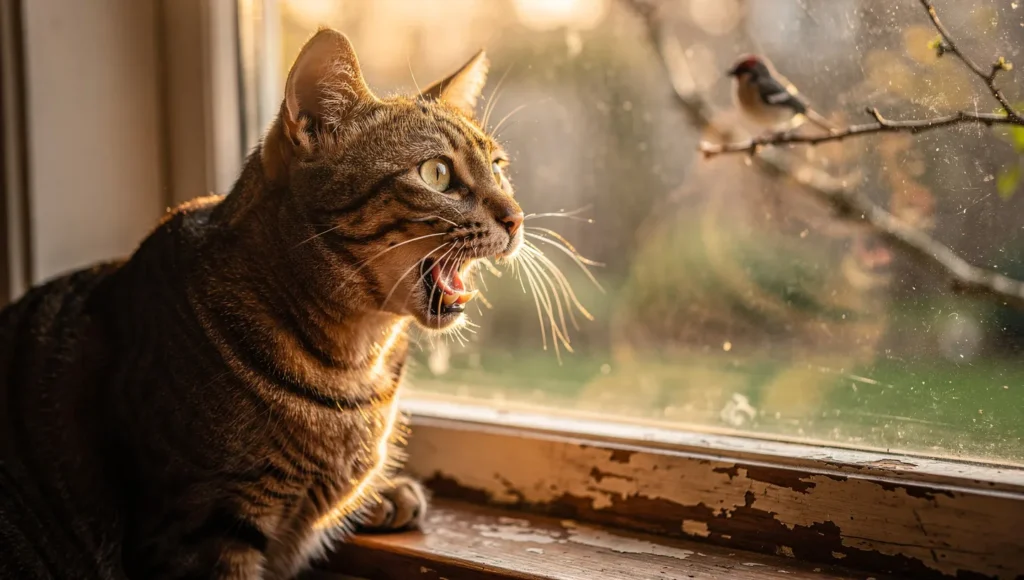
Table of Contents
- 🐦 What Is Cat Chirping? (And How It’s Different From Meowing)
- 🎯 Why Do Cats Chirp? 7 Real Reasons Behind This Sound
- 1. 🦅 Hunting Instinct (Especially at Birds)
- 2. 😤 Excitement and Frustration
- 3. 💬 Trying to Get Your Attention
- 4. 🐾 Communicating With Kittens
- 5. 🎮 Play Mode Activation
- 6. 😮 Mild Frustration (Window Watching Syndrome)
- 7. 🤝 Social Bonding
- 💡 Expert Tip
- 🔊 Cat Chirping vs Trilling vs Meowing – What’s the Difference?
- 🩺 Should You Be Worried About Cat Chirping?
- 💡 How to Respond When Your Cat Chirps
- ❓ FAQ
- Why does my cat chirp instead of meow at birds or toys?
- Is cat chirping a sign of happiness?
- Do male and female cats chirp differently?
- What does it mean when a cat chirps at you?
- Is chirping a hunting behavior?
- Why does my cat chirp but never meow?
- 🐾 The Sweet Language Behind the Chirp
🐦 What Is Cat Chirping? (And How It’s Different From Meowing)
Cat chirping meaning starts with understanding what’s actually happening in your cat’s body when that sound comes out.
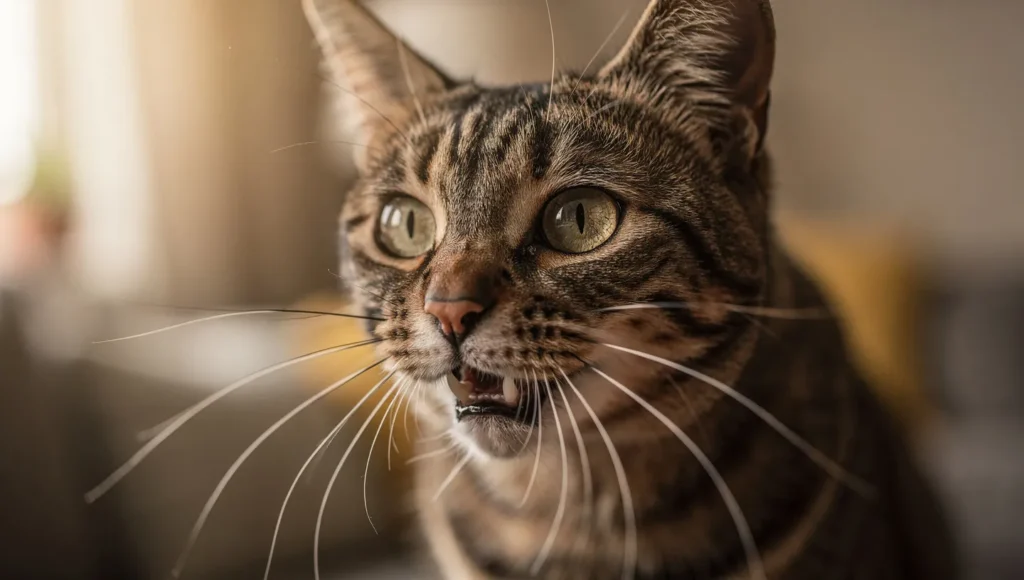
A chirp is a short, clipped vocalization — almost like a rapid “ek-ek-ek” or a stuttered trill. It’s produced when your cat’s jaw chatters slightly while their mouth is almost closed. Compare that to a meow, which is open-mouthed, longer, and typically directed at humans as a learned communication tool.
Here’s what’s happening physically:
- Jaw chattering — the lower jaw quivers rapidly
- Eyes locked on target — usually a bird, bug, or moving object
- Body low and still — full predator focus mode
- Tail tip twitching — barely controlled excitement
The sound is involuntary in many cases. Your cat isn’t choosing to chirp the way they choose to meow at you for breakfast. It bubbles up from deep instinct.
One mistake I often see is owners confusing chirping with distress. The posture tells the whole story. A chirping cat is engaged, not scared.
If you want to understand how this fits into your cat’s broader communication system, this guide on cat meowing at night breaks down how different vocalizations serve completely different purposes.
🎯 Why Do Cats Chirp? 7 Real Reasons Behind This Sound
1. 🦅 Hunting Instinct (Especially at Birds)
This is the big one. Cat chirping at birds is the most documented trigger for this vocalization, and there are two main theories about why it happens.
Theory 1 — Frustration release: Your cat sees prey they can’t reach. The sound is an involuntary outlet for that pent-up predatory energy.
Theory 2 — Mimicry: Researchers observed wild cats in Brazil mimicking the calls of their prey to lure them closer. Your domestic cat may be doing the same thing — hardwired from thousands of years of evolution.
In my experience, both are probably true depending on the cat. Some chirp in frustration, some chirp in active “hunting mode.” Watch the posture to tell the difference.
This hunting drive is also why many cats bring you little “gifts.” If you’ve ever woken up to a toy at your feet, this explanation of why cats bring gifts connects directly to the same instinct behind chirping.
2. 😤 Excitement and Frustration
Glass frustration is real. When your cat watches a squirrel through a closed window, that chirp carries a mix of excitement and genuine frustration at the barrier between them and their target.
I’ve worked with cats that chirp so intensely at window birds that they’ll keep going for 10–15 minutes straight. It’s not harmful — but it’s a strong signal that your cat needs more active stimulation in their daily routine.
3. 💬 Trying to Get Your Attention
What does it mean when a cat chirps at you? This one surprises most owners.
Your cat has learned that chirping works. Maybe you responded with play, with food, or just with eye contact. Cats are masters of operant conditioning — they do what gets results. If chirping at you has historically led to good things, expect more of it.
It’s a softer, more inviting sound than a demanding meow. Think of it as your cat saying: “Hey. Hey. Look at me. Come here.”
4. 🐾 Communicating With Kittens
Mother cats use chirps and trills as directional calls — “follow me,” “come here,” “pay attention.” It’s one of the earliest vocalizations kittens learn to respond to.
Adult cats sometimes carry this behavior forward, using chirp-like sounds to guide or check in with other cats in the household, or even with their favorite human.
5. 🎮 Play Mode Activation
Right before a cat launches into a play session — especially with a feather wand or laser pointer — you’ll often hear a burst of chirping. It’s the sound of their brain switching from “rest” to “hunt.”
Channeling this energy into proper play is one of the best things you can do for your cat’s mental health. Interactive toys that mimic prey movement are especially effective at satisfying this instinct safely.
6. 😮 Mild Frustration (Window Watching Syndrome)
Cats who spend long hours watching outdoor activity without any outlet for their predatory drive can develop what I call “window frustration.” The chirping becomes repetitive and almost compulsive.
The fix isn’t to close the blinds — it’s to add stimulation after window time. A play session following their watching window can break the frustration cycle.
7. 🤝 Social Bonding
Not all chirping is prey-driven. Some cats chirp as a greeting — a quick, warm sound when you walk into the room. It’s softer than their hunting chirp, and it’s often paired with slow blinking or a raised tail.
This connects directly to one of the most comforting sounds cats make. If you’re curious how vocalization ties into your cat’s emotional world, the science behind why cats purr adds a fascinating layer to this conversation.

💡 Expert Tip
If your cat chirps frequently at windows but seems restless or anxious afterward, they may need more environmental enrichment — not just passive watching time. Add a bird feeder outside the window and schedule a 10-minute play session right after their “viewing hour.” You’ll notice a calmer, more satisfied cat within a week.
🔊 Cat Chirping vs Trilling vs Meowing – What’s the Difference?
These three sounds often get confused — but they serve completely different purposes.
| Sound | What It Sounds Like | When It Happens | What It Means |
|---|---|---|---|
| Chirp | Short, clipped “ek-ek” | Watching prey, greeting | Excitement, hunting instinct |
| Trill | Rolling, musical “brrr” | Walking toward you | Affection, social bonding |
| Meow | Open-mouthed, varied | Anytime, at humans | Demand, attention, hunger |
Reading these sounds alongside body posture gives you the full picture. This complete guide to cat body language is the best companion resource for decoding what your cat is really saying.
🩺 Should You Be Worried About Cat Chirping?
Understanding cat chirping meaning helps you know when it’s normal excitement — and when it might signal something else.
Almost never. Chirping is normal, healthy behavior.
When it’s completely fine:
- Directed at birds, bugs, or moving objects
- Happens during or before play
- Used as a greeting when you enter the room
When to pay closer attention:
- Chirping is paired with labored breathing or an open mouth at rest
- Your cat chirps but seems disoriented or confused
- The sound has changed significantly in pitch or frequency overnight
If something feels off beyond the chirping itself, check this list of 10 signs your cat might be sick — it covers the behavioral red flags worth knowing.
💡 How to Respond When Your Cat Chirps
Match their energy — that’s the simplest rule.
- Chirping at birds? Let them watch, then follow up with a play session using a wand toy
- Chirping at you? Acknowledge them — a soft trill back, slow blink, or picking up a toy
- Chronic window frustration? Add a cat window perch to make watching more comfortable, and add a bird feeder outside for enrichment
- Play-triggered chirping? Lean into it — it means your cat is genuinely engaged
The goal is to give that hunting energy somewhere healthy to land. Structured play mimics the full hunting cycle — stalk, chase, catch, and “kill” — which is essential for indoor cats.
❓ FAQ
Why does my cat chirp instead of meow at birds or toys?
Chirping is instinctive — it bypasses the learned meow entirely. It surfaces when your cat’s prey drive or excitement overrides their usual communication habits.
Is cat chirping a sign of happiness?
Usually yes, or at minimum high engagement. A chirping cat is focused and stimulated — which is a good thing.
Do male and female cats chirp differently?
Not significantly. Chirping frequency is more personality and environment-driven than sex-driven.
What does it mean when a cat chirps at you?
Birds trigger the predatory instinct directly. Chirping at you is a learned, social behavior — some cats develop it, others express excitement differently.
Is chirping a hunting behavior?
At its core, yes — though it’s also been adapted into a social vocalization in domestic cats over generations.
Why does my cat chirp but never meow?
Some cats rely more on instinctive sounds like chirping and trilling rather than the learned “meow.” Meowing is primarily a human-directed behavior, while chirping is rooted in hunting drive and excitement. If your cat chirps often but rarely meows, it simply reflects their personality and communication style — not a problem.
🐾 The Sweet Language Behind the Chirp
That tiny chirp isn’t random noise. It’s a window into your cat’s inner world — their focus, their excitement, their trust in you enough to let you hear it.
Every chirp at the window is a little hunter doing what their DNA demands. Every chirp directed at you is an invitation — subtle, honest, and entirely theirs.
You don’t need to do anything complicated. Just listen, respond, and play. That’s all they’re asking for.