
I’m writing this on my fourth cup of coffee.
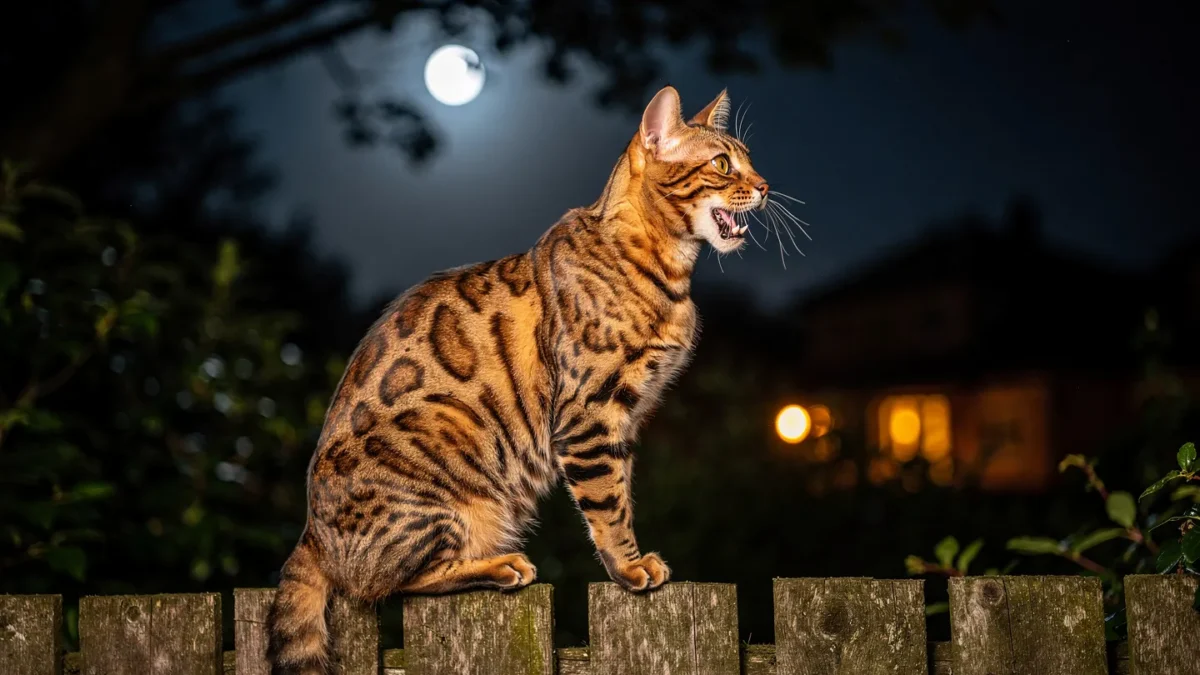
Not because I’m a workaholic. Not because I had a deadline. But because Kovu — my Bengal cat, my “quiet little companion,” my so-called “furry stress reliever” — decided that 3 AM is the absolute perfect time to launch his nightly opera season.
And honestly? I had no one to blame but myself.
When I adopted Kovu eight months ago, I genuinely believed that cat meowing at night was something that happened to other people — not to me and my supposedly “low-maintenance” companion. I pictured him sleeping 18 hours a day, occasionally rubbing against my leg, maybe knocking one thing off the counter for dramatic effect.
What I did NOT picture was standing barefoot in my kitchen at 3:17 AM, whispering “Kovu, please. I have a meeting at 9.”
He did not care about my meeting.
The next morning at work, I walked in looking like something that had been fished out of a dumpster.
Lina — my coworker, professional chaos observer, and self-appointed commentator on my life choices — spotted me from across the room and actually gasped.
“Luca.” She put down her coffee. “Are those… bags under your bags?”
I told her about Kovu. About the meowing. About how it started soft, then got louder, then turned into something that sounded like a distress call from a sinking ship.
She nodded slowly, the way people do right before they say something completely unhelpful.
“Have you tried talking to him? Like, really talking to him?”
I had not.
Then Marcus rolled his chair over — Marcus, our resident academic, the guy who quotes research papers in casual conversation and genuinely owns a color-coded bookshelf.
He adjusted his glasses. Cleared his throat.
“Well, Luca, you have to understand — cats are crepuscular animals.” He said crepuscular like he was presenting a thesis. “Their peak activity windows align with dusk and dawn, which is why Kovu’s vocalizations are concentrated during those pre-circadian hours. It’s really quite logical if you read the literature.”
I stared at him.
“Marcus. It’s 9 AM and I haven’t slept.”
“Right, yes. Anyway. Fascinating stuff.”
And then there was Dave.
Dave means well. Dave really, truly, deeply means well. He just also happens to have the worst advice of any human being currently alive on this planet.
He leaned over with the energy of a man who had just solved cold fusion.
“Bro. Easy fix. When he starts meowing — spray bottle. Just hit him with a little water. Boom. Done.”
I told him I’d tried that.
“Okay okay okay,” he said, undeterred. “What if you just… sing back? Like, match his energy? So he feels heard?”
Reader, I tried it.
Kovu’s meowing increased by approximately 400%.
He thought we were in a band.
That evening, somewhere between desperate and delirious, I called Dr. Sami.
Dr. Sami is the kind of friend every cat owner desperately needs — a veterinarian who has somehow absorbed my increasingly unhinged 11 PM texts for the past two years without once blocking my number.
He picked up. He heard my voice. He laughed for about 45 seconds straight.
Then he said: “Okay, Luca. Let’s actually figure out what’s going on with Kovu.”
And that conversation — that single, sleep-deprived, slightly emotional phone call — is what became this complete guide to cat meowing at night.
Because if you’re reading this right now with raccoon eyes and a cold cup of coffee next to your keyboard, I want you to know: you’re not alone. And more importantly, there’s an actual reason your cat is meowing at night.
Usually more than one.
Let’s break it down.
A quick note before we dive in: Everything in this article is based on personal experience, extensive research from trusted veterinary sources, and advice from professionals I genuinely trust. It is for informational purposes only and is not a substitute for professional veterinary care. If your cat’s meowing is sudden, intense, or paired with other symptoms — please don’t rely on Google. Call your vet.
Table of Contents
- Why Is My Cat Meowing at Night?
- 7 Real Reasons Your Cat Is Running a Midnight Concert
- 1. Hunger — The Classic 3 AM Feeding Demand
- 2. Attention Seeking — “You’ve Been Gone All Day and I Need to Talk”
- 3. Boredom + Excess Energy — Marcus Was Actually Right (Don’t Tell Him)
- 4. Anxiety, Stress & Separation — The Emotional One
- 5. Medical Issues — When the Meowing Is a Cry for Help
- 6. Senior Cat Cognitive Dysfunction — The One Nobody Talks About
- 7. Mating Calls — The Loudest Reason of Them All
- 🟢🟡🔴 The Midnight Emergency Red Flag System
- Should I Ignore My Cat Meowing at Night?
- How to Stop Cat Meowing at Night — Dr. Sami’s Real Action Plan
- Step 1 — Rule Out Medical Causes First
- Step 2 — The Pre-Bedtime Play & Hunt Routine
- Step 3 — Adjust the Feeding Schedule
- Step 4 — Environmental Enrichment (The Boring Fix That Actually Works)
- Step 5 — The “Ignore Correctly” Method
- When Your Cat’s Midnight Cries Are a Real Emergency
- FAQ — Real Questions From Real Sleep-Deprived Owners
- Why does my cat only meow at night and not during the day?
- Why is my old cat suddenly crying at night?
- Should I let my cat sleep in my bedroom to stop the meowing?
- How long does it take to stop nighttime meowing with the routine?
- My cat meows at exactly 3 AM every single night. Is that normal?
- The Night Kovu Finally Let Me Sleep
Why Is My Cat Meowing at Night?
Cat meowing at night happens for several reasons ranging from hunger and boredom to serious medical conditions like hyperthyroidism, UTIs, or cognitive dysfunction in senior cats.
Understanding the specific trigger is the only way to actually fix the problem — not just survive it.
Here’s the thing most articles won’t tell you: there’s rarely just one reason.
With Kovu, it turned out to be a combination of three things happening at the same time. Three. Simultaneously. Like a perfectly orchestrated chaos symphony.
And once Dr. Sami walked me through each possible cause, everything suddenly made sense.
So let’s go through all seven — because one of them is probably your answer too.
7 Real Reasons Your Cat Is Running a Midnight Concert
1. Hunger — The Classic 3 AM Feeding Demand
Let’s start with the obvious one, because honestly, it’s the most common culprit and the easiest to fix.
If you feed your cat on a set schedule and that last meal was at 6 PM, your cat’s internal clock is going to wake them up hungry around 2–3 AM. And cats don’t do subtle.
They don’t nudge you gently. They don’t leave a polite note on the nightstand.
They meow. Loudly. Directly into your face.
The fix here is usually adjusting the feeding schedule — moving the last meal closer to your bedtime makes a surprisingly big difference. We’ll get into the exact strategy in the action plan section below.
2. Attention Seeking — “You’ve Been Gone All Day and I Need to Talk”
Cats are more emotionally complex than people give them credit for.
If you work long hours or have been less available than usual, your cat may genuinely save up all their social energy and unleash it the moment the house goes quiet and you actually stop moving.
Which is, of course, midnight.
Personally, I noticed this pattern with Kovu on weeks I worked late. The nights I came home and spent even 15 minutes playing with him before bed? Silent night. The nights I came home exhausted and went straight to bed? Full concert.
It’s not manipulation. Well — okay, it’s a little bit manipulation. But it’s also genuine need.
3. Boredom + Excess Energy — Marcus Was Actually Right (Don’t Tell Him)
Fine. I’ll say it.
Marcus wasn’t completely wrong.
Cats are crepuscular — meaning their biological peak activity windows naturally fall around dusk and dawn. This is hardwired into their DNA from thousands of years of being small, efficient hunters in the wild.
So when your cat is sprinting across the apartment at 2 AM and screaming into the void, part of that is just… their nature.
Indoor cats especially — with limited stimulation and no actual prey to chase — often redirect all that built-up hunting energy into vocalizations.
The solution? Burn it off before you go to sleep. Interactive play sessions 20–30 minutes before bedtime work incredibly well for this. If you’re not sure what toys actually engage your cat’s hunting instinct properly, we put together a full guide on the best interactive cat toys that covers exactly this.
4. Anxiety, Stress & Separation — The Emotional One
This one hit close to home for me.
Kovu started his midnight meowing phase about two weeks after I rearranged my apartment.
New furniture layout, a different couch position, his cat tree moved three feet to the left. To me, it was just redecorating. To Kovu, apparently, the entire universe had shifted.
Cats are deeply territorial and highly sensitive to environmental changes — new pets, new people, moving boxes, even different laundry detergent smells can trigger anxiety.
And anxious cats vocalize. A lot. At night, when everything is quiet and their nervous system is on full alert.
If you suspect anxiety is behind the midnight concerts, this 14-day separation anxiety reset plan is genuinely one of the most practical breakdowns I’ve come across for actually addressing it.
5. Medical Issues — When the Meowing Is a Cry for Help
And here’s where things get serious.
This is important.
Sudden, intense, or unusually loud nighttime meowing — especially when it’s new behavior — can sometimes be your cat’s only way of telling you something is wrong physically.
Common medical triggers include:
- Urinary Tract Infections (UTIs): Painful, urgent, and more common than most
owners realize. If your cat is also making frequent trips to the litter box or
straining to urinate, don’t wait. Check the full breakdown of
signs of UTI in cats — some of them are surprisingly easy to miss. - Hyperthyroidism: Extremely common in middle-aged and senior cats. An overactive
thyroid causes restlessness, increased vocalization, weight loss despite eating more,
and general agitation. Nighttime is often when it’s most noticeable. - Chronic Pain: Arthritis, dental disease, internal discomfort. Cats are
notoriously good at hiding pain during the day. At night, when defenses are down,
the meowing starts. - Hypertension: High blood pressure, often secondary to kidney disease or
hyperthyroidism, can cause disorientation and loud crying at night.
According to PetMD, any sudden change in vocalization patterns in a cat — especially one that’s previously been quiet — warrants a vet evaluation. That’s not overcautious. That’s just smart ownership.
Learning to read your cat’s other physical signals alongside the meowing matters here. This guide on how to tell if your cat is sick covers the full picture of warning signs worth knowing.
6. Senior Cat Cognitive Dysfunction — The One Nobody Talks About
Most people get this wrong.
If you have an older cat — typically 10 years and above — and they’ve recently started crying at night for no apparent reason, cognitive dysfunction syndrome (CDS) needs to be on your radar.
Think of it as the feline equivalent of dementia. Affected cats become disoriented, confused about where they are or what time it is, and they vocalize — often loudly — because they’re genuinely frightened or lost even in their own home.
This is heartbreaking to watch. And it’s massively underdiagnosed because owners assume it’s just “the cat getting old and cranky.”
It’s not. It’s a medical condition with actual management strategies.
If your senior cat has started showing signs of confusion alongside the nighttime crying, please read through our guide on senior cat care — there’s a section specifically on cognitive and behavioral changes in aging cats that’s worth bookmarking.
7. Mating Calls — The Loudest Reason of Them All
This one needs almost no explanation.
An unspayed female in heat or an unneutered male who can sense a female nearby will produce sounds that are genuinely difficult to describe to someone who hasn’t heard them. It’s somewhere between a wail, a moan, and a sound effect from a horror film.
And it will happen at night. Repeatedly. With full commitment.
Spaying or neutering eliminates this almost entirely. If your cat isn’t fixed yet and the nighttime meowing is operatic in scale, this is almost certainly the reason.
🟢🟡🔴 The Midnight Emergency Red Flag System
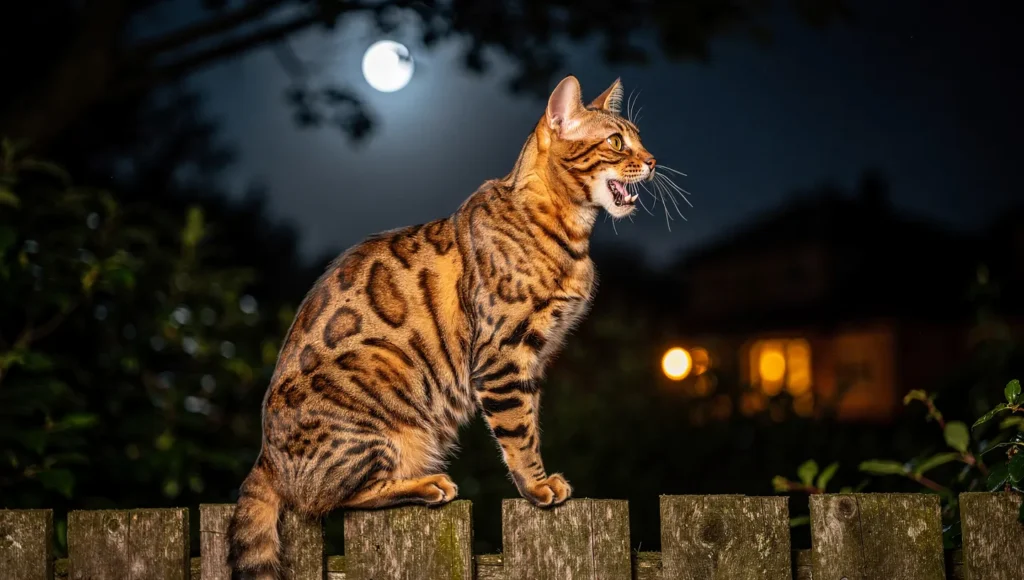
Before you do anything else — before you try any fix, any routine, any strategy — you need to know which category your cat’s meowing falls into.
Because the wrong response to the wrong type of meowing can either make things worse, or worse — delay care your cat actually needs.
Dr. Sami drilled this into me on that late-night phone call — and it genuinely changed how I handle cat meowing at night from that point on.
Here’s the system:
| 🟢 Normal — Behavioral | 🟡 Monitor Closely | 🔴 Call the Vet Now |
|---|---|---|
| Meowing at feeding time | Meowing started recently with no clear trigger | Sudden loud yowling in a previously quiet cat |
| Attention-seeking after you’ve been away | Increased meowing paired with clinginess | Old cat crying at night for the first time |
| Energetic vocalizations during play | Restlessness + meowing at night | Meowing + straining in the litter box |
| Chirping at birds through the window | Meowing paired with hiding behavior | Meowing + loss of appetite |
| Mild meowing that stops when you respond | Changes in litter box habits alongside meowing | Meowing + visible confusion or disorientation |
| Meowing during heat cycle (unfixed cat) | Increased thirst + nighttime vocalization | Meowing + any signs of physical pain |
Most people get this wrong — they go straight to behavioral fixes when the real issue is medical. And they go straight to the vet when the real issue is just a bored cat who needs a proper bedtime routine.
The table above is your first diagnostic step. Use it.
For a deeper read on what your cat’s body is telling you alongside the meowing, this guide on cat body language is one of the most complete breakdowns I’ve seen — it covers posture, ear position, tail signals, the whole picture.
Should I Ignore My Cat Meowing at Night?
Short answer: when it comes to cat meowing at night, sometimes yes, sometimes absolutely not — and knowing the difference is everything.
If your cat is healthy, has been fed, and is meowing purely for attention at 2 AM, then responding — even to tell them to stop — teaches them that meowing works. You become the vending machine. They keep pressing the button.
In that specific scenario, strategic ignoring is the right call.
But — and this is a big but — you should only ignore nighttime meowing once you’ve already ruled out medical causes, hunger, and anxiety. Ignoring a cat in pain because you assumed they were just being dramatic? That’s not a mistake anyone wants to make.
Honestly. This is where things change.
The question isn’t really “should I ignore it?” The question is: do I know for certain what’s causing it?
If yes — strategic ignoring, paired with the right routine below, works well. If no — start with the Red Flag table above and go from there.
How to Stop Cat Meowing at Night — Dr. Sami’s Real Action Plan
This is what actually worked for Kovu. Not Dave’s spray bottle method. Not the singing experiment. This.
Step 1 — Rule Out Medical Causes First
If the meowing is new, sudden, or has changed in intensity — vet visit before anything else. Non-negotiable.
Behavioral fixes don’t work on medical problems. And some medical problems (UTIs in male cats, for example) can become emergencies fast.
Once you’ve confirmed your cat is healthy, move to step two.
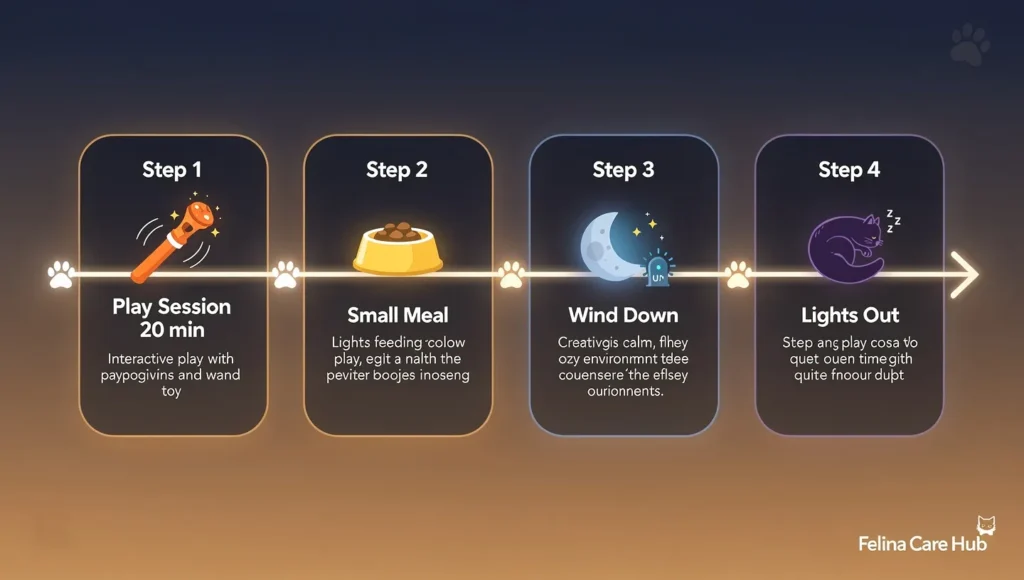
Step 2 — The Pre-Bedtime Play & Hunt Routine
This is the single most effective thing I’ve implemented with Kovu.
About 30 minutes before bed, I do what Dr. Sami calls the “hunt, catch, eat, sleep” sequence — mimicking the natural predatory cycle cats are wired for.
Play session (15–20 min): Active, wand-toy style play that gets him genuinely
tired. Not lazy laser dot circles — real, engaged hunting simulation. Then a small meal immediately after. Then lights down.
The difference was noticeable within three days.
If you’re not sure which toys actually trigger proper hunting behavior, we’ve broken it all down in the interactive cat toys guide — some toys are genuinely much better at this than others.
Step 3 — Adjust the Feeding Schedule
Move the last meal as close to your bedtime as possible.
A cat with a full stomach is a sleepy cat. This is not science fiction. It’s just cat physics.
If you free-feed (food always available), this step doesn’t apply the same way — but consider switching to scheduled meals if nighttime meowing is a consistent problem. The scheduled feeding method also helps with weight management, which is a whole other conversation.
Step 4 — Environmental Enrichment (The Boring Fix That Actually Works)
A mentally stimulated cat during the day = a quieter cat at night.
Puzzle feeders. Window perches with a view. Rotating toys. Even just leaving a paper bag out. Sounds ridiculous. Works remarkably well.
Kovu has a window perch now where he spends about two hours every afternoon watching birds like it’s his personal Netflix. He goes to bed tired. Coincidence? Probably not.
Step 5 — The “Ignore Correctly” Method
If you’ve done steps 1–4 and your cat still meows at night for pure attention — this is the step that seals it.
Complete, consistent non-response. No eye contact. No “ssshh.” No getting up. No angry muttering (I know. It’s hard.).
The key word is consistent. One response in five nights resets the whole thing. Your cat is running a very patient conditioning experiment on you, and they have infinite time and zero work meetings to worry about.
Stay strong.
When Your Cat’s Midnight Cries Are a Real Emergency
There are situations where no amount of routine adjustment is going to help — because the problem isn’t behavioral at all.
Call your vet immediately if your cat:
- Starts yowling loudly and this is completely new behavior
- Is over 10 years old and suddenly crying at night
- Shows any signs of disorientation, getting “stuck” in corners, or seeming confused about familiar spaces
- Is meowing AND not using the litter box normally
- Seems unable to get comfortable, keeps shifting positions, or flinches when touched
- Has stopped eating alongside the nighttime vocalization
Some of these — particularly the senior cat disorientation and litter box changes — can escalate quickly. According to the ASPCA, behavioral changes in cats, especially sudden ones, should always be evaluated by a professional rather than managed at home without a diagnosis.
Also worth reading: if your cat has started hiding alongside the crying, this guide on why cats hide covers what that combination of signals usually means — and when it’s serious.
And if you’re hearing unusual sounds you can’t quite classify as regular meowing — chirping, trilling, yowling — this breakdown of cat chirping and what it means adds useful context on feline vocalizations overall.
FAQ — Real Questions From Real Sleep-Deprived Owners
Why does my cat only meow at night and not during the day?
Because during the day, the house is full of stimulation — movement, noise, activity. At night, when everything goes quiet, your cat’s nervous system kicks into gear. They’re also more likely to feel hunger, boredom, or anxiety when there’s nothing else going on. Cat meowing at night that doesn’t happen during the day is almost always behavioral — unless your cat is also showing other symptoms.
Why is my old cat suddenly crying at night?
This one needs a vet visit. Sudden nighttime crying in senior cats is one of the classic signs of cognitive dysfunction syndrome, hyperthyroidism, or hypertension — all of which are manageable if caught early. Don’t assume it’s just aging.
It might be. But it might also be something treatable.
Should I let my cat sleep in my bedroom to stop the meowing?
It depends. If your cat is meowing because they want access to you and you decide to allow bedroom access — that can work. But it can also train them to escalate if they ever wake up and you’re not responsive enough. Some cats sleep beautifully in the bedroom. Some turn the bedroom into a second concert venue.You know your cat.
How long does it take to stop nighttime meowing with the routine?
Most behavioral meowing responds within 1–2 weeks of consistent routine implementation.
The key word, again, is consistent. Three good nights followed by one night of giving in and two good nights doesn’t count. The routine has to hold.
My cat meows at exactly 3 AM every single night. Is that normal?
Weirdly, yes — cats have remarkably accurate internal clocks. If 3 AM was ever associated with feeding, attention, or any positive outcome, their body will lock nto that time like an alarm. The fix is breaking that association through the pre-bedtime routine and strict non-response at the expected meowing time.
The Night Kovu Finally Let Me Sleep
It took about ten days.
Ten days of the pre-bedtime play session. Ten days of moving his last meal later. Ten days of lying in the dark at 2 AM with a pillow over my face, refusing to react, while Kovu — the undisputed champion of cat meowing at night — sat directly outside my door and questioned every choice I’d ever made.
And then one night — nothing.
I woke up at 7 AM confused. Checked my phone. Checked the room.
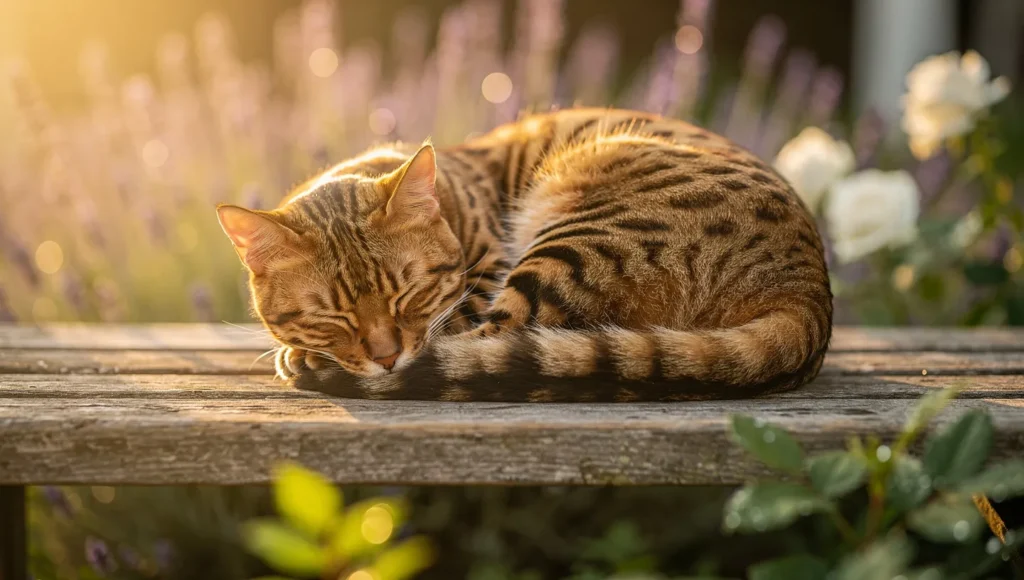
Found Kovu asleep at the foot of my bed, completely unbothered, like none of the previous three weeks had happened.
I cried a little. I’m not ashamed.
Now he does this thing where he climbs up and sleeps right next to my head.
Which — honestly — is its own whole situation, and if you’ve ever wondered why cats do that, we actually wrote a full piece on why cats sleep next to your head that explains the whole thing.
Special thanks to Lina, who accurately diagnosed my raccoon eyes and provided zero useful solutions but excellent moral support.
To Marcus — you were right about the crepuscular thing. I’m still not reading the literature, but I respect the knowledge.
And to Dave: buddy, I say this with love — please never give cat advice again. The singing experiment set us back at least a week.
Dr. Sami — you picked up the phone at 11 PM, you didn’t judge me, and you explained everything without making me feel like an idiot. That call is literally why this article exists.
You are the unsung hero of Kovu’s sleep reform and my continued employment.
Now it’s your turn.
Drop a comment below — what time does your cat’s nightly concert start?
And what’s the most absurd thing you’ve tried to stop it?
(I need to know if anyone has actually matched their cat’s energy and survived.)
Share this with every cat owner you know who’s running on four cups of coffee and zero REM sleep. They need this more than they know. — Luca