
You’re petting your cat, and you notice it — that loose, swinging flap of skin
along their belly. Your first thought? Is my cat overweight… or is something wrong?
The cat primordial pouch is one of the most misunderstood parts of a cat’s
anatomy. Every week, I hear from owners convinced their perfectly healthy cat
has a weight problem — simply because of that jiggly belly flap. The truth?
In the vast majority of cases, it’s completely normal. It’s not fat. It’s not
a medical issue. It’s evolution doing its job.
In this guide, we’ll break down exactly what the primordial pouch is, why your
cat has one, how to tell the difference between a natural pouch and actual
obesity, and the specific signs that do warrant a call to your vet.

Table of Contents
- 🐱 What Is a Cat Primordial Pouch?
- 🦁 Why Do Cats Have a Primordial Pouch?
- 🛡️ Protection During Fights
- ⚡ Extra Flexibility for Running & Jumping
- 🍖 Room for a Big Meal
- ⚖️ Is a Cat Primordial Pouch Fat or Obesity?
- 🐾 Do All Cats Have a Primordial Pouch?
- 📅 When Do Cats Develop a Primordial Pouch?
- 🔍 Why Is My Cat’s Primordial Pouch So Big?
- ⚠️ When Should You Actually Worry?
- Can You Touch a Cat’s Primordial Pouch?
- ✅ The Bottom Line: That Belly Flap Is (Usually) a Good Thing
- ❓ Frequently Asked Questions
- Does a primordial pouch mean my cat is overweight?
- Can kittens have a primordial pouch?
- Do indoor cats have primordial pouches?
- Does neutering cause a primordial pouch?
🐱 What Is a Cat Primordial Pouch?
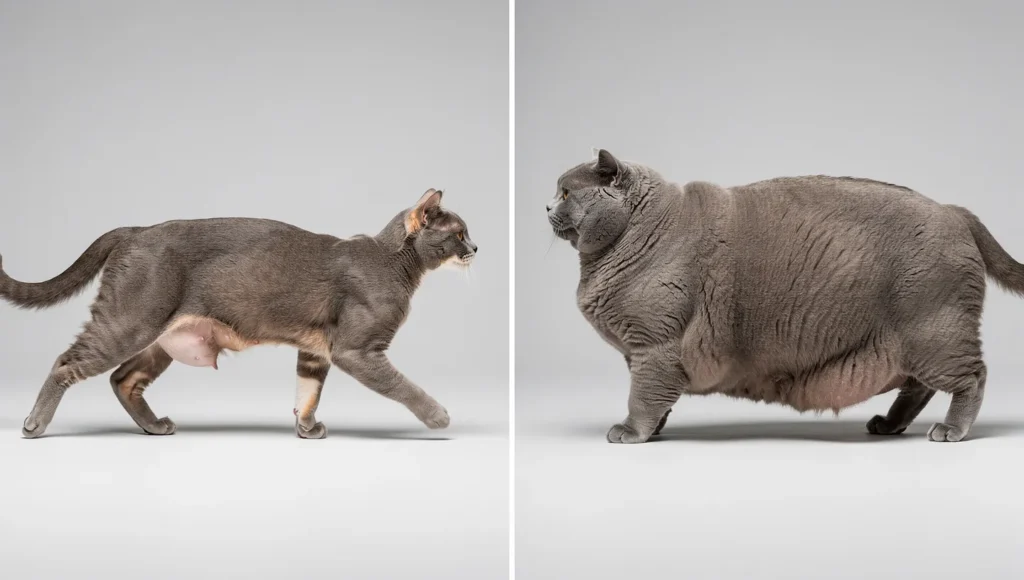
The cat primordial pouch is a loose flap of skin, fat, and tissue that
runs along the length of a cat’s belly — most visible toward the hind legs.
It hangs low. It swings side to side when your cat walks. And it’s completely
separate from weight gain.
Think of it like a built-in storage pocket — loose, soft, and floppy by
design. Unlike fat deposits, which feel firm and are distributed across the
body, the primordial pouch feels saggy and moves freely when you gently shake
it.
In my experience, the cats with the most noticeable pouches are often some of
the leanest, most athletic animals I’ve worked with. Size of the pouch has
very little to do with how much your cat weighs.
You’ll also hear it called:
- Belly flap
- Apron
- Abdominal fold
All the same thing. All perfectly normal.
🦁 Why Do Cats Have a Primordial Pouch?
This is where it gets fascinating. The primordial pouch isn’t a design flaw —
it’s a feature. One that’s been preserved through millions of years of feline
evolution.
🛡️ Protection During Fights
Cats are both predator and prey. When two cats fight, they instinctively kick
at each other’s bellies with their powerful hind legs — going for the most
vulnerable organs.
The primordial pouch acts as a natural shield. That extra layer of loose skin
and tissue provides a buffer around the intestines and vital abdominal organs.
It’s essentially built-in body armor.
⚡ Extra Flexibility for Running & Jumping
Watch a cat sprint at full speed. Their spine extends dramatically with every
stride — and so does their belly.
The primordial pouch allows for that full-body extension without restriction.
It gives the skin the slack it needs to stretch without pulling or tearing.
This is why cats can leap up to 5–6 times their body length with such
remarkable fluidity.
🍖 Room for a Big Meal
Wild cats don’t eat three scheduled meals a day. They hunt, and when they
catch prey, they eat as much as possible — because the next meal isn’t
guaranteed.
The primordial pouch accommodates that kind of feast. It expands to allow a
large meal to pass through comfortably, without putting pressure on the
abdomen.
Domestic cats retained this trait even though their feeding schedules are
considerably more reliable than their wild ancestors’.
⚖️ Is a Cat Primordial Pouch Fat or Obesity?
This is the question I get asked most often — and honestly, it’s the most
important one to answer correctly.
One mistake I often see is owners putting their cats on restrictive diets
because of a visible belly pouch — when the cat is actually at a perfectly
healthy weight. That’s not just unnecessary. It can be genuinely harmful.
Here’s how to tell the difference:
| Feature | Primordial Pouch | Fat / Obesity |
|---|---|---|
| Texture | Soft, loose, jiggly | Firm, dense |
| Movement | Swings when walking | Doesn’t swing freely |
| Location | Along lower belly | Distributed across body |
| Waistline | Still visible from above | Waistline disappears |
| Ribs | Easily felt | Hard to feel through fat |
| Overall shape | Lean body, soft belly | Rounded all over |
Two quick home checks:
- The Rib Check — Run your fingers gently along your cat’s ribcage. You
should be able to feel individual ribs without pressing hard. If you can’t,
weight may be a concern. - The Waistline Check — Look at your cat from directly above. Behind the
ribs, there should be a visible narrowing before the hips. If the body
looks like a rectangle, talk to your vet.
If after these checks you’re still concerned about your cat’s weight, our
guide on Cat Weight Loss
walks you through a stress-free, vet-backed approach to helping your cat reach
a healthy weight.
🐾 Do All Cats Have a Primordial Pouch?
Yes — technically, all cats have a primordial pouch. But how visible it is
varies significantly from cat to cat.
A few factors affect how noticeable it appears:
- Genetics — Some cats are simply born with a more pronounced pouch
- Sex — Both males and females have one; visibility varies individually,
not consistently by sex - Breed — Larger breeds tend to have more visible pouches. If you share
your home with a
Maine Coon, don’t
be surprised if that belly flap is dramatically obvious — it’s completely
normal for the breed - Age — Pouches often become more visible as cats get older
- Body condition — Interestingly, cats that have lost weight may have a
more visible pouch, because the skin doesn’t fully retract
Expert Tip: If your cat has always had a noticeable pouch and nothing
else has changed — eating habits, energy level, behavior — there’s almost
certainly nothing to worry about.
📅 When Do Cats Develop a Primordial Pouch?
Most cats begin showing a visible primordial pouch somewhere between 6 months and 2 years of age — though for many cats, it becomes more noticeable later
in life.
A few common timing patterns I’ve observed:
- After spaying or neutering — This is probably the most common moment
owners first notice the pouch. The procedure itself doesn’t create the
pouch, but hormonal shifts and a slight decrease in activity can make it
more visible. Many owners mistakenly blame the surgery. - After weight loss — When a cat sheds pounds, the skin doesn’t always
snap back. The pouch can appear more pronounced, even though the cat is
actually healthier. - With age — Skin naturally loses some elasticity over time. Senior cats
often have more visible pouches than they did as kittens.
The takeaway: timing alone doesn’t tell you much. What matters is whether
anything else has changed alongside it.
🔍 Why Is My Cat’s Primordial Pouch So Big?
If your cat’s belly flap seems particularly large, there are a few completely
normal explanations:
- Genetics — Some cats are simply built with a more generous pouch. It
runs in families, just like coat length or eye color. - Previous weight fluctuation — A cat that was overweight and then lost
weight may carry more visible loose skin than a cat that was always lean. - Breed characteristics — Certain breeds, especially larger or more
muscular ones, tend to have more prominent pouches by default. - Age-related skin laxity — Perfectly natural, perfectly harmless.
That said, there are situations where a suddenly enlarged or changed belly
warrants attention — and we’ll cover those next.

⚠️ When Should You Actually Worry?
The primordial pouch is almost always benign. But your instincts as an owner
matter — and there are specific changes that deserve a vet visit.
Watch for these warning signs:
- Sudden enlargement — If the pouch noticeably grows over days (not
months), that’s not normal pouch behavior - Firmness or hardness — A healthy pouch is soft and loose. If it feels
hard, dense, or lumpy, get it checked - Pain or sensitivity — If your cat flinches, vocalizes, or tries to
escape when you touch their belly, that’s a red flag - Visible swelling or asymmetry — One side larger than the other, or a
visibly distended abdomen, needs professional evaluation - Changes in eating, energy, or litter box habits — These alongside a
changed belly are a combination worth taking seriously
A saggy belly that has always been there and hasn’t changed? Almost certainly
just your cat’s anatomy doing its job.
For a broader look at what symptoms to watch for at home, our guide on
How to Tell if Your Cat Is Sick
covers 10 critical signs every owner should know.
Can You Touch a Cat’s Primordial Pouch?
Technically, yes. But whether your cat wants you to is a different question
entirely.
Many cats are protective of their belly — pouch or not. The abdomen houses
vital organs, and even the most affectionate cat may swat or bite when touched
there. This isn’t aggression. It’s instinct.
In my experience, cats that tolerate belly touching are usually ones who were
handled gently and frequently from kittenhood. It’s a trust thing, not a
training issue.
Before reaching for that belly flap, read your cat’s signals:
- Relaxed body, slow blinking, soft tail → probably okay to try
- Twitching tail, flattened ears, tense muscles → leave it alone
For a deeper look at reading those signals accurately, our guides on
Cat Body Language
and Why Does My Cat Bite Me
will give you a much clearer picture of what your cat is actually communicating.
✅ The Bottom Line: That Belly Flap Is (Usually) a Good Thing
The cat primordial pouch is one of nature’s more elegant designs — a
multi-purpose feature that protects, flexes, and adapts. It’s been part of
feline anatomy for millions of years, and it’s not going anywhere.
If your cat has a soft, swinging belly flap that’s always been there, you can
breathe easy. That’s not a weight problem. That’s just your cat being a cat.
What deserves your attention is change — sudden hardness, new sensitivity,
rapid enlargement, or any behavioral shifts alongside it. Those are the
moments to pick up the phone and call your vet.
Otherwise? That wobbly belly is just proof that your cat is built exactly the
way nature intended.
❓ Frequently Asked Questions
Does a primordial pouch mean my cat is overweight?
No. The primordial pouch is a natural anatomical feature present in cats of
all sizes and weights. Use the rib check and waistline check described above
to assess your cat’s actual body condition.
Can kittens have a primordial pouch?
Yes, though it’s rarely visible in very young kittens. Most cats begin
showing a noticeable pouch between 6 months and 2 years of age.
Do indoor cats have primordial pouches?
Absolutely. The primordial pouch is genetic, not lifestyle-dependent. Indoor
cats have it just as consistently as outdoor cats.
Does neutering cause a primordial pouch?
Neutering doesn’t create the pouch, but the hormonal and activity changes
that follow the procedure can make an existing pouch more visible. If your
cat’s pouch appeared post-surgery, the timing is coincidental — the
anatomy was always there.
According to research published by the American Association of Feline Practitioners (AAFP), routine monitoring of body condition score — rather than visual belly assessment — is the most reliable way to evaluate feline weight at home.
Additional anatomical context is supported by findings from
Cornell University College of Veterinary Medicine, which notes that loose abdominal skin in domestic cats is a retained evolutionary trait consistent across all domestic cat populations.