
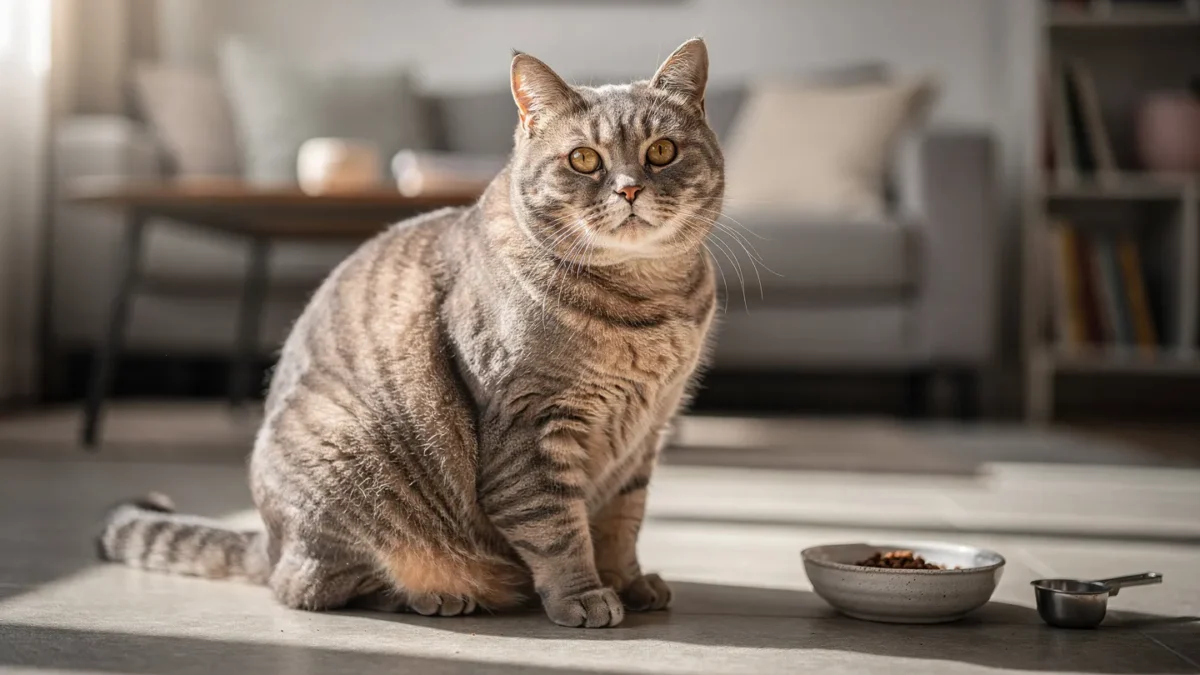
A few weeks ago, a coworker cornered me for what was supposed to be a five-minute cat chat — cat people, you know how that goes. She sighed about her cat: “She’s getting a little… too well-fed.” We laughed, then she asked the real question: “How do I help her lose weight without making her miserable?”
That question stuck with me. So I dug in — vet guidance, real feeding strategies, what actually works versus what just sounds good on paper.
If your cat’s started looking more like a fuzzy ottoman than an athlete, you’re not alone. If you’re looking for practical cat weight loss advice, you’re in the right place. This guide walks through exactly how to help her lose weight safely: body condition, food, portions, activity, and tracking progress, without turning it into a stressful guessing game.
This article is based on personal experience with cats and research into trusted veterinary sources. It’s for informational purposes only and isn’t a substitute for an actual vet visit — especially since a real weight-loss plan should be tailored to your own cat’s health.
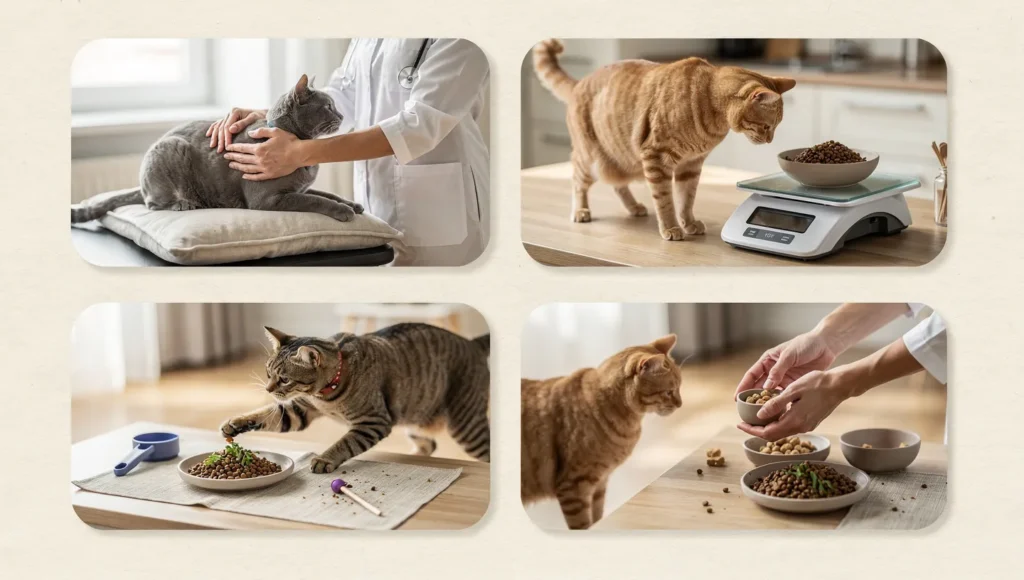
Table of Contents
- Is Your Cat Actually Overweight?
- Why Your Cat’s Weight on the Scale Isn’t the Whole Story
- How to Check Your Cat’s Body Condition at Home
- What a Healthy Cat’s Body Shape Should Look Like
- Before Starting a Cat Weight-Loss Plan
- Why You Shouldn’t Suddenly Cut Your Cat’s Food
- When Your Veterinarian Should Set the Plan
- What Your Vet Should Help You Determine
- How Much Should Your Cat Weigh?
- Why There Isn’t One Ideal Weight for Every Cat
- Current Weight vs. Target Weight
- Why Target Weight Matters More Than Simply Losing Pounds
- How Many Calories Does Your Cat Need for Weight Loss?
- How to Measure Your Cat’s Food Correctly
- What Should You Feed a Cat for Weight Loss?
- How to Feed Your Cat Without Leaving Them Hungry
- How to Help an Indoor Cat Lose Weight Through Activity
- How Fast Should a Cat Lose Weight?
- How to Track Your Cat’s Weight-Loss Progress
- Why Your Cat Isn’t Losing Weight
- Weight Loss in a Multi-Cat Household
- Common Cat Weight-Loss Mistakes
- What If Your Cat Stops Eating During a Weight-Loss Plan?
- A Simple Cat Weight-Loss Plan You Can Follow
- Some questions about weight loss in cats
- How do I get my indoor cat to lose weight?
- What is the best food for a cat trying to lose weight?
- Is wet food better for cat weight loss?
- Can cats lose weight without special diet food?
- How many calories should a cat eat to lose weight?
- How fast should a cat lose weight?
- Why is my cat not losing weight?
- How can I help my cat lose weight without making them hungry?
- How do I help one overweight cat in a multi-cat household?
- One Last Thing Before You Go
Is Your Cat Actually Overweight?
Here’s the short answer: the number on the scale doesn’t tell you much on its own. What actually matters is your cat’s body condition — how she looks and feels, not just what she weighs.
Why Your Cat’s Weight on the Scale Isn’t the Whole Story
A 10-pound cat could be perfectly lean if she’s a big-boned Maine Coon, or seriously overweight if she’s a petite domestic shorthair. Weight alone doesn’t account for frame size, muscle, or breed. Honestly, this is the mistake I made early on with Kovu — I kept comparing his weight to some random number I found online instead of actually looking at him.
That’s why vets rely on something called Body Condition Score (BCS) instead of just a weight chart. It’s basically a hands-on way to judge your cat’s shape, and you can do a rough version of it yourself at home.
How to Check Your Cat’s Body Condition at Home
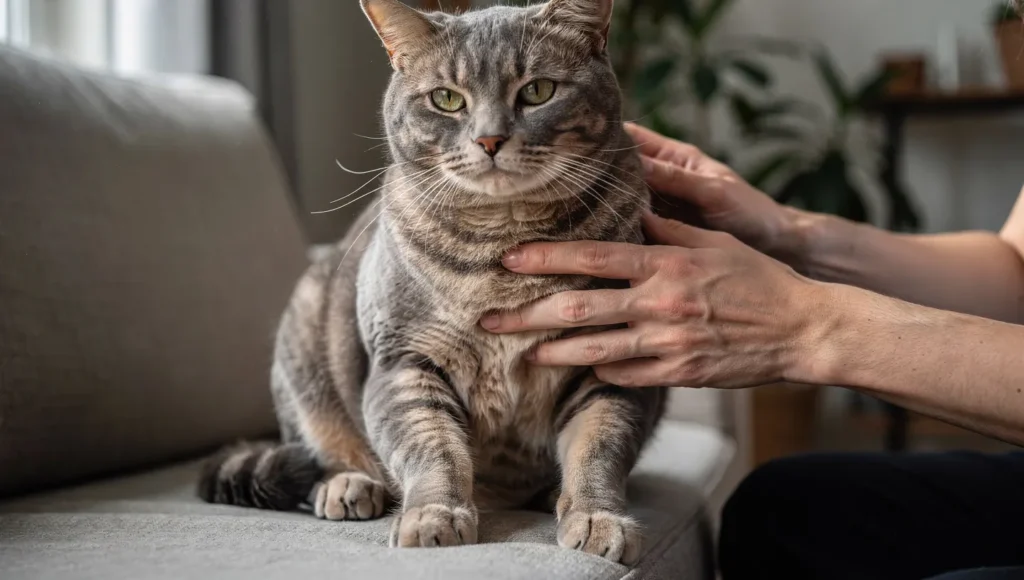
Three quick checks give you a pretty good picture:
- Rib check — Run your hands gently along your cat’s sides. You should be able to feel the ribs with light pressure, similar to feeling the back of your hand. If you have to press hard to find them, that’s a sign of extra padding.
- Waist check — Look down at your cat from above. A healthy cat usually has a visible waist behind the ribs, a slight inward curve. If she looks more like a straight line or an oval, that’s worth paying attention to.
- Belly profile — From the side, there should be a slight upward tuck from the chest to the abdomen, not a belly that hangs low or sways when she walks.
Most people get this wrong: they focus only on the belly. Here’s the thing — that’s actually the least reliable of the three checks, and there’s a good reason why.
What a Healthy Cat’s Body Shape Should Look Like
A healthy cat has visible waist definition, ribs you can feel without digging, and a belly that’s fairly flat or just slightly rounded. She should move easily, without that side-to-side waddle you sometimes see in cats carrying extra weight.
And this is important — that little pouch of skin hanging under a cat’s belly? That’s usually the primordial pouch, and it’s completely normal. Almost every cat has one, lean or not. It’s not automatically a sign of obesity, and squeezing that pouch alone won’t tell you anything useful. If you want the full picture on this, we actually cover it in more depth in our guide to the primordial pouch.
If after these checks you’re still not sure, that’s completely fine — this is exactly the kind of thing your vet can confirm in about thirty seconds during a regular visit.
Before Starting a Cat Weight-Loss Plan
Before you change a single thing about what your cat eats, there’s one step that matters more than any diet or feeding schedule: talking to your vet first.
Why You Shouldn’t Suddenly Cut Your Cat’s Food
I get the instinct — your cat’s overweight, so you just… feed less, right? Please don’t do this. Cutting a cat’s food too fast or too drastically can actually be dangerous, not just uncomfortable. Cats that stop eating or have their calories slashed too quickly are at risk of a serious liver condition called hepatic lipidosis, where the body starts breaking down fat faster than the liver can safely process it.
This isn’t meant to scare you — it’s meant to explain why “just feed less” is genuinely bad advice, no matter how well-intentioned.
When Your Veterinarian Should Set the Plan
Personally, I wouldn’t recommend starting a weight-loss plan entirely on your own if your cat has any of the following:
- Diabetes
- Arthritis or joint pain
- Reduced mobility
- Kidney issues
- Any ongoing medication
- A history of not eating for more than a day or two
If none of that applies and your cat is otherwise healthy, you can still start with the basics in this guide — but a quick vet visit before you begin is still worth it. It costs you one appointment, and it can save you weeks of guessing.
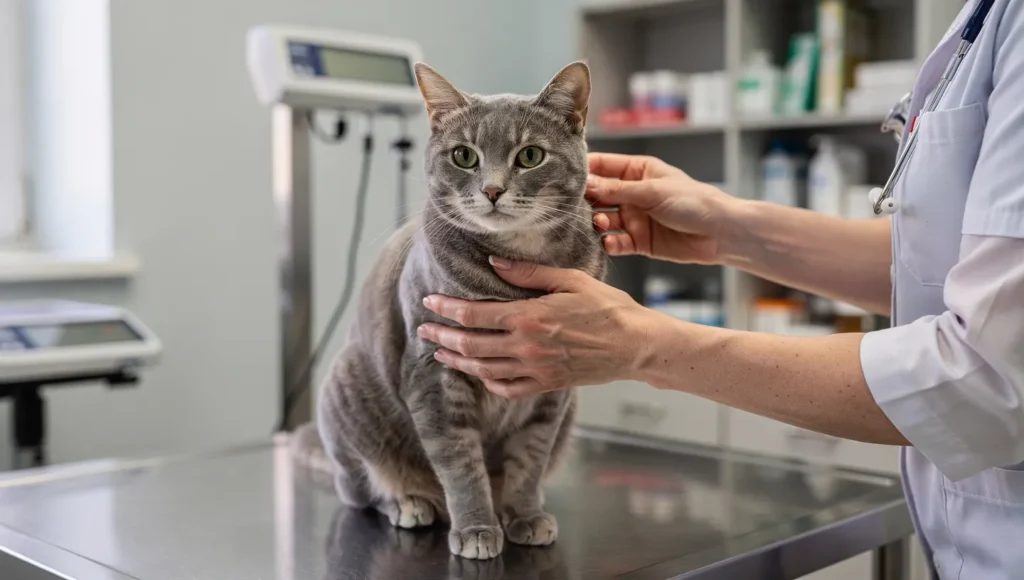
What Your Vet Should Help You Determine
A good starting vet visit usually covers:
| What the vet checks | Why it matters |
|---|---|
| Current weight and body condition | Sets your real starting point |
| Muscle condition | Confirms your cat isn’t just losing muscle |
| Target weight | Gives you a realistic, individual goal |
| Daily calorie goal | Prevents guessing or copying another cat’s plan |
| Feeding plan | Fits the calorie goal into your cat’s actual routine |
| Follow-up schedule | Lets you catch problems early instead of months later |
This is where things change from “hoping it works” to actually having a plan. And this is important — the goal isn’t just a smaller number on the scale. It’s a healthier cat who keeps her muscle while losing the extra fat.
How Much Should Your Cat Weigh?
There’s no single “correct” weight that applies to every cat — and honestly, that’s one of the most common things owners get wrong.
Why There Isn’t One Ideal Weight for Every Cat
I see this question a lot: “My cat is 12 pounds, is that too much?” And the truthful answer is: it depends entirely on the cat. A Maine Coon or a Ragdoll can weigh 15+ pounds and still be perfectly lean, while a small domestic shorthair carrying 12 pounds might already be overweight. Frame size, breed, age, and muscle mass all play into it.
This is exactly why the Body Condition Score from the previous section matters more than any chart with a single “ideal weight” number on it.
Current Weight vs. Target Weight
Your cat’s current weight is just a starting point — a number to track progress against, not a judgment. Her target weight is different: it’s an estimate, usually made by your vet, of what a healthy, lean version of your specific cat would weigh.
Here’s the thing — that target isn’t set in stone. It can shift slightly as your cat loses weight and your vet gets a better read on her frame and muscle condition.
Why Target Weight Matters More Than Simply Losing Pounds
This is where I’d push back on the way most people think about cat weight loss. The goal isn’t “make the number on the scale go down.” The goal is a cat with good body condition who keeps her muscle while losing extra fat.
A cat that loses weight too fast, or loses mostly muscle instead of fat, isn’t actually getting healthier — she just looks smaller. That’s an important distinction, and it’s part of why working from a real target weight (not just “less than now”) makes such a difference.
How Many Calories Does Your Cat Need for Weight Loss?
Short answer: there’s no universal number — it depends on her target weight, current activity, and metabolism. Your vet calculates a starting calorie target based on her ideal weight, not her current one. That’s why copying a friend’s cat’s calorie count almost never works.
- Two cats at the same weight can need very different calorie targets
- Spayed/neutered cats generally need fewer calories than intact cats
- The target gets adjusted every few weeks based on actual progress, not guesswork
How to Measure Your Cat’s Food Correctly
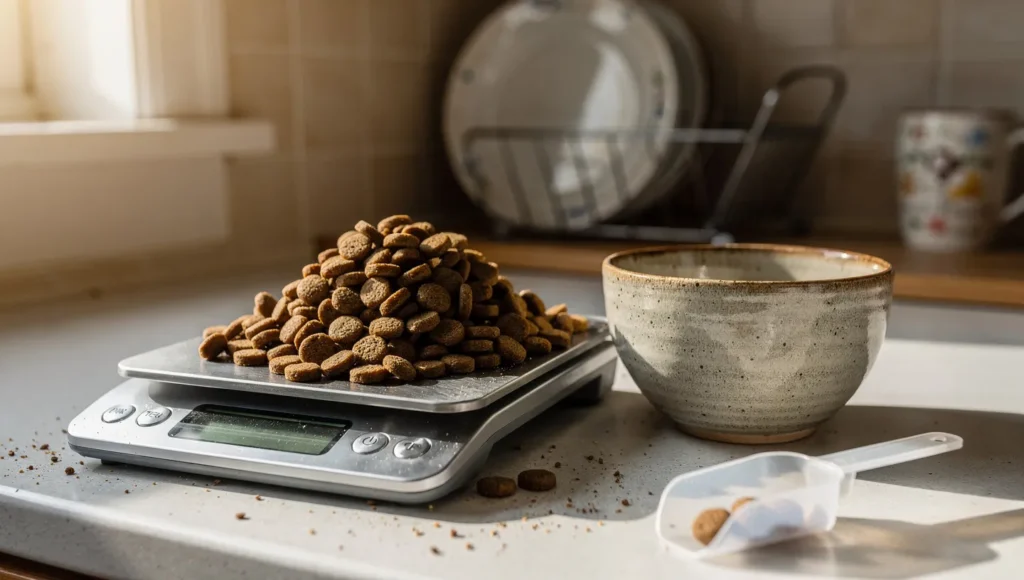
Eyeballing it doesn’t work — studies on pet obesity consistently point to inaccurate portioning as one of the biggest drivers of feline weight gain. A kitchen scale beats a measuring cup every time, since dry food density varies by brand.
| What to Track | Why It Matters |
|---|---|
| Daily food (grams) | Controls actual calorie intake |
| Treats | Prevents hidden, uncounted calories |
| Body weight | Shows the real trend over time |
| Body condition | Confirms fat loss, not muscle loss |
| Activity level | Supports the calorie plan |
Don’t forget: treats count. A single cat treat can be 5–10% of her daily calorie budget — small, but it adds up fast over a month.
What Should You Feed a Cat for Weight Loss?
Not every overweight cat needs a “prescription” diet. What actually helps:
- High-protein food — preserves muscle while she loses fat
- Higher-fiber options — improve satiety so she feels fuller on fewer calories
- Wet vs. dry — wet food’s higher water content means more volume for fewer calories, while dry food is easier to measure precisely (see our full Wet vs Dry Cat Food guide)
- Regular food can work fine too, as long as portions and calories are controlled
If your cat’s picky, ease into any new food gradually — our guide to switching cat food safely walks through a 7-day transition plan.
How to Feed Your Cat Without Leaving Them Hungry
This is the part owners worry about most. A few things that actually help:
- Split daily food into 3–4 smaller measured meals instead of one or two big ones
- Skip free-feeding — it makes portion control nearly impossible
- Handle treats as part of the calorie count, not extra
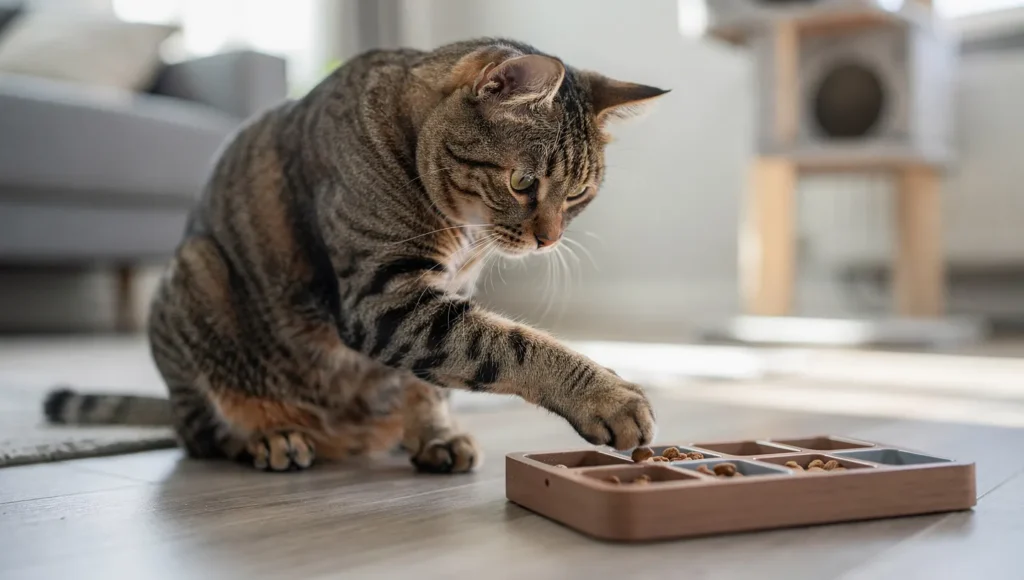
- Use puzzle feeders to slow eating and add mental stimulation
Here’s the thing: a cat on a well-measured plan isn’t starving. She’s just eating on a schedule that matches her actual needs.
How to Help an Indoor Cat Lose Weight Through Activity
Exercise alone won’t fix an overweight cat, but it makes a real difference alongside food control.
- Short, 5–10 minute play sessions, 2–3 times a day beat one long forced session
- Wand toys tap into natural hunting instincts better than anything else
- Cat trees and shelves encourage vertical movement
- Food puzzles turn mealtime into activity
- Increase activity gradually — don’t go from zero to marathon overnight
How Fast Should a Cat Lose Weight?
Slow and steady, always. Rapid weight loss in cats isn’t just ineffective — it’s genuinely risky.
- If she’s losing weight too fast, that’s a reason to call your vet, not celebrate
- If she isn’t losing weight at all after a few weeks, the plan needs reassessing, not more restriction
- Consistency matters more than speed here
How to Track Your Cat’s Weight-Loss Progress
- Weigh weekly, same time of day, for consistency
- Track: weight, body condition, appetite, and activity — not just the scale
- One weigh-in means nothing; the trend over 3–4 weeks is what tells the real story
- Adjust the plan only after a few weeks of data, never after a single bad day
Why Your Cat Isn’t Losing Weight
Most of the time, it’s not about the cat — it’s about the plan:
- Portions are being measured incorrectly (or “eyeballed”)
- Treats are adding up more than you realize
- Someone else in the house is sneaking her food
- She’s grazing on more than you think
- The calorie target itself needs reassessing
Weight Loss in a Multi-Cat Household
This one trips up a lot of owners, myself included. If only one cat needs to lose weight:
- Feed cats in separate rooms or on a schedule, not free-feeding together
- Use microchip or timed feeders to stop cats from eating each other’s food
- Pick up bowls after meals instead of leaving food out all day
Common Cat Weight-Loss Mistakes
- Cutting food too quickly
- Guessing portions instead of measuring
- Ignoring treat calories
- Relying only on exercise, without adjusting food
- Switching food too suddenly
- Copying another cat’s diet plan
- Watching only the scale, ignoring body condition
What If Your Cat Stops Eating During a Weight-Loss Plan?
Don’t mistake appetite loss for the diet “working.” A cat that skips meals for more than 24 hours needs a vet visit, not patience — this can quickly turn dangerous. If this happens, check our guide on what it means when your cat won’t eat and call your vet the same day.
A Simple Cat Weight-Loss Plan You Can Follow
- Assess body condition at home
- Get a target weight from your vet
- Set a calorie and feeding plan
- Measure every meal on a kitchen scale
- Control treats — count them in the calorie budget
- Add daily play, 2–3 short sessions
- Track progress weekly, not daily
- Reassess every few weeks instead of guessing
Some questions about weight loss in cats
How do I get my indoor cat to lose weight?
Combine measured feeding with short daily play sessions — indoor cats especially need the activity built in on purpose.
What is the best food for a cat trying to lose weight?
High-protein, controlled-calorie food works well for most cats — but the “best” one depends on her specific needs, so check with your vet.
Is wet food better for cat weight loss?
It can help, since it’s lower in calories per volume — but it’s not required. Dry food works fine if portions are measured accurately.
Can cats lose weight without special diet food?
Yes, as long as calories and portions are controlled consistently.
How many calories should a cat eat to lose weight?
It varies by cat — your vet calculates this based on target weight, not current weight.
How fast should a cat lose weight?
Gradually. Rapid weight loss is a red flag, not a win.
Why is my cat not losing weight?
Usually inaccurate portions, uncounted treats, or a calorie target that needs adjusting.
How can I help my cat lose weight without making them hungry?
Split meals into smaller portions throughout the day and use puzzle feeders to slow eating.
How do I help one overweight cat in a multi-cat household?
Separate feeding times or spaces, and pick up food bowls after meals.
One Last Thing Before You Go
A successful cat weight-loss plan isn’t about starving your cat — it’s about measuring, monitoring, and adjusting while protecting her health along the way.
And honestly? I’d love to hear how this goes for you. If you’ve been through this with your own cat, share your story in the comments — what worked, what didn’t, what surprised you. And if you know another cat owner whose cat could use a little help, go ahead and share this guide with them. We read every comment, and your experience might be exactly what someone else needs to hear today.