Traveling with a cat often feels like trying to negotiate a peace treaty with a tiny, furry dictator who is deeply suspicious of change. Most of us have been there: the heart-sinking moment you pull out the carrier and your cat disappears under the bed faster than a treat in a hungry kitten’s bowl. We dread the yowling, the frantic scratching, and that look of utter betrayal from the backseat.
But here’s the expert truth: your cat isn’t trying to be difficult. As territorial creatures, their entire sense of security is tied to their home environment. When we travel, we aren’t just moving them from point A to point B; we are temporarily removing their “safety net.”
With over a decade of experience in feline psychology, I’ve learned that the secret to a peaceful journey isn’t a better cage—it’s building a “mobile territory.” By focusing on their sensory needs and psychological comfort, we can turn a stressful ordeal into a safe, manageable adventure for both of you.
🐾 Is it Cruel to Travel with a Cat? Understanding the Feline Mindset
Many devoted owners carry a heavy burden of guilt when they see their cat panting or hiding during a trip. You might ask yourself, “Is this cruel?” The short answer is no, provided you prioritize their emotional well-being over just the logistics of the move.
Cats experience the world primarily through scent and stability. When they are thrust into a new environment, their “internal GPS” goes into overdrive, leading to the stress signals we often see in cat body language, such as dilated pupils or excessive vocalization.
Understanding this mindset is the first step toward a better journey. It’s not about forcing your cat to enjoy the car; it’s about proving to them that they are safe even when the scenery changes. According to the American Association of Feline Practitioners, feline stress can be significantly managed by maintaining a sense of “perceived control” for the cat.
💡 Expert Tip: The “Safe Haven” Concept
Stop viewing the travel carrier as a cage. To a cat, a well-prepared carrier should be a “mobile safe-house.” If the carrier smells like home and feels like a bed, the destination matters much less than the comfort of their immediate surroundings.
🛡️ Choosing the Perfect Cat Travel Carrier for Maximum Safety
Selecting the right cat travel carrier isn’t just about color or aesthetics; it’s about choosing a crash-tested fortress for your feline friend. If the carrier is flimsy, your cat will feel every bump and vibration, skyrocketing their anxiety levels before you even leave the driveway.
The “best” carrier depends entirely on your mode of transport. For air travel, under-seat dimensions are king. For road trips, structural integrity and seatbelt attachments are your top priorities.
Hard-Sided vs. Soft-Sided: Which is Safer for Your Journey?
This is the most common debate among cat parents. While soft carriers are cozy and easier to carry, hard-shelled options often provide superior protection in the event of a sudden stop.
Feature
Hard-Sided Carriers
Soft-Sided Carriers
Best For
Long road trips & Nervous cats
Airline cabin travel & Short vet visits
Durability
High (Hard plastic shell)
Moderate (Heavy-duty fabric)
Cleaning
Easy (Wipe down/hose out)
Moderate (Hand wash or machine)
Safety Rating
Excellent protection against impacts
Good, but can be crushed by heavy luggage
Ventilation
Moderate (Usually 3-side vents)
High (Multiple mesh windows)
🏆 Picking the “Best Cat Carrier” Based on Safety Ratings
When you search for the best cat carrier, look for certifications from organizations like the Center for Pet Safety (CPS). They perform rigorous crash testing to ensure that the carrier stays intact and the cat stays secure during an accident.
For air travel, a Sherpa cat carrier or similar airline-approved brands are the gold standard. They are designed to fit under the seat while providing enough mesh for your cat to see you, which significantly lowers their stress.
💡 Expert Tip: Double Entry is Key
Always look for a carrier with both a front and a top-loading door. If your cat is terrified, trying to “stuff” them through a small front door is a recipe for scratches. Dropping them gently through a top-loading hatch is much less invasive and keeps the mood calm.
Size Matters: The “Goldilocks” Rule
Your carrier should be large enough for your cat to stand up, turn around, and lie down comfortably, but not so large that they slide around during turns. A sliding cat is a panicked cat. If you are preparing for a long haul, remember that you’ll need space for a small water bowl and perhaps a familiar-smelling piece of your clothing to provide a scent-based anchor.
🌿 Essential Prep: Carrier Training and Calming Scents
Success in traveling with a cat is 90% preparation and 10% the journey itself. If the only time your cat sees the carrier is when they are going to the vet or leaving their home forever, they will associate it with fear. Our goal is to change that narrative through “Desensitization” and “Scent Therapy.”
Carrier Training for Cats: Making the “Box” a Bedroom
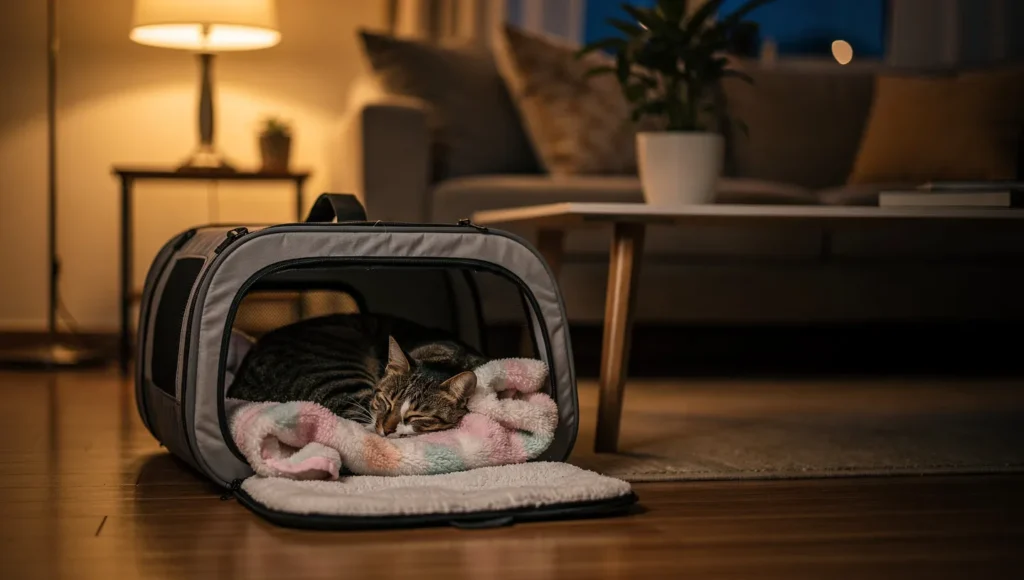
The biggest mistake owners make is hiding the carrier in the garage or a closet. To your cat, that dusty box is a “stress trigger.” Start at least two weeks before your trip. Place the carrier in a high-traffic area of your home—like the living room—and keep the door open.
Positive Reinforcement: Place their favorite homemade cat treats inside the carrier daily.
Meal Time: Move their food bowl closer to the carrier every day until they are comfortably eating inside it.
Scent Familiarity: Put a t-shirt you’ve recently worn inside. Your scent is the ultimate “safety blanket” for a nervous feline.
The Power of Calming Scents for Cats
A cat’s sense of smell is roughly 14 times stronger than a human’s. We can use this to our advantage by creating a “sensory bubble” of calm around them during travel.
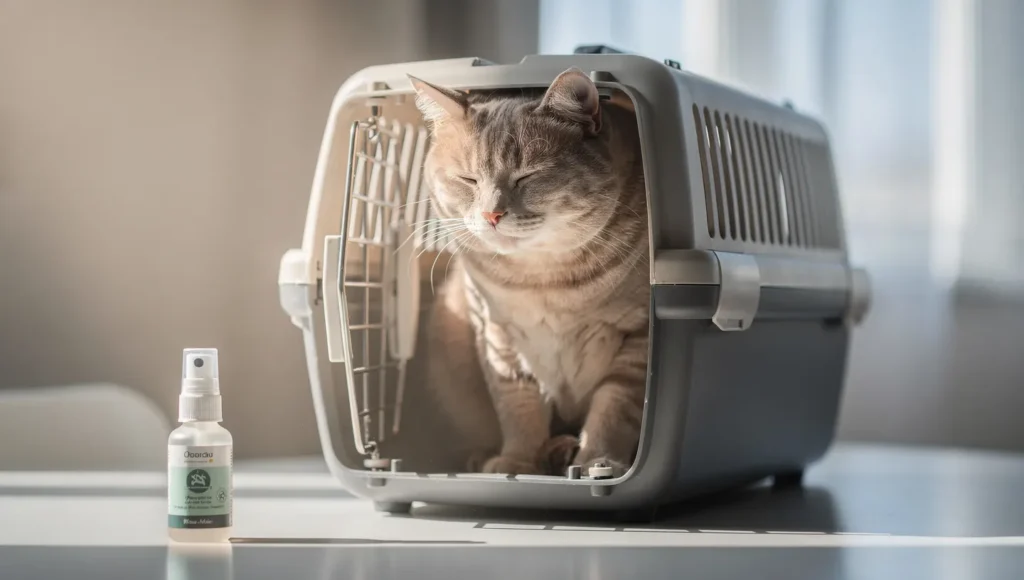
Synthetic Pheromones (The Gold Standard): Products like Feliway mimic the natural facial pheromones cats rub on furniture when they feel safe. Spray the carrier 15 minutes before putting your cat inside. This sends a chemical signal to their brain that says, “This place is secure.”
Using Essential Oils for Cat Anxiety: Proceed with Caution
While searching for natural remedies, you’ll find many mentions of essential oils for cat anxiety. However, cats’ livers cannot process certain compounds found in oils. You must be specific:
Safe Scents: Lavender and Valerian are generally considered safe for short-term travel calm when highly diluted.
The Method: Never apply oils directly to the cat. Instead, use a “passive diffuser” (like a cotton ball) placed outside the carrier mesh or a light mist on the bedding.
Warning: Avoid tea tree, peppermint, or citrus oils, as these are toxic to felines.
2 Hours Before: Spray the carrier bedding with calming pheromones.
30 Minutes Before: Use a calm, low voice. Cats mirror your energy—if you are frantic, they will be too.
🧪 Expert Tip: The “Test Drive”
Before the big trip, do a 10-minute “fake” road trip. Drive around the block, come home, and immediately give them a high-value treat. This teaches them that the car doesn’t always lead to a scary destination; sometimes, it just leads back to treats and safety.
🚗 Road Trip Mastery: Traveling with a Cat in a Car Safely
A car can be a chaotic environment for a feline. Between the hum of the engine, the changing light patterns, and the occasional honk, your cat’s senses are under a constant barrage. Mastering cat safety in cars isn’t just about putting them in a box; it’s about where that box goes and how you manage the environment inside the cabin.
The “No-Loose” Policy: Why Free Roaming is a Danger
Never, under any circumstances, allow your cat to roam free in a moving vehicle. A loose cat can easily crawl under the brake pedal, jump on the dashboard, or become a “feline projectile” in the event of a sudden stop. Even the calmest cat can panic and cause an accident.
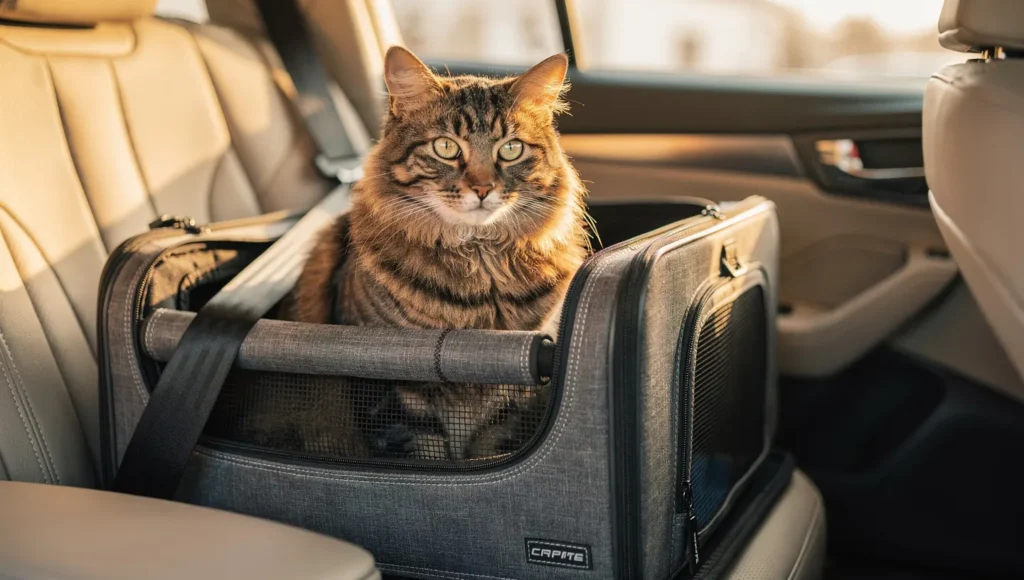
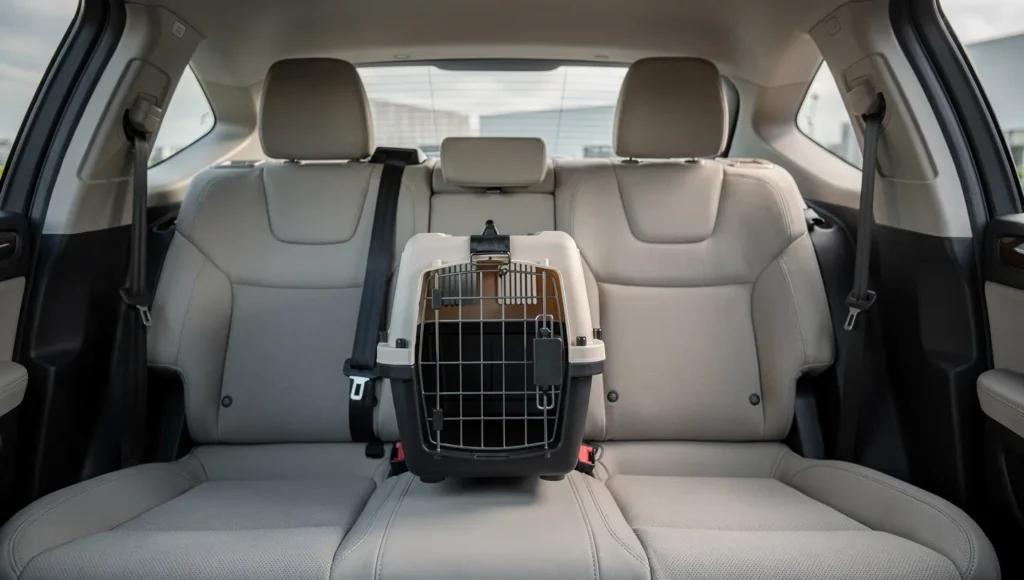
The Best Placement: Secure the carrier on the back seat using a seatbelt through the carrier’s handle or designated loops. If you have a hatchback or SUV, avoid the crumple zone at the very back. The middle of the back seat is often the safest and most stable spot.
🍱 H3: Logistics: Food, Water, and Litter Box Solutions on the Go
Managing your cat’s biological needs on a long haul requires a delicate balance. You want them hydrated, but you don’t want a “stomach upset” disaster at 70 mph.
Preventing Motion Sickness: If your cat is prone to nausea, feed them a small meal 4-6 hours before departure. Avoid feeding them in a moving car. If your cat does have an accident, it’s helpful to understand the difference between travel stress and chronic issues, as discussed in our guide on why cats throw up after eating.
Hydration is Key: Offer water every 2-3 hours during stops. Do not leave a water bowl inside the carrier while driving, as it will likely spill and leave your cat wet and shivering.
The Portable Litter Box: For trips longer than 6 hours, bring a small, disposable litter box. During a rest stop, with all car doors and windows securely closed, let your cat out of the carrier to use the box and stretch. For more on choosing the right substrate for travel, check our best cat litter guide.
💡 Expert Tip: Temperature Awareness
Cats overheat much faster than humans. Never leave your cat alone in a parked car, even for “just a minute” with the windows cracked. In 70°F weather, the inside of a car can hit 100°F in minutes. If you need a bathroom break, ensure one person stays with the cat with the A/C running.
🛡️ Creating a “Quiet Zone”
Turn down the bass on your stereo and keep the volume low. Classical music or “Cat-Specific” music (available on many streaming platforms) has been shown to lower feline heart rates during transport. Cover the carrier with a light, breathable towel if the passing cars and sunlight seem to be overstimulating your cat.
✈️ Flying with Your Feline: Airline Regulations & Health Certificates
Taking your cat to the skies adds a layer of complexity that road trips don’t have. Between TSA security lines and pressurized cabins, the environment is entirely foreign to a cat. However, with the right paperwork and a clear understanding of airline regulations, you can navigate the airport like a pro.
In-Cabin vs. Cargo: The Safety Perspective
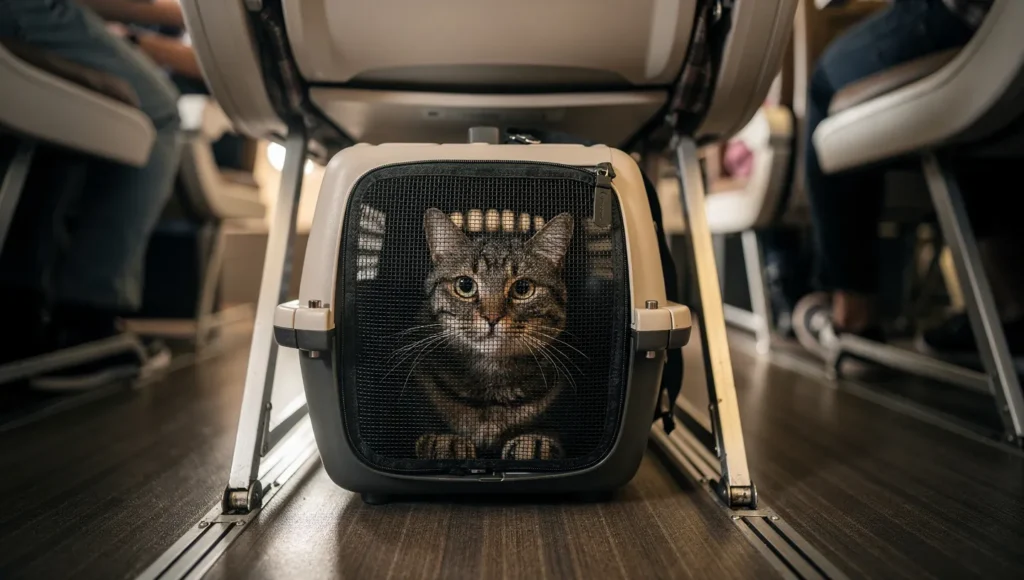
The golden rule for feline air travel is simple: Keep them in the cabin whenever possible. Most major airlines allow small cats to travel under the seat in front of you for a fee.
In-Cabin: Your cat stays within your sight, and the temperature is regulated just like yours. This is the gold standard for reducing travel-induced stress.
Cargo Hold: While modern cargo holds on reputable airlines are pressurized and temperature-controlled, the noise and isolation can be terrifying for a cat. Cargo is usually reserved for larger animals or specific international routes.
⚠️ A Note on Brachycephalic Breeds: If you own a “flat-faced” cat like a Persian or a British Shorthair, many airlines will prohibit them from flying in cargo. Their shortened nasal passages make them highly susceptible to respiratory distress in high-stress or varying pressure environments.
The Paperwork: Health Certificates and Microchips
You cannot simply show up at the gate with a cat. Most airlines and destinations require a Certificate of Veterinary Inspection (CVI), commonly known as a “Health Certificate.”
The 10-Day Rule: Most domestic airlines require this certificate to be issued by a vet within 10 days of your flight.
Vaccination Proof: Your cat must be up-to-date on their rabies vaccine. Always carry a physical copy of the rabies certificate.
Microchipping: For international travel, an ISO-compliant microchip is usually mandatory. Even for domestic flights, it’s a critical safety net in case of an accidental escape at a busy terminal.
💡 Expert Tip: Navigating TSA Security
At the security checkpoint, you will be asked to remove your cat from the carrier so the bag can be X-rayed. Do not try to carry a panicked cat in your arms. > Request a “Private Screening Room.” Most airports have them. It allows you to take your cat out in a secure, enclosed space where they can’t bolt if they get spooked by the loud noises of the terminal.
📋 Quick Summary: Airline Prep Checklist
Item
Requirement
Carrier Size
Must fit under the seat (approx. 18” x 11” x 11”)
Reservations
Call ahead! Most flights limit the number of pets in the cabin (usually 2-4 max).
🏡 Post-Travel Care: Helping Your Cat Decompress and Adjust
The journey doesn’t end when you arrive at your destination. Whether it’s a hotel room or a new home, your cat will likely feel “territorially compromised.” They’ve just spent hours in a vibrating box and are now in a place that doesn’t smell like them.
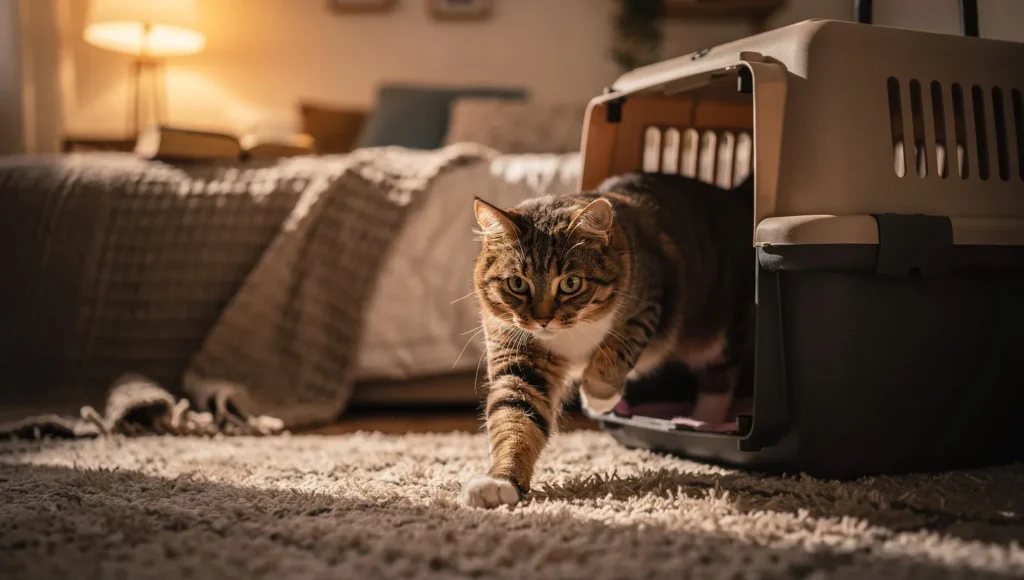
The “Safe Room” Technique: Instead of letting your cat roam the entire new space immediately, set up a small “Safe Room” (like a bathroom or a quiet bedroom). Place their carrier, food, water, and litter box there. Let them emerge from the carrier on their own terms.
Watch their cat body language closely. If they are slinking low to the ground or hiding, they aren’t ready to explore. Give them 24 to 48 hours to “scent-mark” the new room by rubbing their cheeks on corners before opening up the rest of the space.
📋 The Ultimate Cat Travel Checklist (Ready to Save)
To ensure nothing is forgotten in the pre-travel rush, here is your essential gear list:
Secure Carrier: Double-check the latches and zippers.
Health Documentation: Rabies certificate and vet-signed health travel forms.
Scent Anchors: A blanket or t-shirt that smells like home.
Calming Aids: Feliway spray or cat-safe lavender mist.
Portable Litter Solution: Small box, scoop, and bags.
Hydration Kit: Collapsible water bowl and bottled water (local water can sometimes cause upset stomachs).
First Aid Essentials: Gauze, antiseptic wipes, and your vet’s phone number.
High-Value Treats: To reward bravery along the way!
🌟 Expert Tip: The Power of Routine
Try to keep feeding and play schedules as close to “home time” as possible. If they eat at 7 AM at home, feed them at 7 AM at the hotel. Routine is the ultimate antidote to feline anxiety.
Traveling with a cat requires patience, preparation, and a lot of empathy. While it might seem daunting at first, seeing your feline companion safely settled and happy at your destination makes every bit of effort worth it. You’ve got this—and your cat is lucky to have an owner who cares enough to do it right. Safe travels!
A cat enthusiast dedicated to feline well-being. Here, I share the insights of my experience in understanding cat body language, behavior modification, and selecting the best preventative diets. My goal is to make cat ownership a joyful and seamless experience through simple, effective tips that prioritize prevention over cure.