

Let me be honest with you right from the start.
When you decided to dive into the world of Persian cat care, you probably imagined a gorgeous, calm cat sitting regally on your couch like a fluffy little aristocrat, right? Maybe you pictured yourself taking cinematic Instagram photos that would make all your friends jealous.
Well, I’m here — as your loyal, slightly traumatized friend — to tell you the soft truth: a Persian cat is not just a cat. It’s a part-time job with fur.
If you’re ready to rearrange your entire daily schedule because His Royal Fluffiness has decided his thick coat needs a professional spa session, or because those gorgeous eyes of his have started producing enough discharge to flood your carpet — you’re in the right place.
In this honest, practical (and slightly chaotic) guide, I’ll share the real secrets of Persian cat care at home. No drama. No sugarcoating. Just the stuff I wish someone had told me before I got in too deep.
⚠️ Quick heads-up: This article is based on personal experience and research
from trusted sources. It’s meant for informational purposes only and doesn’t replace professional veterinary advice. When in doubt, always check with your vet — they went to school for this so we didn’t have to.

Table of Contents
- So… Are Persian Cats Actually High Maintenance? (Honest Answer)
- The Persian Cat Daily Care Routine That Actually Works
- 🌅 Morning Routine (5–7 minutes)
- 🌙 Evening Routine (5–8 minutes)
- Persian Cat Grooming — The Part Nobody Warns You About
- How to Brush a Persian Cat Without Starting a War
- Dealing With Mats — Before They Become a Crisis
- Persian Cat Eye Cleaning: How to Prevent Tear Stains
- Bathing a Persian Cat (Yes, It’s a Thing)
- 📖 A Quick Story From the Grooming Trenches
- Feeding Your Persian Cat the Right Way
- Wet Food vs Dry Food — What Persians Actually Need
- The Flat Face Problem & Eating Bowls
- Hydration — More Critical Than You Think
- Persian Cat Health Problems You Should Know About
- Brachycephalic Syndrome — The Flat Face Reality
- Tear Stains & Eye Infections
- When to Call the Vet — Red Flags 🚨
- 5 Persian Cat Mistakes I Wish Someone Had Warned Me About
- Is a Persian Cat Right for You? (Quick Decision Guide)
- Questions I Actually Get Asked All the Time
- Are Persian cats high maintenance?
- How often should I groom my Persian cat?
- Can Persian cats live in apartments?
- What do Persian cats usually die from?
- Do Persian cats like to be held?
- Final Thoughts — From One Persian Owner to Another
So… Are Persian Cats Actually High Maintenance? (Honest Answer)
Yes, Persian cats are high maintenance — but here’s the thing: it’s not hard, it’s just different. Once you build a simple daily routine, it becomes second nature. Think of it less like “work” and more like a weird bonding ritual you’ll actually start to enjoy.
Compared to your average domestic shorthair who basically takes care of himself,
a Persian needs daily eye cleaning, regular brushing (we’re talking every single day for that coat), and a little extra attention to his breathing and diet.
Honestly? Most people who struggle with Persian cat care aren’t struggling because it’s too hard. They’re struggling because nobody gave them a proper system.
Here’s a simple comparison so you know what you’re signing up for:
| Care Area | Average Cat | Persian Cat |
|---|---|---|
| Brushing | 2–3x per week | Daily |
| Eye cleaning | Rarely needed | Every day |
| Bathing | Occasional | Every 4–6 weeks |
| Vet checkups | Once a year | Twice a year (recommended) |
| Attention needed | Moderate | High |
Most people get this wrong — they adopt a Persian thinking the grooming is optional.
It’s not. Skip it for a few days and you’ll be dealing with mats that make your cat look like she lost a fight with a velcro wall.
But here’s the flip side: Persians are incredibly calm, affectionate, and apartment-friendly. They’re not jumping off your cabinets or knocking your coffee over at 3am (usually). They just want to exist peacefully in your space — and look absolutely magnificent while doing it.
This is where things change for most new owners: the moment you accept that Persian cat care is a lifestyle, not a chore — everything gets easier.
The Persian Cat Daily Care Routine That Actually Works
Persian cats thrive on routine. Seriously — these cats are creatures of habit, and once you build a simple morning and evening system, you’ll spend maybe 10–15 minutes a day on care. That’s less time than your morning coffee ritual.
Here’s the routine that actually works (learned the hard way, of course):
🌅 Morning Routine (5–7 minutes)
| Task | Time Needed | Why It Matters |
|---|---|---|
| Eye cleaning | 1–2 min | Prevents tear stain buildup overnight |
| Quick brush check | 2–3 min | Catches tangles before they become mats |
| Fresh water check | 30 sec | Persians are notoriously bad drinkers |
| Food (wet preferred) | 1 min | Sets energy for the day |
🌙 Evening Routine (5–8 minutes)
| Task | Time Needed | Why It Matters |
|---|---|---|
| Full brush session | 3–5 min | The real grooming work happens here |
| Eye check (again) | 1 min | Discharge builds up through the day |
| Playtime / bonding | 5–10 min | Prevents boredom and anxiety |
Personally, I do the eye cleaning first thing in the morning before I even make coffee. Sounds obsessive, I know. But once you see what overnight discharge looks like on a white Persian — you’ll understand.
And this is important: don’t skip the evening brush thinking “it’s fine for one night.” Persian fur doesn’t forgive you. It forms alliances with other fur strands and creates mats while you sleep. It’s basically plotting against you.
Persian Cat Grooming — The Part Nobody Warns You About
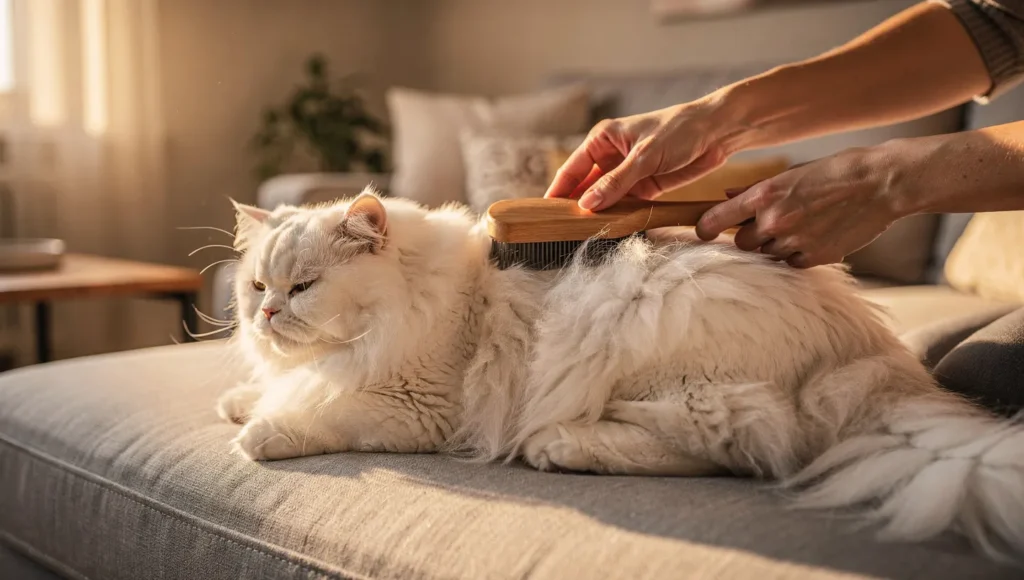
Let’s get into the real stuff. Grooming is honestly the heart of Persian cat care — it’s where most owners either build an amazing bond with their cat or slowly lose their mind. There’s really no in-between.
How to Brush a Persian Cat Without Starting a War
Persian cats need daily brushing. Not weekly. Not “whenever I remember.” Daily.
The trick most people miss? Start slow and start young. A Persian who gets brushed from kittenhood will sit there like royalty while you groom them.
A Persian who discovers the brush at age 2? Well… let’s just say you’ll need some patience and possibly a light suit of armor.
What you actually need:
- A wide-toothed metal comb (for the body)
- A slicker brush (for the undercoat)
- A fine-toothed comb (for the face and ears)
Work section by section. Start at the legs, move to the belly, then the back, and save the face for last. Always brush in the direction of hair growth — going against it is a quick way to end your friendship with your cat.
From my experience, the belly is always the battleground. Most Persians tolerate the back just fine, but the moment that brush touches their belly, you get The Look. You know the one.
For a deeper dive into brushing technique, check out our full guide on how to brush your cat — it covers tools, techniques, and how to handle a cat who’s convinced the brush is her mortal enemy.
Dealing With Mats — Before They Become a Crisis
Here’s the thing about mats: they don’t announce themselves. One day the coat looks fine, and three days later you’ve got a tangle the size of a golf ball hiding behind your cat’s ear.
Mats form fastest in these spots:
- Behind the ears
- Under the armpits (yes, cats have armpits)
- Around the collar area
- At the base of the tail
The golden rule: never pull a mat. Never. You’ll hurt your cat, lose her trust, and probably get a scratch that’ll remind you of this lesson for a week.
Instead, hold the fur above the mat with one hand (to protect the skin), and gently work through the mat with a wide-toothed comb starting from the tip of the tangle, not the root. Small sections. Slow movements. Treats. Lots of treats.
If the mat is tight against the skin and your cat is clearly uncomfortable — stop. That’s a job for a professional groomer or your vet.
We have a full step-by-step breakdown on how to remove matted cat fur safely that walks you through the whole process without causing your cat (or yourself) unnecessary stress.
Persian Cat Eye Cleaning: How to Prevent Tear Stains
This is the daily task that surprises every new Persian owner. Those flat, beautiful faces come with a tradeoff: the tear ducts don’t drain properly, so discharge builds up fast — especially in the inner corners of the eyes.
Leave it for a day or two and you’ll see brown or reddish staining on the fur. Leave it for a week and… well, we don’t need to go there.
The 60-second eye cleaning ritual:
- Use a soft, damp cloth or unscented cat-safe eye wipe
- Gently wipe from the inner corner outward — never inward
- Use a separate wipe for each eye (cross-contamination is real)
- If the discharge is yellow, green, or has a smell — that’s not normal.
Call your vet.
About a teaspoon of warm water on a cotton pad works perfectly for daily cleaning. Nothing fancy needed.
Personally, I keep a small pack of cat eye wipes on my nightstand.
It’s become so routine that my Persian actually comes to me in the morning and sits still for it. Took about three weeks to get there, but we made it.
Bathing a Persian Cat (Yes, It’s a Thing)
Most cats hate baths. Persian cats… have complicated feelings about baths. Some tolerate it. Some turn into tiny furry demons the moment water is involved. You won’t know which kind you have until you try.
Persian cats should be bathed every 4 to 6 weeks. Their thick double coat traps oils and debris in a way that regular brushing alone can’t fix.
A few things that make bath time survivable:
- Use a cat-specific shampoo (human shampoo disrupts their skin pH)
- Warm water only — not hot, not cold. Think comfortable bath temperature
- Have everything ready before you bring the cat in. Once she’s wet,
you’re committed - Dry thoroughly — a damp Persian coat is a mat waiting to happen
For a full walkthrough, our guide on how to bathe a cat covers everything from water temperature to drying techniques that keep the coat fluffy and tangle-free.
📖 A Quick Story From the Grooming Trenches
One summer afternoon, I looked at my Persian — supposedly the calmest breed on the planet — and she looked like an oversized, slightly angry cotton ball. I thought to myself, with full confidence: “How hard can brushing this beautiful coat really be?”
I grabbed the comb. I sat down. I began.
What followed can only be described as a masterclass in humility. Turns out, my cat had been hiding ninja-level reflexes behind that flat, innocent face. Within four minutes, the living room looked like a snow globe filled with fur. She escaped under the bed. I sat on the floor surrounded by fur tumbleweeds, still holding the comb, questioning every decision I’d ever made.
That afternoon taught me the one thing no article had mentioned: Persian cat grooming isn’t just about technique. It’s about trust, timing, and treats. Mostly treats.
Let me save you from my mistake.
Feeding Your Persian Cat the Right Way
Nutrition is a huge part of Persian cat care that a lot of owners overlook, and it’s where quiet mistakes get made that show up later as health problems. The good news? Getting the diet right is actually pretty simple once you understand two things: the flat face factor and the hydration problem.
Wet Food vs Dry Food — What Persians Actually Need
Persian cats do better on wet food. Full stop.
It’s not just about preference — it’s about biology. Persians are naturally low-thirst animals, meaning they rarely drink enough water on their own. Wet food solves a big chunk of that problem by delivering hydration directly through their meals.
That said, a combination approach works well for most owners:
| Food Type | Pros | Cons |
|---|---|---|
| Wet food | High moisture, easier to chew, more protein | More expensive, spoils faster |
| Dry food | Convenient, dental benefits, affordable | Low moisture, harder for flat faces |
| Mixed (both) | Best of both worlds | Requires portion control |
Personally, I do wet food in the morning and a small amount of dry kibble in the evening. It took some trial and error to find the right balance, but my Persian’s coat — and her digestion — improved noticeably within a few weeks of switching to mostly wet food.
For a deeper breakdown of what to look for on the label and which ingredients to avoid, our guide on wet vs dry cat food covers everything in detail.
The Flat Face Problem & Eating Bowls
Here’s something nobody mentions in the pretty cat blogs: Persian cats struggle with regular deep food bowls. Their flat faces make it physically difficult to reach the bottom of a standard bowl, which means they either eat less than they should — or they make a spectacular mess trying.
The fix is embarrassingly simple: use a flat, wide, shallow dish — or better yet, an elevated feeder that tilts slightly toward them.
This small change can reduce food-related stress, improve their eating posture, and honestly just make mealtime less of a comedic event for both of you.
Hydration — More Critical Than You Think
A dehydrated Persian is a Persian heading toward kidney problems, urinary issues, and a very expensive vet bill. And since Persians won’t naturally seek out water the way other cats do, you have to make drinking easy and appealing.
What actually works:
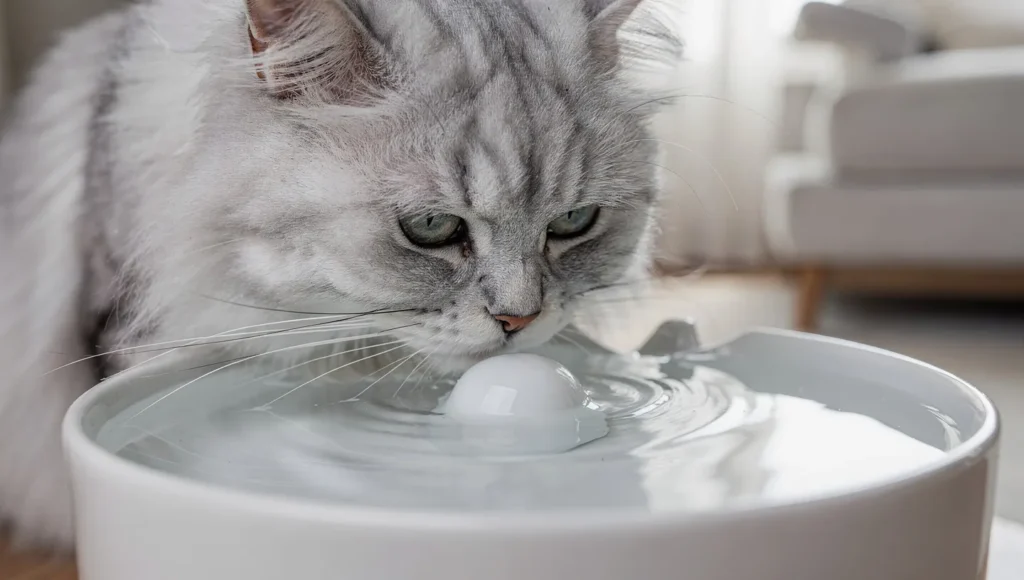
- A cat water fountain — moving water triggers their instinct to drink.
This single purchase made a bigger difference than anything else I tried. - Multiple water stations around the house — don’t make them walk far
for water - Add a small amount of water or broth to wet food for extra hydration
- Avoid plastic bowls — they can develop bacteria buildup that some
cats find off-putting (yes, cats are that picky)
Our full guide on cat hydration has 7 practical strategies for getting even the most stubborn water-avoiders to drink more. Highly recommend giving it a read.
Persian Cat Health Problems You Should Know About
This is the section I wish existed when I first brought a Persian home.
Not to scare you — but to prepare you. Because Persian cats, as magical as they are, come with a specific set of health vulnerabilities that every owner should understand.
Brachycephalic Syndrome — The Flat Face Reality
That adorable smushed face comes with a medical name: brachycephalic syndrome.
It basically means the skull structure is compressed, which affects the nasal passages, throat, and sometimes even the windpipe.
What this looks like in real life:
- Noisy breathing or snoring (often normal, sometimes not)
- Difficulty breathing during heat or exercise
- Sneezing more than average
- Sensitivity to heat and humidity
According to the ASPCA, brachycephalic cats need extra monitoring especially during summer months and should never be left in hot, poorly ventilated spaces.
This doesn’t mean your Persian will have breathing problems — many live perfectly comfortable lives. But it means you should know what to watch for.
Tear Stains & Eye Infections
We covered daily eye cleaning earlier, but let’s talk about when it becomes a health concern rather than just a cosmetic one.
Normal discharge: clear or slightly brownish, small amount, wipes away easily.
See your vet if you notice:
- Yellow or green discharge
- Swelling around the eye
- Your cat pawing at her eye repeatedly
- Cloudiness in the eye itself
- Discharge that returns heavily within hours of cleaning
According to PetMD, Persian cats are also prone to a condition called entropion, where the eyelid folds inward and irritates the eye — something that often requires veterinary treatment.
When to Call the Vet — Red Flags 🚨
Here’s the honest framework I use. No medical jargon, just common sense:
| Sign | What It Means | Action |
|---|---|---|
| 🟢 Occasional sneezing, clear eyes, normal energy | Normal Persian behavior | Monitor |
| 🟢 Small amount of eye discharge, wipes clean | Typical for the breed | Daily cleaning |
| 🟡 Reduced appetite for 1–2 days | Could be stress or minor issue | Watch closely |
| 🟡 Louder breathing than usual | Possible congestion or stress | Monitor + vet if persists |
| 🔴 No eating for more than 24 hours | Serious — act now | Call vet today |
| 🔴 Open-mouth breathing | Emergency in cats | Emergency vet immediately |
| 🔴 Yellow/green eye discharge | Possible infection | Vet within 24 hours |
| 🔴 Sudden personality change | Pain or illness | Vet visit needed |
For a broader checklist of warning signs across all health areas, our guide on how to tell if your cat is sick walks you through 10 critical signs every cat owner should know.
5 Persian Cat Mistakes I Wish Someone Had Warned Me About
Most people get this wrong — not because they don’t care, but because nobody told them. Here are the five mistakes that show up most often, including a couple I made myself.
1. Skipping eye cleaning “just for today” Today becomes tomorrow becomes a week of staining that takes three times as long to fix. The 60 seconds it takes is non-negotiable.
2. Using a deep food bowl
Already covered this above, but it’s worth repeating. A shallow dish is not optional for a flat-faced cat. It’s basic ergonomics.
3. Waiting too long between grooming sessions
Three days without brushing a Persian coat is enough to create mats in the high-friction zones. Daily is the only schedule that works long-term.
4. Assuming Persians are fully independent
They’re calm — but they’re not aloof. Persians form deep attachments and can develop real anxiety if left alone for long stretches.
They need your presence more than they let on.
5. Ignoring early breathing changes
A little more snoring, slightly heavier breathing — it’s easy to dismiss as “just how Persians are.” Sometimes it is. But sometimes it’s the early sign of a problem that’s much easier to treat early.
When in doubt, mention it to your vet at the next visit.
Honestly, number four surprised me the most. I assumed my Persian was happy doing her own thing. Turns out she was just quietly waiting for me in every room I walked into. Once I understood that, our whole relationship shifted.
Is a Persian Cat Right for You? (Quick Decision Guide)
Before we wrap up this Persian cat care guide, here’s the honest checklist. No sales pitch — just real talk.
A Persian cat is probably right for you if:
✅ You’re home most of the day or work from home
✅ You enjoy calm, quiet companionship over high-energy play
✅ You’re willing to commit to 10–15 minutes of daily care
✅ You live in an apartment or indoor-only environment
✅ You find grooming relaxing rather than stressful
✅ You can afford occasional professional grooming and vet visits
A Persian cat might not be the right fit if:
❌ You travel frequently and don’t have reliable pet care
❌ You want a low-maintenance, fully independent cat
❌ You’re not comfortable with daily eye and coat maintenance
❌ You have severe cat allergies (Persian coats shed significantly)
❌ You have very young children who play rough — Persians are gentle
and can get stressed easily
And about the 3-3-3 rule — if you’re bringing a Persian home for the first time, this is worth knowing: most cats need 3 days to feel safe, 3 weeks to learn the household routine, and 3 months to truly feel at home. Persians often take the full three months before they fully relax and show you their real personality. Don’t rush it.

Questions I Actually Get Asked All the Time
Are Persian cats high maintenance?
Yes — but in a manageable way. The daily routine takes about 10–15 minutes once you get used to it. The challenge is consistency, not complexity.
How often should I groom my Persian cat?
Brushing should happen every day. Bathing every 4–6 weeks. Eye cleaning every single morning without exception.
Can Persian cats live in apartments?
Absolutely — they’re one of the best breeds for apartment living. They’re calm, quiet, and don’t need outdoor access.
What do Persian cats usually die from?
The most common causes are polycystic kidney disease (PKD), heart disease, and complications related to their brachycephalic anatomy. Regular vet checkups twice a year are the best prevention.
Do Persian cats like to be held?
Most do — they’re affectionate and enjoy being close to their humans. That said, every cat is an individual. Some Persians love being carried; others prefer sitting next to you rather than on you. Read your cat.
Final Thoughts — From One Persian Owner to Another
In the end, my loyal friend in this wild journey of cat parenting — yes, Persian cats are demanding. Yes, the grooming is real. Yes, there will be mornings when you’re cleaning eye discharge before you’ve had your coffee, and evenings where you’re detangling fur while your cat gives you the most offended look imaginable.
But here’s what nobody tells you until you’re already in it: a Persian whose needs are met through proper Persian cat care is one of the most quietly rewarding relationships you’ll ever have.
They don’t demand loudly. They don’t knock things off tables to get your attention (usually). They just… show up. In your lap. In your space. In that warm, heavy, purring kind of way that makes everything else feel a little less chaotic.
Every brushing session, every eye wipe, every carefully chosen bowl of wet food — it all adds up to a cat who is healthy, comfortable, and genuinely happy. And that’s worth every minute.
Thank you, from the bottom of my heart, to every patient, dedicated Persian owner out there. You are the unsung heroes behind these beautiful, high-maintenance, absolutely worth-it creatures.
Now it’s your turn. Did your Persian outsmart you during grooming today? Has she claimed your favorite spot on the couch and dared you to say something about it? Drop your story in the comments below — we read every single one with a huge smile. And if this guide helped you even a little, share it with a fellow Persian parent.
Let’s end the era of surprise mats and mystery tear stains together. 🐱