

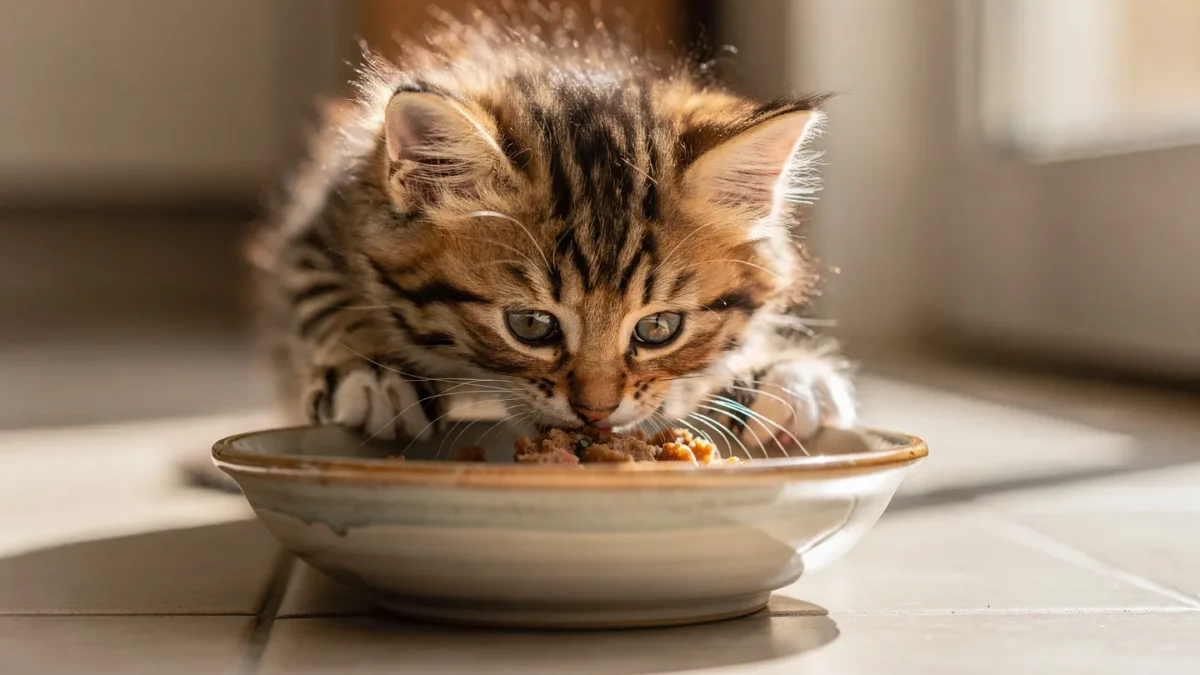
Marcus is one of those guys who does everything right. He researched the best kitten food for weeks, picked a brand with a fancy label, a high price tag, and what looked like a five-star ingredient list. He was proud of that choice.
Then his kitten barely touched it.
A few days in, she’d walk up to the bowl, sniff it, and just… walk away. That’s when Marcus called me, a little frustrated and a lot confused. “I spent good money on this. What am I missing?”
Turns out, he was missing something most kitten owners never even think about. And honestly? I made the same mistake with my first cat.
Not all high quality canned kitten food is actually high quality. The label can look premium, the price can be premium — but what’s inside the can tells a completely different story. And once you know how to read it, you can’t unsee it.
This guide will show you exactly what to look for, what to avoid, and how to make a confident choice when shopping for high quality canned kitten food your kitten will actually love eating.
Quick note: This article on choosing high quality canned kitten food is based on personal experience and research from trusted sources like PetMD and ASPCA. It’s meant for informational purposes only and doesn’t replace professional veterinary advice.
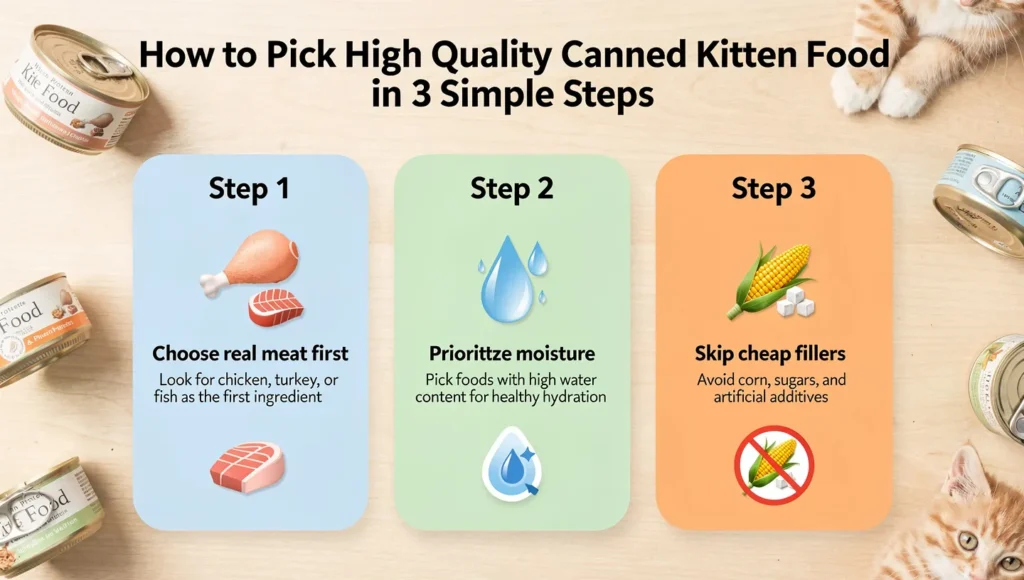
Table of Contents
- So What Actually Makes Kitten Food “High Quality”?
- How to Read a Canned Kitten Food Label (Without Getting Tricked)
- The 3-Step Decision System (This Is Where It Gets Simple)
- Top High Quality Canned Kitten Food Brands Worth Trying
- The Texture Thing Nobody Talks About (And Why It Matters More Than You Think)
- Why Kittens Need More Moisture Than You Think
- Quick Answers Every Kitten Owner Needs
- What is the healthiest canned food for kittens?
- Which wet food brand is best for kittens?
- How much wet food should a kitten eat per day?
- Is grain-free kitten food better?
- The Mistake Marcus Made — And What He Does Differently Now
- One Last Thing Before You Go
So What Actually Makes Kitten Food “High Quality”?
High quality canned kitten food starts with one thing: real, named animal protein as the first ingredient — like chicken, turkey, or salmon. It should also have high moisture content (over 70%), no artificial additives, and zero unnecessary fillers like corn syrup or wheat gluten.
Here’s a quick breakdown of what separates genuinely good food from the stuff that just looks good on the shelf:
- Real protein first: Chicken, turkey, salmon — not “meat by-product” or “animal digest”
- High moisture content: Kittens need hydration. Wet food should be above 70% moisture
- No mystery fillers: Corn syrup, wheat gluten, carrageenan — these have no place in kitten food
- AAFCO statement: Look for “complete and balanced for growth” — that’s the minimum standard
- No artificial preservatives: BHA, BHT, ethoxyquin are red flags
And here’s something Marcus didn’t know — and most people don’t: quality isn’t just about ingredients. It’s also about whether your kitten will actually eat it. A food can check every nutritional box and still end up ignored if the texture doesn’t match what your kitten prefers.
Pâté, shreds, chunks in gravy — these aren’t just marketing. They shape your kitten’s preferences for life. Kittens introduced to only one texture early on can develop what’s called food neophobia — a real resistance to trying anything new. More on that in a bit.
According to ASPCA’s cat nutrition guidelines, kittens have significantly higher protein and calorie requirements than adult cats — which makes choosing the right food during this stage critical, not optional.
🔗 If you want to understand the full picture of what kittens need nutritionally, this guide on what cats eat and the best diet for a healthy cat is a great starting point.
How to Read a Canned Kitten Food Label (Without Getting Tricked)
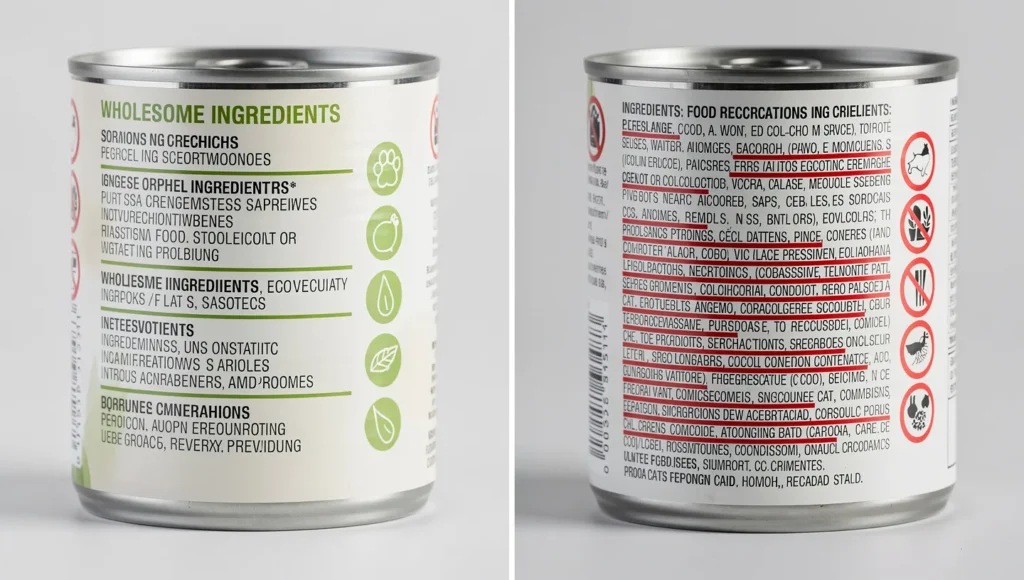
This is where most people’s eyes glaze over. I get it — ingredient lists are long, the font is tiny, and half the words sound like a chemistry exam. But here’s the thing: once you know these three secrets, you’ll spend about 30 seconds on any label and know exactly what you’re dealing with.
Secret 1: The 95% Rule
If a can says “Chicken for Kittens” — by law, chicken must make up at least 95% of the total product (excluding water). But if it says “Chicken Dinner” or “Chicken Entrée”? That drops to just 25%. And “with Chicken”? A measly 3%.
Same word. Completely different product.
Most people never notice this. Marcus definitely didn’t.
Secret 2: “Chicken” vs. “Chicken By-Product” — Not the Same Thing
Real chicken = actual muscle meat. Protein-rich, digestible, what kittens actually need.
Chicken by-product = leftover parts. Feet, intestines, undeveloped eggs. Not necessarily dangerous, but not what you’re paying premium prices for either.
Personally, I always look for a named protein — chicken, turkey, salmon — sitting alone at the top of the list. No “by-product” attached to it.
Secret 3: The Ingredients to Avoid (The Red Flag List)
Some ingredients show up in even “premium” brands. Watch out for:
- Carrageenan — a thickening agent linked to digestive inflammation in some studies
- Corn syrup or sugar — kittens don’t need added sugar. Ever.
- Wheat gluten — a cheap protein filler that can irritate sensitive stomachs
- BHA / BHT — artificial preservatives with questionable long-term effects
- Unnamed “meat” or “animal” anything — if they won’t name the protein, you don’t want it
🔗 Want to go even deeper on this? Our full guide on how to read cat food labels breaks down every section of the label with real examples.
The 3-Step Decision System (This Is Where It Gets Simple)
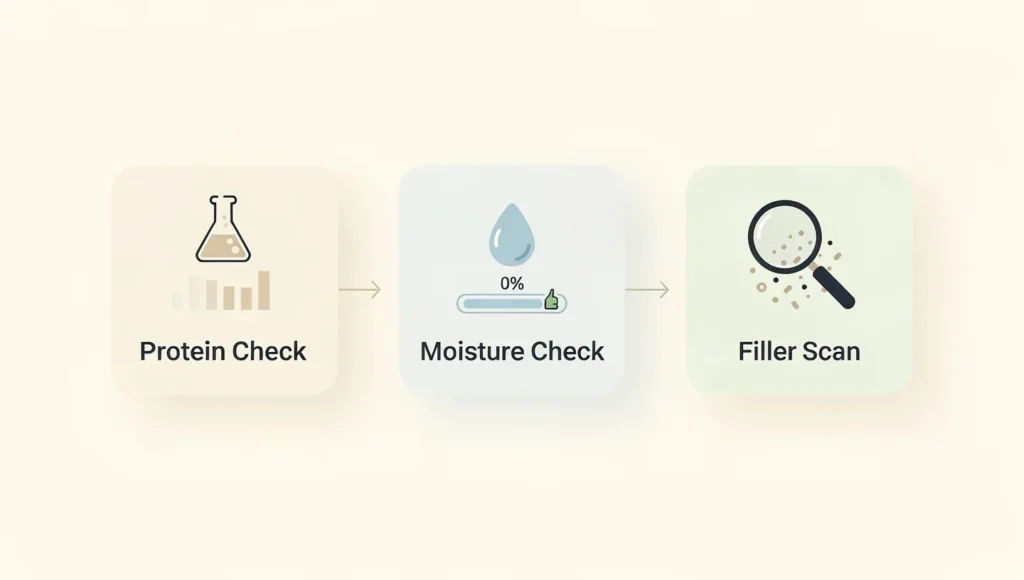
Here’s the thing. You don’t need a nutrition degree to find high quality canned kitten food. You just need a system.
After years of reading labels, talking to other cat owners, and yes — learning from Marcus’s expensive mistake — I put together a simple 3-step filter I use every single time I’m standing in the pet food aisle.
Step 1: Check the Protein Source
Flip the can. Look at the first ingredient. Is it a named animal protein — chicken, turkey, salmon, duck? Good. Is it “meat by-product,” “animal digest,” or just “fish”? Put it back.
That first ingredient alone tells you 80% of what you need to know.
Step 2: Check the Moisture Content
Look for the Guaranteed Analysis panel. Moisture should be at 70% or higher for wet food. Anything lower starts defeating the purpose of feeding wet food in the first place.
Kittens have a naturally low thirst drive — they’re designed to get most of their water from food. This isn’t optional hydration. It’s how their kidneys stay healthy long-term.
Step 3: Scan for Fillers
Run your eye down the ingredient list. If you see corn syrup, wheat gluten, or carrageenan in the first 10 ingredients — pass. There are too many good options out there to settle for filler-heavy food.
And that’s it. Three steps. Under a minute.
Most people get this wrong because they’re looking at the front of the package — the beautiful photography, the “grain-free” badge, the “natural” claim. Those words mean almost nothing legally. The back of the can is where the truth lives.
🔗 Still unsure about wet vs. dry? This breakdown of wet vs. dry cat food will help you figure out what ratio works best for your kitten’s stage.
Top High Quality Canned Kitten Food Brands Worth Trying
Okay, so now you know what to look for in high quality canned kitten food. Let’s talk about brands that actually deliver on the label — brands I’ve personally researched.
I’m not here to give you a generic top-10 list. Instead, here’s a small, curated selection of brands that consistently pass the 3-step filter — and why each one earns its spot.
| Brand | Why It Works | Best For | Texture |
|---|---|---|---|
| Wellness CORE | High protein, no fillers, named meat first | Most kittens | Pâté & chunks |
| Instinct Original | Cage-free chicken, minimal ingredients | Sensitive stomachs | Pâté |
| Tiki Cat | Very high moisture, real whole fish | Hydration-focused | Shreds in broth |
| Royal Canin Kitten | Vet-recommended, AAFCO complete | Picky eaters | Loaf & gravy |
| Purina Pro Plan Kitten | Science-backed, widely available | Everyday feeding | Pâté & classic |
A few honest notes:
- Royal Canin is a vet favorite, and for good reason — but read the label.
Some varieties include by-products. That’s not automatically bad,
but it’s worth knowing. - Tiki Cat is excellent for hydration-focused feeding. The broth-style
options are great, especially for kittens that are borderline picky about
drinking water. - Wellness CORE is my personal go-to recommendation for first-time kitten
owners who want simplicity without compromising quality.
According to PetMD’s kitten nutrition guidelines, kittens require nearly twice the calories per pound of body weight compared to adult cats — and those calories need to come primarily from animal protein, not carbohydrates or fillers.
The Texture Thing Nobody Talks About (And Why It Matters More Than You Think)
Here’s where it gets interesting — and this is something Marcus and I talked about for a while after his kitten refused that expensive pâté.
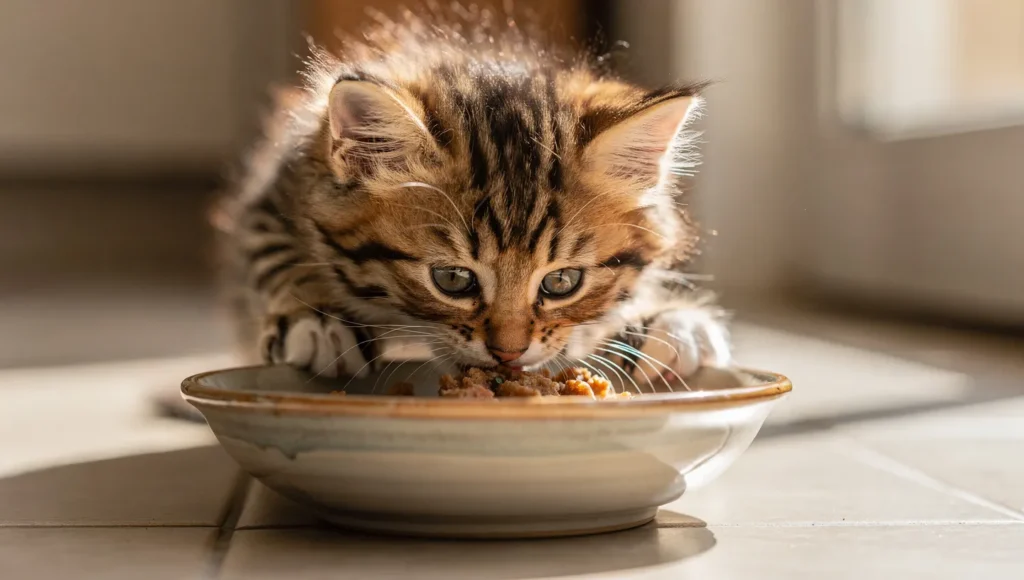
Kittens are texture learners. During the first few months of life, they form strong preferences for the way food feels in their mouth — pâté, shreds, chunks, gravy, minced. And if they only experience one texture during that window?
They can develop food neophobia — a genuine resistance to trying anything different.
This is where so many owners get stuck. Their kitten eats only one brand, only one texture, and the moment there’s a shortage, a formula change, or a vet-recommended switch — it becomes a two-week battle of wills between you and a 2-pound animal who will absolutely win.
From my experience, the smartest thing you can do is rotate textures early. Offer pâté one week, shreds the next, chunks in gravy the week after.
Same quality standards — different textures. You’re not confusing your kitten. You’re building flexibility.
And trust me, future-you will be very grateful.
😄 Okay, real talk for a second.
I once spent 20 minutes standing in a pet store aisle reading the back of every single kitten food can while another customer slowly backed away from me like I was conducting a science experiment. Was I embarrassed? A little. Did I find the best option on the shelf that day? Absolutely.
The point is — it’s okay to be that person. Your kitten can’t read labels. You can.
Why Kittens Need More Moisture Than You Think
Let’s talk about why high quality canned kitten food is a must for hydration.
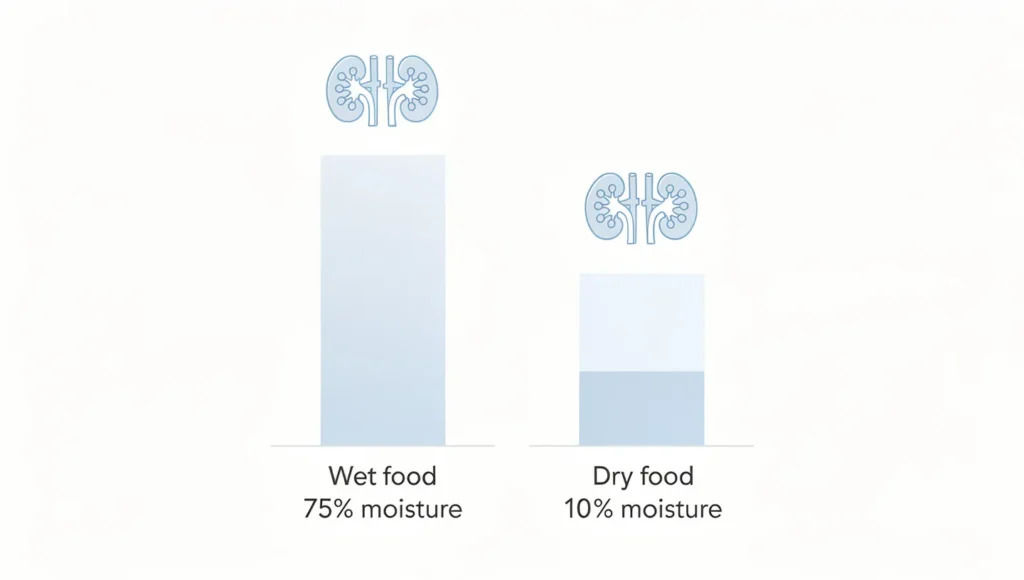
Kittens — like all cats — evolved as desert animals. Their ancestors got most of their hydration from prey, not from a water bowl. Which means domesticated cats have a naturally low thirst drive. They simply don’t feel thirsty the way dogs or humans do.
This is where wet food becomes less of a “preference” and more of a biological need.
High quality canned kitten food typically contains 70–80% moisture. Dry kibble? Around 10%. That gap is enormous when you consider that chronic low-level dehydration in cats is directly linked to kidney disease, urinary tract issues, and digestive problems down the line.
This is where it changes things: feeding your kitten high-moisture food from the start isn’t just about nutrition. It’s about building kidney health habits that can add years to their life.
From my experience, the kittens I’ve seen thrive long-term were almost always raised on a wet-food-primary diet. Not exclusively — but primarily.
🔗 If your kitten is already showing signs of low water intake, this guide on cat hydration covers 7 practical strategies to get even the most stubborn cats drinking more.
Quick Answers Every Kitten Owner Needs
What is the healthiest canned food for kittens?
The healthiest canned kitten food has a named animal protein as the first ingredient (like chicken or turkey), moisture above 70%, an AAFCO
“complete and balanced for growth” statement, and no artificial preservatives or mystery fillers. Brands like Wellness CORE, Instinct Original, and Tiki Cat consistently meet these standards.
Which wet food brand is best for kittens?
There’s no single “best” — it depends on your kitten’s texture preference and any sensitivities. That said, Wellness CORE and Purina Pro Plan Kitten are two of the most consistently recommended options by vets and experienced cat owners alike. Start with one, observe how your kitten responds, and adjust from there.
How much wet food should a kitten eat per day?
A general guideline is about 1 oz of wet food per pound of body weight per day — split into 3–4 small meals for kittens under 6 months.
But this varies by brand and caloric density, so always check the feeding guide on the can and adjust based on your kitten’s growth.
🔗 For a detailed feeding chart broken down by age and weight,check out this guide on how much to feed a kitten.
Is grain-free kitten food better?
Not necessarily. “Grain-free” doesn’t automatically mean higher quality — it just means grains were replaced with something else, often potatoes or peas. What matters more is the protein source and the overall ingredient quality. Some kittens do better grain-free, especially those with sensitivities. But for most healthy kittens, it’s not a requirement.
The Mistake Marcus Made — And What He Does Differently Now
A few weeks after that first phone call, Marcus called again. This time, he was laughing.
He’d gone back to the pet store, flipped every can over, read the labels using the 3-step filter, and found something his kitten actually loved. Simple ingredient list, named protein first, decent moisture content. Nothing fancy on the outside — but solid on the inside.
“She finished the whole bowl,” he told me. “First time that’s happened.”
And here’s what I love about Marcus — he didn’t just fix the problem for himself. He started texting other friends who had cats, sending them photos of the back of cans, pointing out the red flags. Classic Marcus. Once he learns something, he shares it.
Honestly? That’s exactly the kind of cat owner his kitten is lucky to have. Someone who cares enough to get it wrong first, then get it right.
🔗 By the way — if your kitten is going through a phase of refusing food altogether (not just being picky about texture), this guide on what to do when your cat is not eating walks you through exactly when to worry and when to wait.
One Last Thing Before You Go
You don’t need to be a nutritionist to pick out high quality canned kitten food every time. You just need to know where to look and what to look for.
Flip the can. Check the protein. Check the moisture. Scan for red flags. Rotate the textures early.
That’s it. That’s the whole system.
Marcus figured it out — and his kitten is thriving because of it. Genuinely one of the most caring cat owners I know, and someone I’m glad shared his “expensive lesson” with me so we could share it with you.
If this guide helped you, I’d really love to hear about it. Drop a comment below and tell me: what brand are you currently feeding your kitten — and have you ever had a “Marcus moment” where you spent good money on something your cat completely ignored? 😄
I read every single comment, and honestly? Your stories are my favorite part of running this site. Can’t wait to hear yours.
— And a big thank you to Marcus, wherever you are right now, probably reading labels in a pet store and quietly judging everyone around him. We appreciate you.