

I used to ask myself, can cats eat tuna daily? and I honestly thought I was doing something nice for my cat by saying yes.
Every morning, I’d crack open a can of tuna — she’d come running, tail up, practically vibrating with excitement. It felt like love. It felt like I was giving her something special.
Then one day, she stopped eating her regular food. Completely. Wouldn’t even sniff it. And when I finally got her to the vet, the first question they asked was: “How much tuna have you been giving her?”
That was the moment I realized I’d accidentally created a problem I didn’t even know existed.
📌 Quick note before we dive in: This article is based on personal experience and research from trusted sources like ASPCA and AVMA. It’s meant to inform, not replace advice from your own vet — especially if your cat has existing health issues.
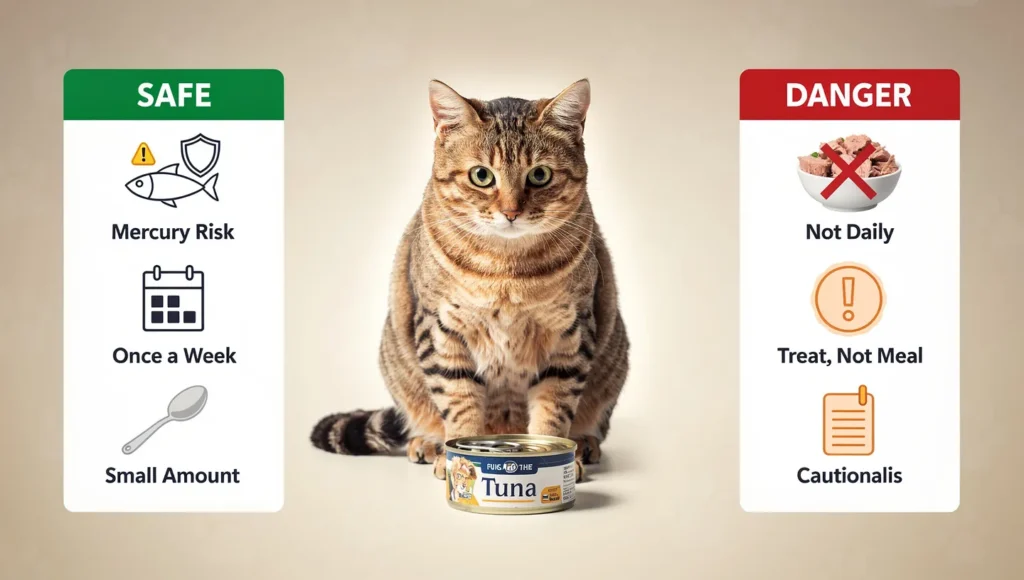
Table of Contents
- Can Cats Eat Tuna Daily? (The Real Answer & Safe Limits)
- What Happens If You Feed Your Cat Tuna Every Day?
- Mercury Poisoning
- Nutritional Deficiency — And One Disease Most Articles Skip
- Tuna Addiction — The Behavioral Trap
- Canned Tuna vs. Fresh Tuna — Which Is Safer for Cats?
- Can Cats Eat Tuna Daily? A Guide to Safe Portions & Dosage
- Can Kittens Eat Tuna?
- Healthy Tuna Alternatives Your Cat Will Actually Love
- Tuna Myths vs. Facts
- Can cats eat tuna daily? (The official recommendation)
- Can cats live on tuna alone?
- Can cats drink the juice from a tuna can?
- Can cats eat tuna in water every day?
- Why is tuna bad for cats in large amounts?
- My cat only eats tuna — what do I do?
- Final Verdict
Can Cats Eat Tuna Daily? (The Real Answer & Safe Limits)
Yes — but only as an occasional treat, not a daily meal. Tuna isn’t toxic to cats in small amounts, but feeding it every day can lead to serious health problems over time, including mercury poisoning, nutritional deficiencies, and a behavioral issue called tuna addiction.
Here’s the thing: cats are naturally drawn to tuna because of its intense smell and high protein content. Their noses are incredibly sensitive — way more than ours — and tuna basically hits every sensory trigger they have.
But that doesn’t mean it’s good for them long-term.
Think of it this way: just because your cat loves something doesn’t mean it loves them back.
If you want a full picture of what cats should actually be eating, this guide on what cats eat and the best diet for a healthy feline is a solid starting point.
What Happens If You Feed Your Cat Tuna Every Day?
This is where things get real. Most people assume tuna is a safe, healthy protein source — and in small doses, it can be. But daily feeding is a completely different story. When we look at the question, can cats eat tuna daily, the biggest concern is always mercury buildup.
Mercury Poisoning
Tuna — especially albacore — contains higher levels of mercury than most other fish. In humans, we can process small amounts over time. Cats are much smaller, and their bodies aren’t built to handle the same exposure.
When mercury accumulates in a cat’s system, it can cause:
- Loss of coordination and balance
- Tremors or muscle weakness
- Difficulty walking (sometimes described as a “drunken” gait)
- In severe cases, neurological damage
According to the ASPCA Animal Poison Control, heavy metal toxicity is a real risk with certain fish — and tuna is one of the primary culprits when fed in excess.
Honestly, when I first read about this, I felt genuinely awful. I’d been giving my cat tuna multiple times a week thinking it was a healthy protein boost. I had no idea.
Nutritional Deficiency — And One Disease Most Articles Skip
Here’s something most websites won’t tell you.
Feeding too much tuna doesn’t just cause mercury buildup — it can also lead to a condition called Steatitis, also known as Yellow Fat Disease.
This happens when a cat’s diet is too high in unsaturated fatty acids (which tuna contains in abundance) and too low in Vitamin E. The fat tissue in the cat’s body becomes inflamed — and it’s incredibly painful.
Symptoms include:
- Sensitivity to touch (especially around the belly)
- Reluctance to move
- Fever and loss of appetite
- Hardened, lumpy fat deposits under the skin
Beyond steatitis, a tuna-heavy diet also depletes thiamine (Vitamin B1), which plays a critical role in brain and nerve function. A thiamine deficiency can cause seizures, vision problems, and in extreme cases, death.
Tuna also lacks several key nutrients cats need to thrive — taurine balance, proper calcium-phosphorus ratios, and essential fatty acids in the right proportions. It simply wasn’t designed to be a complete diet.
For a deeper look at how to actually read what’s in your cat’s food, check out this breakdown of cat food labels and what the ingredients really mean.
Tuna Addiction — The Behavioral Trap
This one doesn’t get nearly enough attention.
Tuna has such an overwhelming smell and flavor that it can literally rewire your cat’s preferences. Over time, daily tuna feeding can turn your cat into what vets sometimes call a “finicky eater” — a cat who refuses anything that isn’t tuna.
And this is important: it’s not just pickiness. The intense sensory experience of tuna overstimulates the palate to the point where regular cat food — even high-quality, nutritionally complete food — starts to seem “wrong” to them.
I watched this happen with my own cat. She’d take one sniff of her regular food and walk away like I’d personally offended her. It took weeks of patient, gradual transition to get her eating normally again.
Most people get this wrong — they think they’re spoiling their cat in a sweet way. But the reality of why can cats eat tuna daily becomes a problem is often tied to tuna addiction—a behavioral trap that’s hard to break. that can make it nearly impossible to switch your cat back to a balanced diet when needed.
If your cat is showing signs of picky eating or refusing meals, this article on cats refusing food and water might be helpful too.
Canned Tuna vs. Fresh Tuna — Which Is Safer for Cats?
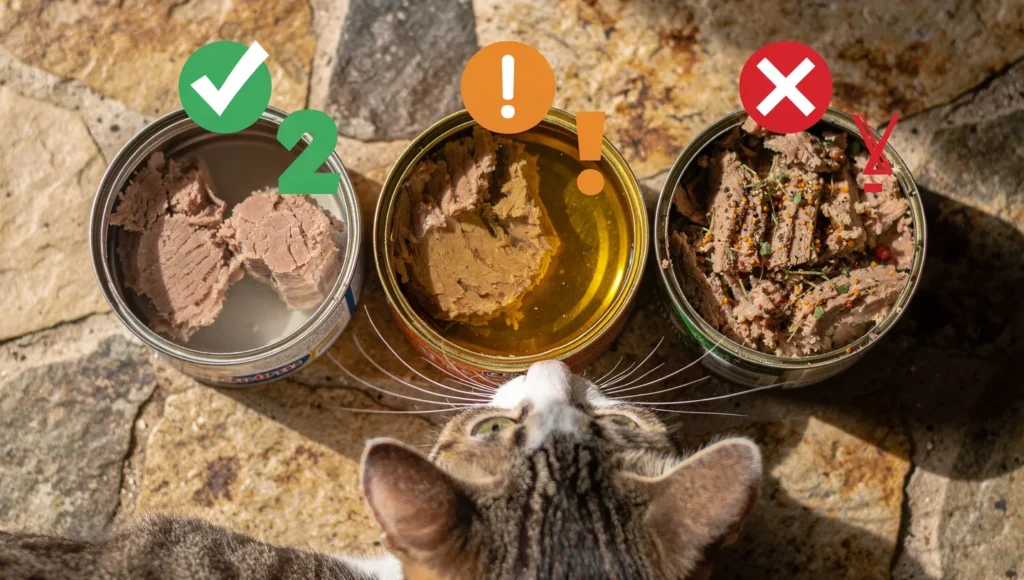
Not all tuna is equal. If you’re going to offer it as an occasional treat, the type you choose actually matters quite a bit.
Here’s a quick breakdown:
| Type of Tuna | Safe? | Notes |
|---|---|---|
| Canned in water | ✅ | Best option — low sodium, no oil |
| Canned in oil | ⚠️ | Too high in fat, can upset digestion |
| Seasoned/flavored | ❌ | Often contains onion, garlic, salt |
| Fresh/raw tuna | ⚠️ | Higher mercury, destroys thiamine |
| Regular human tuna | ⚠️ | Sodium levels too high for cats |
Personally, if I’m offering tuna at all now, it’s plain canned tuna in water — no salt added, no seasoning, nothing extra. And even then, it’s a small amount, once a week at most.
The seasoned varieties are genuinely dangerous. Onion and garlic — even in powder form — are toxic to cats. And the sodium levels in regular human canned tuna are simply too high for a cat’s kidneys to handle regularly.
For a full list of human foods that can harm your cat, this guide on human foods toxic to cats covers everything you need to know.
Can Cats Eat Tuna Daily? A Guide to Safe Portions & Dosage
No, cats should not eat tuna daily. A safe amount is roughly a teaspoon — about the size of your thumbnail — This small amount ensures they get the flavor without the mercury load. once a week at most. That’s it.
| Cat Weight | Safe Amount | Frequency |
|---|---|---|
| Under 8 lbs | ~1 tsp | Once a week max |
| 8–12 lbs | ~1–2 tsp | Once a week max |
| Over 12 lbs | ~2 tsp | Once a week max |
Think of tuna as a garnish, not a meal. Bottom line: can cats eat tuna daily? No — and now you know exactly why. A little flavor boost on top of their regular food — not a replacement for it. If your cat is already overweight, I’d skip it altogether and check out this guide on
cat weight management before adding any extras to their diet.
Can Kittens Eat Tuna?
Short answer: no. Kittens have developing kidneys and a far more sensitive digestive system than adult cats. The mercury risk is higher, the sodium is too much, and the nutritional imbalance can cause real damage during a critical growth window.
Stick to kitten-specific food designed for their stage of development. If you’re raising a young cat and want a solid roadmap, this kitten care guide covers feeding, health, and everything in between.
Healthy Tuna Alternatives Your Cat Will Actually Love
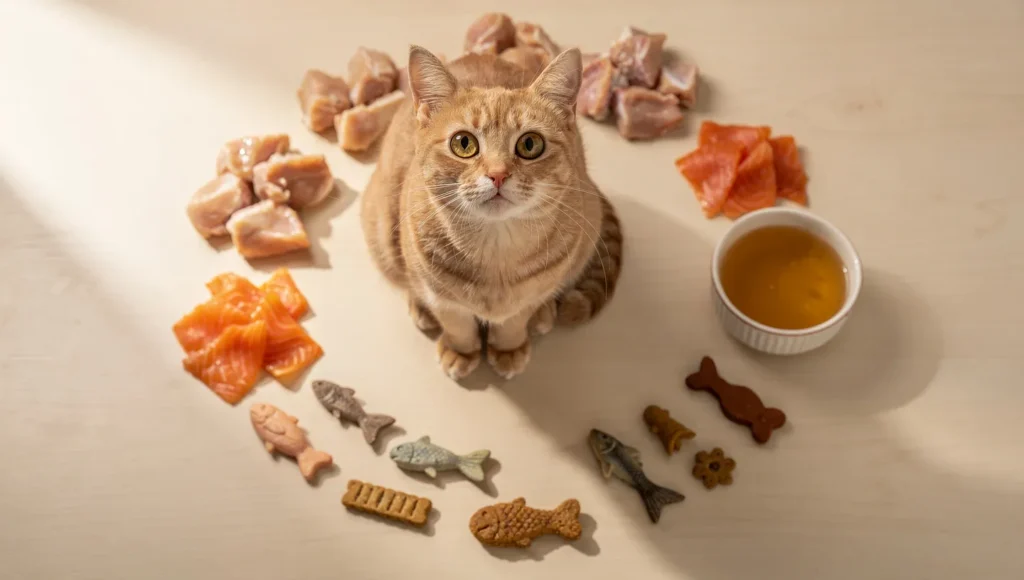
Here’s the thing — your cat doesn’t need tuna. They just think they do because it smells incredible. There are better options that give them the protein hit without the risks:
- Plain cooked chicken — boiled, no seasoning, easy to prepare
- Cooked salmon — rich in omega-3s, lower mercury than tuna
- Cat-specific fish treats — formulated with safe sodium levels
- Bone broth (unseasoned) — great for hydration and palatability
That last one is underrated. A small pour of plain bone broth for cats over regular food can make even the pickiest tuna addict interested in their bowl again.
And if you want the full picture on what’s actually safe from your kitchen, this guide on human foods toxic to cats is worth bookmarking.
Tuna Myths vs. Facts
Can cats eat tuna daily? (The official recommendation)
No. Daily tuna leads to mercury buildup, nutritional deficiencies, and behavioral addiction. Once a week in small amounts is the safe limit.
Can cats live on tuna alone?
Absolutely not. Tuna lacks taurine balance, proper vitamins, and essential nutrients cats need to survive. A tuna-only diet will cause serious health problems within months.
Can cats drink the juice from a tuna can?
Occasionally, yes, but only if it’s from “tuna in water” with NO added salt. Never give them the oil from a can, as it can cause diarrhea or even pancreatitis in sensitive cats.
Can cats eat tuna in water every day?
Even tuna in water — the safest variety — shouldn’t be fed daily. The mercury accumulates regardless of the packaging. Once a week, small amount, that’s the rule.
Why is tuna bad for cats in large amounts?
Three reasons: mercury toxicity, thiamine and Vitamin E depletion (which can cause Steatitis and neurological damage), and palate addiction that makes cats refuse balanced food.
My cat only eats tuna — what do I do?
Transition slowly. Mix a tiny amount of their regular food into the tuna, then gradually shift the ratio over 7–10 days. It takes patience, but it works. This guide on switching cat food safely walks you through the exact process.
Final Verdict
Tuna isn’t evil. It’s just not a meal — it’s a treat. A small one, offered occasionally, is perfectly fine for most healthy adult cats.
The mistake is making it a habit. Once it becomes a daily ritual, you’re not spoiling your cat anymore — you’re quietly creating a health and behavioral problem that’s genuinely hard to undo.
From my experience, the best thing you can do is use tuna as a very occasional reward, keep portions small, and make sure their real nutrition comes from a complete, balanced diet.
Your cat will thank you for it. Even if they don’t show it right away. 🐾