


Bringing home a kitten feels like pure magic—right up until 3:00 a.m. when that tiny, four-legged ball of fluff transforms into an unhinged track star using your curtains as climbing gear.
Raising a kitten is thrilling, but it quickly comes with a mountain of questions: How much food is actually enough? When do those core shots happen? And how do you survive the razor-sharp needle claws?
Successful kitten care comes down to a predictable foundation: a secure safe zone, age-appropriate balanced nutrition, a vet-guided vaccination schedule, and structured daily socialization.
This comprehensive blueprint covers everything your kitten needs through their entire first year—from their first week home to their first birthday milestone.
Table of Contents
- Quick Kitten Care Timeline: What to Expect, Week by Week
- Preparing Your Home Before Your Kitten Arrives
- Kitten-Proofing Checklist
- Essential Supplies List
- The First Few Days at Home
- Veterinary Care and Vaccination Schedule
- Core Vaccines (FVRCP and Rabies)
- Non-Core Vaccines and Testing
- Deworming and Parasite Prevention
- Spay/Neuter Timing
- Feeding Your Kitten Through the First Year
- How Much and How Often to Feed
- Self-Service vs. Fractioned vs. Combination Feeding
- Transitioning to Adult Food
- Litter Box Training
- Grooming Basics for Kittens
- Play, Socialization, and the “Rule of Seven”
- Daily Play Requirements
- The Critical Socialization Window (6–14 Weeks)
- Getting Your Kitten Comfortable With the Carrier and Car Rides
- Common First-Year Mistakes to Avoid
- Questions Every New Cat Owner Asks
- What is the 3-3-3 rule for kittens?
- What care does a kitten need?
- Can I leave my kitten home alone?
- Where should a kitten sleep at night?
- How do you take care of a kitten without a mother?
- One Last Thing
Quick Kitten Care Timeline: What to Expect, Week by Week
| Age | What’s Happening | What You Need to Do |
|---|---|---|
| 0–4 weeks | Nursing, eyes/ears opening, minimal mobility | Kittens this young should stay with mom or a foster; bottle-feeding only if orphaned |
| 4–6 weeks | Starting to eat solid food, litter box learning begins | Introduce wet/dry kitten food, shallow litter box |
| 6–8 weeks | Weaned, first vet visit typically happens here | Schedule first vaccination round, deworming |
| 8–16 weeks | Core socialization window, rapid growth | FVRCP boosters every 3–4 weeks, daily play, start carrier training |
| 14–16 weeks | Rabies vaccine window, FeLV/FIV testing if applicable | Finalize core vaccine series |
| 5–6 months | Sexual maturity approaches | Schedule spay/neuter |
| 6–12 months | Growth slows, adult behavior emerges | Begin transition to adult food |
| 12 months | Officially an adult cat | Full transition to adult formula and routine vet checkups |
This is a general framework—every kitten grows at a slightly different pace, and your veterinarian will adjust the schedule based on your kitten’s specific health and history.
Preparing Your Home Before Your Kitten Arrives
Kitten-Proofing Checklist
Kittens investigate the world mouth-first, which means anything within reach is a potential hazard. Before bringing your kitten home:
- Secure loose electrical cords and blind cords
- Put away strings, hair ties, dental floss, and rubber bands—these can cause serious internal blockages if swallowed
- Check for toxic houseplants and remove or relocate them
- Store medications, cleaning products, and small choking hazards out of reach
- Cover or block access to high, unstable furniture until your kitten has better balance
- Know which human foods are toxic to cats and keep them off counters
Essential Supplies List
Before kitten day, have these ready:
- A litter box with low sides (kittens can struggle to climb into standard-height boxes)
- Kitten-specific food (wet and dry)
- Food and water bowls
- A carrier
- A cozy bed or blanket
- A scratching post
- A few safe toys
The First Few Days at Home
The first days are about letting your kitten adjust at their own pace rather than overwhelming them with attention. A well-known approach here is the 3-3-3 rule: roughly 3 days to decompress, 3 weeks to settle into a routine, and 3 months to feel fully at home. If you want the complete breakdown of what each phase actually looks like day-to-day, our full guide to bringing a new cat home walks through it in detail.
For now, the short version: keep the environment calm, let your kitten come to you, and resist the urge to over-cuddle in those first 24–48 hours.
Veterinary Care and Vaccination Schedule
Core Vaccines (FVRCP and Rabies)
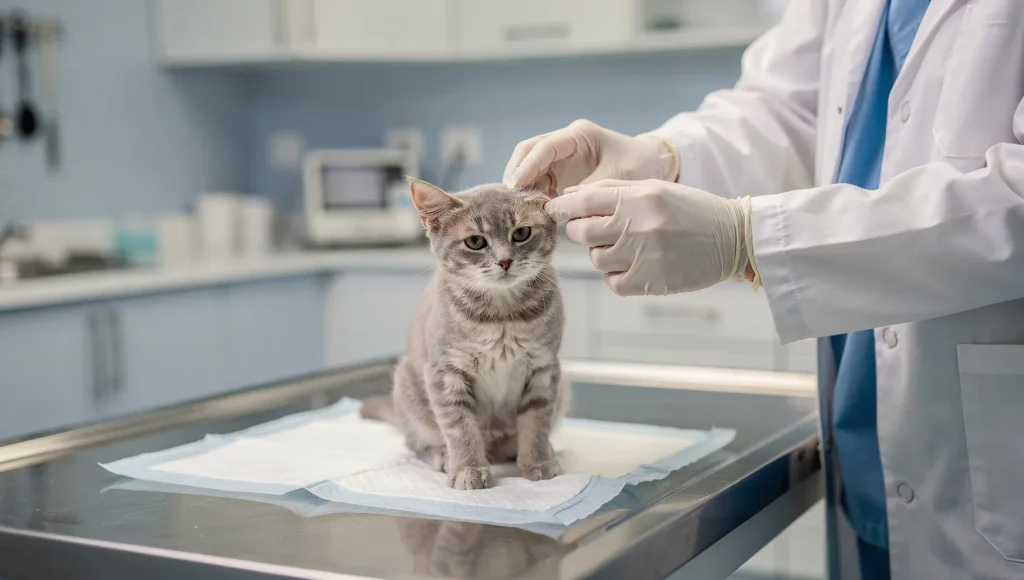
According to veterinary guidelines from the Cornell Feline Health Center, Vaccinations are one of the most important parts of kitten care in the first few months. Most kittens begin their vaccination series between 6 and 8 weeks of age, with boosters continuing every 3 to 4 weeks until they reach roughly 16 weeks old. The core vaccines include:
- FVRCP — a combination vaccine protecting against feline viral rhinotracheitis, calicivirus, and panleukopenia. This one is typically given as a series of at least three boosters.
- Rabies — usually given between 14 and 16 weeks, and must be administered by a licensed veterinarian to be legally valid in most areas.
Non-Core Vaccines and Testing
Depending on your kitten’s lifestyle and household, your vet may also recommend:
- FeLV (Feline Leukemia Virus) testing and vaccination, especially for kittens who’ll spend time outdoors or live with other cats
- FIV (Feline Immunodeficiency Virus) testing, often done around 14–16 weeks alongside FeLV
Deworming and Parasite Prevention
Kittens are especially prone to intestinal parasites, even if they’ve never been outdoors. Vets typically recommend deworming at the first visit and again a few weeks later, with ongoing flea prevention started as soon as your kitten is old enough for it. If you notice symptoms like a swollen belly or visible segments near the tail, our guide on signs of worms in cats can help you figure out what you’re looking at.
Spay/Neuter Timing
Most veterinarians recommend spaying or neutering around 5 to 6 months of age, before kittens reach sexual maturity. Beyond preventing unwanted litters, early spay/neuter is linked to a lower risk of certain cancers and reduces behaviors like roaming, spraying, and heat-related restlessness.
Feeding Your Kitten Through the First Year
How Much and How Often to Feed
Nutrition is a cornerstone of good kitten care, since kittens burn through energy fast and need more protein and calories per pound than adult cats.
Very young kittens typically eat 3 to 4 small meals a day, and appetite can fluctuate noticeably during growth spurts—don’t be surprised if your kitten seems ravenous one week and picky the next. For a detailed breakdown by age and weight, our full feeding chart for kittens covers exact portions.
Self-Service vs. Fractioned vs. Combination Feeding
There are three common approaches to feeding kittens:
- Self-service (free feeding) — dry food left out at all times, allowing your kitten to graze naturally. Works well for kittens who self-regulate and aren’t prone to overeating.
- Fractioned feeding — dividing the day’s food into smaller scheduled meals rather than free access. This gives you more control over portions and timing.
- Combination feeding — dry food available throughout the day, paired with scheduled wet food meals. This is a popular middle ground, since wet food adds moisture and protein while dry food supports natural grazing habits.
If you’re unsure which approach fits your kitten, our guide on high-quality canned kitten food covers how to choose a wet food that fits well into any of these routines.
Transitioning to Adult Food
Kittens typically stay on kitten-specific formula until around 12 months of age (slightly later for large breeds). When it’s time to switch, doing it gradually over about a week helps avoid stomach upset. Our step-by-step guide to switching cat food safely walks through the full transition process.
Litter Box Training
Most kittens instinctively know how to dig and bury, but the location of the box matters just as much as the training itself. Kittens typically start using a litter box between 3 and 4 weeks of age, learning largely by watching their mother—so if you’ve adopted an orphaned or very young kitten, expect to guide the process a bit more directly.
A few basics that make training smoother:
- Use a box with low sides so your kitten can climb in easily
- Place your kitten in the box after meals and naps, since that’s when accidents are most likely
- Keep the box in a quiet, low-traffic spot—not right next to food or water bowls
- Scoop daily; kittens are far more likely to avoid a dirty box
If you’re dealing with a kitten who seems to understand the box but still has accidents, the issue is often about placement rather than training. Our guide on litter box placement covers the most common setup mistakes and how to fix them.
Grooming Basics for Kittens
Grooming isn’t just about appearance—it’s an early opportunity to build trust and get your kitten comfortable with being handled, which pays off enormously at future vet visits.
Start with short, gentle brushing sessions to get your kitten used to the sensation. Our guide on how to brush your cat breaks down technique by coat type. Nail trimming can also start early—even just handling and touching the paws regularly makes actual trims far less stressful later. This step-by-step guide to trimming cat nails safely walks through the process.
Most kittens don’t need frequent baths, and many actively dislike water. Unless your kitten gets into something messy, grooming through brushing is usually enough for the first year.

Play, Socialization, and the “Rule of Seven”
Daily Play Requirements
Kittens have short attention spans but high energy, so several short bursts of play work better than one long session. Aim for at least four 15-minute play sessions spread throughout the day. If your kitten nips or pounces too aggressively during play, redirecting to a toy—rather than pulling your hand away—teaches them what’s actually okay to bite. For more on decoding and managing this, our guide on why cats bite is worth a read.
A quick note on toys: if you use a laser pointer, always end the session by letting your kitten “catch” something physical, like a treat or toy. Chasing a light they can never actually catch can lead to frustration-based behavior over time.
The Critical Socialization Window (6–14 Weeks)
Between 6 and 14 weeks of age, kittens are forming their picture of what’s safe and what’s not—this is often called the critical socialization period. Kittens who are exposed to a variety of people, sounds, textures, and gentle handling during this window tend to grow into more confident, adaptable adult cats.
One helpful framework here is the “Rule of Seven”: aiming to give your kitten seven different positive experiences each day during this window. That could mean a new texture underfoot, a new sound, meeting a new (vaccinated, friendly) animal, or simply being handled by a new person. It doesn’t need to be complicated—the goal is variety, not intensity.
Getting Your Kitten Comfortable With the Carrier and Car Rides
Here’s a detail a lot of new owners miss: for many kittens, the very first time they enter a carrier is the day they’re driven to the vet—which means the carrier, the car, and the vet clinic all get mentally linked to something stressful, right from the start.
You can avoid that association by introducing the carrier early, on your terms. Leave it out in a common area with the door open, toss in a blanket or a few treats, and let your kitten explore and nap in it on their own schedule. Occasionally closing the door for a minute or two while they’re inside, then rewarding calm behavior, helps build tolerance gradually.
Short, calm car rides—engine off at first, then on, then a brief drive around the block—can make future trips noticeably less stressful for everyone involved.

Common First-Year Mistakes to Avoid
A few patterns show up again and again in first-time kitten care:
- Skipping the vet-visit “practice runs.” Only bringing your kitten in when something’s wrong makes every visit feel like bad news to them.
- Free-feeding without monitoring weight. Self-service feeding works for many kittens, but it’s still worth tracking whether they’re gaining appropriately—not too little, not too much.
- Assuming litter box issues are behavioral. Most early accidents are about box access, size, or location, not defiance.
- Under-socializing during the critical window. Waiting until a kitten is older to introduce new experiences is much less effective than doing it during the 6–14 week period.
- Declawing as a scratching solution. Veterinary organizations increasingly discourage this procedure; a good scratching post and consistent redirection handle the same problem without it.
Questions Every New Cat Owner Asks
What is the 3-3-3 rule for kittens?
It’s a general guideline for adjustment: roughly 3 days to decompress in a new home, 3 weeks to settle into a routine, and 3 months to feel fully comfortable. Our full guide to a kitten’s first days covers this in more depth.
What care does a kitten need?
Good kitten care comes down to a few essentials: a safe, kitten-proofed space, age-appropriate food, a properly sized litter box, a vaccination schedule started around 6–8 weeks, and daily play and socialization.
Can I leave my kitten home alone?
For short periods, yes—most kittens over about 10–12 weeks can be left alone for a few hours as long as the space is safe and they have food, water, and a litter box. Very young kittens (under 8 weeks) generally shouldn’t be left unsupervised for long stretches.
Where should a kitten sleep at night?
Wherever feels safest and most consistent for your household—a cozy bed in a quiet corner of your room, or their own small space. What matters most is keeping the location consistent so your kitten builds a reliable routine.
How do you take care of a kitten without a mother?
Orphaned kittens under 4 weeks need specialized neonatal care. According to the ASPCA, this involves round-the-clock bottle-feeding with a specialized kitten milk replacer (KMR), manual stimulation for elimination, and constant thermal support.
One Last Thing
That chaotic kitten phase—the midnight zoomies, the ankle pouncing, and the endless curiosity—passes much faster than you think. Before you know it, that tiny palm-sized explorer will be a calm, confident adult cat ruling the household.
The fundamentals of kitten care don’t change much: nourish their rapid growth, stay on track with their veterinary milestones, and build trust one gentle play session at a time.
Now, we want to hear from you: What is the most hilarious or chaotic thing your new kitten has done so far? Drop your story in the comments below—we read and reply to every single one!
If this guide helped you feel more prepared, share it with a friend who just brought home a new kitten, or in your favorite pet community. It might just save someone’s curtains!