
My niece and nephew came over one Saturday afternoon, and honestly, it started out great. They’re seven and nine, super energetic, and they love Luna — my tortoiseshell cat. She’d been with me for about three months at that point, so she was still getting used to the house, to me, to everything.
The kids were running around, laughing loud, chasing each other through the living room. Luna was sitting on the couch, watching them. Everything looked fine. Normal, even. But looking back, I realize I was missing all the subtle cat aggression signs that were starting to surface. And then… it wasn’t.
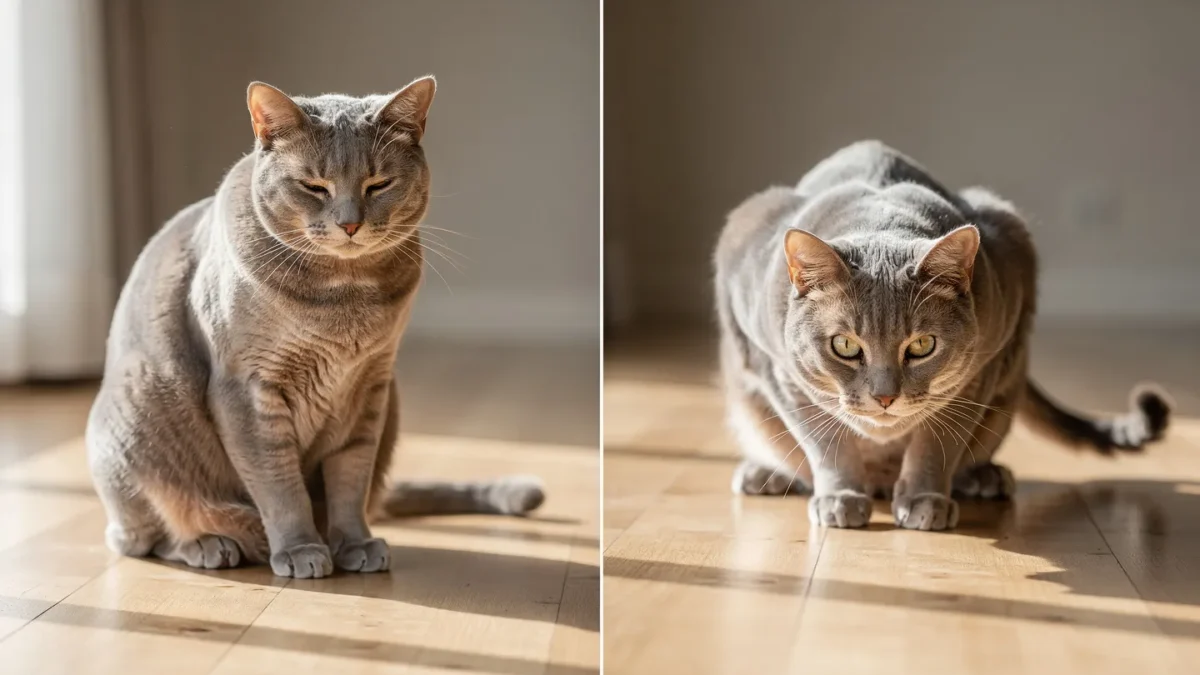
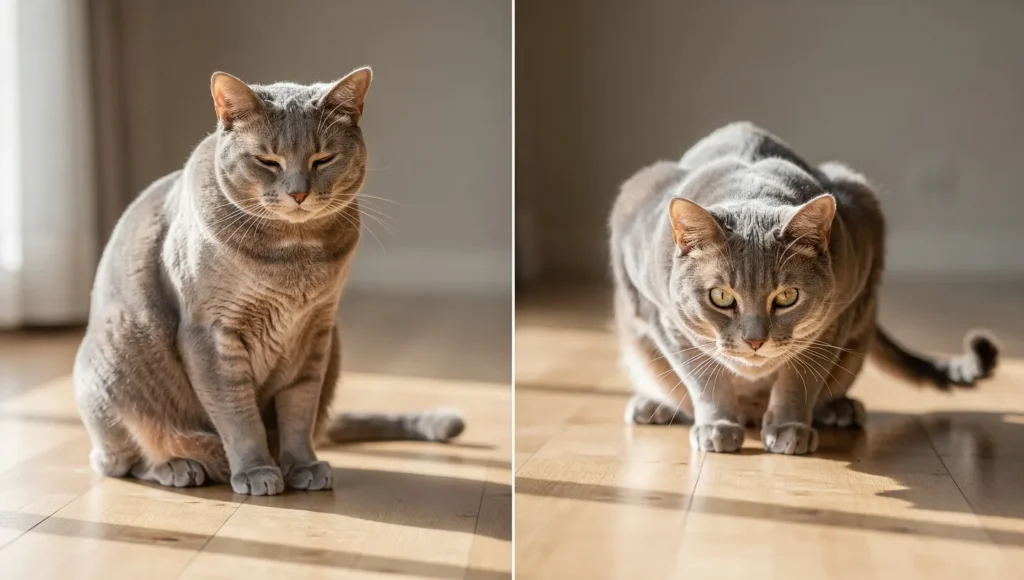
She went very still. Her tail started doing this slow, stiff swish. Her ears went back. Her whole body looked different — tighter somehow.
Before I could say anything, she swiped at my nephew’s hand. Nothing serious, thank God, just a warning scratch. But it shook me. I thought, I need to understand what just happened.
That evening, after they left, I started digging. I read everything I could find, texted my friend Diane who volunteers at a local shelter, and eventually started to piece it together. Luna hadn’t attacked out of nowhere. She’d been screaming at us — in her own language — for at least two minutes before it happened. I just hadn’t been paying attention.
This guide is everything I learned, and everything I wish I’d known before that afternoon.
Quick note: this article is based on personal experience and research from trusted sources like ASPCA and PetMD. It’s meant to help you understand your cat better — not to replace a visit to your vet. If your cat’s behavior changes suddenly or seems extreme, please talk to a professional.
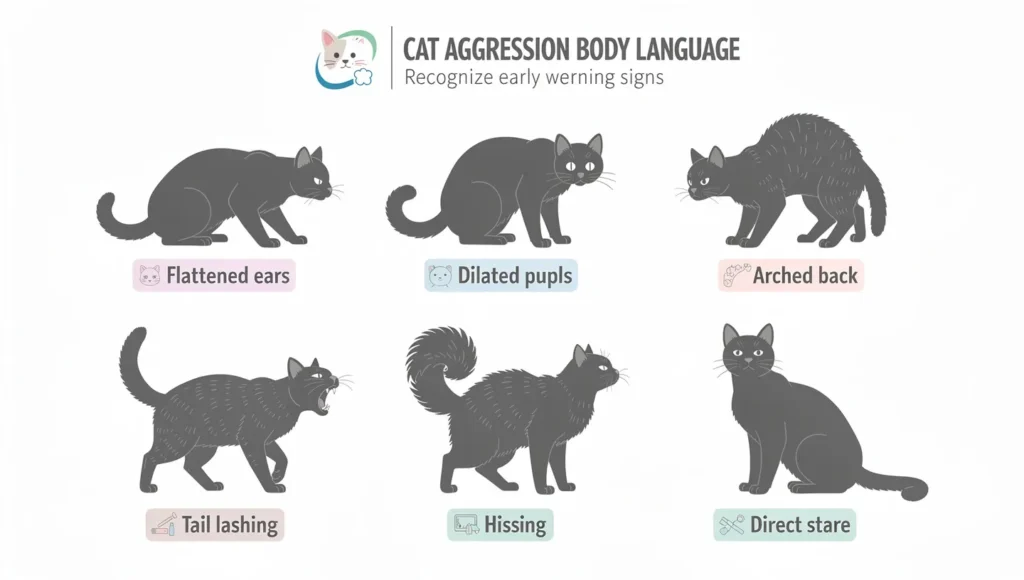
Table of Contents
- Why Do Cats Show Aggression?
- The 7 Warning Signs Your Cat Is About to Attack
- 1. Ears Pinned Flat or Rotated Back
- 2. Pupils Fully Dilated (or Narrowed to Slits)
- 3. Tail Lashing or Thumping Hard
- 4. Arched Back and Puffed-Up Fur
- 5. Crouched, Frozen Posture or Slow Stalking
- 6. Hissing, Growling, or Spitting
- 7. Hard, Unblinking Direct Stare
- Play Aggression vs Real Aggression — How to Tell the Difference
- Types of Cat Aggression You Should Know
- Fear Aggression
- Territorial Aggression
- Redirected Aggression
- Overstimulation Aggression
- Why Is My Cat Suddenly Aggressive? (When to Worry) {#sudden}
- What to Do When You See These Signs {#what-to-do}
- 👉 A Few Questions Cat Owners Always Ask
- How do I know if my cat is about to attack?
- Why did my cat attack me unprovoked?
- What does an aggressive cat look like?
- Cat ears back — aggressive or just annoyed?
- Is hissing always a sign of aggression?
- One Last Thing
Why Do Cats Show Aggression?
Cats don’t attack randomly. Almost every aggressive episode has a reason — even when it doesn’t feel that way to us.
Here’s the thing most people get wrong: they treat aggression as a personality flaw instead of a communication system. Luna wasn’t being mean that afternoon. She was overwhelmed, overstimulated, and completely out of options. The swipe was a last resort — not a first choice.
According to the ASPCA{target=”_blank”}, aggression is one of the most common behavioral issues reported by cat owners, and the majority of cases have identifiable triggers.
Cats are hardwired for self-preservation. In the wild, showing weakness is dangerous. So they don’t broadcast distress the way dogs do — no whimpering, no running to you for comfort. Instead, they send signals that most of us never learned to read. Flattened ears. Twitching tails. Hard stares. A body that looks coiled.
Personally, I think the saddest part is that by the time a cat actually hisses or swipes, they’ve already tried everything else. They’ve been politely asking to be left alone for minutes. We just missed it.
Once I understood that, everything changed with Luna. Not because she became a different cat — but because I became a more observant owner.
The 7 Warning Signs Your Cat Is About to Attack
Before a cat attacks, they almost always send a clear chain of warning signals. Learning to recognize early cat aggression signs gives you a window — sometimes just seconds — to de-escalate before things go wrong. — sometimes just seconds — to de-escalate before things go wrong.
Here are the seven most reliable cat aggression signs to watch for:
1. Ears Pinned Flat or Rotated Back
This is usually the first visible signal, and it’s easy to miss if you’re not looking for it.
A relaxed cat holds their ears upright and slightly forward — like two little radars scanning the room. The moment stress kicks in, those ears start rotating. First sideways (like airplane wings), then fully flattened against the skull.
Flat ears mean one thing: I am not okay right now.
Combined with any other sign on this list, flattened ears should be your immediate cue to back off and give the cat space. I noticed Luna doing this right before the scratch. Her ears had been “airplane mode” for at least a minute. I just didn’t connect the dots in time.
Want to go deeper on this? Cat Ear Position Meaning breaks down every ear position and what it’s really communicating.
2. Pupils Fully Dilated (or Narrowed to Slits)
Pupil size is one of the most honest things about a cat — they can’t fake it.
Fully dilated pupils (big, round, black) in normal lighting = high arousal. That could mean fear, excitement, or aggression. Context matters here. A cat stalking a toy has dilated pupils. So does a cat about to attack.
Narrowed, slit-like pupils in a tense body = cold, focused aggression. That’s actually the more dangerous one. It means the cat has made a decision.
One important note: dilated pupils alone don’t always mean aggression. A cat playing with a feather wand will also have wide pupils. Always read the whole picture, not one signal in isolation.
3. Tail Lashing or Thumping Hard
Most people think a wagging tail means a happy cat. That’s dogs. In cats, it’s almost the opposite.
A slow, low tail swish = mild irritation or focus. A fast, hard lash back and forth = escalating agitation. A stiff tail held low and thumping the floor = get out of the way.
The speed and intensity of the tail movement tells you how fast the situation is escalating. Luna’s tail that afternoon was doing the slow stiff swish — building up, not releasing tension. By the time it was lashing, she was already past the point of no return.
For a full breakdown of what the tail is saying, Cat Tail Language covers every position and movement in detail.
4. Arched Back and Puffed-Up Fur
This one looks dramatic because it is dramatic.
An arched back with fur standing on end (piloerection) is a cat making themselves look as large and threatening as possible. It’s a fear response that also signals they are ready to fight if pressed.
You’ll usually see this combined with a sideways stance — the cat positions their body at an angle to appear even bigger. It’s pure instinct, completely involuntary.
This is not a bluff you should test. A cat in this posture is genuinely distressed and will follow through.
5. Crouched, Frozen Posture or Slow Stalking
Here’s the thing — not all pre-attack body language is big and dramatic.
Sometimes a cat goes very still. Weight shifts forward. Body lowers. Head drops just slightly. Eyes lock on the target. This is the stalking posture, and it means the cat has shifted into predator mode — whether the “prey” is a toy, a bird outside, or unfortunately, a moving hand.
This is actually scarier than the puffed-up posture, because it’s quieter. No hissing, no arched back. Just stillness and focus.
If you see your cat freeze and stare like this — especially at a person — stop moving and give them an out.
6. Hissing, Growling, or Spitting
By the time you hear these sounds, the cat has been warning you for a while.
Hissing is a cat’s way of saying this is your last warning. Growling is sustained — it means the threat is still present and the cat is still on high alert. Spitting is rare but intense — a sharp, explosive sound that usually accompanies a sudden startle.
Most people get this wrong: they think hissing means the cat is being aggressive. Actually, it’s the opposite — hissing is the cat trying to avoid a fight. They’re giving you the chance to back down.
Don’t punish a hiss. Don’t try to soothe the cat by getting closer. Just give space.
7. Hard, Unblinking Direct Stare
In cat language, a direct unblinking stare is a challenge.
It’s the opposite of the slow blink (which is a sign of trust and affection — here’s what the slow blink actually means). A hard stare with a rigid body means the cat is assessing whether to escalate.
Two cats doing this at each other is a standoff. A cat doing this at a person usually means they feel cornered or threatened.
Look away slowly. Don’t stare back. Don’t lean in. Averting your gaze signals that you’re not a threat — and it genuinely works.
Quick Reference Table — Cat Aggression Warning Signs
| Sign | What It Looks Like | Urgency Level |
|---|---|---|
| Ears pinned flat | Ears pressed against skull | ⚠️ Early warning |
| Dilated pupils (in context) | Large round black pupils, tense body | ⚠️ Monitor closely |
| Tail lashing hard | Fast, stiff side-to-side whipping | 🔴 Back off now |
| Arched back + puffed fur | Body raised, fur standing up | 🔴 Do not approach |
| Frozen / stalking posture | Low, still, eyes locked | 🔴 Give space immediately |
| Hissing or growling | Audible warning sounds | 🔴 Last warning |
| Hard direct stare | Unblinking, rigid body | ⚠️ Look away slowly |
Play Aggression vs Real Aggression — How to Tell the Difference
Play aggression is the most common reason cats scratch or bite their owners — and most people don’t even realize it’s happening until it’s too late.
The good news: the difference is pretty clear once you know what to look for.
| Play Aggression | Real Aggression | |
|---|---|---|
| Body language | Relaxed, bouncy, dilated pupils | Tense, low, ears flat |
| Sound | Silent or light chirping | Hissing, growling |
| Target | Hands, feet, moving objects | Specific person or animal |
| After the bite | Cat runs off playfully | Cat stays tense or retreats and hides |
| Trigger | Boredom, understimulation | Fear, pain, territory, overstimulation |
Personally, I went through a solid two weeks thinking Luna was just “playing rough.” She wasn’t aggressive — she was bored and under-stimulated. The fix wasn’t discipline. It was two 10-minute play sessions a day with a wand toy, and the biting stopped almost completely.
If your cat is doing the play version, the problem is usually energy with nowhere to go — not a personality issue.
Types of Cat Aggression You Should Know
Not all aggression looks the same, and the type matters because the solution is different for each one.
Fear Aggression
Cat feels trapped or threatened with no escape route. Classic signs: crouched body, ears flat, hissing. Give an exit and the aggression usually stops on its own.
Territorial Aggression
Common when a new pet or person enters the home. The cat isn’t being mean — they’re protecting what feels like their space. Slow, structured introductions help enormously. (This guide on introducing two cats walks through the whole process.)
Redirected Aggression
This is the sneaky one. The cat gets aroused by something they can’t reach (a bird outside, another cat on the street) and redirects that energy onto whoever is nearby — including you. The attack feels completely unprovoked because the real trigger happened minutes earlier.
Overstimulation Aggression
Petting goes fine for two minutes, then the cat suddenly bites your hand. This isn’t random. Cats have a stimulation threshold, and when it’s crossed, they snap. Watch for the tail starting to flick during petting — that’s the early warning sign. Stop before you reach it.
Why Is My Cat Suddenly Aggressive? (When to Worry) {#sudden}
This is where you need to pay close attention.
Sudden cat aggression signs with no obvious trigger are almost always a medical issue until proven otherwise. Pain, hyperthyroidism, dental disease, neurological problems — all of these can flip a cat’s behavior overnight.
Go to the vet promptly if:
- The aggression appeared suddenly with no behavioral trigger
- Your cat is also hiding more, eating less, or moving differently
- They react aggressively when touched in a specific area (possible pain)
- They’re older — senior cats are more prone to pain-related behavioral changes
A behavioral cause needs a behavioral solution. But a medical cause needs a vet. Don’t try to train your way out of a pain problem. Knowing how to tell if your cat is sick is genuinely one of the most important skills you can develop as an owner.
What to Do When You See These Signs {#what-to-do}
Simple, fast, effective — in that order.
Do this:
- Stop all movement immediately
- Avert your gaze — don’t stare back
- Give the cat a clear escape route
- Back away slowly and calmly
- Let the cat decompress on their own timeline — don’t follow them
Never do this:
- Raise your voice or use physical punishment
- Try to pick up or restrain an agitated cat
- Stare them down or lean toward them
- Force interaction after an episode
And this is important: if someone gets scratched or bitten, wash the wound thoroughly with soap and water right away. Cat bites in particular can cause infection quickly — according to the AVMA{target=”_blank”}, they carry a high risk of bacterial infection even when they look minor.

👉 A Few Questions Cat Owners Always Ask
How do I know if my cat is about to attack?
The clearest pre-attack signals are ears pinned flat, pupils fully dilated, tail lashing hard, and a low frozen body. If you see two or more of these together — stop moving and give space immediately.
Why did my cat attack me unprovoked?
It probably wasn’t unprovoked — the trigger was just something you didn’t notice. Redirected aggression (arousal from something outside), overstimulation, or pain are the three most common causes of seemingly random attacks.
What does an aggressive cat look like?
Tense body close to the ground, ears flattened, pupils dilated or narrowed to slits, tail low and stiff or actively lashing. They look “coiled” — like they’re ready to spring. Very different from a relaxed, loose-bodied cat.
Cat ears back — aggressive or just annoyed?
Ears rotating sideways (“airplane mode”) = mildly annoyed or anxious. Ears fully flattened against the skull = genuinely stressed or preparing to act. Context and the rest of the body tells you which.
Is hissing always a sign of aggression?
No — and this matters. Hissing is actually a de-escalation attempt. The cat is trying to warn you off so they don’t have to fight. A hissing cat wants you to back away. Respect it and they usually don’t need to go further.
One Last Thing
Reading these cat aggression signs won’t make your cat less aggressive overnight. But it will make you a faster, calmer responder. But it will make you a faster, calmer responder — and that alone changes the whole dynamic.
Luna still has moments where she’s done with being touched and her tail starts going. The difference now is I notice it at the tail-swish stage, not the swipe stage. We haven’t had an incident in over a year.
Your cat isn’t trying to be difficult. They’re just talking. Once you learn the language, the whole relationship shifts.
If this helped, share it with a fellow cat owner — especially anyone with kids around cats. And if you’ve had a scary moment with your own cat that you figured out eventually, drop it in the comments. Those real stories help more people than any article can.