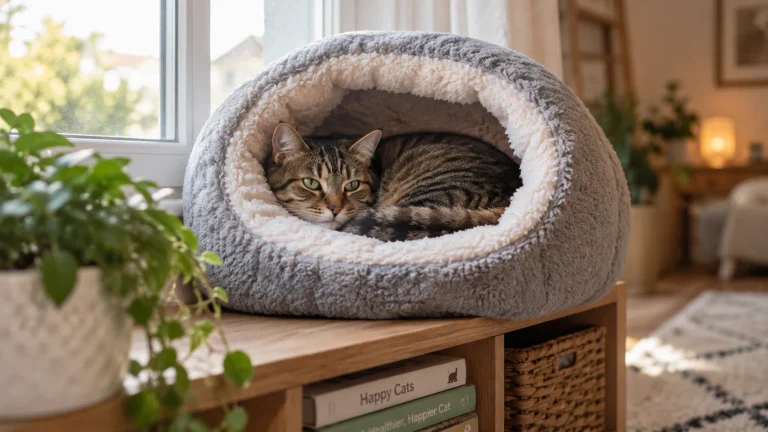

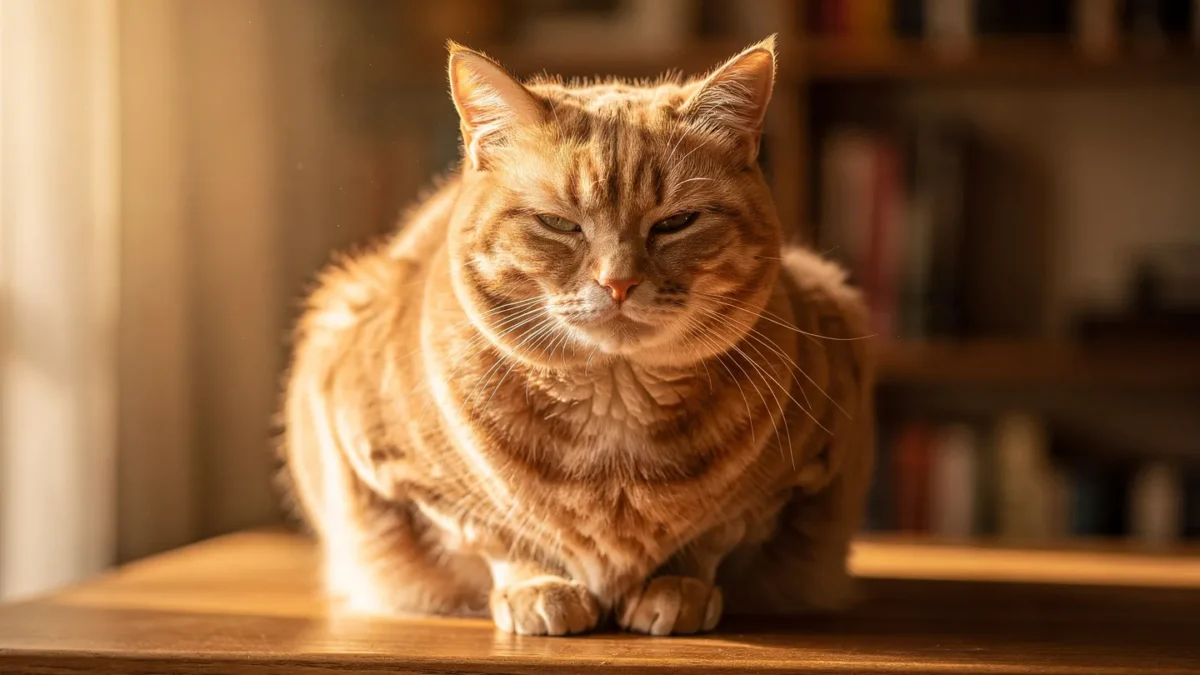
I still remember the afternoon at Groundwork Coffee in Los Feliz — one of those lazy Saturdays where the conversation drifts from work drama to our cats. Lisa, my coworker who treats her cat Mochi like a small, judgmental roommate, pulled out her phone to show me a photo.
“Does this look weird to you?” she asked, sliding her screen across the table.
Mochi was sitting hunched in the corner of the bathroom — back rounded, head slightly low, paws tucked tight underneath her. Not the classic “loaf.” Something different. Something that made my stomach drop a little.
“When did she start doing this?” I asked.
Lisa shrugged. “Like… two days ago? I thought she was just being dramatic.”
Here’s the thing — I’d seen that posture before. With my own cat, Beans, about three years earlier. And I also thought it was just Beans being Beans. Spoiler: it wasn’t.
That conversation at Groundwork is honestly what pushed me to get really serious about understanding cat posture meaning. Because once you learn the language, you can’t un-know it. Because once you learn the language, you can’t un-know it. You start seeing things in your cat you never noticed before — and sometimes, that changes everything.
Quick note before we dive in: Everything in this guide is based on personal experience and research from trusted sources like the ASPCA and PetMD. It’s meant for informational purposes only and doesn’t replace a visit to your vet. When in doubt, call your vet — always.
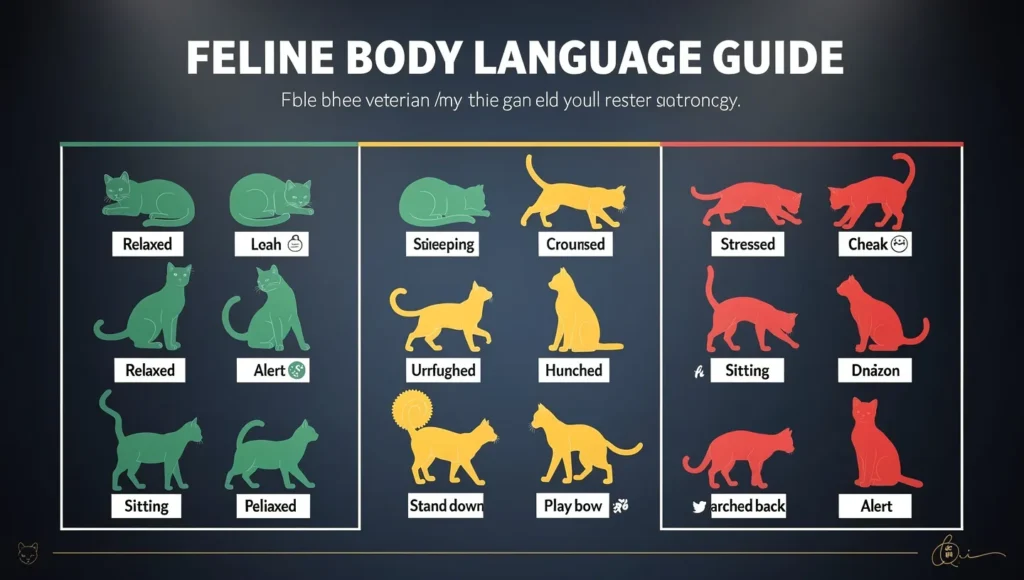
Table of Contents
- Why Your Cat’s Posture Is More Than Just “How They’re Sitting”
- The 17 Cat Postures Decoded (And What Each One Really Means)
- 1. The Loaf Position (A Classic Cat Posture Meaning) 🟢
- 2. The Full Stretch (Belly Up) 🟢
- 3. The Slow Curl (Side Sleeping) 🟢
- 4. The Tucked Paws Sit 🟢
- 5. The Upright Alert Sit 🟡
- 6. The Hunch (The Most Critical Cat Posture Meaning) 🔴
- 7. The Halloween Arch 🟡
- 8. The Low Crouching Stalk 🟡
- 9. The Head Press Against Wall 🔴
- 10. The Slow Blink Sit 🟢
- 11. The Tail-Wrapped Sit 🟢
- 12. The Kneading Crouch 🟢
- 13. The Butt Loaf 🟢
- 14. The Flattened Ears Crouch 🔴
- 15. The “Dead Cat” Flop 🟢
- 16. The Bread Loaf with Half-Closed Eyes 🟢
- 17. The Paw-Over-Nose Sleep 🟢
- Reading the Full Picture — Posture + Tail + Ears + Eyes Together
- 🚨 Red Flag Postures — When to Call the Vet Immediately
- What Lisa’s Cat Taught Me (The Part I Didn’t Expect)
- You Asked, I Answered
- What does it mean when a cat sits hunched over?
- Why does my cat’s posture look “off” sometimes?
- What does a relaxed cat sitting posture look like?
- When should I worry about my cat’s posture?
- Can posture alone tell me if my cat is sick?
- One Last Thing
Why Your Cat’s Posture Is More Than Just “How They’re Sitting”
At its core, cat posture meaning refers to the intentional and instinctive body positions cats use to communicate their emotional state, comfort level, and physical health. Understanding the specific cat posture meaning in different contexts is the key to unlocking your pet’s silent language.
Cats don’t talk. But they never stop communicating.
Every position your cat holds — the tight tuck of the paws, the angle of the spine, the height of the head — is a sentence. Sometimes it says “I’m living my best life right now.” Sometimes it says “I’m in pain and I don’t know how to tell you.”
The tricky part? A lot of these postures look similar on the surface. And that’s exactly where most owners get it wrong.
This is where things change. Once you understand the difference between a cat that’s just cozy and a cat that’s uncomfortable, you become a genuinely better owner. Not in a dramatic way — just in a quiet, daily way that matters.
A quick note on how this guide works: for each posture, I’ll give you the meaning, the emotional state behind it, and — most importantly — what you should actually do about it.
The 17 Cat Postures Decoded (And What Each One Really Means)
1. The Loaf Position (A Classic Cat Posture Meaning) 🟢
What it looks like: Your cat sits with all four paws tucked neatly underneath the body, forming a perfect bread loaf shape. Tail wrapped around the sides or hidden underneath.
What it means: This is one of the most misunderstood postures — because it can mean a few different things depending on the details. In most cases, the loaf is a sign of contentment and moderate relaxation. Your cat is comfortable enough to tuck away their “weapons” (claws and legs), but still alert enough to move quickly if needed.
Personally, I love the loaf. Beans does it every single morning on the kitchen counter while I’m making coffee, and it took me an embarrassingly long time to realize it was basically her way of saying “I’m watching you but I’m not worried about you.”
What to do: Enjoy it. If the loaf looks tight and tense — paws pressed too hard into the surface, spine slightly rounded — read on to posture .
2. The Full Stretch (Belly Up) 🟢
What it looks like: Cat lying completely on their back, belly fully exposed, legs sprawled in multiple directions. Sometimes with a slightly open mouth.
What it means: This is the trust fall of the cat world. A fully exposed belly means your cat feels 100% safe in their environment. There’s zero threat response happening. They’re not worried about predators, they’re not in pain, and they genuinely feel comfortable around you.
And this is important — a belly-up cat is not an invitation to touch the belly. I learned this the hard way with my first cat, Peanut. The belly display is an emotional signal, not a request. Most cats will immediately snap into defense mode if you reach in. Some won’t. Know your cat.
What to do: Nothing. Bask in the fact that your cat trusts you completely. Maybe take a photo. Definitely don’t ruin the moment.
3. The Slow Curl (Side Sleeping) 🟢
What it looks like: Cat lying on their side, body slightly curled, legs loosely extended. Eyes closed or half-closed.
What it means: Deep relaxation. Your cat has fully committed to rest mode. Unlike the loaf (which keeps them ready to move), the side curl means they’ve decided nothing is happening and nothing needs to happen.
According to PetMD , cats that regularly sleep in open, relaxed positions tend to be in low-stress environments with strong bonds to their owners.
What to do: Let them be. If your cat has suddenly started sleeping in curled positions after previously being a loaf cat, it’s usually just a temperature preference shift.
4. The Tucked Paws Sit 🟢
What it looks like: Similar to the loaf, but the cat is sitting more upright — back straight-ish, front paws tucked neatly underneath, tail wrapped around.
What it means: Calm, content, slightly observant. This is a cat who’s present but unbothered. It’s the feline version of sitting with your arms crossed — not defensive, just… composed.
Mochi does this one constantly, according to Lisa. She calls it “Mochi’s board meeting face.” Which honestly is the most accurate description I’ve ever heard.
What to do: Nothing needed. Just appreciate the tiny professional in your home.
5. The Upright Alert Sit 🟡
What it looks like: Cat sitting fully upright, spine very straight, front legs extended and rigid, eyes wide, ears forward or slightly rotating.
What it means: High attention. Something caught their interest — a sound, a movement, a smell. The emotional state here can range from pure curiosity to low-level anxiety depending on what’s triggering the posture.
A quick and easy way to tell the difference: curious cats will have forward-facing ears and slightly dilated pupils. Anxious cats will have ears that are rotating or slightly pulled back, and their tail may twitch at the tip.
What to do: Watch and wait. If the alertness passes in a few minutes, you’re fine. If your cat stays in this rigid posture for extended periods without a clear trigger, that’s worth noting — especially in combination with other postures.
6. The Hunch (The Most Critical Cat Posture Meaning) 🔴
What it looks like: Back rounded and arched upward, head held low (below shoulder level), neck slightly stiffened, paws pressed firmly into the surface. The cat might look like they’re trying to make themselves smaller. Eyes may be half-closed or glassy.
What it means: This is the one. This is the posture that Lisa sent me a photo of at Groundwork. And this is the one I need you to take seriously.
The hunch is one of the primary visual indicators of pain or physical discomfort in cats. Unlike the defensive Halloween arch (which is a quick, reactive puff-up), the hunch is sustained. Cats in pain will hold this position for hours. They’re not being dramatic. They’re protecting something — usually the abdomen, the spine, or a source of internal discomfort.
Honestly? When Beans first started doing this, I waited two days before I called the vet. I wish I hadn’t.
According to the ASPCA, prolonged hunching combined with lethargy, reduced appetite, or changes in litter box behavior are considered clinical signs that warrant veterinary evaluation.
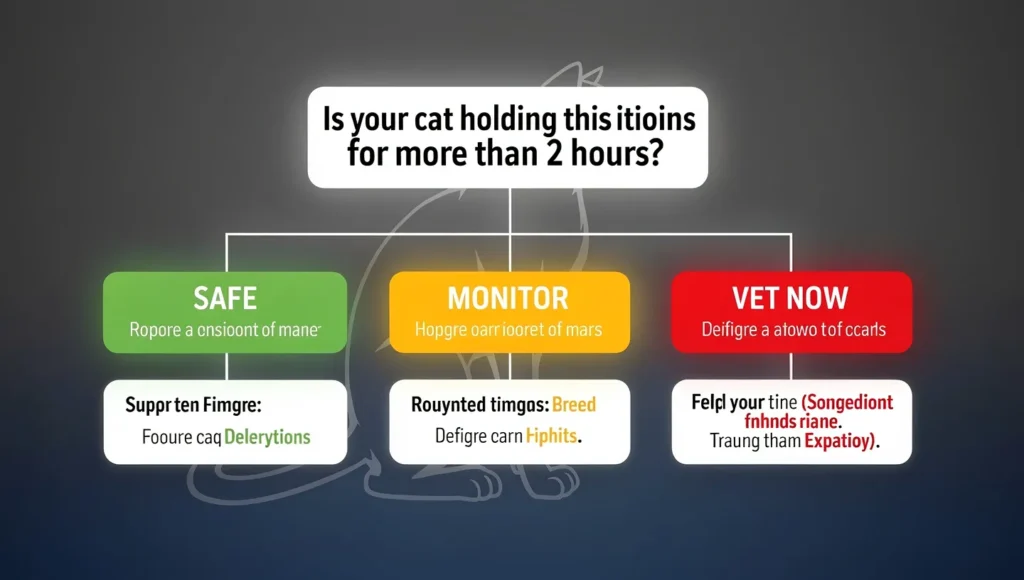
What to do: Don’t wait. If the hunch lasts more than a few hours, or if it comes with any other symptom — not eating, not drinking, hiding, unusual vocalizations — call your vet. This is not a “let’s see how it goes” situation. If you’ve also noticed changes in how your cat is using the litter box, that’s an additional flag — cat peeing outside the box is often connected to the same pain response.
7. The Halloween Arch 🟡
What it looks like: Back arched dramatically upward, fur puffed out along the spine (piloerection), legs stiffened, tail either puffed or held low.
What it means: This is a reactive fear or threat response. Your cat perceived something as dangerous and their body went into full threat-display mode. The goal is to look bigger. It’s instinctive and usually passes quickly.
This is different from the hunch — the Halloween arch is sharp and sudden. The hunch is slow and sustained. If you can remember one thing from this section, let it be that.
What to do: Give them space. Don’t approach. Let the trigger pass. If your cat is doing this regularly around the house without an obvious cause, it might be worth reading up on how to read your cat’s full body language — there may be a stressor in their environment you haven’t identified yet.
8. The Low Crouching Stalk 🟡
What it looks like: Body low to the ground, belly nearly touching the floor, head extended forward, rear slightly raised, slow deliberate movement or complete stillness.
What it means: Two possibilities: predatory focus (they spotted something — a bug, a toy, your foot) or fear-based flattening. The difference is in the energy. A predatory stalk has a certain focused intensity — pupils dilated, tail low and still. A fear crouch has a flattened quality — ears pulled back, body pressed as close to the ground as possible, tail tucked.
What to do: If it’s predatory — enjoy the show. If it looks fear-based, remove the stressor if you can identify it.
9. The Head Press Against Wall 🔴
What it looks like: Cat pressing their head directly into a wall, corner, or surface — not nuzzling, not rubbing. Pressing. Sustained and still.
What it means: This is a medical emergency. Head pressing is a neurological symptom associated with serious conditions including high blood pressure, brain tumors, toxic poisoning, or hepatic encephalopathy. It is not a quirky behavior. It is not cute.
If you ever see this — not even “I think I see this” but actually see it — go to the vet immediately.
What to do: Emergency vet. Now. This is the one posture on this list where there is no “watch and wait.” If you want to know more about recognizing serious symptoms early, this guide on how to tell if your cat is sick is a good bookmark to have.
10. The Slow Blink Sit 🟢
What it looks like: Cat sitting calmly, looking at you, eyes slowly closing and reopening. Sometimes paired with the tucked paws sit.
What it means: This is the feline “I love you.” Cats don’t use this slow blink with threats or strangers. It’s a trust signal — a deliberate lowering of their guard. If you slow blink back, many cats will return it.
I do this with Beans every morning and I’m not even a little embarrassed about it.
What to do: Slow blink back. Gently. No sudden movements. You’re having a conversation.
11. The Tail-Wrapped Sit 🟢
What it looks like: Cat sitting upright with their tail wrapped neatly around their front paws.
What it means: Contentment with a side of composure. This is a cat who’s settled and comfortable. The tail wrap is often a temperature regulation behavior too — it keeps the paws warm. But emotionally, it signals a calm, regulated state.
What to do: Nothing. They’re fine.
12. The Kneading Crouch 🟢
What it looks like: Cat crouching on a soft surface — your lap, a blanket, a pillow — rhythmically pushing their front paws in and out while purring.
What it means: Pure comfort and nostalgia, essentially. This behavior originates from kittenhood when kittens knead their mother to stimulate milk flow. Adult cats carry it into their emotional repertoire as a self-soothing behavior. If your cat is kneading on you, that’s a significant compliment. You are their safe space.
For a deeper look at why cats do this (and what it really means emotionally), check out why cats knead.
What to do: Let it happen. Put a thick blanket on your lap if the claws are an issue.
13. The Butt Loaf 🟢
What it looks like: Cat sitting with their rear end slightly elevated, front legs down, head low. Looks vaguely like they’re about to do something but then decided not to.
What it means: Usually just a transitional resting position — somewhere between alertness and the full loaf. Sometimes cats land here while grooming and just… stay.
Beans does this and it looks profoundly undignified. She doesn’t care. Neither should you.
What to do: Nothing. It’s fine. It’s hilarious. Enjoy it.
14. The Flattened Ears Crouch 🔴
What it looks like: Ears pressed completely flat against the head, body low, tail tucked or lashing, eyes wide.
What it means: Severe fear or aggression. Your cat is overwhelmed. This is the posture of a cat who feels genuinely threatened and is preparing to either fight or flee. Do not approach. Do not try to comfort with physical touch.
What to do: Create distance. Remove the trigger if possible. Give them a safe space to decompress. Paired with understanding cat ear position meaning, this posture becomes much easier to predict before it escalates.
15. The “Dead Cat” Flop 🟢
What it looks like: Cat suddenly falls over onto their side — sometimes dramatically, sometimes mid-walk — and just… lies there.
What it means: The ultimate compliment. This is a cat who feels so safe and comfortable that they simply cannot be bothered to maintain structural integrity. It’s often done at you — in front of you, near you — because they want you to witness their supreme relaxation.
It also means they want attention, and they’ve chosen the most theatrical way to ask for it.
What to do: Pet them. They performed. They deserve the recognition.
16. The Bread Loaf with Half-Closed Eyes 🟢
What it looks like: Classic loaf position, but eyes are heavy, half-open, blinking slowly.
What it means: Drowsy contentment. They’re in that perfect half-awake state — comfortable, warm, not worried about anything. Often seen in afternoon sunlight.
What to do: Let them be. Take a photo. Put it as your wallpaper.
17. The Paw-Over-Nose Sleep 🟢
What it looks like: Cat sleeping with one or both front paws draped over their face, covering their nose.
What it means: Usually just warmth regulation — the nose is one of the areas where cats lose the most heat, and covering it conserves warmth. But it’s also a deep relaxation signal. A cat won’t cover their face unless they feel completely safe.
What to do: Nothing. It’s perfect. Don’t ruin it.
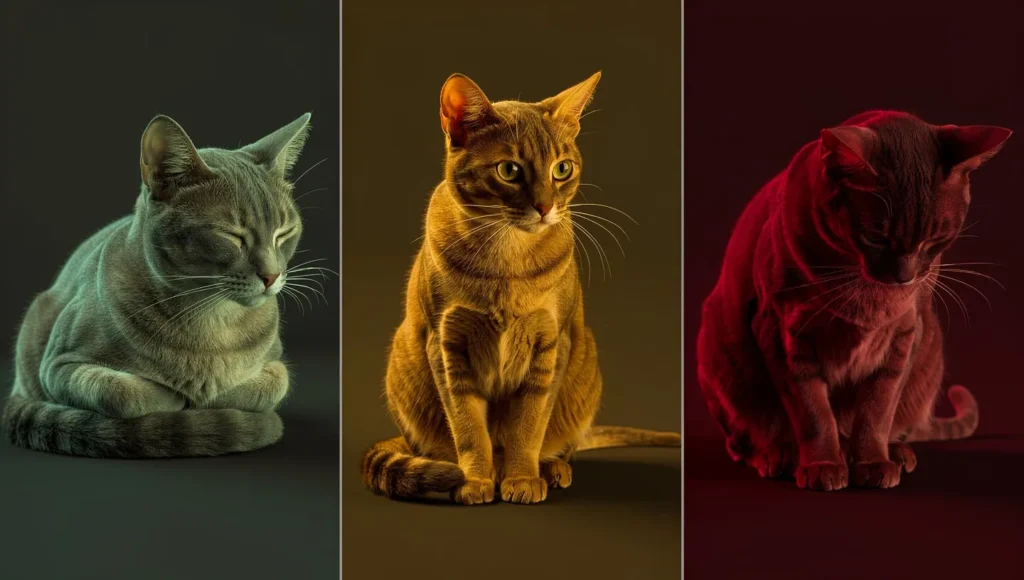
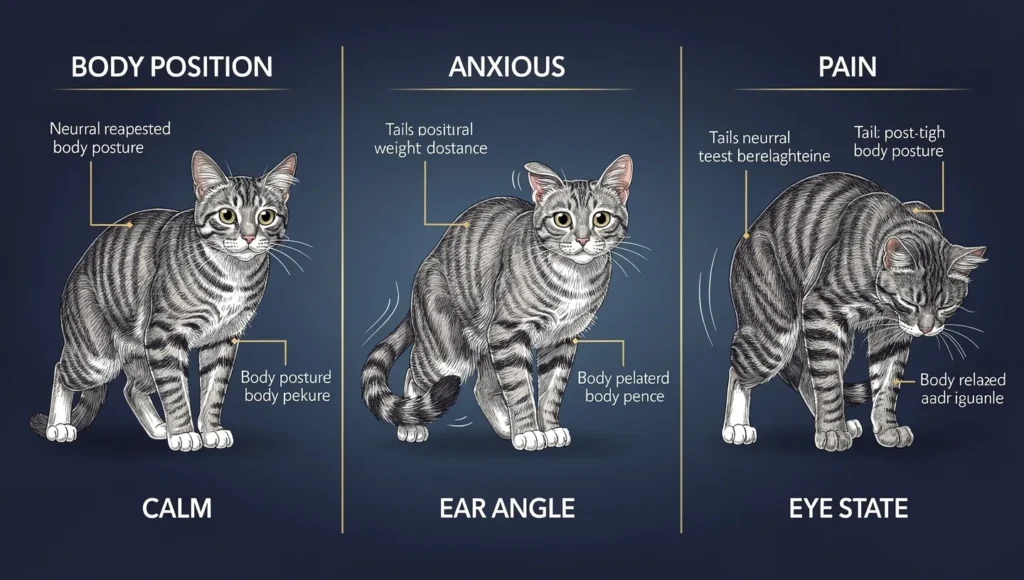
Reading the Full Picture — Posture + Tail + Ears + Eyes Together
Most people get this wrong. They look at one thing — the body — and miss the whole sentence.
Here’s how to read the full signal:
| Signal | Relaxed 🟢 | Anxious 🟡 | Pain/Fear 🔴 |
|---|---|---|---|
| Body | Loose, open loaf or flop | Tight loaf, stiff sit | Hunch, pressed low |
| Tail | Wrapped loosely or still | Twitching at tip | Tucked under or puffed |
| Ears | Forward, soft | Rotating, scanning | Flat against head |
| Eyes | Half-closed, slow blink | Wide, pupils dilated | Glassy, squinting |
One signal alone means little. Three signals pointing the same direction? That’s a clear message.
For a deeper breakdown of tail signals specifically, cat tail language is worth a full read.
🚨 Red Flag Postures — When to Call the Vet Immediately
Honestly, this is the section I wish someone had handed me before the Beans incident.
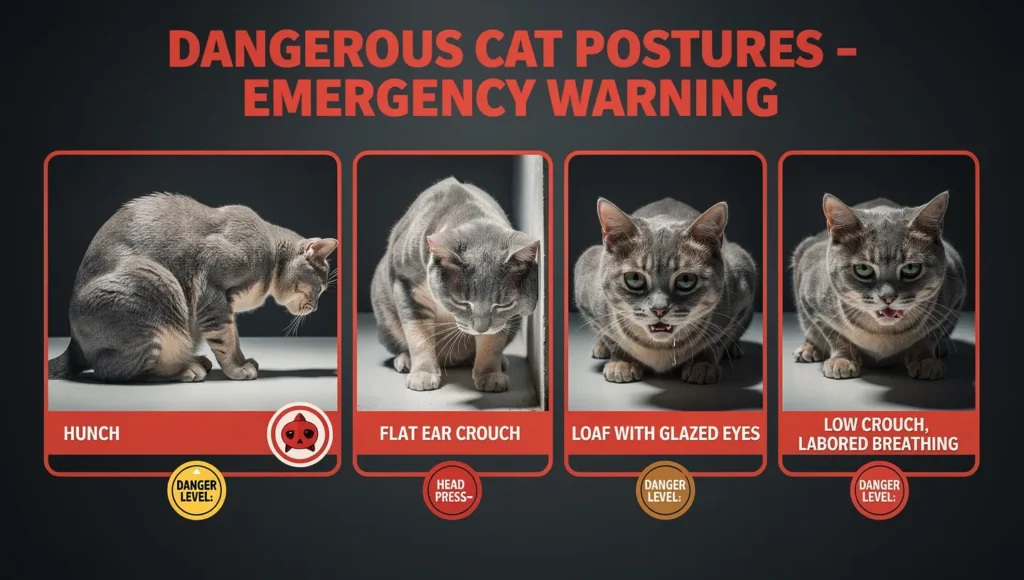
| Posture | What It May Indicate | Action |
|---|---|---|
| Sustained hunch | Abdominal or spinal pain | 🔴 Call vet same day |
| Head pressing against wall | Neurological emergency | 🔴 Emergency vet NOW |
| Flattened ears + crouching for hours | Severe stress or pain | 🔴 Vet evaluation |
| Loaf + glazed eyes + no appetite | Illness, organ issues | 🔴 Call vet |
| Low crouch + labored breathing | Respiratory distress | 🔴 Emergency vet NOW |
| Any posture + sudden behavior change | Could be anything serious | 🟡 Monitor / call vet |
According to the ASPCA, sustained postural changes combined with appetite loss or lethargy are considered clinical warning signs — not something to wait out.
If you’re ever unsure, this guide on how to tell if your cat is sick gives you a clear checklist to run through before you pick up the phone.
What Lisa’s Cat Taught Me (The Part I Didn’t Expect)
I actually circled back to Lisa about two weeks after that coffee at Groundwork. Mochi had been to the vet — early-stage kidney irritation, caught in time, fully manageable. That hunch was the only sign they got.
“Dr. Carter told me if I’d waited another week I probably wouldn’t have noticed until it got worse,” Lisa said.
Dr. Carter, by the way, is one of those vets who doesn’t sugarcoat things but also doesn’t make you feel stupid for missing something. The kind of person who’ll sit with you over a chart for twenty minutes explaining why cats hunch the way they do. I’ve learned more from casual conversations with him than from half the articles I’ve read.
(Also — he once told me, completely deadpan, that the reason cats do the dead flop near you is because “they want credit for being relaxed.” Which is the most cat thing I’ve ever heard.)
The point is: Lisa caught it because she paid attention to a posture she didn’t recognize. That’s the whole game.
You Asked, I Answered
What does it mean when a cat sits hunched over?
It usually signals pain or physical discomfort — particularly in the abdomen or spine. If the hunch is sustained (more than a few hours) or paired with any other symptom, call your vet.
Why does my cat’s posture look “off” sometimes?
Every cat is an individual, and a cat posture meaning can shift based on temperature, mood, and energy levels. One odd position isn’t always a red flag.
What does a relaxed cat sitting posture look like?
Loose body, soft eyes, tail wrapped gently or still, ears forward. If they look like they’re melting slightly — you’re good.
When should I worry about my cat’s posture?
When it’s sustained, unusual for that cat, and paired with other changes — appetite, litter box habits, energy levels, vocalizations. Any one of those combinations is worth a vet call. The signs your cat might be sick guide covers this in more detail.
Can posture alone tell me if my cat is sick?
Not definitively, but analyzing the cat posture meaning is one of the most reliable early signals—especially because cats hide pain so well.
One Last Thing
You don’t need to memorize all 17 postures today. Start with three: the hunch, the head press, and the full flop. One tells you something’s wrong. One tells you it’s an emergency. One tells you everything is exactly right.
The more time you spend observing your cat, the faster decoding every cat posture meaning becomes second nature. It’s the ultimate way to stay connected to your feline friend’s well-being.
And if you’ve got a story about a posture that confused you, scared you, or made you laugh — drop it in the comments. Seriously. Some of the best things I’ve learned about cats came from other owners sharing what they noticed. That’s what makes this community worth something.
What’s the strangest posture your cat has ever done? Tell me below — I read every single one. 👇