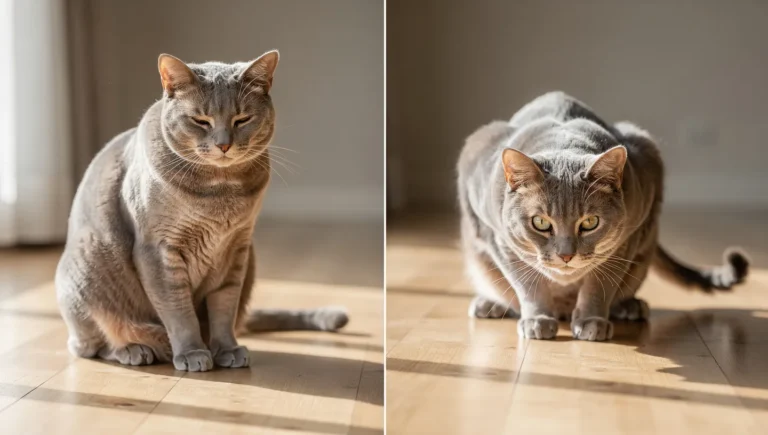

If you want to know how to tell if cat is happy, you should know that I was once clueless—the first time my cat Mochi slow-blinked at me, I thought something was wrong with her eyes.
I literally googled “cat blinking slowly — eye infection?”
Turns out? That slow blink was her way of saying I love you. And I almost took her to the vet for it.
If you’ve ever stared at your cat wondering whether she’s happy,bored, or just silently judging your life choices — you’re not alone. Most of us learned to read dogs. Nobody taught us cats.
And here’s the thing: cats are communicating with you. Constantly. You just need to know what to look for.
Quick note: This article is based on personal experience and research from trusted sources like ASPCA and PetMD. It’s meant to inform, not replace advice from your vet. If something feels off with your cat, always check with a professional.
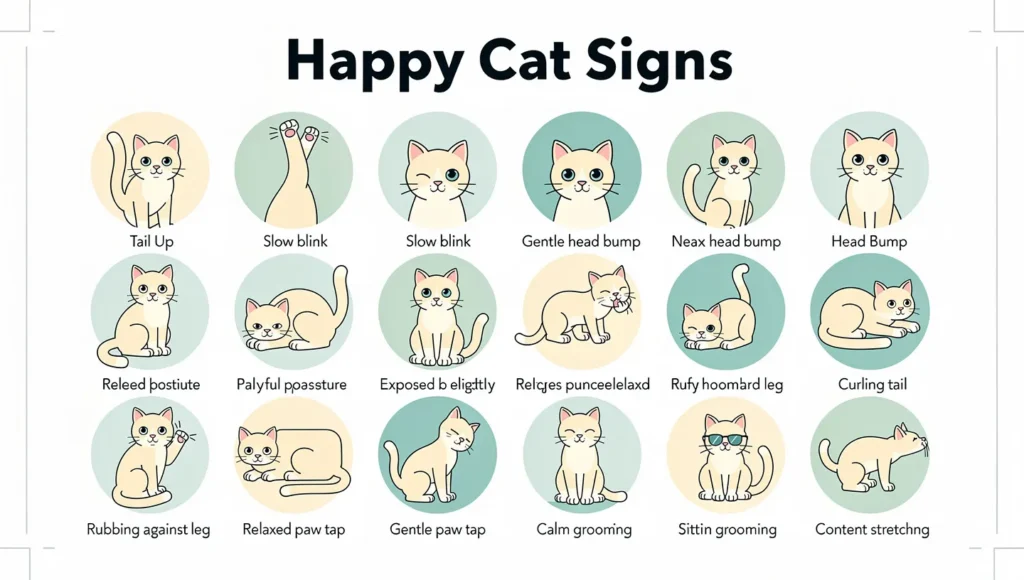
Table of Contents
- So, How Do You Actually Tell if a Cat Is Happy?
- The 15 Signs Your Cat Is Genuinely Happy
- Body Language Signs (1–5)
- Behavioral Signs (6–10)
- Social & Emotional Signs (11–15)
- What Your Cat’s Mood Actually Means (The Context Rule)
- 🟢🟡🔴 The Cat Mood Reading System
- Happy vs. Stressed — The Real Difference
- Signs of a Stressed or Unhappy Cat
- Does Your Cat Actually Trust You?
- Simple Ways to Make Your Cat Even Happier
- Quick Answers to Questions Most New Owners Ask
- How can I tell if my cat is happy at home?
- Does purring always mean a cat is happy?
- Can cats smile?
- How do cats say “I love you”?
- What does a relaxed cat look like?
- How do I know if my cat trusts me specifically?
- One Last Thing
So, How Do You Actually Tell if a Cat Is Happy?
You can tell if a cat is happy by looking for relaxed body language, such as soft half-closed eyes, an upright tail with a curved tip, frequent slow blinking, and a calm, trusting posture around you. Feline happiness is defined by a pattern of these subtle behavioral signals.
Here’s the part most people get wrong when they ask how to tell if cat is happy.
We look for one big obvious sign — like a wagging tail in dogs. But cats don’t work that way. A purring cat isn’t always happy. A quiet cat isn’t always stressed.
Context is everything.
Honestly, once I understood that, everything clicked.
Feline happiness exists on a spectrum:
- Content — relaxed, no demands, just present
- Secure — feels safe in their environment
- Trusting — comfortable showing vulnerability around you
- Excited — engaged, playful, alert
- Overstimulated — looks fine… until suddenly it doesn’t
Most owners only recognize the extremes. For more science-backed insights, the ASPCA confirms that behavioral context is the foundation of feline well-being. The goal of this guide is to help you read everything in between.
The 15 Signs Your Cat Is Genuinely Happy
This is where most articles give you a generic list and call it a day.
We’re going deeper.
Each sign below comes with context — because the same behavior can mean completely different things depending on the situation. And that context? That’s what separates a cat owner from someone who actually understands their cat.
Body Language Signs (1–5)
1. Tail Held High
A cat walking toward you with their tail straight up — maybe with a little curl at the tip — is a genuinely happy cat. That’s a greeting. It’s the feline equivalent of a smile and a wave.
From my experience, Mochi does this every single morning when I walk into the kitchen. Not because she loves me unconditionally — she wants breakfast. But still.
The tail doesn’t lie, and it’s a key indicator of how to tell if cat is happy.
The context rule: Tail up + relaxed body = happy.
Tail up + puffed fur + arched back = something completely different. Read the whole cat, not just one part.
2. Slow Blinking
A relaxed, half-closed eye — followed by a slow, deliberate blink — is one of the clearest trust signals a cat can give you.
According to research published in Scientific Reports, cats are more likely to slow-blink at their owners than at strangers. It’s not random. It’s intentional.
Personally, the first time I slow-blinked back at Mochi and she actually returned it — I felt like we’d finally had our first real conversation.
→ For a full breakdown of what this means, check out our guide on cat slow blink meaning.
3. Relaxed Ears
Happy cat ears sit naturally forward — not pinned back, not rotating like satellite dishes tracking a threat.
When your cat is sitting near you with soft, forward-facing ears and no tension in their face, that’s contentment. That’s a cat who feels safe.
Most people get this wrong — they assume any alert ear movement means something’s wrong. Not necessarily. Curious ears move. Happy ears just… rest.
→ Learn more about reading ear positions in our cat ear position meaning guide.
4. Soft, Half-Closed Eyes
This one pairs perfectly with the slow blink. When your cat looks at you with heavy, half-lidded eyes — like they’re about to doze off mid-stare — that’s pure relaxation.
It means: I feel safe enough to lower my guard around you.
For a prey animal that’s wired to stay alert 24/7, that kind of vulnerability is a big deal.
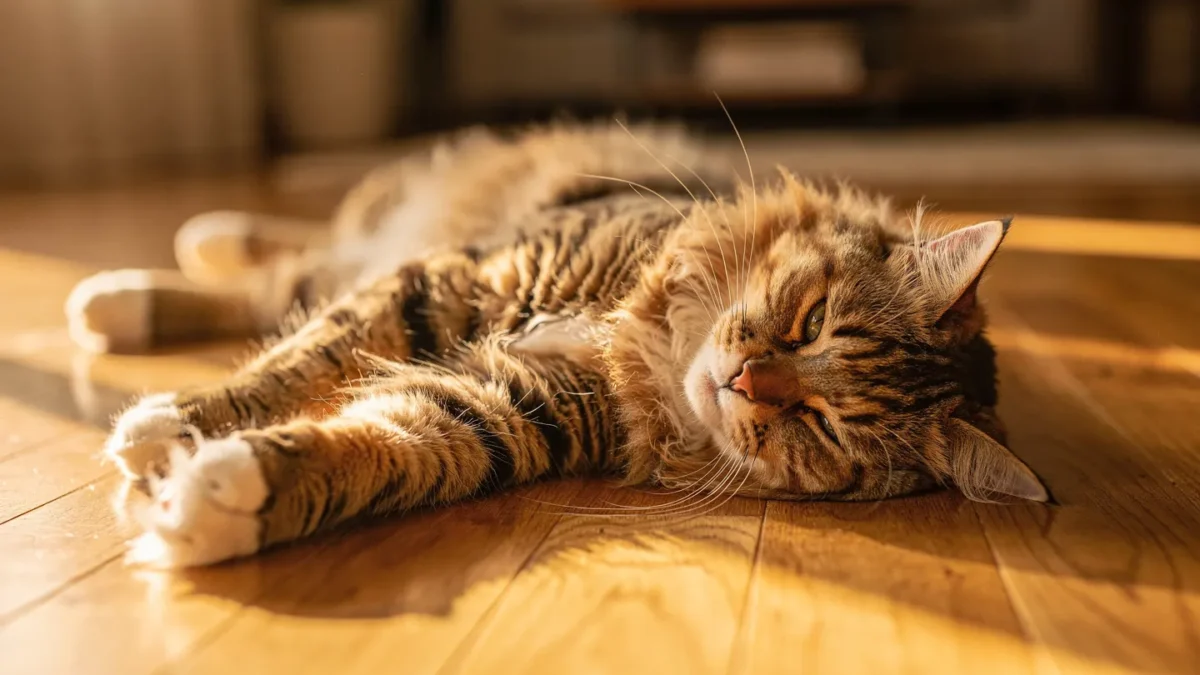
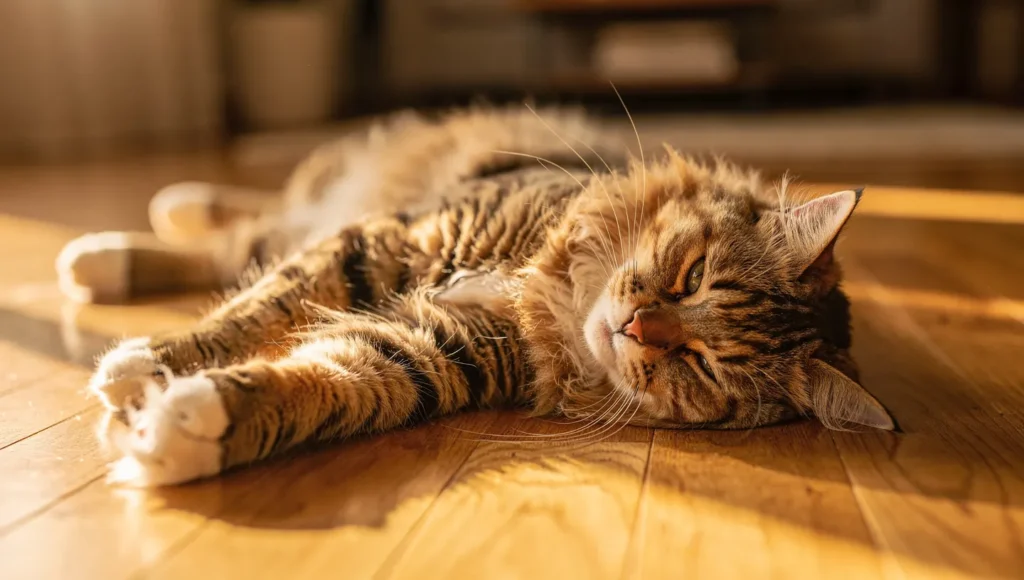
5. The Exposed Belly — Proceed With Extreme Caution
Ah. The belly.
This is where things get dangerous. And I mean that literally.
When your cat rolls over and shows you their stomach, most people’s first instinct is: oh, they want belly rubs!
Wrong.
This is what behaviorists sometimes call the Venus Flytrap Response. Your cat looks soft, open, irresistible. You reach in. And then — scratch, bite, chaos.
Here’s the thing: an exposed belly is a trust signal, not an invitation. Your cat is saying I feel safe enough to show you my most vulnerable spot.
That doesn’t mean please touch it.
Some cats genuinely enjoy belly rubs — Mochi is one of them, but only for about four seconds before she decides she’s done. Read your individual cat. Always.
Behavioral Signs (6–10)
6. Kneading — “Making Biscuits”
That rhythmic push-push-push motion your cat does on your lap, a blanket, or your favorite sweater? That’s kneading. When trying to learn how to tell if cat is happy, this is one of the most deeply comforting behaviors a cat can show.
It starts in kittenhood — kittens knead their mother to stimulate milk flow. In adult cats, it carries over as a sign of deep contentment and safety.
When Mochi kneads on my hoodie at 11pm, I know she’s had a good day.
→ We did a full deep-dive on this behavior here: Why Do Cats Knead?
7. Following You Around
A happy, secure cat wants to be near you. Not on top of you necessarily — just in the same room, aware of where you are.
If your cat follows you from the bedroom to the kitchen to the bathroom (yes, especially the bathroom) — that’s not clinginess. That’s affection.
The distinction matters though.
There’s a difference between a cat who follows you because they enjoy your company, and a cat who follows you because they’re anxious and need constant reassurance.
A happy cat follows you, then settles. An anxious cat follows you and can’t relax.
→ More on this in our guide:
Why Does My Cat Follow Me Everywhere?
8. Head Bunting (The Forehead Push)
Your cat walks up, lowers their head, and bumps it right into your face, hand, or leg.
That’s bunting. And it’s essentially your cat marking you as theirs — in the best possible way.
It deposits their scent on you. It’s territorial, yes — but in a warm, “you belong to my safe world” kind of way. A stressed or unhappy cat doesn’t bunt. They hide.
9. Chirping and Trilling
That little bird-like sound your cat makes — especially when they spot something out the window or greet you at the door — is a happiness sound.
Trilling in particular is a sound cats use almost exclusively with people they like. It’s different from a meow. It’s softer, quicker, more musical.
→ We broke down the full science of this in: Cat Chirping Meaning
10. Active, Engaged Play
A cat that plays — really plays, not just half-heartedly batting at a toy — is a cat with mental and emotional bandwidth to spare.
Play requires a cat to feel safe enough to be not on guard. A stressed cat doesn’t play. A bored cat barely plays.
A happy cat? They’ll stalk that feather wand like their life depends on it.
This is where environment matters a lot. If your cat has stopped playing, that’s worth noticing.
Social & Emotional Signs (11–15)
11. Sleeping Near You (or On You)
Cats choose their sleeping spots very deliberately. They don’t sleep somewhere that feels unsafe.
If your cat sleeps at the foot of your bed, curled against your legs, or on your chest — that’s trust made physical. They’re choosing their most vulnerable state, and they’re choosing to do it near you.
→ Curious why cats specifically sleep near your head?
Here’s the full explanation.
12. Grooming You
When your cat licks your hair, your hand, or your arm — they’re grooming you.
Cats groom the cats they’re bonded to. It’s called allogrooming, and it’s one of the highest forms of feline affection.
You’ve been accepted into the colony. Congratulations.
13. Showing Vulnerability
Beyond the belly — a happy, secure cat will sleep in exposed positions. Stretched out completely. On their back. Legs splayed.
This is called the “dead bug” or “loaf” position depending on the pose. Either way, it screams: I feel completely safe here.
14. Bringing You “Gifts”
Look, I know. Nobody wants a dead mouse at 6am.
But here’s the thing — when your cat brings you something (prey, a toy, a random sock) — they’re sharing. That behavior is rooted in deep trust and affection. In cat logic, they’re providing for you.
It’s strange. It’s also kind of beautiful.
→ Full breakdown here: Why Do Cats Bring Gifts?
15. Purring — In the Right Context
And here’s the sign everyone knows — and almost everyone slightly misunderstands.
Purring is often happiness. But not always.
Cats also purr when they’re anxious, unwell, or in pain. The purr is a self-soothing mechanism as much as an expression of joy.
The difference? Context.
A cat purring while kneading on your lap, eyes half-closed, body fully relaxed = happy.
A cat purring while hunched in a corner, not eating, not moving = something else entirely.
And this is important:
the science behind purring is genuinely fascinating — and it goes way beyond happiness.
What Your Cat’s Mood Actually Means (The Context Rule)
Here’s something most cat content completely ignores.
The same behavior can mean five different things depending on when it happens, where it happens, and what else your cat is doing at the same time.
Most people get this wrong. They see one signal and draw a conclusion. But cats communicate in combinations — not single gestures — which is exactly how to tell if cat is happy or just tolerating the moment.
Think of it like reading a sentence. One word tells you almost nothing. The full sentence tells you everything.
🟢🟡🔴 The Cat Mood Reading System
Use this as a quick reference — not a diagnosis. If something consistently lands in the 🔴 zone, that’s worth a vet conversation.
| Signal | 🟢 Happy/Relaxed | 🟡 Uncertain/Neutral | 🔴 Stressed/Unhappy |
|---|---|---|---|
| Tail position | Upright, soft curl | Low, slow movement | Puffed, tucked under |
| Ears | Forward, relaxed | Slightly rotated | Flat, pinned back |
| Eyes | Soft, half-closed, slow blink | Wide, alert | Dilated, hard stare or avoid |
| Body posture | Loose, open, stretched | Crouched, compact | Arched, frozen, hiding |
| Purring | Relaxed context, kneading | Sitting alone quietly | Hunched, not eating |
| Eating | Normal appetite | Slightly off | Refusing food, hiding |
| Grooming | Regular, calm | Over-grooming slightly | Excessive or none at all |
This is where things change for most owners who read this table.
A cat can look calm — sitting quietly, not making noise — and still be in a state of low-grade chronic stress.
Behaviorists call this chronic stress as opposed to acute stress.
Acute stress is obvious — your cat hides during a thunderstorm. Done, over, they come back out.
Chronic stress is quieter and more damaging. It’s a cat who stopped playing six months ago.
Who eats less but you figured “she’s just not hungry.” Who stopped jumping on the couch where she used to sleep.
Small changes over time. Easy to miss. Worth paying attention to.
Happy vs. Stressed — The Real Difference
I had a neighbor who was convinced her cat Sophie was “just a calm cat.” Sophie barely moved. Sat in one spot most of the day. Never played.
“She’s just low-energy,” she kept saying.
Then she got a second cat — an energetic tabby kitten — and within three weeks, Sophie started playing again. Turned out Sophie wasn’t calm. She was lonely and under-stimulated.
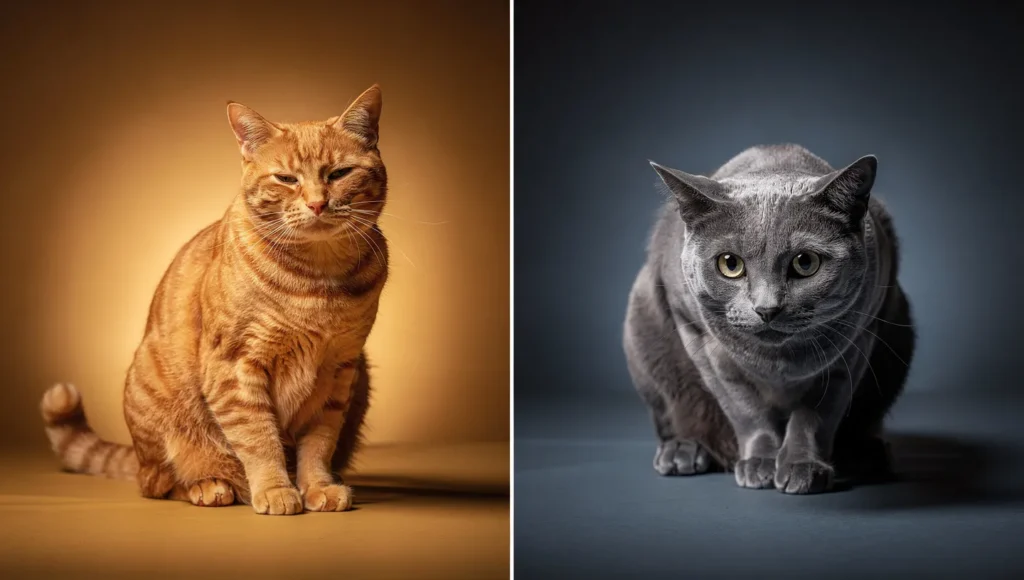
The difference between a relaxed cat and a shut-down cat can look almost identical from the outside. Here’s how to tell them apart:
Signs of a Stressed or Unhappy Cat
- Hiding more than usual — not just napping in a quiet spot,
but genuinely avoiding all social contact - Flattened or pinned-back ears — consistently,
not just during a loud noise - Over-grooming — bald patches, irritated skin,
obsessive licking - Litter box issues — going outside the box
is often stress-related before anything else - Sudden aggression — especially if it’s new behavior
with no obvious trigger - Appetite changes — eating significantly less, or not at all
→ If your cat is hiding a lot, this guide breaks down exactly what that means:
Why Do Cats Hide?
→ And if you’re seeing signs of anxiety or clinginess alongside stress, this might be relevant:
Cat Separation Anxiety: 14-Day Reset Plan
Does Your Cat Actually Trust You?
Honestly, this might be the question behind every question in this article.
Because what most cat owners are really asking when they search “how to tell if cat is happy” is: does my cat actually like me?
And the answer — for most people reading this — is probably yes. Here’s how you know.
Your cat chooses to be near you when they don’t have to.
They have the whole house. They pick your spot.
They show you their slow blink.
From my experience, once a cat starts doing this regularly, the trust is real and established.
They sleep in vulnerable positions around you.
A cat that sleeps fully stretched out, belly up, near you — is a cat that feels completely safe.
They make eye contact without aggression.
Soft eye contact, not a hard stare. There’s a big difference.
→ For the complete guide to reading what your cat’s eyes are communicating:
Cat Eyes Meaning: What Your Cat Is Really Telling You
→ And for the full picture of what every part of their body is saying at once:
Cat Body Language: The Ultimate Expert Guide
Simple Ways to Make Your Cat Even Happier
You don’t need to overhaul your entire life. Small, consistent changes make a real difference.
Give them vertical space.
Cats feel safer when they can be up high. A cat tree or window perch changes their relationship with the whole room.
→ Best Cat Window Perches 2026 — our full guide with safety tips.
Play with them — really play.
Ten minutes of active play with a wand toy does more for your cat’s emotional health than most people realize. It reduces stress, burns energy, and builds trust.
→ Best Interactive Cat Toys — what actually works, and why.
Respect their signals.
When your cat walks away — let them. When they approach — let them lead. Trust is built by respecting the moments they say “not right now.”
Keep their environment predictable.
Cats are creatures of routine. Feeding times, clean litter, familiar scents — these aren’t small things.
They’re the foundation of a cat who feels secure.
Talk to them.
I know how that sounds. But cats learn your voice. They associate it with safety. A soft, calm voice during daily interactions does more than most “calming products” ever will.
Quick Answers to Questions Most New Owners Ask
How can I tell if my cat is happy at home?
Look for a combination of signals — upright tail when greeting you, slow blinking, normal appetite, active play, and choosing to be near you. One sign alone doesn’t tell the full story. The pattern does.
Does purring always mean a cat is happy?
No — and this surprises a lot of people. Cats purr when content, but also when anxious, unwell, or in pain. The difference is context. A purring cat that’s relaxed, kneading, and soft-eyed is happy. A purring cat that’s hiding and not eating needs attention.
Can cats smile?
Not the way humans do — but a slow blink is the closest thing to a feline smile. Soft, half-closed eyes paired with a slow blink is your cat’s version of “I’m happy and I trust you.”
How do cats say “I love you”?
Slow blinking, head bunting, grooming you, sleeping near you, trilling when they see you, and bringing you things — even things you didn’t ask for and definitely don’t want.
What does a relaxed cat look like?
Loose body, no muscle tension, tail low or gently curved, ears forward, eyes soft or half-closed, breathing slow and steady. They look like they have absolutely nowhere to be. Which, honestly, they don’t.
How do I know if my cat trusts me specifically?
They’ll choose your presence when they’re vulnerable — sleeping near you, showing their belly in your direction, slow-blinking at you specifically. Trust with cats is personal.
They don’t give it to everyone in the house equally.
One Last Thing
You don’t need to become a feline behavior expert to make your cat happy.
You just need to pay attention.
Watch the tail. Notice the eyes. Respect the slow blink. Let them lead sometimes.
The fact that you’re even reading an article like this one tells me your cat is already pretty lucky.
Now I want to hear from you.
What’s the most confusing thing your cat has ever done that made you question whether they were happy, bored, or just running their own private agenda?
Drop it in the comments — I read every single one, and honestly some of your stories are better than anything I could write.
And if you have a friend who’s currently staring at their cat trying to figure out if they’re loved or just tolerated — send them this. It might save them a lot of confusion.
And possibly a few accidental scratches.