

So, the other day I got a call from Sami — my sister’s son.
If you’ve been following Felina Care Hub for a while, you might remember him. A few months back, he called me in a mild panic asking whether he should get a cat. He was a total beginner, didn’t know the first thing about what owning a cat actually involves.
I wrote about that whole conversation in our beginner’s cat breed guide, and honestly, the response from you guys was really touching — a lot of you said “this is exactly how I felt too.”
Well, Sami called again.
This time, his cat — a sweet little female he ended up naming Luna — has been with him for a few months now. She’s settled in, she’s running the apartment, and Sami is officially obsessed. His question this time? “I want to get her a proper bed. Like a real one. What should I buy?”
I told him: slow down. Before we talk about what to buy — let’s talk about whether she actually needs one. And that’s exactly what this article is about. Many owners ask, do cats need a bed of their own, or are we just projecting our human needs onto them?
Do cats need a bed? The answer is more interesting than you’d think.
A quick note before we dive in: Everything in this article is based on personal experience living with cats and research from trusted sources like ASPCA and AVMA. It’s meant to be helpful and informative — not a substitute for advice from your vet, especially if your cat has specific health needs.
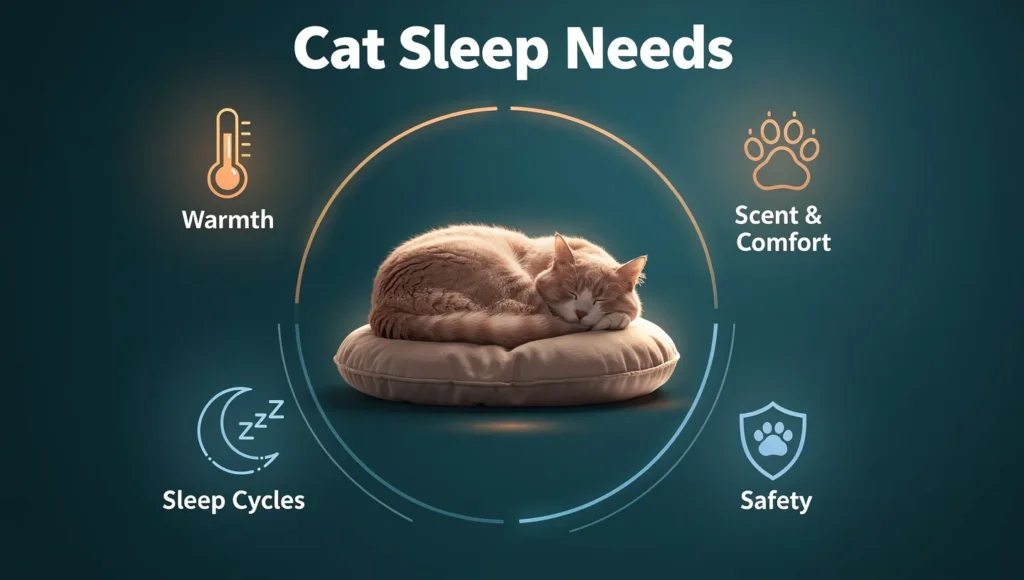
Table of Contents
- Do Cats Need a Bed? (The Honest Answer)
- What Cats Actually Look for in a Sleep Spot
- 1. Smell (This One Is Huge)
- 2. Warmth
- 3. Safety and Height
- 4. Quiet and Low Traffic
- The Science Behind Cat Sleep (And Why It Matters)
- Sleep Cycles: Not So Different From Ours
- Why Sleep Quality Actually Matters
- The Hunting-Rest Cycle
- When a Cat Bed Actually Makes a Difference
- 🐾 Senior Cats (7+ Years): The Orthopedic Case
- 🌡️ Cold-Weather Cats & Lean Breeds: The Heated Bed Case
- 😰 Anxious Cats: The Calming Bed Case
- 🧠 The Memory Foam Question
- The Mistakes Most Cat Owners Make (Including Me)
- How to Pick the Right Spot (More Important Than the Bed Itself)
- Quick Chat: Common Doubts
- Do cats need a bed of their own?
- Should cats sleep with you?
- What type of bed is best for senior cats?
- Why does my cat ignore her bed?
- Why does my cat sleep on the floor instead of her bed?
- Are heated cat beds safe?
- One Last Thing (For Sami — and For You)
Do Cats Need a Bed? (The Honest Answer)
Technically, cats don’t strictly need a store-bought bed — but they absolutely need a dedicated “Safe Zone.”
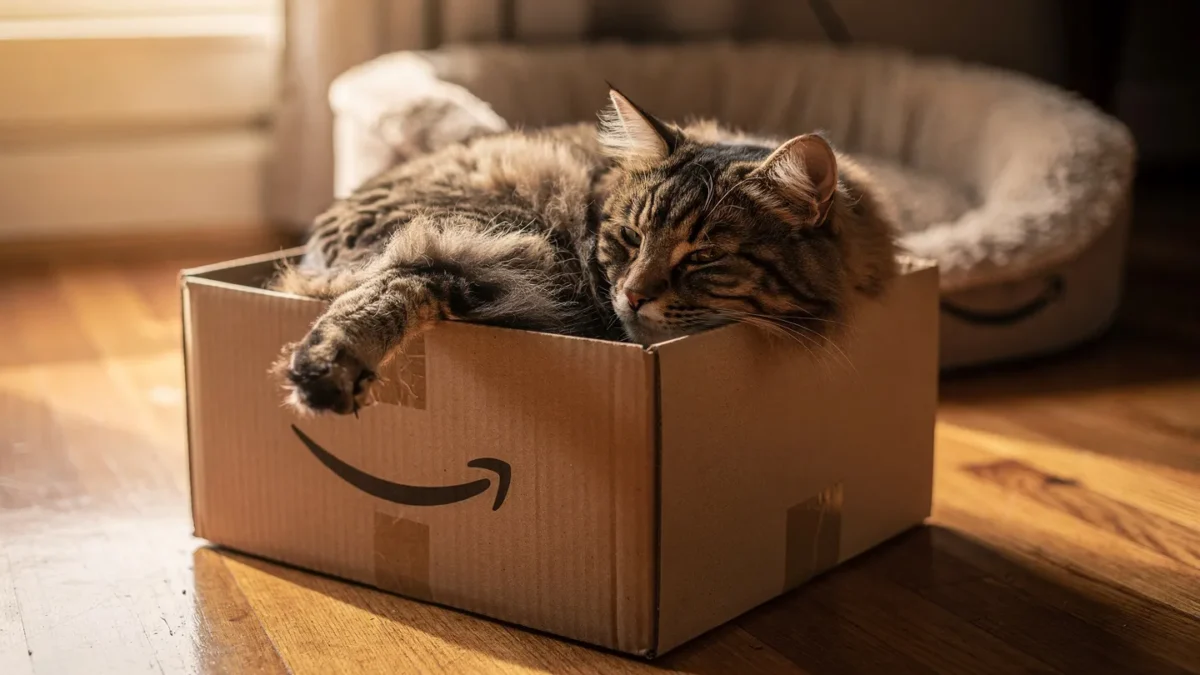
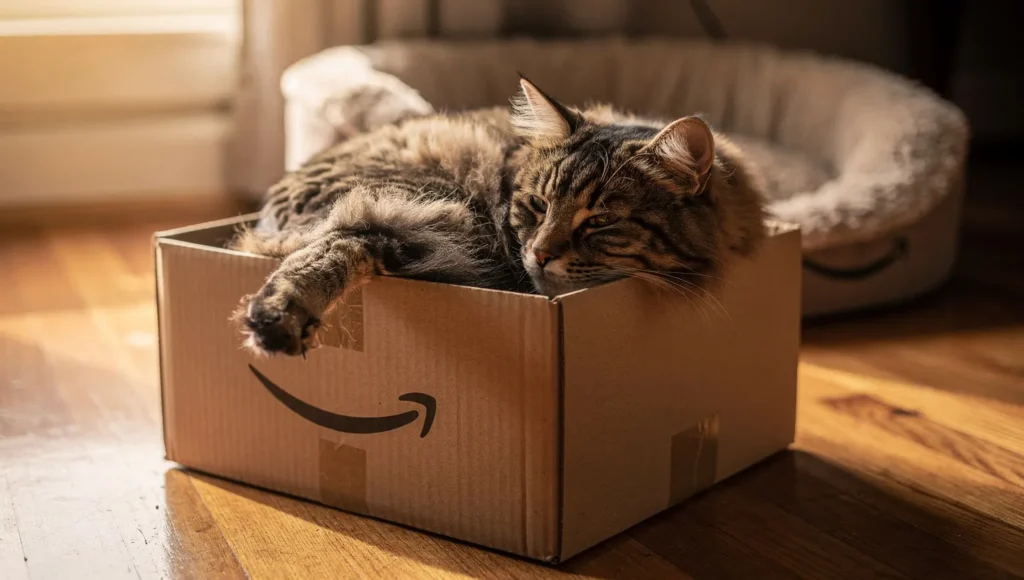
Here’s the difference: a bed is a product. A Safe Zone is a feeling. It’s a spot your cat has mentally claimed as her own — somewhere warm, quiet, familiar, and most importantly, hers. Whether that’s a $90 orthopedic cat bed or a cardboard Amazon box with an old t-shirt in it? Honestly, to your cat, those two things are not that far apart.
That said — and this is important — there are specific situations where an actual cat bed isn’t just nice to have, it genuinely makes a difference. We’ll get into all of that. But first, let’s talk about what your cat is actually looking for when she picks a sleep spot.
What Cats Actually Look for in a Sleep Spot
Most people get this wrong.
They spend weeks researching the fluffiest, most aesthetically pleasing cat bed on Amazon, wondering if cats actually need a bed that matches the living room decor — and then watch their cat walk right past it and curl up in a laundry basket. Sound familiar?
Here’s the thing: cats don’t choose a sleep spot based on how soft it is. They choose based on a completely different set of priorities. And once you understand those priorities, everything starts to make sense.
1. Smell (This One Is Huge)
This is the factor most owners completely overlook — and it’s probably the most important one.
Cats are scent-driven creatures. When your cat picks a sleep spot, she’s not just getting comfortable. She’s essentially saying: “This place smells like me, and that means it’s safe.”
A brand-new bed straight out of the packaging? To her, that thing smells like a factory and a delivery truck. No wonder she ignores it.
From my experience, the fastest way to get a cat to accept a new bed is to put one of your worn t-shirts in it for a day or two. Your scent + her scent = safe territory. It works almost every time.
2. Warmth
Cats run warmer than we do — their body temperature sits between 100.5–102.5°F — and they’re constantly seeking environments that help them maintain that heat.
This is why they gravitate toward sunny patches on the floor, the top of the dryer, or that one specific spot on the couch that happens to be above a heating vent.
A good bed traps body heat. That’s genuinely valuable, especially in colder months or for cats who tend to run on the leaner side.
3. Safety and Height
Cats are predators, but they’re also prey. That dual nature never fully switched off, even after thousands of years of domestication. A sleep spot that feels exposed makes a cat feel vulnerable — even if the biggest threat in your apartment is a Roomba.
This is why so many cats prefer sleeping in boxes, on top of bookshelves, or tucked into corners. Enclosed or elevated spots trigger a sense of security that an open flat bed in the middle of the room simply doesn’t provide.
4. Quiet and Low Traffic
Cats don’t want to sleep next to the TV, near the front door, or in a hallway where people are constantly walking by. They want calm. They want predictable. They want a spot where nobody’s going to accidentally step on them or startle them awake every twenty minutes.
Personally, I think this is where a lot of well-intentioned cat owners go wrong — they put the bed somewhere convenient for them, not somewhere that actually works for the cat.
The bottom line here? Before you buy anything, look at where your cat already chooses to sleep. That spot is telling you everything you need to know about what she actually wants.
The Science Behind Cat Sleep (And Why It Matters)
Here’s a fun fact that surprises a lot of new cat owners: your cat sleeps between 12 and 16 hours a day. Some cats — especially older ones — push that closer to 20 hours.
That’s not laziness. That’s biology.
Cats are crepuscular hunters, meaning they’re naturally wired to be most active at dawn and dusk. The long sleep periods in between? That’s their body conserving energy for the hunt — even if the only “hunt” in your apartment is chasing a feather wand for eight minutes before losing interest.
Sleep Cycles: Not So Different From Ours
Cats cycle through light sleep and deep sleep, just like we do. During light sleep — which makes up the majority of their rest — they stay partially alert. You’ve probably noticed this: your cat looks totally passed out, but the second you open the treat drawer from across the house, she’s instantly awake and staring at you.
Deep sleep, on the other hand, is when the real restoration happens. This is when you’ll see those tiny paw twitches, the whisker flickers, the occasional sleepy chirp.
According to research published by ASPCA, disrupted or poor-quality sleep in cats can contribute to increased stress levels and behavioral changes over time — which is something worth taking seriously.
Why Sleep Quality Actually Matters
This is where it connects back to our original question: do cats need a bed to reach that high-quality deep sleep? The answer lies in the environment you create.
If your cat isn’t sleeping well — because her spot is too cold, too exposed, too noisy, or just uncomfortable — that affects her mood, her immune function, and even her digestion. I noticed this firsthand with my older cat,
Milo. Around age 9, he started sleeping more restlessly, moving from spot to spot through the night. It wasn’t until I set up a warmer, more enclosed sleeping area for him that he finally settled. The difference in his daytime energy was honestly noticeable within a week.
For a deeper look at cat sleeping patterns and what different positions actually mean, I’d recommend checking out this guide we put together:
Why Do Cats Sleep So Much? A Complete Guide to Sleeping Habits & Positions — it covers a lot of the behavioral science behind it in a way that’s pretty eye-opening.
The Hunting-Rest Cycle
Here’s something that doesn’t get talked about enough.
Cats in the wild follow a very specific rhythm: hunt → catch → eat → groom → sleep. That cycle is deeply wired into their nervous system. When indoor cats don’t get enough stimulation before sleep — no play, no “hunt” — that cycle gets disrupted. They become restless, hyperactive at weird hours, or just generally unsettled.
This is why interactive play before bedtime isn’t just fun. It’s actually important for sleep quality. And a consistent, comfortable sleep spot helps close that loop properly.
When a Cat Bed Actually Makes a Difference
Okay, so we’ve established that cats don’t need a bed the way they need food or water. But here’s where things change.
There are specific situations where the right bed isn’t just a nice extra — it’s something that genuinely improves your cat’s quality of life. And if your cat falls into any of these categories, it’s worth paying attention.
🐾 Senior Cats (7+ Years): The Orthopedic Case
This is where I get a little serious.
As cats age, their joints change. Arthritis is incredibly common in older cats — according to AVMA, studies suggest that over 90% of cats over the age of 12 show some degree of degenerative joint disease on X-rays. Most owners never even notice, because cats are masters at hiding discomfort.
A hard floor, a thin blanket, or even a regular soft bed without proper support can put real pressure on aging joints overnight. This is exactly where an orthopedic cat bed — one with memory foam or high-density supportive base — makes a measurable difference.
We’re talking about genuine joint support that reduces pressure points and helps your cat wake up moving more comfortably.
For senior cats, I’d also pair the right bed with a broader care routine. This guide on senior cat care and nutrition covers a lot of the things that often get overlooked as cats age.
🌡️ Cold-Weather Cats & Lean Breeds: The Heated Bed Case
Some cats feel the cold more than others.
Hairless breeds like Sphynx, lean cats with low body fat, very young kittens, and senior cats with slower metabolisms all struggle to retain body heat efficiently. For these cats, a heated cat bed — or even a self-warming bed that uses body heat retention technology — isn’t a luxury. It’s actually closer to a health necessity.
The warmth helps with more than comfort. It keeps muscles relaxed, supports circulation, and can even ease the stiffness that comes with joint issues. Just make sure any heated bed you choose has an auto-shutoff feature and is specifically designed for pets — not a heating pad meant for humans.
😰 Anxious Cats: The Calming Bed Case
If your cat is the nervous type — startles easily, hides
often, or struggles when you’re away — a calming cat bed with high bolstered edges can genuinely help.
The raised sides create that enclosed, den-like feeling that anxious cats crave. It mimics being curled up against something solid — safe on three sides, visible on one.
The deep-cradling design also encourages a curled sleeping position, which is naturally self-soothing for cats.
If your cat shows signs of anxiety beyond just sleep issues, this is worth reading: Cat Separation Anxiety: The 14-Day Reset Plan — it goes deep into what’s actually happening and what you can do about it.
🧠 The Memory Foam Question
A lot of people ask whether memory foam cat beds are actually worth it or just a marketing gimmick.
Honestly? For young, healthy cats — probably not necessary. For cats with joint issues, weight problems, or post-surgery recovery? The pressure-distributing properties of quality memory foam are real and documented.
The key word is quality — cheap memory foam compresses completely within weeks and loses its supportive function entirely.
If you’re going to invest in memory foam, look for at least 2–3 inches of high-density foam as the base layer. Anything thinner is mostly decorative.
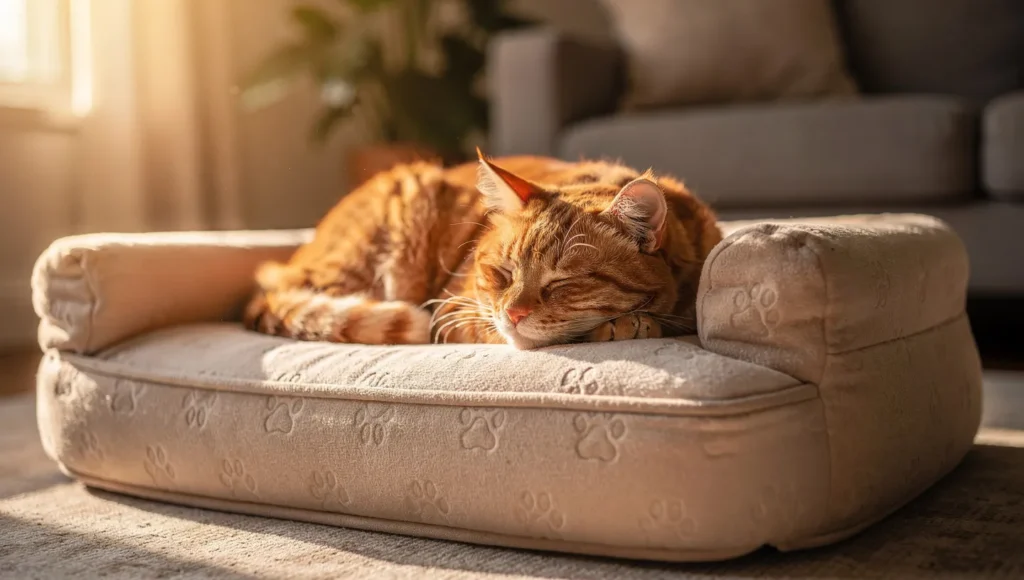
Quick Reference: Which Bed for Which Cat?
| Cat Profile | Best Bed Type | Key Benefit |
|---|---|---|
| Senior (7+ years) | Orthopedic / Memory Foam | Joint Support |
| Hairless / Lean breeds | Heated / Self-Warming | Body Heat Retention |
| Anxious / Nervous cats | Calming / Bolstered | Security & Deep Rest |
| Healthy adult cat | Any — focus on placement | Comfort & Ownership |
| Post-surgery recovery | Memory Foam + Low Entry | Pressure Relief |
The Mistakes Most Cat Owners Make (Including Me)
Been there. Done that. Bought the expensive bed.
When I first got serious about cat care and started asking do cats need a bed or just a quiet corner, I made every mistake in the book.
Here are the ones I see constantly:
- Buying before observing — Watch where your cat
already sleeps for a week before spending a dime.
That spot is your blueprint. - Wrong location — Placing the bed in a high-traffic
area, near loud appliances, or in direct drafts. Cats
need quiet and predictable. - Skipping the scent step — A new bed smells foreign.
Put a worn t-shirt in it for 48 hours before
introducing it. Game changer. - Flat open beds for anxious cats — If your cat
likes to hide, an open flat bed will never work. Go
for bolstered or hooded. - Ignoring the size — A bed that’s too small forces
an unnatural sleeping position. Your cat should be
able to fully stretch out.
Honestly? The $8 cardboard box phase taught me more about my cat’s preferences than any product review ever did.
How to Pick the Right Spot (More Important Than the Bed Itself)
The perfect bed in the wrong spot is still the wrong choice. Here’s what actually works:
- Elevated spots — Near a window ledge or on a stable shelf. Cats feel safer with a view. Pair this with a good cat window perch for maximum effect.
- Away from noise — No TVs, washing machines, or busy hallways nearby.
- Warm zones — Near a sunny window or a gentle heat source. Avoid cold floors and drafty corners.
- Your scent nearby — A spot close to where you spend time works better than an isolated corner.
- Consistent location — Once she accepts a spot, don’t move it. Cats hate change.
According to ASPCA, environmental consistencyis one of the biggest factors in reducing feline stress at home. Location matters more than thread count.
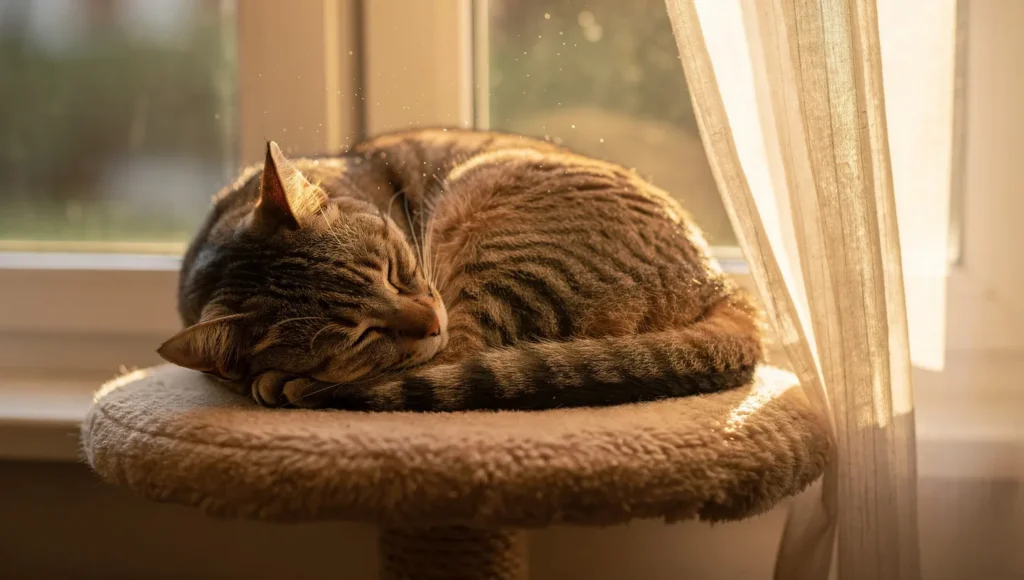
Quick Chat: Common Doubts
Do cats need a bed of their own?
Not strictly — but a dedicated Safe Zone they can always return to reduces stress and helps regulate their sleep-wake cycle. It doesn’t have to be expensive. It has to be theirs.
Should cats sleep with you?
Personal choice — but if your cat already does it and you’re both sleeping well, there’s no harm. If she’s restless or waking you up, setting up an appealing alternative nearby usually solves it.
What type of bed is best for senior cats?
Orthopedic memory foam with low entry points and good joint support. Non-negotiable for cats 7+. Pair it with regular check-ins on mobility — here’s a full guide on senior cat care that covers exactly what to watch for.
Why does my cat ignore her bed?
Almost always one of three things: wrong location, unfamiliar scent, or the wrong bed style for her personality. Try the t-shirt trick, move it somewhere quieter, or switch to a more enclosed design.
Why does my cat sleep on the floor instead of her bed?
The floor might be cooler, or the bed simply hasn’t become “hers” yet. Cats regulate temperature actively — a cool tile in summer beats the warmest fleece bed. If it’s not seasonal, go back to basics: scent, location, enclosure.
Are heated cat beds safe?
Yes — as long as they’re designed specifically for pets and include an auto-shutoff function. Never use human heating pads. For thin-coated or senior cats, a low-wattage self-warming option is often safer and sufficient.
One Last Thing (For Sami — and For You)
When Sami asked me what bed to buy for Luna, my first question was: “Where does she sleep right now?”
He thought about it and said: “On my hoodie. The one I leave on the couch.”
There’s your answer, Sami. Start there. Get something with a similar feel, put it in the same spot, tuck that hoodie inside it for a few days. Luna will figure out the rest.
And if she’s still a kitten or getting older, check the table above and match the bed to where she is in life — not just what looks good on Instagram.
Ultimately, the question shouldn’t just be ‘do cats need a bed,’ but rather, ‘does my cat have a space where she feels 100% safe? The right bed isn’t the most expensive one. It’s the one your cat actually uses.