
My nephew Sami called me on a Tuesday night, which already felt suspicious. He never calls — he texts. So when I picked up, I knew something was up.
“I want to get a cat,” he said. “But I have no idea where to start. Like… which one won’t drive me crazy?”
I laughed. Because honestly? I asked the exact same question years ago. And I got the wrong answer.
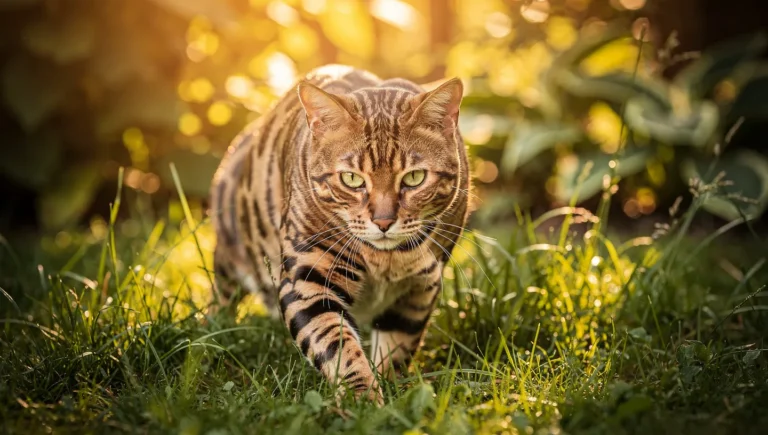
I ended up with a Bengal. Beautiful cat. Absolutely unhinged energy. As a first-time owner with a 9-to-5 job and a one-bedroom apartment, it was… a lot. I loved her, but I won’t lie — there were weeks I felt completely overwhelmed.
So when Sami asked me that question, I didn’t just send him a list. I sat down and really thought about what makes a cat actually work for someone who’s never done this before.
This guide is basically that conversation — just written down to help you find the best cat breeds for beginners that actually fit a modern lifestyle.
📌 Quick Disclaimer: Everything here is based on personal experience and research from trusted sources like ASPCA and AVMA. I’m not a vet, and this isn’t medical advice. If you have specific health concerns about a breed, always check with a professional.
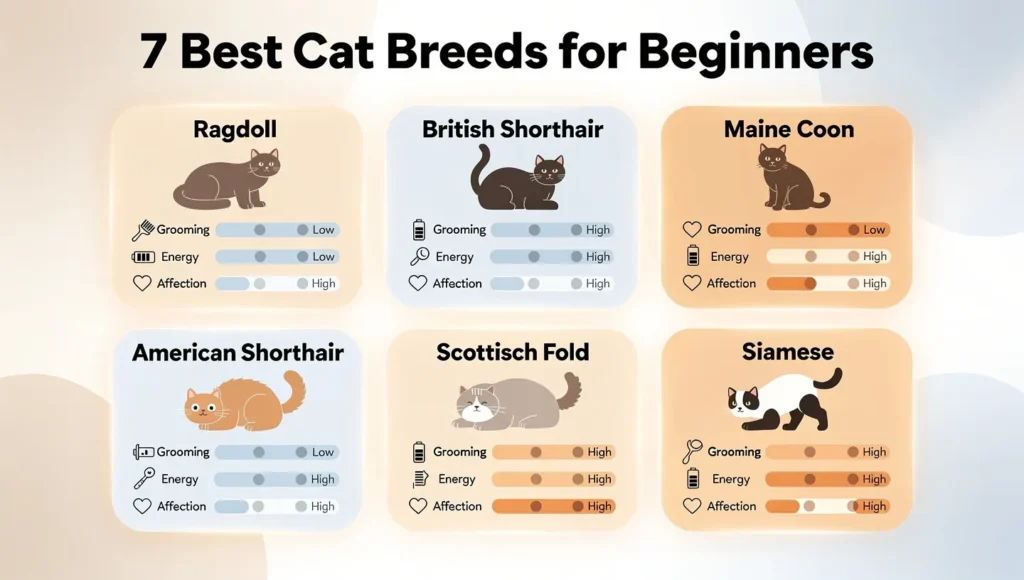
Table of Contents
- What Actually Makes a Cat “Beginner-Friendly”?
- The 7 Best Cat Breeds for Beginners
- 1. Ragdoll — The Easiest Cat You’ll Ever Own (With One Honest Caveat)
- 2. British Shorthair — The “Set It and Forget It” Cat
- 3. Maine Coon — Big Heart, Surprisingly Easy
- 4. American Shorthair — The Quietly Perfect Beginner Cat
- 5. Scottish Fold — Adorable, But Read This First
- 6. Persian — Only If You’re a “Calm Beginner”
- 7. Siamese — Friendly, But Loud (Like, Really Loud)
- Shelter Cats: The Hidden Gem Nobody Talks About
- Which Cat Is Actually Right for YOU?
- Worst Cat Breeds for Beginners (And Why)
- The Most Common Mistake First-Time Cat Owners Make
- Quick Answers 😕
- What is the best cat for a beginner?
- What’s the best first cat to get?
- Is 1 or 2 cats easier for beginners?
- What is the 3-3-3 rule for cats?
- One Last Thing
What Actually Makes a Cat “Beginner-Friendly”?
When looking for the best cat breeds for beginners, a ‘friendly’ cat is one that adapts well to new environments, doesn’t require intense daily grooming or stimulation, and tends to be forgiving of rookie mistakes. In simple terms: calm temperament, low-to-moderate energy, and predictable behavior.
But here’s the thing most articles skip — “easy” means different things for different people.
For Sami, who works from home and lives in an apartment? Easy means a cat that won’t scream for attention every 20 minutes. For someone else with kids and a busy schedule? Easy means a cat that can handle noise and unpredictability without shutting down.
There are three things I always look at:
- Temperament — Is this cat naturally calm and adaptable, or does it need constant stimulation?
- Grooming needs — Are we talking a quick weekly brush, or a 30-minute daily session?
- Energy level — Will this cat be okay if you’re at work for 8 hours, or will it redecorate your apartment out of boredom?
Keep these three in mind as we go through the list.
The 7 Best Cat Breeds for Beginners
1. Ragdoll — The Easiest Cat You’ll Ever Own (With One Honest Caveat)
If I had to recommend one breed to almost every first-time owner, it would be the Ragdoll. Full stop.
These cats are almost comically easygoing. They go limp when you pick them up (that’s literally where the name comes from), they follow you around like a soft, quiet shadow, and they almost never scratch or bite out of aggression.
According to the AVMA, low-stress temperament is one of the most important factors in successful first-time cat ownership — and Ragdolls basically wrote the manual on that.
Personally, I’d describe them as “dog-like cats.” They’ll greet you at the door. They’ll sit next to you while you watch TV. They won’t destroy your couch the moment you leave.
The honest caveat? Ragdolls need you. They’re not independent cats. If you travel a lot, work 12-hour days, or just want a cat that does its own thing — this might not be the right fit. They can develop anxiety when left alone too often. (More on that in our full Ragdoll care and temperament guide.)
Care snapshot:
- Grooming: Medium (semi-long coat, weekly brushing)
- Energy: Low-medium
- Affection level: Very high
- Best for: Work-from-home owners, families, apartment dwellers
2. British Shorthair — The “Set It and Forget It” Cat
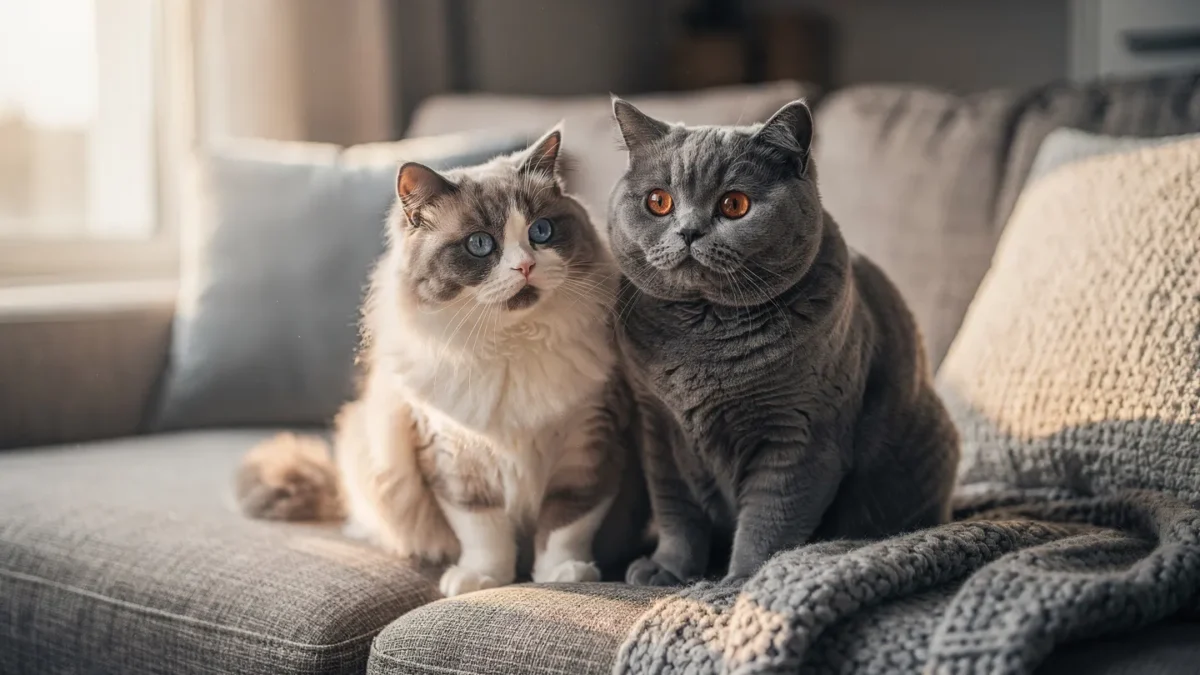
When Sami told me he was leaning toward a Ragdoll, I said: “Great choice. But have you considered the British Shorthair?”
He hadn’t. Most people haven’t — and that’s a shame.
The British Shorthair is basically the perfect cat for someone who wants companionship without neediness. They’re affectionate, but not clingy. They’re playful, but not chaotic. They’ll sit near you on the couch but won’t crawl on your face at 2am demanding attention.
Most people get this wrong — they assume “calm” means “boring.” A British Shorthair is genuinely fun to be around. They just operate on a lower frequency. Think: steady, reliable, low-drama.
From my experience, these cats are also remarkably adaptable. New apartment? Fine. New schedule? Fine. New family member? Usually fine, with a short adjustment period.
One thing worth knowing: they have a tendency to gain weight, especially as indoor cats. So portion control matters early on. If you want to dig into that, our cat weight management guide is a good place to start.
Care snapshot:
- Grooming: Low (short, dense coat — brush once a week)
- Energy: Low-medium
- Affection level: Medium (on their terms)
- Best for: Busy owners, apartments, first-time cat parents who want independence + warmth
(For the full picture, check out our British Shorthair complete care guide.)
3. Maine Coon — Big Heart, Surprisingly Easy
I know what you’re thinking. “That giant fluffy cat? For a beginner?”
Yes. Absolutely yes. In fact, they are often ranked among the best cat breeds for beginners because of their dog-like devotion.
Maine Coons are one of those breeds that look high-maintenance but actually aren’t. Their coat is surprisingly self-maintaining compared to other long-haired breeds. And their personality? Genuinely one of the friendliest in the cat world.
They’re curious, playful, and get along well with kids, dogs, and pretty much anyone who walks through the door. According to ASPCA, sociable breeds tend to adjust faster to new homes — and Maine Coons are textbook social cats.
The one thing to keep in mind: they need space and mental stimulation. A cat tree, some puzzle feeders, regular play sessions. They’re not couch potatoes. But they’re also not wall-climbing chaos machines. There’s a big difference.
If you want the full breakdown, our Maine Coon care guide covers everything from grooming to health.
Care snapshot:
- Grooming: Medium (long coat, 2-3x weekly brushing)
- Energy: Medium-high
- Affection level: Very high
- Best for: Active owners, families, homes with space
4. American Shorthair — The Quietly Perfect Beginner Cat
Honestly? This one doesn’t get enough credit.
If you want a low-drama companion, the American Shorthair is arguably one of the best cat breeds for beginners ever. The American Shorthair is the cat equivalent of a reliable car. Not flashy. Not dramatic. Just… consistently good.
They’re healthy, adaptable, low-grooming, and genuinely pleasant to live with. They don’t demand constant attention, but they’ll show up when you need company. They’re fine being alone during the day, which matters a lot if you have a regular office schedule.
This is the breed I would have gotten if I’d done my research before that Bengal situation.
Care snapshot:
- Grooming: Low (short coat, minimal brushing)
- Energy: Medium
- Affection level: Medium
- Best for: First-timers with a 9-to-5, apartments, families
5. Scottish Fold — Adorable, But Read This First
Let me be straightforward here, because I think most articles aren’t.
Scottish Folds are undeniably cute. Those folded ears, that round face — Sami’s exact words were “that’s the one I want” the moment he saw a photo.
But here’s what I told him: Scottish Folds carry a genetic mutation that affects cartilage throughout their entire body — not just their ears. This can lead to painful joint issues, sometimes serious ones. According to research from veterinary genetics studies, all Scottish Folds carry this mutation to some degree.
This is where things change. Choosing a Scottish Fold isn’t just an aesthetic decision — it’s a health and ethics conversation.
That said: if you find a responsible, health-focused breeder, and you’re prepared for potential vet visits down the line, they can be wonderful, calm companions. Just go in with eyes open. Our Scottish Fold health and care guide gives you the full picture.
Care snapshot:
- Grooming: Low-medium
- Energy: Low
- Affection level: High
- Best for: Calm households — with an honest awareness of health risks
6. Persian — Only If You’re a “Calm Beginner”
Persians are gorgeous, gentle, and incredibly low-energy. They’re not going to jump on your counters or knock things off shelves for fun. They’re happy to lounge, be petted, and look beautiful doing absolutely nothing.
But — and this is important — their coat requires daily brushing. Not weekly. Daily. If you skip it, matting happens fast, and matting is uncomfortable for them and stressful for you.
Personally, I wouldn’t recommend a Persian as a first cat unless you’re genuinely excited about grooming as part of your routine. If brushing sounds like a chore, it will become one quickly.
For the right person though? A Persian is a dream. Quiet, sweet, and deeply affectionate.
Care snapshot:
- Grooming: High (daily brushing — non-negotiable)
- Energy: Very low
- Affection level: High
- Best for: Calm, home-based owners who enjoy hands-on grooming
7. Siamese — Friendly, But Loud (Like, Really Loud)
The Siamese is one of the most affectionate, people-oriented cats you’ll ever meet. They bond deeply, they’re smart, and they’re genuinely entertaining to live with.
Here’s the thing though: they communicate. A lot. Loudly. At 3am if they feel like it.
If you live alone and work from home and want a cat that feels almost like a conversation partner — a Siamese might be perfect. If you have thin walls, neighbors close by, or a light sleeping partner, you might want to think twice.
They also don’t do well with long hours of solitude. Two Siamese is often easier than one, oddly enough.
Care snapshot:
- Grooming: Low (short coat)
- Energy: High
- Affection level: Very high — almost intense
- Best for: Social, home-based owners who don’t mind noise
[Image 2: Comparison Table]
| Breed | Energy | Grooming | Friendliness | Best For |
|---|---|---|---|---|
| Ragdoll | Low-Med | Medium | ★★★★★ | WFH, apartments |
| British Shorthair | Low-Med | Low | ★★★★ | Busy owners |
| Maine Coon | Med-High | Medium | ★★★★★ | Active families |
| American Shorthair | Medium | Low | ★★★★ | 9-to-5 owners |
| Scottish Fold | Low | Low-Med | ★★★★ | Calm homes |
| Persian | Very Low | High | ★★★★ | Grooming enthusiasts |
| Siamese | High | Low | ★★★★★ | Social, home-based |
Shelter Cats: The Hidden Gem Nobody Talks About
Most beginner guides jump straight to breeders. I think that’s a mistake. While people search for the best cat breeds for beginners, they often overlook adult shelter cats who are already ‘trained’ for home life.
Adult cats from shelters are often the most beginner-friendly option of all. Their personality is already established — what you see is what you get. No surprise energy levels at month three. No wondering if the kitten phase will ever end.
When Sami asked me “should I get a kitten or an adult cat?”, I was honest: kittens are adorable and exhausting. An adult shelter cat who already knows how to use a litter box, doesn’t need round-the-clock feeding, and just wants a quiet home? That’s genuinely easier for most first-timers.
It won’t be a specific breed. But it might be the perfect cat.
Which Cat Is Actually Right for YOU?
Most people get this wrong — they pick based on looks and figure the personality will sort itself out. It won’t.
Ask yourself these three questions honestly:
1. How many hours a day are you home?
- Most of the day → Ragdoll, Siamese, Maine Coon
- Standard 8-hour workday → British Shorthair, American Shorthair, Shelter adult cat
- Frequently traveling → Reconsider timing, or get two cats
2. Apartment or house?
- Apartment → British Shorthair, Ragdoll, Persian, Scottish Fold
- House with space → Maine Coon, American Shorthair, Siamese
- For a deeper dive: best cat breeds for apartments
3. How do you feel about grooming?
- Love it / don’t mind → Persian, Maine Coon, Ragdoll
- Prefer minimal → British Shorthair, American Shorthair, Siamese
[Image 3: Decision Tree — Match Your Lifestyle to the Right Beginner Cat]
Worst Cat Breeds for Beginners (And Why)
This section exists because nobody else writes it clearly. So here it is.
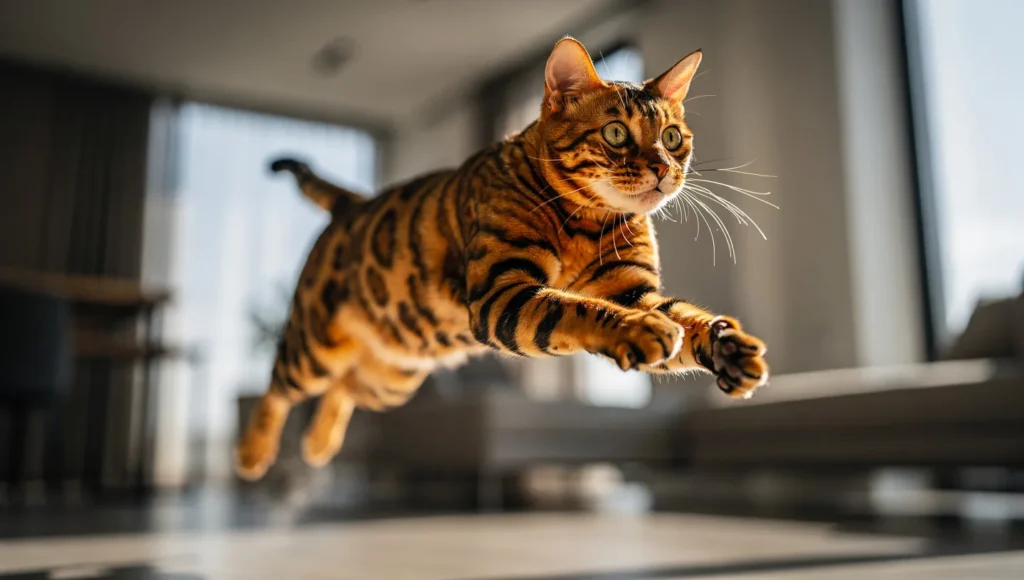
Bengal — Stunning cat. Genuinely wild energy. They need hours of stimulation daily, they get bored fast, and a bored Bengal will find creative ways to make your life interesting. I know from experience. Not for beginners.
(See: Bengal cat behavior guide)
Savannah — Part wild cat genetics. High prey drive, high energy, high everything. Even F4 and F5 generations can be a handful. Experienced cat owners only.
Sphynx — These cats are incredible if you know what you’re doing. But they need weekly baths, they’re extremely social to the point of anxiety if left alone, and their skin care routine is real. Not a low-maintenance choice despite having no fur.
None of these are bad cats. They’re just cats that need an owner who’s ready for them.
The Most Common Mistake First-Time Cat Owners Make
Sami, after our long phone call, said something that stuck with me.
“I almost just picked the one that looked coolest in the photos.”
That’s it. That’s the mistake.
Most first-time owners choose based on appearance, then spend weeks or months adjusting to a personality they didn’t expect. A cat that seemed chill in photos turns out to be incredibly vocal. A breed that looked low-maintenance turns out to need daily grooming.
The fix is simple: match the cat’s personality to your lifestyle, not your aesthetic preferences. Looks fade. Living with a mismatched energy level for 15 years doesn’t.
And once you do bring your cat home — those first few days matter a lot. Our guide on new cat first night walks you through exactly what to expect and how to make the transition smooth.
Quick Answers 😕
What is the best cat for a beginner?
The Ragdoll and British Shorthair consistently top the list for first-time owners. Both have calm temperaments, adapt well to apartment living, and are forgiving of rookie mistakes. That said, the “best” cat depends on your lifestyle — how much time you’re home, your living space, and your grooming tolerance.
What’s the best first cat to get?
If you want a specific recommendation: start with a British Shorthair or an adult shelter cat. Both are low-maintenance, predictable in temperament, and don’t require the intense time investment that kittens do.
Is 1 or 2 cats easier for beginners?
Honestly, for most beginners — one cat is easier to start. You’re learning the routine, the costs, the vet visits. That said, some breeds like Siamese and Ragdolls do better with a companion. Get one first, settle in, then reassess after a few months.
What is the 3-3-3 rule for cats?
The 3-3-3 rule is a helpful framework for new cat owners: give your cat 3 days to decompress, 3 weeks to learn your routine, and 3 months to fully settle in and show their true personality. Don’t judge your cat’s behavior in week one — they’re still figuring out their new world.
One Last Thing
After all that research and that long phone call, Sami ended up adopting a 3-year-old tabby mix from a local shelter. No specific breed. Just a calm, quiet cat who needed a home.
He texted me a week later: “She sleeps on my lap every evening. This is the best decision I’ve ever made.”
That’s really what this is about. Not just finding the best cat breeds for beginners based on a list, but finding the right match for your heart.
Take your time. Be honest about your lifestyle. And if you’re unsure, walk into a shelter and let a cat choose you. It works more often than you’d think.