
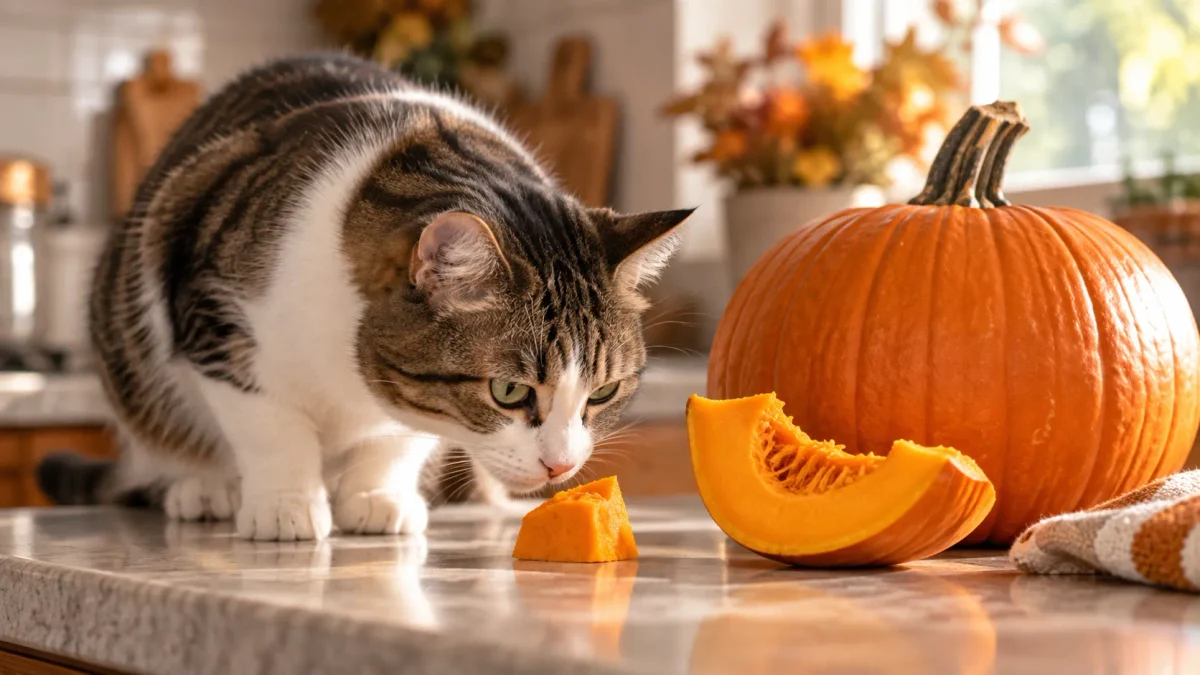
Picture this: it’s fall, there’s a pumpkin pie cooling on the counter, and your cat suddenly appears out of nowhere, nose twitching, absolutely convinced this is her business now.
Or maybe it’s less charming — you’re on your third trip to the litter box today, half-annoyed and half-worried, and someone in a Facebook cat group swears “just add pumpkin, it fixes everything.” Meanwhile, someone else in the same thread is warning that pumpkin is secretly dangerous. So, is pumpkin for cats actually a safe solution or a hidden risk?.
Here’s the short answer: plain canned pumpkin is genuinely good for most cats — safe, fiber-rich, and useful for digestive hiccups. But it’s not a miracle cure, and “how much” and “what kind” matter a lot more than most articles let on.
This guide walks through the real dosage numbers by weight, what to avoid completely, and a few safety details — kittens, kidney disease, and a sneaky ingredient called xylitol — that most pet sites skip entirely.
A quick note before we dive in: this article is based on research into trusted veterinary sources, not personal veterinary experience. It’s meant for general information and doesn’t replace advice from your own vet, especially if your cat has an existing health condition.
Table of Contents
- Is Pumpkin Good for Cats?
- What Does Pumpkin Actually Do for Your Cat?
- Pumpkin for Cats With Diarrhea vs. Constipation
- The Dosage Table Nobody Gives You
- Is Pumpkin Safe for Kittens?
- Pumpkin and Kidney Disease (CKD): What Owners Need to Know
- The Hidden Danger: Xylitol in “Sugar-Free” Pumpkin
- Pumpkin Pie Filling, Seeds, and Raw Pumpkin: What to Avoid
- Fresh vs. Canned Pumpkin: Which Is Better?
- How to Actually Get Your Cat to Eat It
- Quick Answers Cat Owners Keep Asking
- Is it okay to give a cat pumpkin every day?
- What are the side effects of pumpkin for cats?
- Is pumpkin a “silent killer” for cats?
- Is pumpkin a laxative for cats?
- So, Should You Hand Over the Pumpkin?
Is Pumpkin Good for Cats?
Yes — plain, cooked or canned pumpkin (with no added sugar, spices, or salt) is safe and can genuinely help with digestion, hairballs, and weight management when given in small amounts. It’s not a required part of a cat’s diet, but it’s one of the few “human foods” that actually earns its reputation.
Pumpkin brings fiber, potassium, and vitamin A to the table, all of which cats can benefit from occasionally. The catch — and it’s a real one — is that “pumpkin” covers a lot of ground, from a can of plain purée to a spiced pie filling loaded with sugar. Only one of those is cat-appropriate. More on that later.
What Does Pumpkin Actually Do for Your Cat?
Pumpkin’s biggest strength is its fiber content, and that fiber does more than one job depending on what your cat needs. Based on the research, here’s what owners can reasonably expect:
- Digestive regulation — the soluble fiber absorbs excess water in the gut, which can firm up loose stools and add bulk to help things move along when a cat is backed up
- Hairball support — that same fiber can help hair travel through the digestive tract instead of building up into a hairball
- Weight management — pumpkin is low in calories but adds bulk, so a spoonful can help a cat feel fuller without piling on extra energy (a small piece of a bigger puzzle — a full cat weight loss strategy usually needs more than just a pumpkin scoop)
- Mild hydration boost — canned pumpkin is mostly water, so it can nudge a cat’s fluid intake up slightly, though it’s no substitute for proper hydration habits
None of this makes pumpkin a treatment for anything serious. Think of it as a supportive nudge, not a fix.
Pumpkin for Cats With Diarrhea vs. Constipation
Here’s the part that trips a lot of owners up: pumpkin can help with both diarrhea and constipation, which sounds contradictory until you understand why. Soluble fiber works by regulating water in the gut — absorbing excess moisture when there’s too much, and adding bulk and moisture when there’s too little.
| Situation | How Pumpkin Helps | What to Watch For |
|---|---|---|
| Constipation | Adds moisture and bulk to stool, stimulating movement | Make sure your cat has plenty of fresh water too — dehydration often makes constipation worse |
| Diarrhea | Soluble fiber absorbs excess water, helping firm up loose stools | If diarrhea lasts more than a day or two, pumpkin isn’t a substitute for figuring out the actual cause |
Reviewers and cat owners online consistently report noticeable improvement within a few days of adding pumpkin for mild digestive upset — but “mild” is the operative word.
If your cat’s stool doesn’t improve, or things get worse, that’s your cue to stop guessing and call the vet. For a deeper look at persistent loose stools, our diarrhea guide walks through when it’s genuinely time to worry.
The Dosage Table Nobody Gives You
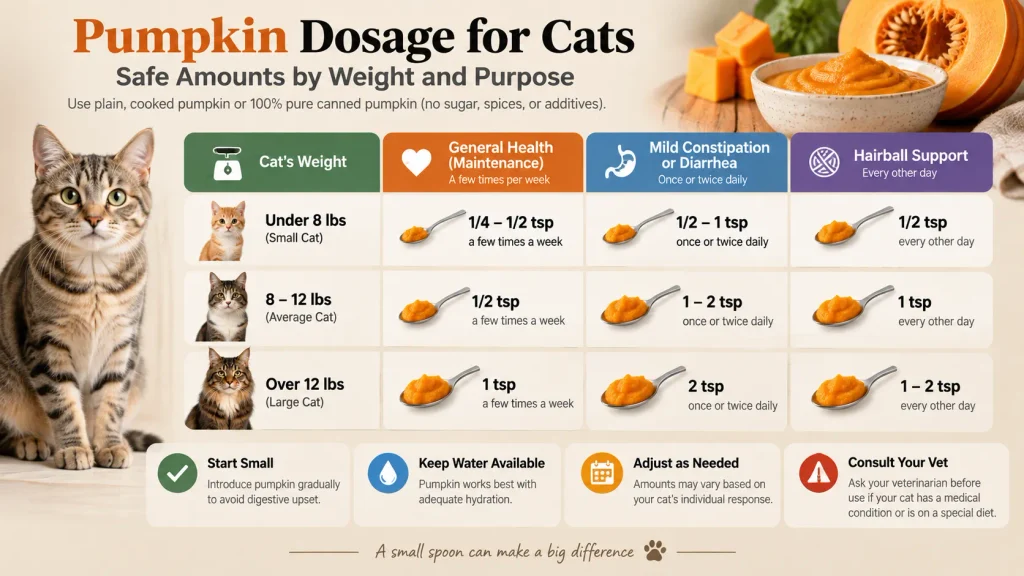
This is where most pumpkin articles get vague — “a teaspoon or so” isn’t exactly precise. Based on the ranges most commonly recommended across veterinary and pet nutrition sources, here’s a more useful starting point:
| Cat’s Weight | Maintenance / General Health | Mild Constipation or Diarrhea | Hairball Support |
|---|---|---|---|
| Under 8 lbs (small cat) | ¼ to ½ tsp, a few times a week | ½ to 1 tsp, once or twice daily | ½ tsp, every other day |
| 8–12 lbs (average cat) | ½ tsp, a few times a week | 1 tsp, once or twice daily | ½ to 1 tsp, every other day |
| Over 12 lbs (large cat) | ½ to 1 tsp, a few times a week | 1 to 2 tsp, once or twice daily | 1 tsp, every other day |
A few things worth knowing before you grab a spoon:
- Start smaller than the table suggests. Every cat’s tolerance is different, and some will get an upset stomach even from “normal” amounts.
- Most sources cap daily pumpkin at 1–2 tablespoons total, regardless of cat size — more than that risks tipping a helpful fiber boost into diarrhea territory.
- Mix it into wet food. Plain pumpkin on its own is a hard sell for a lot of cats; blending it into a meal your cat already likes tends to go over better.
- If nothing changes after a few days, stop guessing. Persistent digestive issues need a vet visit, not a bigger spoonful of pumpkin.
For the actual product, plain 100% canned pumpkin purée — not pie filling — is the easiest option ( Plain Canned Pumpkin Purée ).
Is Pumpkin Safe for Kittens?
The honest answer is: it depends who you ask, and that’s worth saying plainly instead of papering over. Some sources treat small amounts of pumpkin as fine for kittens who are already weaned and eating solid food, often recommending it for mild constipation.
Others push back hard, arguing that kittens need calorie- and nutrient-dense food to grow and that pumpkin adds bulk without meaningful nutrition — a real concern for an animal that’s supposed to be gaining weight, not filling up on fiber.
Where there’s no disagreement at all: pumpkin has no place in the diet of an unweaned kitten who’s still nursing or on kitten milk replacer. That’s not a fiber question — it’s a “this kitten needs concentrated nutrition, full stop” situation.
If you’re raising a very young kitten, our kitten care guide covers what they actually need at each stage far better than a spoonful of squash ever could.
For weaned kittens with occasional mild constipation, a very small amount (think a few licks, not a spoonful) is generally considered low-risk — but this is exactly the kind of situation where a quick check with your vet beats guessing.
Pumpkin and Kidney Disease (CKD): What Owners Need to Know
If your cat has chronic kidney disease, don’t add pumpkin — or any new food — to their diet without running it by your vet first. Cats with CKD are often on carefully managed diets, and pumpkin’s potassium and fiber content can matter more than it would for a healthy cat, depending on where your cat’s bloodwork stands.
This isn’t a “pumpkin is dangerous for CKD cats” statement — the evidence on that specific interaction is limited, and it genuinely varies by cat. It’s more that CKD diets are already a balancing act, and tossing in an unplanned ingredient — even a generally healthy one — isn’t a decision to make solo.
If your cat has any diagnosed condition, this is one of those moments where “check with your vet” isn’t just boilerplate advice; it’s the actual answer. Source
The Hidden Danger: Xylitol in “Sugar-Free” Pumpkin
Here’s a warning most pumpkin guides completely skip: some “sugar-free” or diet-friendly canned pumpkin products are sweetened with xylitol — and xylitol is genuinely toxic to pets. This isn’t a “use caution” situation; it’s a confirmed toxicity risk that can cause a rapid, dangerous drop in blood sugar and, in more serious cases, liver damage.
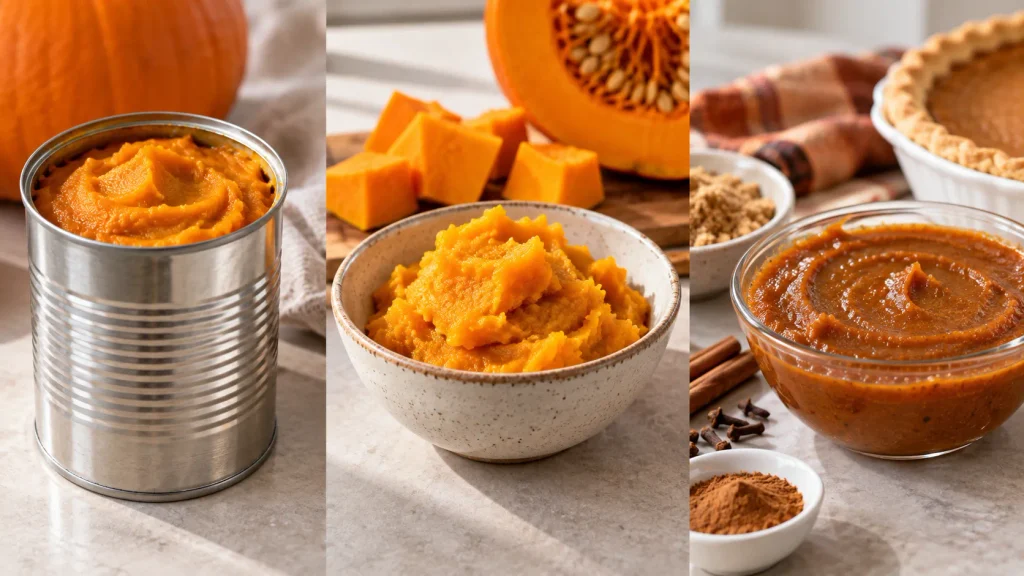
The fix is simple, but it means actually reading the label instead of grabbing whatever can looks “healthy”:
- Look for an ingredient list with exactly one item: pumpkin. Nothing else.
- Be suspicious of anything labeled “diet,” “sugar-free,” or “low-calorie” — check the ingredients, not the marketing.
- If you’re genuinely unsure, plain 100% pumpkin purée from the baking aisle (not the pet food aisle) is usually the safest bet, since it’s made for human consumption and rarely contains sweeteners.
If your cat has already eaten something containing xylitol, don’t wait it out — contact your vet or an emergency animal clinic right away. Source
Pumpkin Pie Filling, Seeds, and Raw Pumpkin: What to Avoid
Not all pumpkin is created equal, and this is where a lot of well-meaning owners accidentally get it wrong. Here’s the breakdown:
- Pumpkin pie filling — a hard no. It’s loaded with sugar and spices like nutmeg and cinnamon, some of which can cause mild toxicity or, at minimum, a rough stomach. This is the single most common mix-up owners make, since it sits right next to plain pumpkin on the grocery shelf.
- Raw pumpkin — not toxic, but genuinely hard for cats to digest and not worth the risk of an upset stomach. Cooked (or canned) is the way to go.
- Pumpkin seeds — not toxic in themselves, but they’re a real choking hazard, especially swallowed whole and in a hurry (which, let’s be honest, is how most cats eat anything). If you do offer seeds, they should be plain, unsalted, and ideally ground or crushed first.
- The stem and skin — the stem is rough on a cat’s digestive system, and the skin isn’t something cats digest well either. Stick to the flesh.
One myth worth killing outright: pumpkin seeds do not deworm your cat. This idea shows up a lot in comment sections and Facebook groups, but there’s no solid evidence it works in cats the way people claim, and relying on it instead of an actual dewormer can let a real parasite problem go untreated.
If you’re seeing signs of worms, our guide on worm symptoms in cats is a much safer starting point than a jar of pumpkin seeds.
Fresh vs. Canned Pumpkin: Which Is Better?
Honestly, either works — the “better” option depends on what you’re optimizing for.
- Fresh pumpkin gives you full control over what goes in (nothing but pumpkin), but it means baking or steaming it yourself, then mashing or puréeing before serving. More effort, zero additives.
- Canned pumpkin is faster and just as safe, as long as the label reads “100% pumpkin” with nothing else on the ingredient list. This is what most owners end up reaching for, and it’s perfectly fine.
Whichever you pick, the rule stays the same: plain, cooked, no additives.
How to Actually Get Your Cat to Eat It
Some cats will lick pumpkin straight off a spoon like it’s the best day of their life. Others will sniff it once, give you a deeply unimpressed look, and walk away. Based on what owners consistently mention in cat food communities, a few tricks tend to help:
- Mix it into wet food rather than serving it plain — most cats accept it far more readily when it’s blended into something they already like.
- Freeze small portions in an ice cube tray, then thaw one cube at a time. This keeps an opened can from going to waste and makes portioning painless. A can typically stays good in the fridge for about a week, and considerably longer frozen.
- Try a pumpkin-based treat or food topper ( Pumpkin Cat Food Topper ) if your cat flatly refuses the plain stuff — some brands blend it with flavors cats find harder to resist.
- Go slow. A tiny taste on a fingertip before committing to a full spoonful in their bowl can help picky cats warm up to it.
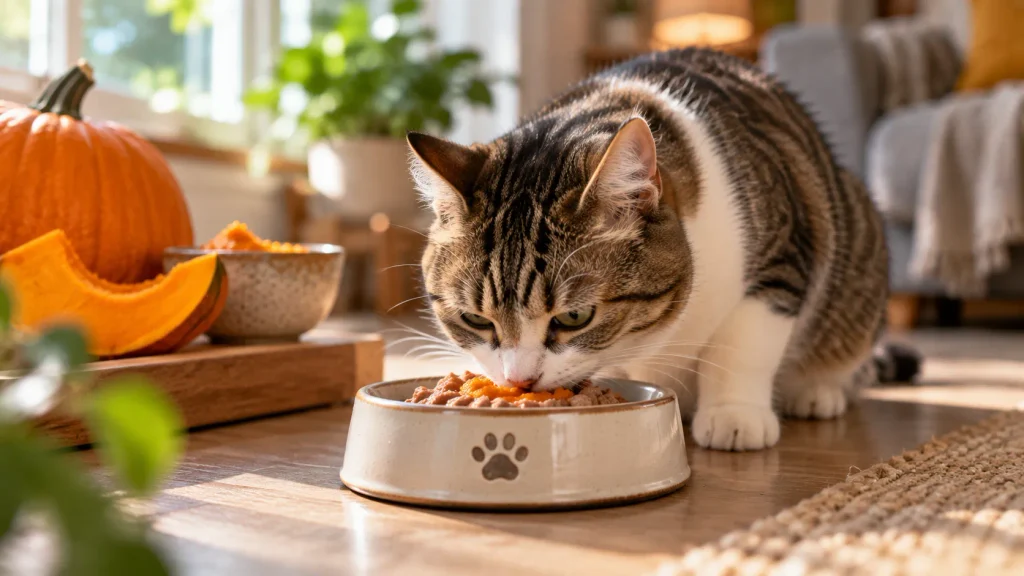
If your cat simply isn’t interested after a few honest attempts, that’s fine too — pumpkin is a nice-to-have, not a requirement.
Quick Answers Cat Owners Keep Asking
Is it okay to give a cat pumpkin every day?
In small amounts, yes for most healthy cats — but daily isn’t necessary. Occasional use (a few times a week, or as needed for digestion) is plenty for most cats.
What are the side effects of pumpkin for cats?
The most common is diarrhea from overdoing it. You might also notice a slightly orange tint to your cat’s stool after eating pumpkin — that’s harmless and just reflects the pigment.
Is pumpkin a “silent killer” for cats?
No — plain pumpkin itself isn’t dangerous. What can be genuinely risky is what sometimes comes with it: xylitol in sugar-free varieties, spices in pie filling, or feeding it in place of a proper diet for a cat with an underlying condition like kidney disease. The pumpkin isn’t the villain; the fine print is.
Is pumpkin a laxative for cats?
Sort of, in a gentle way. Its fiber and moisture content can stimulate bowel movement in constipated cats, though it works more like a mild dietary aid than an actual laxative medication.
So, Should You Hand Over the Pumpkin?
At the end of the day, pumpkin isn’t a magic fix — it won’t cure a serious digestive issue, and it definitely won’t replace a trip to the vet when something’s genuinely wrong.
But as a simple, low-risk addition for the occasional upset stomach or hairball season? It earns its spot in the cabinet, as long as you stick to the plain stuff and skip anything that even smells like pie filling.
We read every comment on this one, so we’d genuinely love to hear from you: has your cat ever tried pumpkin, and did she dive in — or give you that classic offended stare and walk off? Tell us in the comments below.
And if this guide saved you a trip down a confusing rabbit hole of conflicting advice, feel free to pass it along to another cat owner who’s staring at a can of pumpkin right now, wondering the exact same thing.