
You’re scrolling through cat videos late at night, and suddenly you see it—a sleek, spotted feline playing fetch like a Labrador, chirping like a bird, and leaping six feet in the air as if gravity is optional. Your heart races. “I need that cat,” you think. But before you fall headlessly in love with the exotic Savannah cat, let me be bluntly honest with you: owning one isn’t just about Instagram-worthy moments. It’s a commitment that can feel more like adopting a wild animal than bringing home a typical house cat.
I’ve spent over a decade working with exotic cat breeds, and I can tell you that Savannah cat behavior is unlike anything most cat owners have experienced. These aren’t your grandma’s lap cats. They’re intelligent, relentlessly energetic, and yes—sometimes frustratingly stubborn. The question isn’t whether they’re beautiful (they absolutely are), but whether you’re truly ready for the behavioral rollercoaster that comes with owning a domestic cat with serval DNA.
In this guide, I’m going to walk you through everything you need to know about Savannah cat behavior—from the wild instincts of an F1 to the more manageable temperament of an F4. No sugarcoating. No breeder sales pitches. Just real talk from someone who’s seen both the magic and the mayhem these cats can bring.
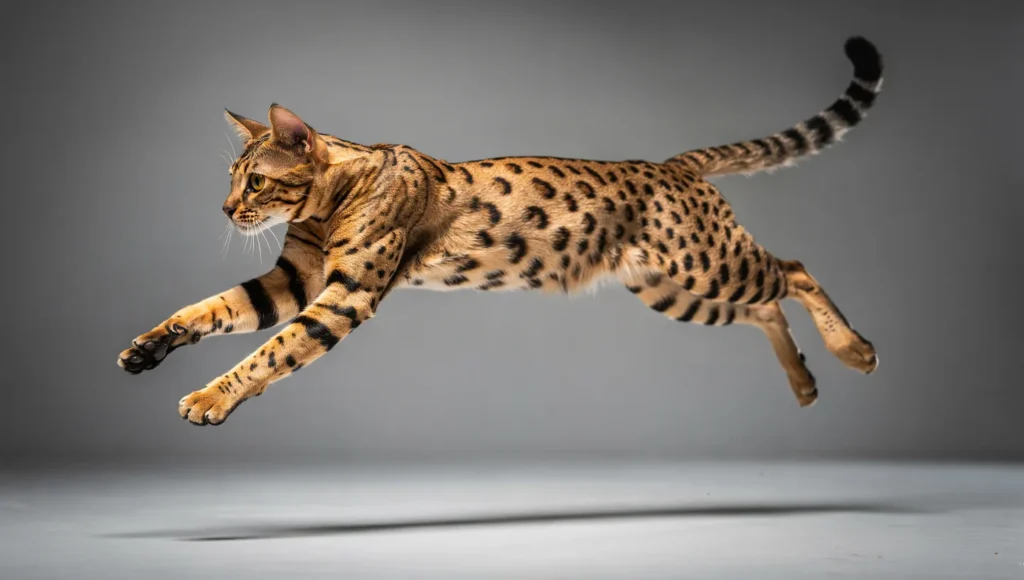
Table of Contents
- 🐆 Understanding the Savannah Cat Personality: Part Wild, All Heart
- 🧬 How Savannah Cat Behavior Changes from F1 to F4 (The Generation Factor)
- 🔥 F1 Savannah Behavior: The Wildest of Them All
- ⚖️ F2-F3 Savannah Behavior: The Sweet Spot for Experienced Owners
- 🏠 F4+ Savannah Behavior: The Family-Friendly Option
- 🎭 7 Signature Savannah Cat Behaviors (Decoded)
- 🎾 1. The Fetch Obsession
- 🚶 2. Leash Walking Like a Dog
- 💦 3. Water Fascination (Yes, They Love It)
- 🤲 4. Kneading with Power
- 👃 5. Head-Butting and Scent Marking
- 👅 6. Excessive Licking (Grooming You)
- 🗣️ 7. Unique Vocalizations
- ⚠️ Are Savannah Cats Aggressive or Dangerous? (The Honest Truth)
- 🏢 Can Savannah Cats Live in Apartments? (The Real Requirements)
- 📅 The Savannah Cat Daily Routine (What 24 Hours Really Looks Like)
- 🚨 Common Savannah Behavior Problems (And How to Fix Them)
- Problem 1: Destructive Behavior
- Problem 2: Excessive Meowing at Night
- Problem 3: Food Aggression
- Problem 4: Litter Box Refusal
- ✅ Is a Savannah Cat Right for You? (The Honest Compatibility Quiz)
- 💡 Final Thoughts: The Savannah Commitment
🐆 Understanding the Savannah Cat Personality: Part Wild, All Heart
Here’s what most people don’t realize when they first encounter savannah cat behavior: you’re not just getting a unique-looking pet. You’re bringing home an animal whose personality is literally coded by how much wild African serval blood flows through their veins. And that percentage changes everything.
Quick Summary
Savannah cats blend serval instincts with domestic affection in a way that’s both thrilling and challenging. Expect dog-like loyalty, Olympic-level athleticism, and behaviors that mirror their wild ancestry—but understand that temperament varies dramatically by generation. An F1 Savannah and an F4 Savannah are as different as a wolf and a golden retriever.
Let me paint you a picture of what daily life with a Savannah actually looks like. These cats don’t lounge on windowsills for hours like a Persian. They don’t purr contentedly while you binge-watch Netflix. Instead, they’re pacing the hallway at 3 AM, plotting their next vertical leap. They’re “helping” you shower because they’re fascinated by running water. They’re bringing you their favorite toy for the fortieth time today because their play drive is insatiable.
The savannah cat personality is defined by three core traits that remain consistent across all generations:
Intelligence That Borders on Unnerving
These cats will figure out how to open cabinets, turn on faucets, and escape enclosures you thought were secure. I’ve watched a two-year-old F3 Savannah solve a puzzle feeder meant for dogs in under three minutes. They observe, they learn, and they remember. This intelligence is exhilarating when you’re teaching them tricks—and maddening when they use it to outsmart your cat-proofing efforts.
Energy Levels That Demand Respect
We’re not talking about a playful kitten phase that mellows with age. Savannah cats maintain high energy well into adulthood. They need mental stimulation and physical activity the way other cats need food and water. Neglect this, and you’ll come home to shredded furniture, knocked-over plants, and a very bored, very destructive feline.
Loyalty That Rivals Any Dog
Here’s the beautiful part: when a Savannah bonds with you, it’s profound. They’ll follow you from room to room, greet you at the door, and yes—even play fetch until your arm gives out. But this loyalty comes with possessiveness. Some Savannahs bond so intensely with one person that they become aloof or even territorial with others in the household.
Now, here’s where the generation factor becomes critical. An F1 Savannah (50% serval) will exhibit these traits at their most extreme—wild, unpredictable, and often unmanageable for the average pet owner. By the time you reach F4 and beyond, you get a cat that retains the Savannah’s signature personality but in a package that’s far more compatible with typical family life.
The honest truth? Most first-time Savannah owners are not prepared for F1 or F2 behavior. They see the exotic beauty and miss the behavioral fine print. These early-generation cats require experienced handlers, massive space, and in many U.S. states and countries, they’re outright illegal to own because they’re classified as wild hybrids.
But if you choose the right generation for your lifestyle, understand their needs, and commit to meeting them, a Savannah cat can be one of the most rewarding companions you’ll ever have. They’re not for everyone—and that’s exactly what makes them special.
In the next section, I’ll break down exactly how savannah cat behavior shifts across generations, so you can make an informed decision about which one (if any) belongs in your home.
🧬 How Savannah Cat Behavior Changes from F1 to F4 (The Generation Factor)
If there’s one thing that confuses prospective Savannah owners more than anything else, it’s the “F” classification system. You’ll see breeders advertising “F1 Savannah – $20,000” and “F5 Savannah – $1,500” and wonder why there’s such a massive price gap. Here’s the truth that will save you from a costly mistake: that F number isn’t just about price or appearance—it’s the complete blueprint for your cat’s personality, energy level, and whether you’ll be living with a manageable exotic pet or a barely-domesticated wild animal.
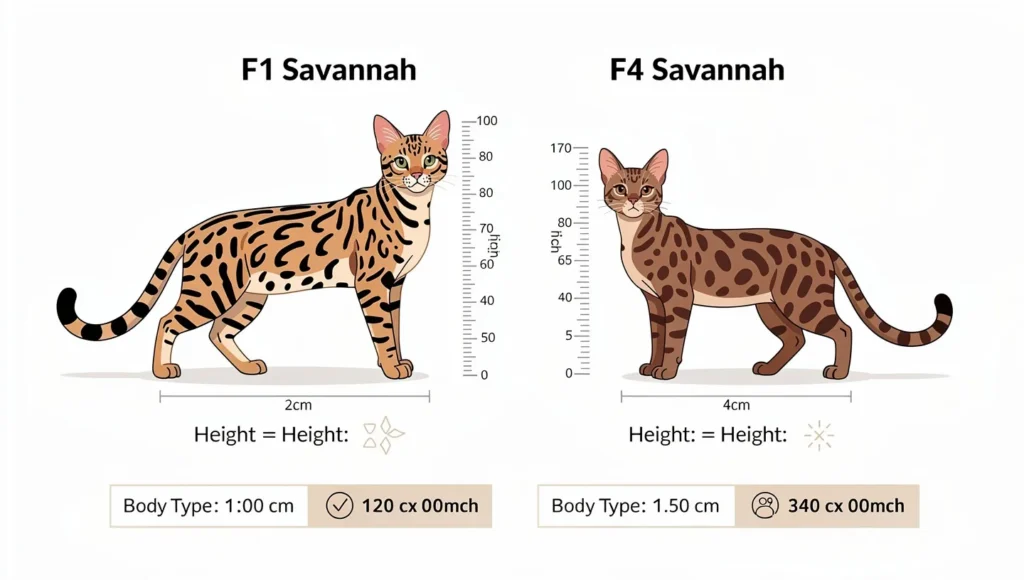
The “F” stands for “filial generation,” and it tells you how many generations removed your cat is from their serval ancestor. An F1 is a first-generation hybrid with one serval parent (50% wild). An F2 has one serval grandparent (around 25-30% wild). By F4, you’re looking at roughly 10-15% serval genetics—and believe me, that percentage makes all the difference in the world.
In my years of consulting with Savannah owners, I’ve seen heartbreaking situations where families bought an F1 or F2 without understanding what they were getting into. The cat ends up rehomed, stressed, or worse—confined to a life that doesn’t meet their needs because the owners can’t handle the intensity. Let me break down what each generation actually means for daily life, so you can make the right choice from the start.
🔥 F1 Savannah Behavior: The Wildest of Them All
Let’s start with the most extreme end of the spectrum, because this is where most people’s fantasies collide head-on with reality. An F1 Savannah is 50% African serval, and trust me when I say: you can’t train out wild instincts that are hardwired into their DNA.
I’ll never forget consulting with a couple who bought an F1 male without doing their homework. Within six months, their “dream cat” had destroyed two couches, escaped their yard three times, and sent their elderly Siamese into permanent hiding. They loved him—but they were in over their heads. That’s the F1 experience in a nutshell: breathtaking beauty paired with behavioral challenges that most households simply cannot manage.
F1 Savannah Behavior at a Glance:
| Trait | F1 Characteristics | What This Means for You |
|---|---|---|
| Energy Level | Extreme (4-6 hours daily activity required) | You need a dedicated “cat room” or outdoor enclosure. Apartment living is nearly impossible. |
| Affection Style | Selective bonding (often one-person cats) | Don’t expect a social butterfly. They choose their human and barely tolerate others. |
| Trainability | High intelligence but stubborn | They’ll learn commands—when they feel like it. Think independent husky, not obedient golden retriever. |
| Vocalization | Loud hisses, chirps, and exotic sounds | Your neighbors will hear them. These aren’t soft meows—they’re wild cat vocalizations. |
| Space Needs | Minimum 1,500 sq ft + outdoor access | Confining an F1 to a typical home is like caging a cheetah. They need vertical and horizontal space. |
| Prey Drive | Extreme (not safe with small pets) | Forget about pet birds, hamsters, or even small dogs. Their hunting instinct is razor-sharp. |
The Legal Reality You Can’t Ignore
Here’s something many breeders conveniently forget to mention: F1 Savannahs are illegal or heavily restricted in many U.S. states and countries. Alaska, Massachusetts, Georgia, Hawaii, and New York either ban them outright or require exotic animal permits. Why? Because legally, they’re classified as wild hybrids, not domestic pets. Before you even consider an F1, check your local regulations—or you could face confiscation and hefty fines.
Who Should (and Shouldn’t) Get an F1
In my professional opinion, F1 Savannahs are appropriate for:
- Experienced exotic animal handlers
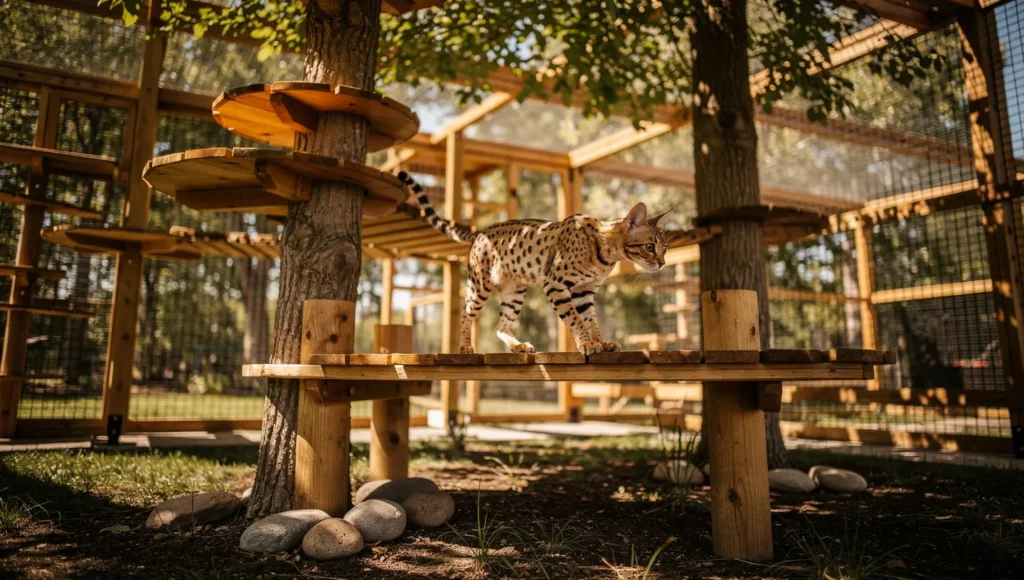
- People with large properties and secure outdoor enclosures
- Owners who can dedicate 4-6 hours daily to enrichment and play
- Those living in states where F1s are legal
F1s are NOT appropriate for:
- First-time cat owners (even experienced domestic cat owners struggle)
- Families with young children or other small pets
- Apartment dwellers or anyone without significant outdoor space
- People expecting a typical “pet” experience
Real Breeder Insight
I spoke with Amanda Torres, a TICA-registered Savannah breeder with 15 years of experience, who told me: “I turn away more F1 buyers than I accept. People see the price tag and think it’s a status symbol. But unless you’ve raised exotics before, an F1 will overwhelm you. I always steer first-timers toward F3 or F4—they still get the Savannah magic without the wild animal challenges.”
That’s the honest truth about F1 savannah cat behavior. They’re magnificent creatures, but they demand a lifestyle most people can’t—or shouldn’t—provide.
⚖️ F2-F3 Savannah Behavior: The Sweet Spot for Experienced Owners
Now we’re entering territory where things become more manageable—but don’t mistake “more manageable” for “easy.” F2 and F3 Savannahs still carry significant serval genetics (25-30% for F2, 12-20% for F3), which means you’re still dealing with wild instincts, just dialed down a notch.
Think of F2-F3 as the bridge between wild and domestic. They retain most of the exotic Savannah behaviors that make the breed so captivating, but in a package that’s slightly more compatible with human households. I call this the “sweet spot” for experienced cat owners who want the authentic Savannah experience without crossing into wild animal territory.
What Changes from F1 to F2-F3:
Energy Requirements Drop (Slightly)
You’re looking at 2-4 hours of active play instead of 4-6. Still high by normal cat standards, but it’s the difference between “exhausting” and “intensely demanding.” An F3 can adapt to apartment living if—and this is critical—you provide massive vertical enrichment and daily interactive play sessions.
Affection Becomes More Reliable
F2-F3 Savannahs are more likely to bond with multiple family members instead of fixating on one person. They’re still selective (don’t expect lap cat behavior), but they’ll participate in household life rather than treating everyone except their chosen human as intruders.
Vocalizations Mellow
You’ll still hear chirps and distinctive Savannah “talking,” but the loud, borderline-alarming hisses of an F1 become less frequent. They’re chatty cats—just not “wake the neighbors at 2 AM” chatty.
Trainability Improves
The stubbornness softens. F3 Savannahs, in particular, respond beautifully to positive reinforcement training. I’ve personally trained F3s to walk on leashes, use toilets, and even perform agility courses. Their intelligence is still sky-high, but they’re more willing to cooperate.
Prey Drive Remains Strong (But More Manageable)
Here’s where you still need caution. F2-F3 Savannahs can coexist with other cats and cat-savvy dogs, but I wouldn’t trust them around small animals. Their hunting instinct is alive and well—they’ll stalk, pounce, and “hunt” toys with intensity that would terrify a typical house cat.
Real-Life F3 Experience
One of my clients, Jennifer, lives in a 1,200 sq ft apartment with her F3 male, Pharaoh. She made it work by installing floor-to-ceiling cat trees, dedicating 90 minutes daily to interactive play, and creating a “catio” (enclosed balcony space) where he can experience the outdoors safely. Her advice? “An F3 is doable in an apartment—but you have to restructure your entire living space around their needs. It’s not about ‘fitting a cat into your life.’ It’s about building your life around theirs.”
The Legal Landscape Improves
Most states that ban F1 Savannahs allow F2-F3 without permits, though it’s still worth checking local ordinances. You’re crossing into “legal pet” territory rather than “exotic animal” classification.
Who Thrives with F2-F3 Savannahs:
- Cat owners with prior experience in high-energy breeds (Bengals, Abyssinians)
- Active individuals or couples who enjoy interactive pet relationships
- People with 1,000+ sq ft living spaces and the ability to create enrichment zones
- Those willing to invest in premium cat furniture and daily engagement
Who Should Skip F2-F3:
- Anyone expecting a low-maintenance cat
- Families with toddlers (their play is too rough for small children)
- People with limited budgets (vet care for hybrids is expensive)
- Those living in small apartments without catio or outdoor access
🏠 F4+ Savannah Behavior: The Family-Friendly Option
Here’s where we finally enter “normal pet owner” territory. By F4 and beyond (F5, F6, F7), you’re looking at cats with roughly 10-15% or less serval genetics. They still look exotic—those gorgeous spots, large ears, and long legs remain—but behaviorally, they’re much closer to a high-energy domestic cat than a wild animal.
I recommend F4+ Savannahs to 90% of people who contact me wanting to own this breed. Why? Because you get to experience the unique Savannah personality without the extreme behavioral challenges that come with earlier generations. It’s like getting the Porsche experience in a car that handles like a well-tuned sports sedan instead of a Formula 1 race car.
The F4+ Behavioral Profile:
Energy: High, But Sustainable
F4 Savannahs need about 60-90 minutes of daily play and enrichment. That’s still more than your average cat, but it’s achievable for working professionals. Think of it as the equivalent of owning an athletic dog breed—they need their exercise, but it won’t consume your entire day.
Affection: Genuine and Consistent
This is where you finally get that warm, social Savannah people dream about. F4+ cats are affectionate without being clingy, playful without being destructive, and they genuinely enjoy human company. They’ll curl up next to you on the couch (though true “lap cat” behavior is still rare—these are active cats by nature).
Vocalization: Chatty, Not Loud
F4 Savannahs are conversational. They’ll chirp when they’re happy, meow when they want something, and “talk” during play sessions—but it’s endearing, not overwhelming. Your neighbors won’t complain, and you’ll find their vocalizations charming rather than startling.
Multi-Pet Compatibility
Here’s the big win: F4+ Savannahs can live peacefully with other cats and dogs, provided proper introductions are made. Their prey drive is still higher than a typical domestic cat, but they’re not going to view your Chihuahua as a hunting target. I’ve seen F5 Savannahs coexist beautifully with everything from senior cats to newly adopted kittens.
Apartment Living: Absolutely Possible
With proper enrichment—tall cat trees, window perches, and interactive toys—an F4 Savannah can thrive in an 800+ sq ft apartment. You don’t need a mansion; you just need to think vertically and provide mental stimulation.
Comparison Table: F4 Savannah vs. Other High-Energy Breeds
| Trait | F4 Savannah | Bengal Cat | Abyssinian |
|---|---|---|---|
| Energy Level | High | High | High |
| Dog-like Behavior | Yes (fetch, leash-walking) | Moderate | Rare |
| Water Fascination | Strong | Moderate | Low |
| Trainability | Excellent | Excellent | Good |
| Vocalization | Moderate-High | Moderate | Low-Moderate |
| Size (Adult Male) | 15-20 lbs | 10-15 lbs | 8-12 lbs |
| Best For | Active families/individuals | Experienced cat owners | Busy households wanting companionship |
The Honest Drawback
Here’s what you sacrifice with F4+: that undeniable “wild” edge. An F4 won’t have the dramatic size, extreme athleticism, or exotic vocalizations of an F1 or F2. If you’re chasing the most wild-looking, impressive Savannah possible, F4+ will feel like a compromise. But if you want a livable, lovable companion that still turns heads at the vet, F4 is your answer.
Real Owner Testimonial
Mark, a software engineer in Seattle, owns an F5 Savannah named Apollo: “I researched for two years before getting Apollo. I knew I wanted the Savannah personality—the intelligence, the playfulness, the dog-like loyalty—but I also needed a cat that wouldn’t destroy my apartment while I’m at work. An F5 was perfect. He plays fetch, walks on a leash, and entertains himself when I’m busy. But he also snuggles during movie nights and doesn’t require the insane energy management of an F1. Best of both worlds.”
Who Should Choose F4+ Savannahs:
- First-time Savannah owners (this is your entry point)
- Families with children ages 6+
- Apartment dwellers committed to enrichment
- Anyone wanting exotic looks with domestic manageability
- Multi-pet households
Who Might Find F4+ “Not Enough”:
- Exotic animal enthusiasts wanting maximum wild traits
- People seeking a showpiece status symbol (F4s aren’t as impressive to strangers)
- Those with experience handling F1-F2 and wanting more intensity
The Bottom Line on Generations
After walking you through F1 to F4+, here’s my professional recommendation: Unless you have prior exotic animal experience, significant space, and 4+ hours daily to dedicate to your cat, start with F3 at the earliest—but F4+ is ideal for 95% of prospective owners.
The savannah cat behavior you’ll experience isn’t about “better” or “worse” across generations—it’s about compatibility. An F1 isn’t superior to an F4; it’s just wildly different. Your job is to honestly assess your lifestyle, experience level, and commitment capacity—then choose the generation that matches.
In the next section, we’ll decode the specific behaviors that make Savannahs so unique across all generations: the fetch obsession, the water fascination, and those unforgettable vocalizations that set them apart from every other cat breed.
🎭 7 Signature Savannah Cat Behaviors (Decoded)
These aren’t quirks—they’re hardwired traits that separate Savannahs from every other domestic cat breed. Here’s what to expect:
🎾 1. The Fetch Obsession
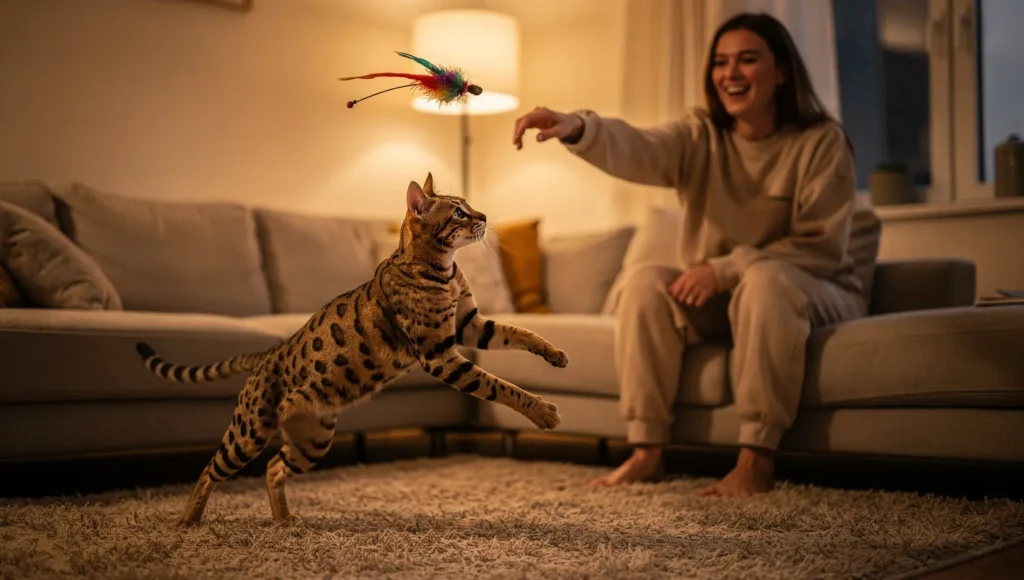
Why it happens: Hunting instinct meets retriever DNA. Savannahs are one of the few cat breeds that genuinely play fetch—and they’ll outlast you every time.
What to do:
- Use lightweight toys (ping pong balls work great)
- Teach “drop it” early or they’ll hoard toys
- Expect 20-30 fetch rounds daily (F1-F3) or 10-15 (F4+)
🚶 2. Leash Walking Like a Dog
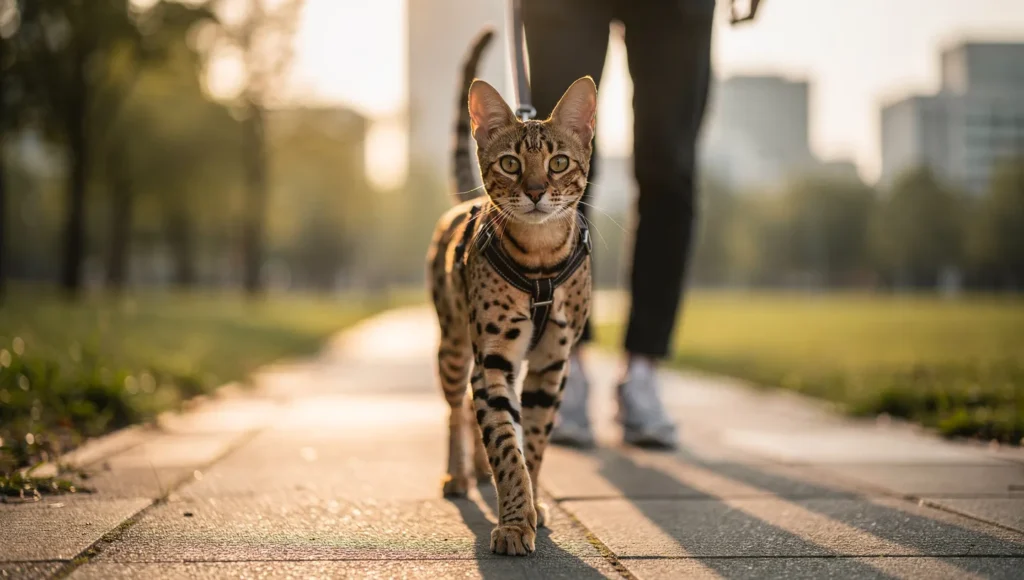
The reality: With proper harness training, Savannahs walk better than most dogs. Their curiosity makes outdoor exploration a non-negotiable need.
Training tips:
- Start indoors at 12-16 weeks
- Use escape-proof harnesses (they’re Houdinis)
- Never use retractable leashes—they bolt without warning
Pro warning: F1-F2 need experienced handlers. F4+ are easier for beginners.
💦 3. Water Fascination (Yes, They Love It)
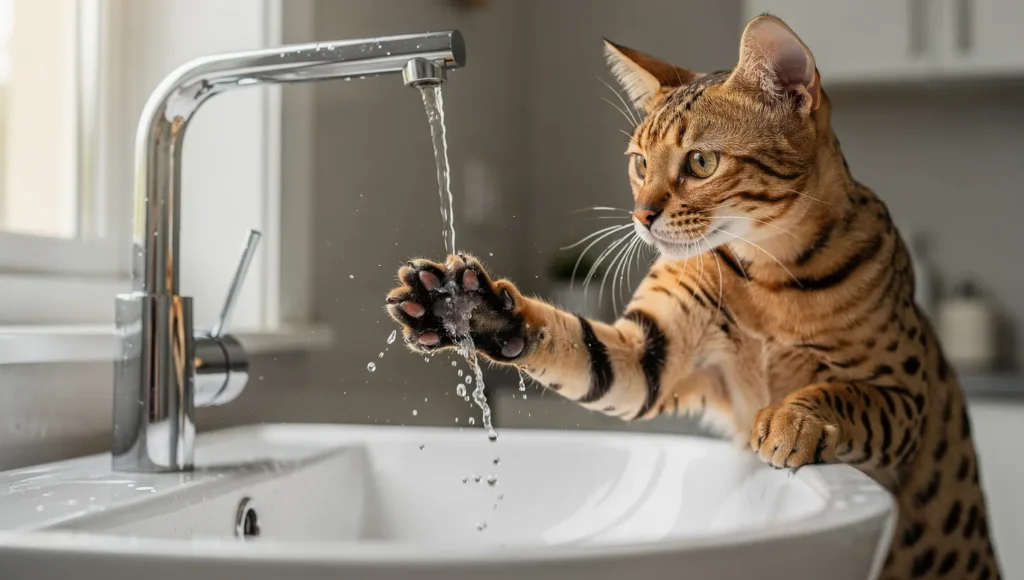
The serval connection: Wild servals fish in streams. Your Savannah inherited this—expect bathroom invasions and water bowl chaos.
What this looks like:
- Pawing water dishes until flooded
- Jumping in showers uninvited
- Playing with dripping faucets for hours
Solution: Get a cat water fountain or accept soggy bathroom floors. Resistance is futile.
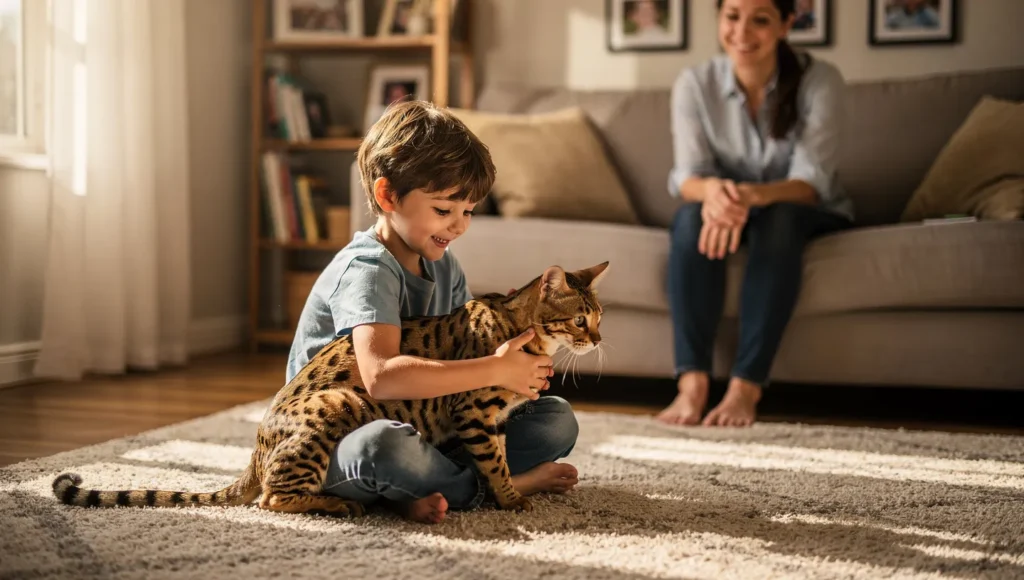
🤲 4. Kneading with Power
The difference: Savannahs knead like they’re auditioning for a massage therapist job—hard, rhythmic, and sometimes painful.
What it means: Pure affection. It’s a compliment, even if your thighs disagree.
Survival tip: Keep nails trimmed or invest in thick blankets for lap time.
👃 5. Head-Butting and Scent Marking
Territorial instinct: They mark you (and everything you own) as “theirs” through scent glands on their face.
When it’s excessive: If they’re rubbing obsessively on furniture corners, increase playtime. Boredom intensifies marking behavior.
👅 6. Excessive Licking (Grooming You)
The why: Bonding behavior borrowed from their domestic side. You’re part of their “colony.”
Red flag: If licking becomes compulsive (same spot repeatedly), check for stress or anxiety.
🗣️ 7. Unique Vocalizations
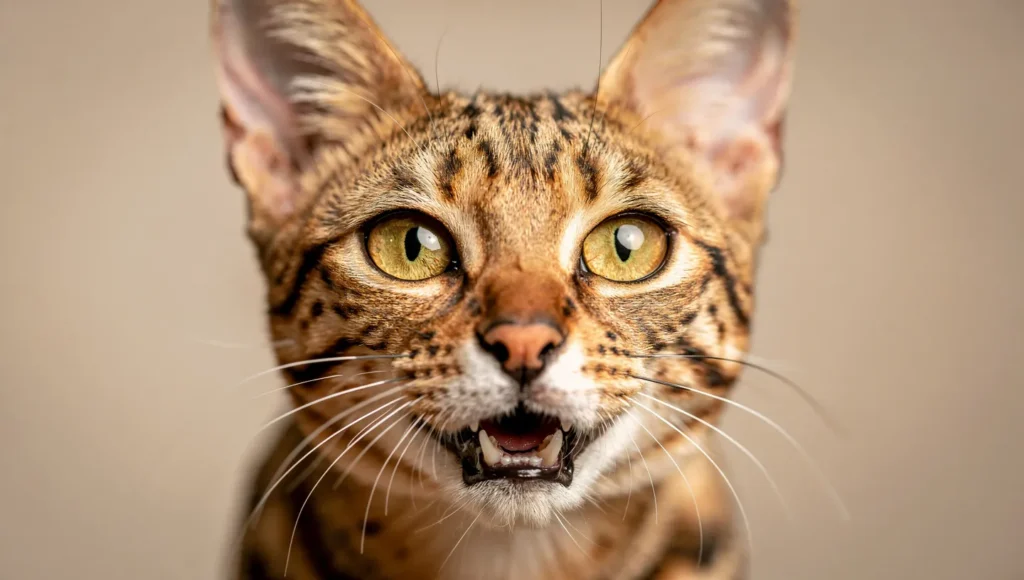
The Savannah sound palette:
- Chirps: Happy/excited (sounds like a bird)
- Hisses: Warning (louder in F1-F2)
- Meows: Standard requests (but more insistent)
- Chattering: Prey-watching mode
Noise level by generation:
- F1-F2: Loud enough to startle guests
- F3-F4: Conversational and manageable
⚠️ Are Savannah Cats Aggressive or Dangerous? (The Honest Truth)
Short answer: No—but their play style looks aggressive to people unfamiliar with the breed.
What people mistake for aggression:
- Pouncing/stalking during play: This is hunting simulation, not an attack
- Rough play biting: They play like wildcats because they’re part wildcat
- Territorial hissing: F1-F2 protect their space—it’s instinct, not hostility
Expert Tip
“Aggression in Savannahs is almost always redirected hunting drive, not true hostility. The key is channeling energy, not suppressing it.” — Dr. Sarah Mitchell, Feline Behaviorist (Cornell University College of Veterinary Medicine)
Real aggression warning signs:
- Unprovoked attacks (not during play)
- Aggressive behavior after litterbox changes (medical issue)
- Constant hiding + hissing (fear-based, needs behavioral vet)
Kids & other pets:
- F1-F2: Not recommended with children under 12 or small pets
- F3: Supervised interaction only
- F4+: Generally safe with kids 6+ and other cats/dogs
The truth: Proper socialization (8-16 weeks) determines temperament more than generation. Under-stimulated Savannahs act out—but that’s behavioral, not aggression.
🏢 Can Savannah Cats Live in Apartments? (The Real Requirements)
Blunt answer: F1-F2 need houses with outdoor access. F3-F4+ can thrive in apartments if you meet these non-negotiables:
Minimum Apartment Setup Checklist:
✅ 800+ sq ft space (smaller = constant stimulation needed)
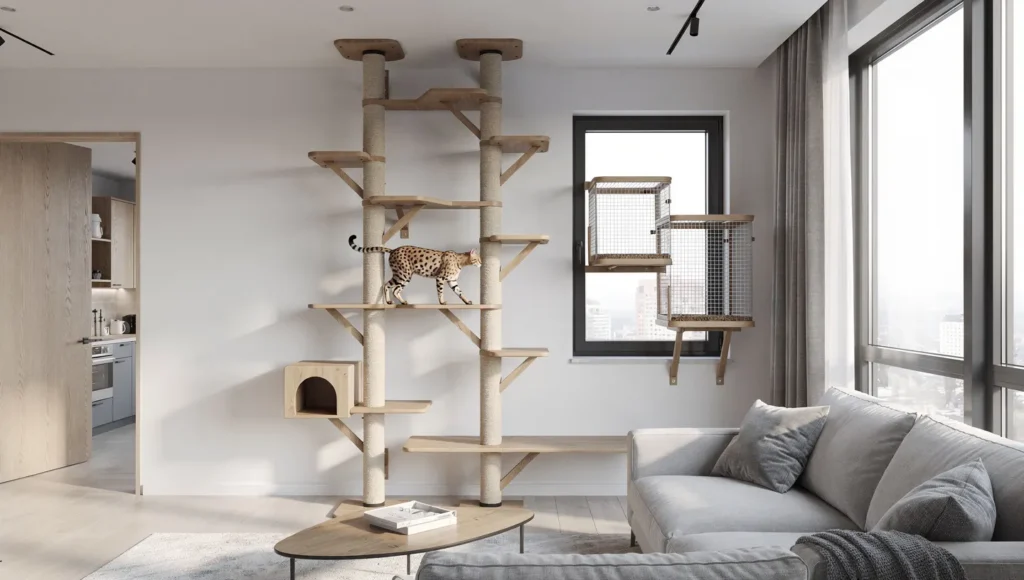
✅ Floor-to-ceiling cat trees (6ft+) — they live vertically
✅ Window perches with bird views (mental enrichment)
✅ Interactive toy rotation — boredom = destruction
✅ 45-90 min daily play sessions (split morning/evening)
✅ Catio or enclosed balcony (optional but highly recommended)
❌ Noise-sensitive neighbors — Savannahs are vocal
Enrichment is non-negotiable:
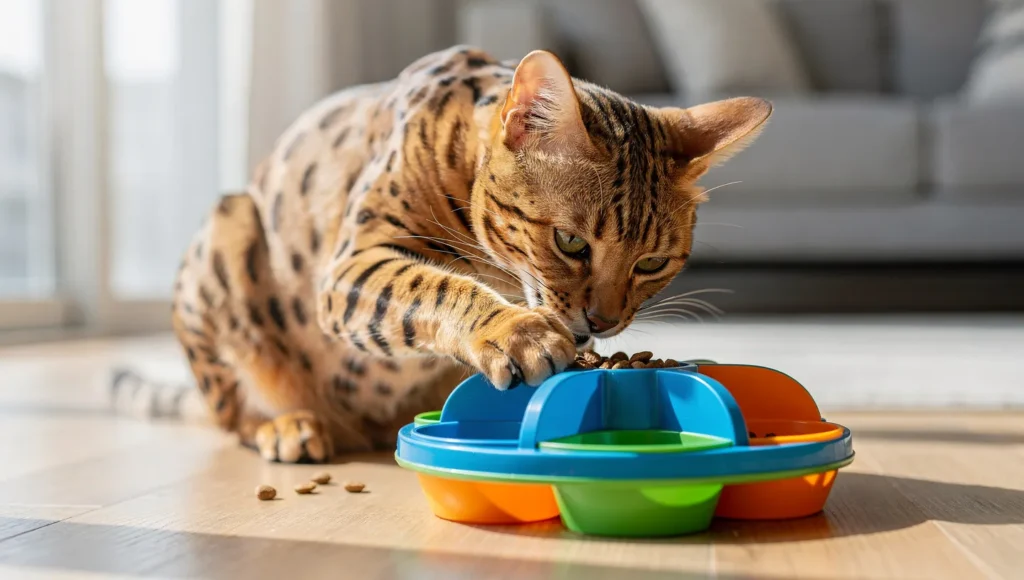
- Puzzle feeders for meals (slows eating + mental work)
- Rotating toys weekly to prevent boredom
- Interactive toys like laser pointers, feather wands, motorized mice
Real apartment owner insight:
“I live in 900 sq ft with my F4. It works because I built a ‘cat highway’ on my walls—shelves that let him circle the apartment 8 feet off the ground. Cost $200 in materials. Best investment ever.” — Rachel K., Chicago
Space requirements by generation:
| Generation | Minimum Space | Outdoor Access? |
|---|---|---|
| F1-F2 | 1,500+ sq ft | Required |
| F3 | 1,000+ sq ft | Strongly recommended |
| F4+ | 800+ sq ft | Optional (catio works) |
Deal-breakers for apartments:
- Zero outdoor access (even F4s need some fresh air)
- Inability to dedicate 1-2 hours daily to play
- Thin walls + noise complaints
Bottom line: Apartment living is possible for F3+, but you’re restructuring your home around their needs—not fitting them into yours.
📅 The Savannah Cat Daily Routine (What 24 Hours Really Looks Like)
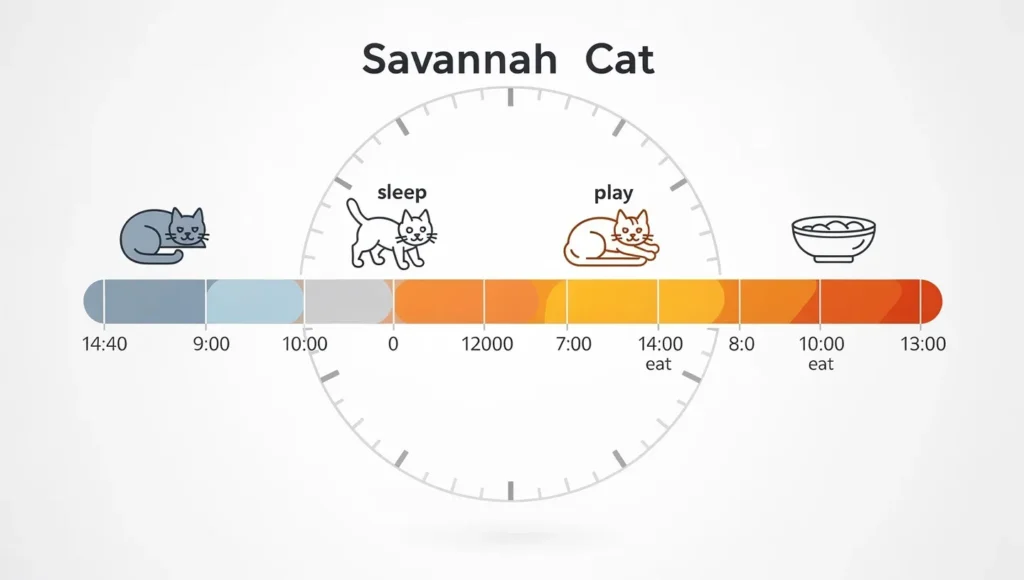
F3-F4 Daily Schedule (Most Common):
| Time | Activity | Energy Level | Your Role |
|---|---|---|---|
| 6:00 AM | Dawn zoomies | ⚡⚡⚡ | Stay out of the way |
| 7:00 AM | Breakfast (puzzle feeder) | ⚡⚡ | Set up hunting game |
| 9:00 AM | Window watching | 😴 | Ensure bird feeder visible |
| 12:00 PM | Play session #1 | ⚡⚡⚡ | 20-30 min interactive toys |
| 2:00 PM | Deep sleep | 😴😴 | Leave them alone |
| 5:00 PM | Pre-dinner zoomies | ⚡⚡⚡ | Play session #2 (20 min) |
| 6:00 PM | Dinner | ⚡⚡ | Slow feeder recommended |
| 8:00 PM | Cuddle/bonding time | ❤️ | Best window for affection |
| 10:00 PM | Night hunt simulation | ⚡⚡ | Final play before bed |
Key insights:
- Crepuscular rhythm: Most active at dawn/dusk (inherited from servals)
- Sleep 12-16 hours but in short bursts—not lazy lounging
- Play before meals mimics wild hunting → eating pattern (reduces food aggression)
Adjustment for working owners:
- Automatic feeders with puzzle mode for lunch
- Leave interactive toys (not just plush)
- Tire them out before work (7 AM play session is critical)
🚨 Common Savannah Behavior Problems (And How to Fix Them)
Problem 1: Destructive Behavior
Root cause: Boredom. Full stop.
Solutions:
- Add vertical space (they’re destroying furniture because they’re understimulated)
- Rotate toys every 3-4 days
- Redirect scratching to tall posts (4ft+ for Savannahs)
Problem 2: Excessive Meowing at Night
Why it happens: Unspent energy + crepuscular instincts.
Protocol:
- Intense play session 1 hour before your bedtime
- Feed dinner after play (mimics hunt → eat)
- Ignore nighttime meows (responding rewards behavior)
Still struggling? Read our complete night meowing guide.
Problem 3: Food Aggression
The serval factor: They’re hardwired to protect kills.
Fix:
- Feed in separate room away from other pets
- Use slow feeders to extend meal time
- Never approach while eating (F1-F2 especially)
Problem 4: Litter Box Refusal
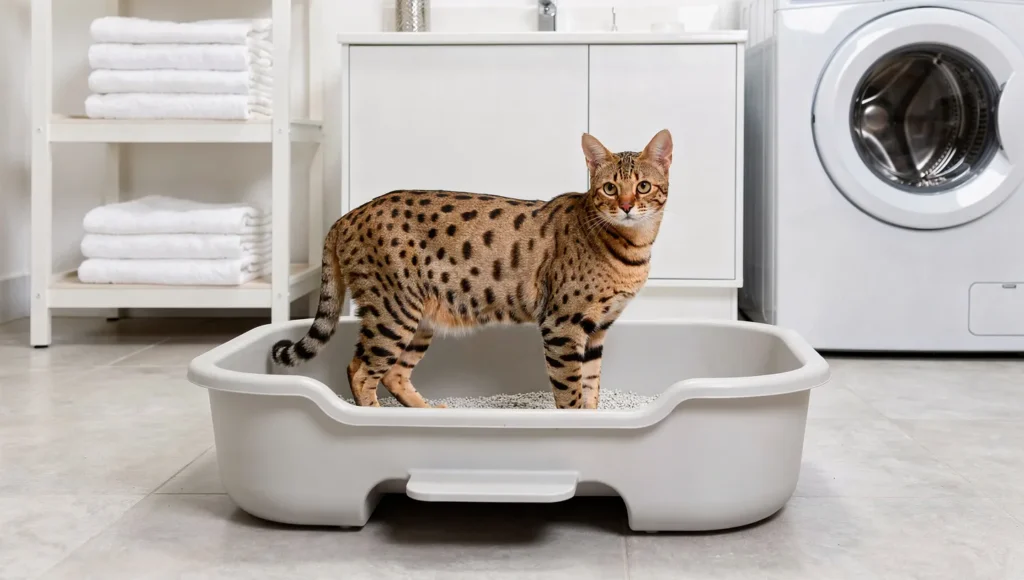
Common culprit: Box too small. Savannahs are large cats.
Requirements:
- XL boxes only (24″+ length for adults)
- Low-dust, unscented litter
- 1 box per cat + 1 extra (standard rule applies)
Medical red flag: Sudden litter avoidance = vet visit ASAP.
✅ Is a Savannah Cat Right for You? (The Honest Compatibility Quiz)
Answer honestly—your future cat’s wellbeing depends on it:
The Reality Check:
❓ Can you dedicate 1-2 hours daily to active play?
❓ Is your home 800+ sq ft (F4) or 1,500+ sq ft (F1-F2)?
❓ Can you afford $2,000-$20,000 initial cost + exotic vet rates?
❓ Are Savannahs legal in your state/country?
❓ Do you have experience with high-energy or exotic pets?
❓ Can you commit 15-20 years?
❓ Are you prepared for loud vocalizations and high maintenance?
Scoring:
- ✅ 7/7: F1-F2 compatible (with proper permits/space)
- ✅ 5-6/7: F3-F4 realistic
- ❌ <5: Consider Bengal, Abyssinian, or Oriental Shorthair instead
Alternative breeds if Savannah isn’t right:
- Bengal: Similar energy, less extreme
- Abyssinian: Playful, affectionate, apartment-friendly
- Oriental Shorthair: Social, vocal, lower maintenance
💡 Final Thoughts: The Savannah Commitment
After walking you through everything from wild F1 instincts to manageable F4 companions, here’s what I want you to remember: A Savannah cat isn’t a pet you add to your life—it’s a lifestyle you build around.
These cats demand more, give more, and challenge you more than any domestic breed. But when you match the right generation to your capabilities, the reward is a bond that rivals any dog’s loyalty with the grace of a wild cat.
In my decade of working with exotic breeds, I’ve seen Savannahs transform owners into better, more engaged pet parents. They don’t let you be lazy. They force you to be creative, active, and deeply attuned to their needs. And in return? You get a companion who plays fetch at dawn, chirps when you come home, and makes you feel like you’re living with a piece of the African savanna.
Ready to start your Savannah journey? Begin with our kitten preparation guide and ensure your home is ready for one of the most extraordinary cats you’ll ever meet. Just promise me one thing: choose the generation that matches your reality, not your fantasy.
Your future Savannah is counting on you to get this right.