Kitten care guide success starts the very moment you decide to bring a tiny feline into your life. It’s a journey filled with purrs, “making biscuits,” and—let’s be honest—a fair amount of sleepless nights and “what do I do now?” moments. Whether you are a first-time owner or a seasoned cat lover, understanding the unique psychological and physical needs of a growing kitten is the key to a lifelong bond.
Welcoming a kitten is a major life transition, both for you and your new furry friend. This isn’t just about providing food and shelter; it’s about creating a “Safe Haven” where a tiny hunter can thrive. In this comprehensive guide, we move beyond basic tips to provide you with a professional roadmap that covers everything from the “first 24-hour survival” to long-term wellness.
✨ Why This Guide is Different
Most resources focus on the “what,” but we focus on the “why.” Understanding the instinctual behavior of your kitten—like why they hide or why they meow at 3 AM—changes how you react. Instead of feeling frustrated, you’ll feel empowered.
Expert Tip: Your kitten’s first few weeks in your home are the “imprinting phase.” Every positive interaction you have now is a deposit into a “trust bank” that will last for the next 15 to 20 years.
🏠 Kitten Care Guide: Pre-Arrival & The “Safety Audit”
Before your tiny companion steps paw into your home, you must perform a “Safety Audit.” To a kitten, your living room is an Olympic-sized playground filled with both wonders and hidden dangers. Preparing your space is the first commandment of any kitten care guide because it prevents accidents before they happen.
🛡️ Kitten-Proofing 101: Seeing the World at 6 Inches Tall
Kittens are naturally curious and surprisingly flexible. To properly kitten-proof, you literally need to get down on your hands and knees. Look for:
Loose Wires: Kittens love to chew. Use cord protectors or hide cables behind furniture to prevent electrical shocks.
Toxic Plants: Many common houseplants like Lilies, Azaleas, and Pothos are poisonous. Swap them for cat-safe alternatives like Spider Plants.
Small Openings: If their head fits, their body fits. Block gaps under appliances or behind cabinets.
Window Screens: Ensure all screens are securely fastened; a kitten’s weight is enough to push out a loose screen during a “zoomie” session.
🎒 The Essential Kit: Your New Member’s First Inventory
Don’t get distracted by flashy, expensive gadgets. Focus on the biological needs first. A successful transition depends on having the right tools ready from second one.
Essential Item
Why It Matters
Pro Tip
High-Sided Litter Box
Cleanliness and privacy.
Start with a low-entry box for tiny legs.
Stainless Steel Bowls
Hygiene and durability.
Avoid plastic; it can cause feline acne.
Kitten-Specific Food
Growth and brain development.
Ensure it mentions “Growth” or “All Life Stages.”
Scratching Post
Instinctual claw health.
Get a vertical post to save your sofa.
💡 Quick Summary: The “Base Camp” Strategy
Don’t give your kitten the whole house on day one. It’s overwhelming! Instead, set up a “Base Camp” in a quiet spare room or a large bathroom. This room should contain their bed, food, water, and litter box. Let them master this small “territory” first to build their confidence.
Expert Tip: Place the water bowl at least 3-5 feet away from the food bowl. In the wild, cats avoid water near their prey to prevent contamination—this instinct remains strong in your living room!
If you’re unsure about what’s safe for them to snack on during these first few days, check out our guide on What Can Cats Eat? to avoid any digestive mishaps.
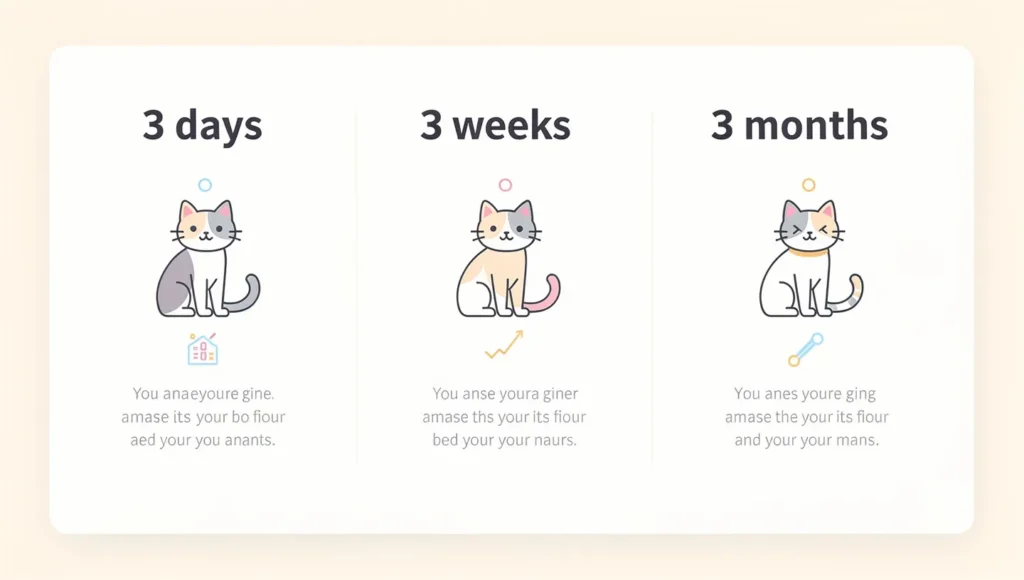
🐾 The 3-3-3 Rule: Navigating Your Kitten’s First 90 Days
In the world of professional feline behavior, we use the 3-3-3 Rule to manage expectations. A kitten doesn’t just “arrive”; they “unfold.” This framework is the heart of a modern kitten care guide, helping you understand the psychological shifts your kitten undergoes during their first three months in a new “territory.”
🗓️ Phase 1: The First 3 Days (Decompression)
During these first 72 hours, your kitten is likely in “survival mode.” Everything—the smells, the sounds, the people—is alien.
Behavior: They may hide under the sofa, eat very little, or only come out at night.
Your Job: Give them space. Don’t force cuddles. Speak in low, soothing tones.
Success Metric: Seeing them use the litter box and taking a few bites of food.
🗓️ Phase 2: The First 3 Weeks (Building Routine)
Once the initial shock wears off, your kitten starts to realize they are safe. This is when their true personality begins to peek through the shyness.
Behavior: They start exploring beyond the “Base Camp,” testing boundaries (like jumping on counters), and initiating play.
Your Job: Establish a strict feeding and play schedule. This predictability lowers their cortisol levels.
Success Metric: Hearing the first purrs and seeing “kneading” (making biscuits) on your lap.
Internal Link Opportunity: Understand this behavior better with our guide on Why Do Cats Knead?
🗓️ Phase 3: The First 3 Months (Total Integration)
By the end of 90 days, the kitten feels a sense of ownership over the home. They are no longer a “guest”; they are a family member.
Behavior: They have a favorite sleeping spot, a bond with specific family members, and a clear understanding of the household rhythm.
Your Job: Focus on advanced socialization and long-term habits.
Success Metric: A kitten that greets you at the door and shows no fear in their day-to-day environment.
📊 Summary: The 3-3-3 Transformation Table
Timeline
Emotional State
Primary Goal
First 3 Days
Overwhelmed / Fearful
Safety and Decompression
First 3 Weeks
Curious / Testing
Routine and Trust
First 3 Months
Confident / Bonded
Socialization and Training
Expert Tip: If your kitten is still hiding 24/7 after the first week, don’t panic. Some “mini-leopards” take longer to adjust. Focus on “scent swapping”—rub a soft cloth on yourself and leave it in their hiding spot so they associate your scent with safety.
During this period, you might notice strange night behaviors. If your new friend is keeping you up, check out our tips on Cat Meowing at Night to regain your sleep.
🍽️ Fueling Growth: Weaning and The Ideal Kitten Diet
Proper nutrition is the cornerstone of any kitten care guide. During their first year, kittens grow at an astronomical rate, requiring almost double the energy per pound of body weight compared to adult cats. This isn’t just about filling their bellies; it’s about providing the building blocks for their brain, bones, and immune system.
🍼 The Kitten Weaning Process: From Milk to Solids
Most kittens begin the kitten weaning process around 3 to 4 weeks of age. If you are caring for a motherless kitten, this is a delicate time.
Introduction: Start by mixing kitten-specific wet food with kitten milk replacer (KMR) to create a “mush” or “gruel” consistency.
Transition: Gradually decrease the amount of liquid over 2 to 3 weeks until they are eating solid kitten food comfortably.
Patience: Never rush this. Forcing a kitten to eat solids too early can lead to severe digestive upset or “food aversion.”
🍱 What to Feed a Kitten (8–12 Weeks)
By the time they are 8 weeks old, most kittens are fully weaned. At this stage, they need a diet rich in Taurine (for heart and eye health) and DHA (for brain development).
Age Range
Feeding Frequency
Diet Type
4–8 Weeks
5–6 meals per day
Gruel (KMR + Wet Food)
2–6 Months
3–4 meals per day
High-protein Kitten Food
6–12 Months
2 meals per day
Transitioning to Adult portions
💧 The Hydration Secret
Kittens have a low thirst drive. While dry kibble is convenient, relying solely on it can lead to dehydration. Incorporating wet food ensures they get the moisture necessary for healthy kidney function. For a deeper dive into the “Kibble vs. Canned” debate, read our analysis on Wet vs Dry Cat Food.
Expert Tip: Avoid “Free Feeding” (leaving a bowl full of food out all day). Instead, use “Puzzle Feeders” or scheduled meals. This mimics their natural hunting instincts and prevents the onset of feline obesity early in life.
If you’re curious about adding some variety to their bowl as they grow, make sure you know exactly what can cats eat safely to avoid toxic human foods.
🚽 Kitten Care Guide: Stress-Free Litter Training
One of the most rewarding aspects of feline companionship is their natural instinct for cleanliness. Unlike other pets, most kittens have an innate desire to bury their waste. However, a successful kitten care guide must address the fact that “accidents” are usually a communication issue, not a behavioral one.
💡 The “Litter Logic”: Setting the Stage for Success
Before you bring your kitten home, you need to think like a cat. Location and substrate are everything.
The Right Box: For a tiny kitten, a high-sided adult box is like climbing a mountain. Start with a low-entry litter box that they can easily step into without struggle.
Substrate Matters: Most kittens prefer a soft, sandy texture that feels natural under their paws. Avoid heavily scented litters, as a kitten’s sense of smell is far more sensitive than yours.
Privacy vs. Accessibility: Place the box in a quiet, low-traffic area. If the house is large, place a box on every floor so they are never too far from a “restroom.”
🚀 Success Strategies: The “Golden Timing”
The secret to fast training is catching the right moment. Most kittens feel the urge to go immediately after eating or right after waking up from a nap.
Gently Place Them: After a meal, gently set your kitten in the box.
Let Them Dig: Use your finger to gently scratch the litter to show them the texture; often, this sound triggers their instinct to dig.
Positive Reinforcement: When they use the box, offer soft-voiced praise or a tiny treat. Never scold a kitten for an accident, as this creates a fear-association with the box itself.
🛠️ Troubleshooting Common Mishaps
If your kitten is consistently avoiding the box, it’s time to play detective. Is the box dirty? Is the litter too deep? According to the International Cat Care standards, the tray should be cleaned at least twice a day to meet feline hygiene expectations.
The Problem
Likely Reason
The Solution
Peeing near the box
Box is too dirty or small.
Scoop daily and upgrade the size.
Crying while digging
Potential UTI or discomfort.
Consult a vet immediately.
Peeing on soft fabrics
Stress or texture preference.
Use an enzymatic cleaner and add a box.
Expert Tip: If your kitten has started targeting your furniture, don’t panic. It’s often a sign of stress or a medical nudge. Check out our deep dive on Cat Peeing on the Bed for a step-by-step resolution.
For more on choosing the best “sand” for your home, our guide to the Best Cat Litter 2026 covers everything from odor control to kitten-safe materials.
💉 Kitten Vaccination Schedule: Building a Lifetime of Immunity
A comprehensive kitten vaccination schedule is the single most important investment you will make in your cat’s long-term health. Think of vaccines not as a chore, but as a biological “shield” that protects your tiny friend from invisible, life-threatening viruses. In this section, we break down the medical essentials every owner must know to build a solid health foundation.
🩺 Your First Vet Visit: What to Expect
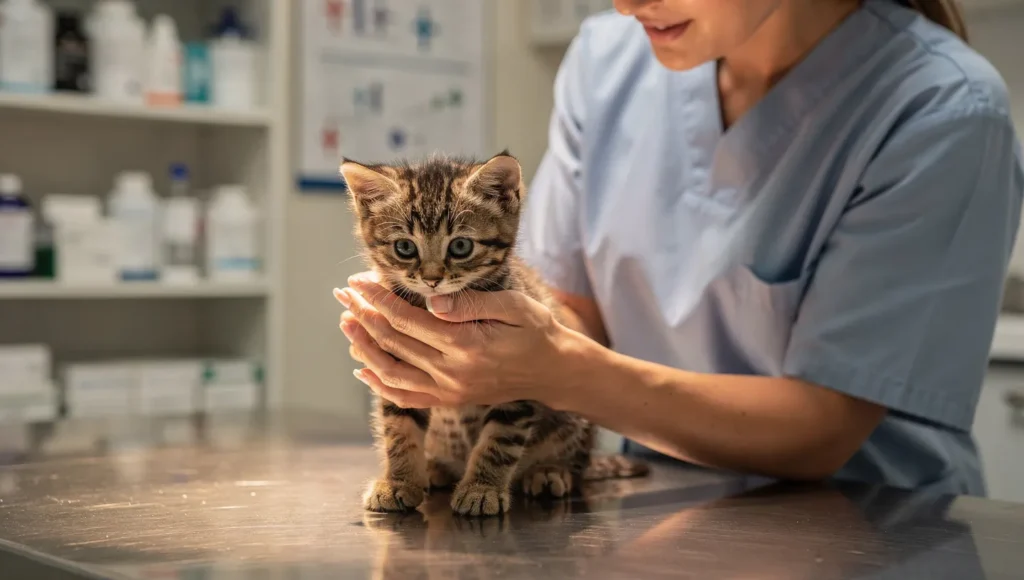
Your first vet visit kitten appointment should happen within 48 to 72 hours of bringing them home. This isn’t just for shots; it’s a full “head-to-tail” physical audit. Your vet will check for:
Congenital Issues: Checking the heart for murmurs or the roof of the mouth for a cleft palate.
Parasite Screening: Kittens almost always carry roundworms or hookworms inherited from their mother.
Weight Baseline: Monitoring growth progress against breed standards.
📅 The Master Kitten Health Checklist & Timeline
Most kittens require a series of vaccinations every 3–4 weeks until they reach approximately 16–20 weeks of age. This “booster” system is crucial because the mother’s antibodies can interfere with early vaccines.
Even “indoor-only” kittens are at risk. Fleas can hitch a hike on your clothes, and mosquitoes (which carry heartworm) can fly through open windows. A professional kitten health checklist must include:
De-worming: Usually started at 2 weeks of age and repeated.
Flea/Tick Prevention: Topical or oral treatments safe for their specific weight.
Heartworm Prevention: Critical in many regions to prevent sudden cardiac issues.
Expert Tip: Keep a “Health Journal” for your kitten. Note down the dates of their shots, any mild reactions (like lethargy), and their weight. Having this data ready can be a lifesaver during an emergency.
Not sure if your kitten’s current behavior is just a “nap” or a sign of trouble? Our guide on How to Tell if Your Cat is Sick helps you decode the subtle signals before they become medical emergencies.
🧠 Socialization & Behavior: Raising a Confident Hunter
Behavioral health is just as critical as physical health. In fact, more cats are surrendered to shelters for behavioral issues than for medical ones. A truly expert kitten care guide must prioritize the “Socialization Window”—a magical period between 2 and 12 weeks of age where a kitten’s brain is like a sponge, soaking up what is “safe” and what is “scary.”
🕒 The Critical Socialization Window
If you miss this window, you aren’t doomed, but you will be playing “catch-up.” To raise a confident, well-adjusted cat, you must expose them to a variety of stimuli in a positive way. This is often called kitten socialization.
Handling: Gently touch their paws, ears, and belly daily. This makes future vet visits and nail trims much easier.
Sounds: Expose them to the vacuum, doorbells, and even recordings of thunderstorms at a low volume, rewarding calm behavior with treats.
People: Introduce them to people of different ages, sizes, and even those wearing hats or glasses to prevent “stranger danger.”
⚔️ Understanding Play & “Single Kitten Syndrome”
Kittens learn how to be cats through play. If they don’t have a sibling, they might develop “Single Kitten Syndrome,” where they don’t learn “bite inhibition.” They don’t realize that their teeth and claws hurt!
Hands Are Not Toys: Never use your fingers to wrestle with a kitten. Use “wand toys” to keep distance between your skin and their claws.
Redirecting: If they bite your hand, immediately stop play and offer a kicker toy. This teaches them: “Biting skin = Fun stops. Biting toys = Fun continues.”
📊 Quick Summary: The Confident Kitten Checklist
Action
Frequency
Why It Matters
Gentle Handling
Daily
Prepares for grooming and medical exams.
Active Play Sessions
15 mins (3x Daily)
Burns energy and prevents destructive behavior.
Scent Swapping
Weekly
Introduces new smells in a non-threatening way.
Expert Tip: Watch their tail! A twitching tail during play is excitement; a puffed-up “Halloween cat” tail is fear. Learning to read these signals early will prevent 90% of future behavior problems.
🌙 Kitten Care Guide: Troubleshooting Common Challenges
Even with the best preparation, real life with a tiny feline can be unpredictable. This part of our kitten care guide is dedicated to the “pain points” most new owners face during the first few weeks. From sleep deprivation to tiny teeth, here is how to troubleshoot the most common kitten hurdles.
😴 The Midnight Serenade: Stopping Night Meowing
It is 3:00 AM, and your kitten is screaming at your bedroom door. Why? Usually, it’s a mix of loneliness, extra energy, or habit-forming behavior.
The Solution: Ensure a high-intensity play session followed by a late-night meal right before you go to bed. This mimics the natural “Hunt-Eat-Groom-Sleep” cycle.
The Golden Rule: Never respond to night meowing with attention (even negative attention). If you get up to quiet them, you’ve just taught them that meowing works!
Internal Link Opportunity: For more detailed strategies, read our guide on Cat Meowing at Night.
🦷 The “Tiny Terror” Phase: Managing Play Biting
Kittens explore the world with their mouths. If your kitten is treating your ankles like a snack, they aren’t being mean—they are practicing their hunting skills.
Freeze: If they bite, stop moving immediately. Movement triggers their prey drive.
Redirect: Gently offer a plush “kicker” toy that they can bite and bunny-kick to their heart’s content.
Hissing (The Mama Cat Method): A sharp, short “Pshhh” sound can mimic a mother cat’s warning and startle them into stopping.
🙈 The Vanishing Act: What if They Won’t Stop Hiding?
If your kitten is still under the bed after day three, they may just be a “Wallflower” personality.
The Fix: Move their food bowl closer to their hiding spot every day. Use “Interactive Play” (like a feather wand) to lure them out without forcing physical contact.
Internal Link Opportunity: Discover the “secret signals” behind this behavior in our guide: Why Do Cats Hide?.
📊 Quick Checklist: Is it Normal or a Vet Visit?
Situation
Likely Normal
Call the Vet If…
Feeding
Skipping one meal due to sleep.
They haven’t eaten in 24 hours.
Energy
Sleeping 18-20 hours a day.
They are “floppy” or unresponsive.
Bathroom
One “accident” outside the box.
Straining, crying, or blood in stool.
Expert Tip: Patience is your best tool. Most “behavioral problems” in kittens are simply developmental stages that pass with consistent training and a predictable routine.
🏁 Conclusion: Your Journey is Just Beginning
Raising a kitten is a marathon, not a sprint. By following this kitten care guide, you aren’t just keeping a pet alive; you are nurturing a complex, emotional, and highly intelligent creature. Remember that every “accident” on the carpet or midnight meow is just a stepping stone toward a deep, lifelong friendship.
The “3-3-3 rule” and the routines you establish today are the foundation of your kitten’s future. Stay patient, stay observant, and most importantly, enjoy the tiny purrs and head-butts along the way. Your kitten doesn’t need a perfect owner—they just need a consistent and loving one.
📥 Take the Next Step
Ready to become a pro cat parent? Don’t stop here!
Download our “New Kitten Checklist” to ensure you haven’t missed a single safety step.
Join our community at Felina Care Hub for more expert tips delivered to your inbox.
Expert Tip: Your kitten’s personality will continue to evolve until they are about two years old. Keep socialized, keep playing, and keep learning together!
A cat enthusiast dedicated to feline well-being. Here, I share the insights of my experience in understanding cat body language, behavior modification, and selecting the best preventative diets. My goal is to make cat ownership a joyful and seamless experience through simple, effective tips that prioritize prevention over cure.