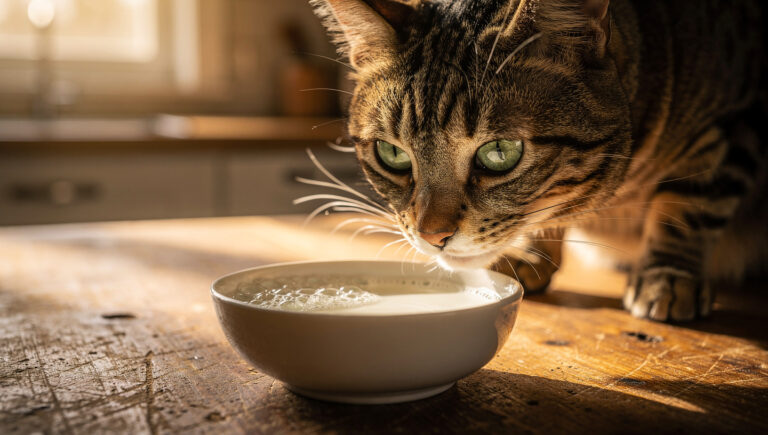

You’re watching your cat strain in the litter box — again. Or maybe the opposite problem: loose stools that won’t quit. Before you panic or reach for an expensive supplement, check your pantry. There might be a humble orange can sitting right there that could help.
Pumpkin for cats has been one of my go-to recommendations for over a decade. It’s simple, affordable, and backed by solid nutritional science. But — and this matters — not all pumpkin is created equal, and more isn’t always better.
So, is pumpkin good for cats? Yes, when used correctly. Is pumpkin safe for cats? Absolutely — as long as it’s 100% pure pumpkin, nothing added, nothing fancy.
In this guide, you’ll learn exactly how pumpkin supports your cat’s digestive health, the right dosage by body weight, which type to buy, and when pumpkin simply isn’t enough.
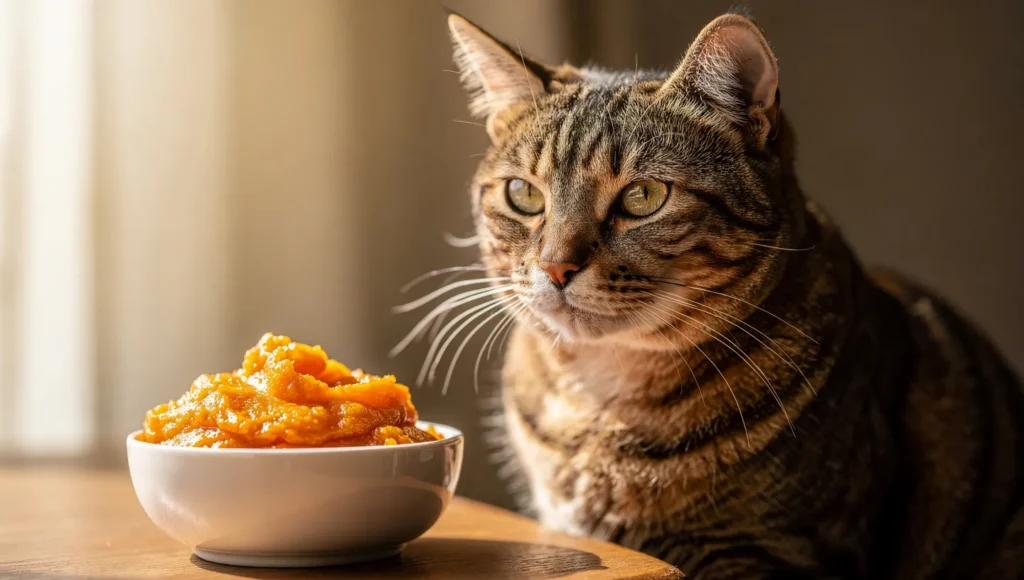
Table of Contents
- 🌿 Is Pumpkin Good for Cats?
- 🥕 The Nutritional Benefits of Pumpkin for Cats
- 🚨 Is Pumpkin Safe for Cats? (And What to Avoid)
- 🥧 Plain Pumpkin vs. Pumpkin Pie Filling
- 🥩 Raw Pumpkin vs. Cooked Pumpkin
- 🐱 Can Kittens Eat Pumpkin?
- 🐾 Pumpkin for Cats Constipation – Does It Really Help?
- 🥄 How Much Pumpkin to Give a Cat for Constipation
- 💧 Pumpkin for Cats with Diarrhea – Helpful or Harmful?
- 💡 Expert Tip
- 📊 How Much Pumpkin Can I Give My Cat? (Complete Dosage Chart)
- 🛒 Best Pumpkin for Cats (What to Buy in the U.S.)
- 🤝 When I Personally Recommend Pumpkin (From Experience)
- ⚠️ When Pumpkin Is NOT the Answer
- ❓ FAQs – Pumpkin for Cats
- Does pumpkin help cats poop?
- Does pumpkin settle a cat’s stomach?
- Can I give my cat pumpkin every day?
- How fast does pumpkin work for cats?
- Is too much pumpkin bad for cats?
- Final Thoughts
🌿 Is Pumpkin Good for Cats?
Let’s be direct: yes, pumpkin is genuinely good for cats — not as a meal replacement, but as a powerful digestive support tool.
It’s low in calories, naturally hydrating, and packed with a specific type of fiber that does something most cat foods simply don’t do: it helps regulate the gut from both ends.
🥕 The Nutritional Benefits of Pumpkin for Cats
Pumpkin for cats works because of its unique fiber profile — a combination of soluble and insoluble fiber that few single ingredients can match.
Here’s what that means in practice:
- Soluble fiber dissolves in water and forms a gel-like substance in the gut. This slows digestion, absorbs excess water during diarrhea, and helps firm up loose stools.
- Insoluble fiber adds bulk to the stool and keeps things moving — which is why it’s so effective for constipation.
- Moisture content — canned pumpkin is roughly 90% water, which quietly supports hydration with every spoonful. If your cat is a reluctant drinker, this matters more than you might think. (More on hydration strategies in our Cat Hydration Guide.)
- Low calorie density — one teaspoon contains just a few calories, making it a smart addition for cats managing their weight. If that’s a concern in your household, our Cat Weight Loss Guide pairs well with this topic.
- Beta-carotene, potassium, and vitamin C — in small amounts, yes, but every bit of micronutrient variety supports long-term wellness.The Cornell Feline Health Center recommends consulting a veterinarian for any digestive symptoms lasting beyond 48 hours.
One mistake I often see is cat owners assuming pumpkin is just a “folk remedy.” It’s not. The fiber mechanism is well-documented, and the results — when used correctly — are consistent.
🚨 Is Pumpkin Safe for Cats? (And What to Avoid)
Pumpkin itself is completely safe for cats. The danger isn’t the pumpkin — it’s what comes with it.
🥧 Plain Pumpkin vs. Pumpkin Pie Filling
This is the single most important distinction in this entire guide.
100% pure canned pumpkin = safe.
Pumpkin pie filling = never.
Pumpkin pie filling contains sugar, nutmeg, cinnamon, and sometimes xylitol — all of which are toxic to cats. The cans look nearly identical on the shelf. Read the label every single time.
Look for one ingredient: pumpkin.
🥩 Raw Pumpkin vs. Cooked Pumpkin
Raw pumpkin isn’t toxic, but it’s harder to digest and most cats won’t touch it. Cooked or canned plain pumpkin is far more bioavailable and palatable.
If you cook fresh pumpkin at home, steam or bake it plain — no butter, no salt, no seasoning of any kind.
🐱 Can Kittens Eat Pumpkin?
Yes, but with extra caution on quantity. Kittens have sensitive, still-developing digestive systems.
Start with no more than ¼ teaspoon and observe carefully for 24 hours. If no digestive upset occurs, you can continue at that dose when needed.
For a full picture of kitten nutrition and digestive care, our Kitten Care Guide covers early feeding in detail.
For a broader look at which human foods cross the danger line, the Human Foods Toxic to Cats guide is essential reading for any cat owner.
🐾 Pumpkin for Cats Constipation – Does It Really Help?
Short answer: yes, and here’s why it actually works.
When a cat is constipated, the stool moves too slowly through the colon. As it sits there, the colon keeps pulling moisture out of it — making it harder, drier, and more difficult to pass. It’s an uncomfortable cycle.
Insoluble fiber from pumpkin interrupts that cycle. It adds physical bulk to the stool, which stimulates the intestinal walls to contract and push things forward. Think of it as a gentle mechanical nudge — no chemicals, no laxatives, just fiber doing what fiber does.
I’ve worked with cats that were straining for two days straight, and a simple addition of pumpkin to their wet food made a noticeable difference within 12 to 24 hours. Not always, but often enough that it’s always my first suggestion before anything else.
Hydration plays a huge role here too. A dehydrated cat is far more prone to constipation. If your cat isn’t drinking enough, pumpkin alone won’t solve the underlying issue. Our guide on Why Does My Cat Not Drink Water is worth reading alongside this one.
🥄 How Much Pumpkin to Give a Cat for Constipation
Start low. Always.
| Cat Size | Weight | Starting Dose | Max Dose |
|---|---|---|---|
| Small / Kitten | Under 7 lbs | ¼ teaspoon | ½ teaspoon |
| Average Adult | 7–11 lbs | ½ teaspoon | 1 teaspoon |
| Large Adult | 12+ lbs | 1 teaspoon | 1½ teaspoons |
Give once daily, mixed into wet food. If no improvement after 48 hours, don’t increase the dose — contact your vet instead.

💧 Pumpkin for Cats with Diarrhea – Helpful or Harmful?
This is where pumpkin gets interesting — and where most people are surprised.
The same ingredient that helps with constipation can also help with diarrhea. That’s the magic of soluble fiber.
During diarrhea, the gut is moving too fast and not absorbing water properly. Soluble fiber acts like a sponge — it absorbs excess water in the intestines, slows transit time, and helps form a more normal stool consistency.
But — and this is important — pumpkin is a supportive tool, not a diagnostic answer.
When NOT to use pumpkin for diarrhea:
- If diarrhea has lasted more than 48 hours
- If you see blood or mucus in the stool
- If your cat is lethargic or refusing food
- If vomiting accompanies the diarrhea
In those cases, pumpkin is not what your cat needs. A vet visit is. Our guide on How to Tell if Your Cat is Sick walks you through the warning signs clearly.
For occasional soft stools after a food change or mild stomach upset, pumpkin is a reasonable first step. For anything beyond that, don’t wait.
If your cat tends to vomit after eating, that’s a separate issue worth understanding — our article on Why Does My Cat Throw Up After Eating covers the key differences between normal and concerning patterns.
💡 Expert Tip
Always introduce pumpkin gradually — start with half the recommended dose for the first two days. Jumping straight to a full teaspoon, even in an adult cat, can cause gas and bloating. The goal is a smooth digestive transition, not a dramatic one. Mix it deep into wet food so your cat doesn’t pick around it.
📊 How Much Pumpkin Can I Give My Cat? (Complete Dosage Chart)
Here’s the full reference chart for daily use:
| Cat Weight | Daily Amount | Frequency | How to Serve |
|---|---|---|---|
| Under 5 lbs | ¼ teaspoon | Once daily | Mixed in wet food |
| 5–8 lbs | ½ teaspoon | Once daily | Mixed in wet food |
| 8–12 lbs | 1 teaspoon | Once daily | Mixed in wet food |
| 12–15 lbs | 1½ teaspoons | Once daily | Mixed in wet food |
| 15+ lbs | 2 teaspoons | Once daily | Split between meals |
Three rules to follow:
- Always mix with wet food — never serve pumpkin dry or alone
- Monitor the litter box for 24–48 hours after starting
- If your cat refuses it, try warming the food slightly to enhance the aroma
Not sure whether wet or dry food is better for your cat’s digestion overall? Our Wet vs. Dry Cat Food Guide breaks it down without the confusion.
🛒 Best Pumpkin for Cats (What to Buy in the U.S.)
Walk into any grocery store and you’ll find two types of canned pumpkin sitting side by side. Only one belongs near your cat.
What to look for:
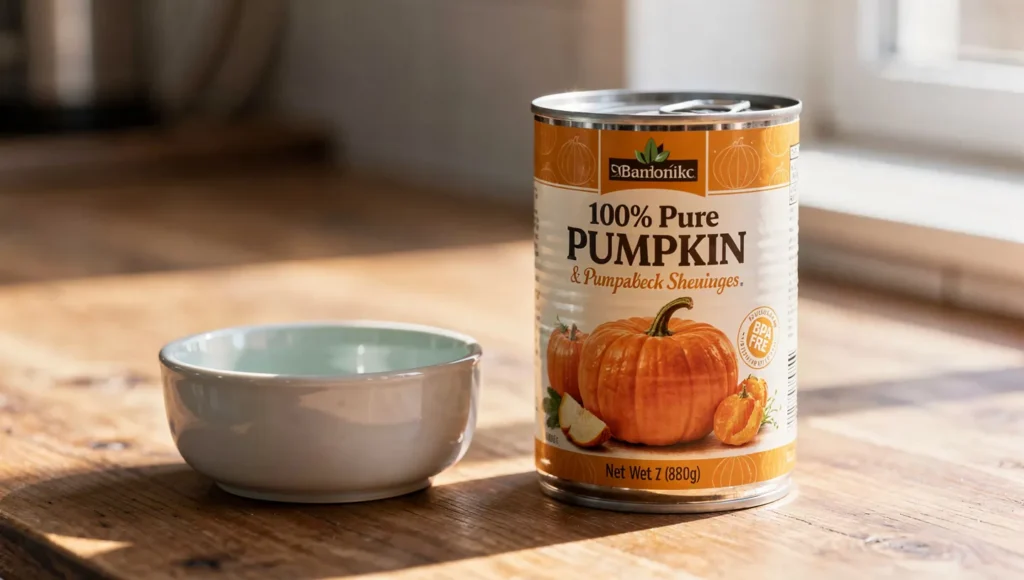
- Label says: “100% Pure Pumpkin”
- Ingredient list has exactly one item: pumpkin
- BPA-free can when possible (brands like Farmer’s Market Organic use BPA-free packaging)
- Organic is a nice bonus, not a requirement
What to avoid:
- Anything labeled “pumpkin pie filling” or “pumpkin pie mix”
- Any product with spices, sugar, or “natural flavors” listed
- Fresh raw pumpkin (safe but impractical and harder to portion)
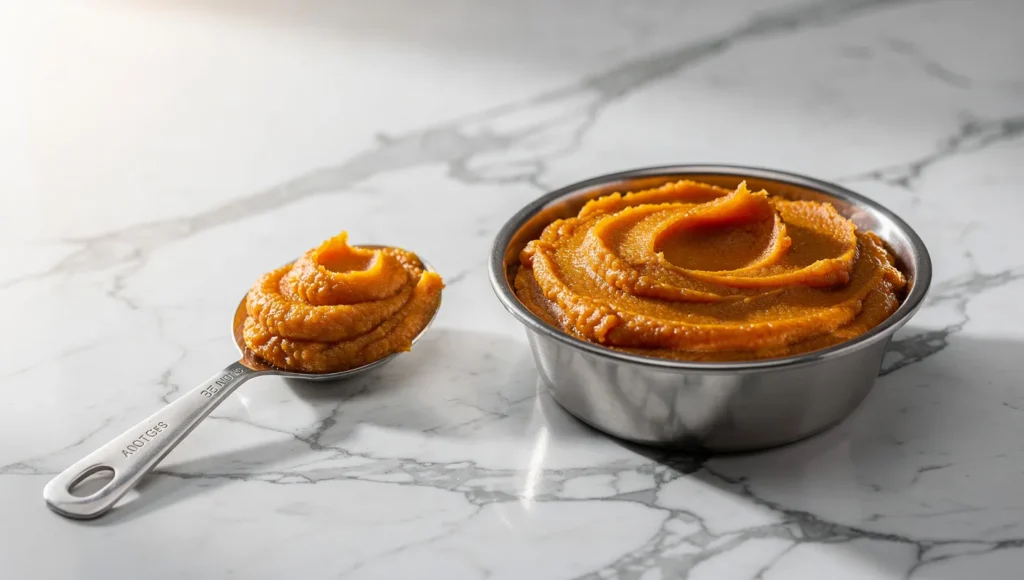
Storage: Once opened, store in an airtight container in the refrigerator. Use within 3 to 5 days. You can also freeze it in ice cube trays for single-serving portions — each cube is roughly one teaspoon.
🤝 When I Personally Recommend Pumpkin (From Experience)
In my experience working with indoor adult cats, pumpkin tends to be most effective in three specific situations.
First, when a cat has recently switched foods and is experiencing transitional soft stools — the fiber helps stabilize the gut while the digestive system adjusts. If you’re in the middle of a food transition, our How to Switch Cat Food Safely guide pairs perfectly with this approach.
Second, when an older or less active cat develops mild, recurring constipation — often from reduced gut motility and lower water intake. A small daily dose mixed into wet food works quietly in the background.
Third, when I see owners reaching for expensive probiotic supplements for minor, occasional digestive upset. Before spending money, try pumpkin for three to five days. In many cases, it’s all the gut needs.
One mistake I often see: owners giving pumpkin for weeks without monitoring results. Set a clear window — three to five days. If you don’t see improvement, stop and consult your vet. Pumpkin is a support tool, not a long-term management strategy for chronic issues.
⚠️ When Pumpkin Is NOT the Answer
Pumpkin is genuinely useful — but it has real limits, and knowing those limits is just as important as knowing the benefits.
Stop and call your vet if you notice any of the following:
- Constipation lasting more than 48–72 hours despite pumpkin use
- Diarrhea that continues beyond 48 hours
- Blood in the stool — any amount
- Vomiting alongside digestive issues
- Lethargy, hiding, or loss of appetite
- Straining with no output at all (this can signal a blockage)
These are not pumpkin situations. These are veterinary situations.
Pumpkin works beautifully for mild, occasional digestive irregularity. It is not a substitute for professional diagnosis when something is genuinely wrong.
❓ FAQs – Pumpkin for Cats
Does pumpkin help cats poop?
Yes. Plain canned pumpkin helps constipated cats by adding insoluble fiber that increases stool bulk and stimulates intestinal movement.
Does pumpkin settle a cat’s stomach?
Often yes. The soluble fiber absorbs excess water during diarrhea and can calm minor digestive upset. It won’t address the underlying cause, but it supports gut stability in the short term.
Can I give my cat pumpkin every day?
Small daily amounts (½ to 1 teaspoon) are generally well-tolerated for short periods. Long-term daily use without a specific need isn’t recommended — too much fiber can interfere with nutrient absorption over time.
How fast does pumpkin work for cats?
Most owners notice results within 12 to 24 hours for constipation. For diarrhea, improvement typically shows within 24 to 48 hours.
Is too much pumpkin bad for cats?
Yes. Excessive pumpkin can cause bloating, gas, or paradoxically worsen diarrhea. Stick to the dosage chart above and don’t exceed 2 teaspoons daily for any cat.
Final Thoughts
Pumpkin for cats earns its reputation — not through hype, but through simple, reliable fiber science.
A small spoonful of 100% pure canned pumpkin, mixed into wet food, can ease constipation, firm up loose stools, and quietly support your cat’s digestive rhythm. It costs almost nothing, has minimal side effects when used correctly, and works fast enough that you’ll know within a day or two whether it’s helping.
But keep perspective. Pumpkin is a supportive tool in your care routine — not a cure, not a diagnosis, and not a substitute for veterinary attention when your cat genuinely needs it.
The best thing you can do as a cat owner is stay observant. Watch the litter box. Notice changes in appetite, energy, and behavior. The earlier you catch something, the easier it is to address.
Your cat can’t tell you something feels off. But if you’re paying attention, you’ll know.