

I’ll be honest with you. This whole thing started because of Marcus.
Marcus is my coworker. The guy who has an opinion about everything — cars, coffee, fantasy football, and apparently, cats. So when I mentioned I was looking into ragdoll cat care and thinking about getting one, he leaned back in his chair, he leaned back in his chair like he’d just been appointed the world’s leading feline expert and said:
“Bro. Get a Ragdoll. They’re basically stuffed animals. You put them down, you pick them up, they don’t care. Zero drama.”
I trusted Marcus. I don’t know why I trusted Marcus — this is the same man who once told me that cooking pasta “doesn’t need a timer.” But I trusted him.
Three weeks later, I drove two hours to pick up the fluffiest, most blue-eyed creature I’d ever seen. And because Marcus was so confident about everything, I named the cat “Biscuit” — partly because he looked like a warm, soft biscuit, and partly to make sure Marcus never felt too important about this whole thing.
Biscuit came home on a Friday evening. I set up his little corner, gave him food, turned off the lights, and thought: Easy. Just like Marcus said.
Then I made the mistake of going to the bathroom and closing the door.
What followed was five minutes of the most dramatic, soul-crushing meowing
I have ever witnessed from a living creature. Not loud. Not angry. Just… devastated. Like I’d abandoned him at a train station in 1943. I opened the door and found Biscuit sitting exactly one inch from the door, staring at me with his enormous blue eyes like I had personally wronged him on a cosmic level.
That was just night one.
The next morning, I walked into the office looking like I hadn’t slept — because I hadn’t. Not really. Biscuit had decided that my pillow was a perfectly acceptable sleeping location, which meant my head was not.
I’d spent the night slowly migrating to the left side of the bed while Biscuit expanded.
Sofia looked up from her coffee the second I walked in. “You got the cat last night, didn’t you?”
I hadn’t said a word.
“You have that look,” she said. “I had that look. For like two weeks.”
Dave rolled his chair over. Dave has two cats and speaks about them the way some people speak about their children — with equal parts love and exhaustion. “First night?” he asked. I nodded. He nodded back slowly, the way veterans acknowledge each other.
Then Priya — who I didn’t even know had a cat — spun around from her desk and said, completely deadpan: “Did he find your face? They always find your face.”
And then they all laughed. At me. For a solid thirty seconds.
But here’s the thing — after they finished laughing, they actually helped. Sofia told me about the first week adjustment period and why I shouldn’t panic. Dave explained that the bathroom thing is completely normal — Ragdolls just genuinely don’t understand why doors exist. Priya told me to get a second litter box because “trust me, you’ll thank yourself later.”
I thanked Sofia for not letting me spiral into panic-Googling at 2 AM.
I thanked Dave for the litter box wisdom that genuinely changed my life. And I thanked Priya for the face comment, which, while deeply unsettling, was completely accurate.
And now — a few months, one very fluffy couch, and approximately 400 cat hairs on every black shirt I own later — I want to pay it forward. To you. To every person standing at the edge of the Ragdoll rabbit hole, wondering if this is a good idea.
It is. But let me actually tell you what you’re signing up for.
Quick note before we dive in: Everything here is based on personal experience and research from trusted sources like the ASPCA and Cornell Feline Health Center. I’m not a vet — just someone who survived the first night and lived to write about it. For medical concerns, always check with your veterinarian.
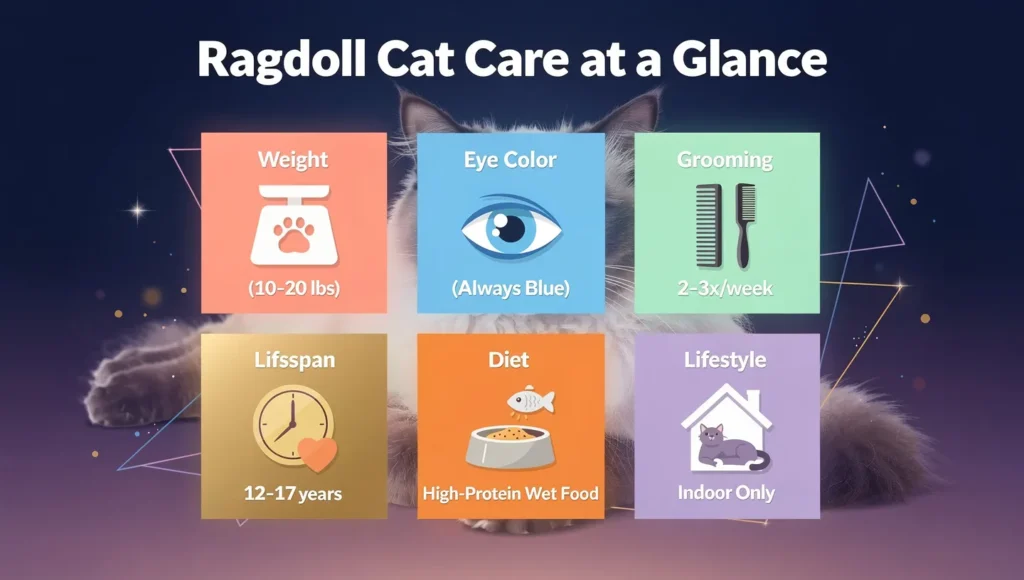
Table of Contents
- So… What Does Ragdoll Cat Care Actually Look Like?
- The Ragdoll Personality: Myths vs. Reality
- Living With a Ragdoll — A Day in Real Life
- Ragdoll Cat Grooming: The Avalanche Nobody Warned Me About
- Ragdoll Health: The 3 Things Every Owner Must Know
- Ragdoll Cat Care Tip 1: Feeding Without Overcomplicating It
- Is a Ragdoll Right for You? (Honest Answer)
- Real Questions About Ragdoll Cat Care (Answered Honestly)
- Is it easy to take care of a Ragdoll cat?
- Do Ragdoll cats need special care?
- Are Ragdolls clingy?
- Do Ragdoll cats sleep with you?
- What is the 3-3-3 rule for cats?
- Biscuit Says Hi — And So Do I
So… What Does Ragdoll Cat Care Actually Look Like?
By definition, a Ragdoll is a large, semi-longhaired domestic cat breed known for going limp when held — like a ragdoll — and for being one of the most affectionate, people-oriented breeds you’ll ever meet. They’re gentle, calm, and deeply attached to their humans.
But “calm” doesn’t mean “low-effort.” It means they trade chaos for something more emotionally demanding: your actual presence.
Ragdolls typically weigh between 10 and 20 pounds, with males usually on the heavier end. Their eyes are always blue — from pale sky to deep sapphire — and their coat is a color-point pattern, meaning darker on the ears, face, paws, and tail. They’re not fully developed until around 4 years old, which is adorably inconvenient because they stay kitten-brained for a very long time.
Here’s the thing most articles won’t tell you: Ragdolls aren’t just “affectionate.” They’re emotionally wired to be near you. This isn’t a feature you can turn off. It’s the whole personality.
The Ragdoll Personality: Myths vs. Reality
Marcus was wrong. Here’s a proper breakdown:
| Myth | Reality |
|---|---|
| Ragdolls are lazy | They need emotional stimulation daily |
| They’re low maintenance | Their coat requires brushing 2–3x per week |
| Perfect for everyone | Not great for owners who travel often |
| They don’t feel lonely | Separation anxiety is genuinely common |
| They’re quiet | They’ll follow you and softly narrate your life |
| They don’t need much space | They need vertical space and enrichment |
Honestly, the “lazy” myth is the one that catches most people off guard.
Biscuit isn’t lazy. He’s deliberate. He conserves energy specifically to deploy it the moment I sit down and attempt to do literally anything.
Living With a Ragdoll — A Day in Real Life
Here’s what nobody puts in the breed description:
Morning: Biscuit is already awake when my alarm goes off. Not because he wants breakfast — though he does — but because he has apparently decided that 6:47 AM is when we make eye contact for the first time and reconnect after the long separation of sleep.
Getting ready: He follows me to the bathroom. He sits outside if the door is closed. He chirps once, softly, like a polite complaint. I’ve started leaving the door open.
Working from home: He cycles between my keyboard, my lap, and the windowsill — with occasional detours to the paper I’m trying to read. It’s a very intentional rotation.
Evening: This is prime time. He’s most playful between 6 and 9 PM, which is also when I’m most tired. The universe planned this specifically.
Bedtime: He will be on the bed. Negotiating where is between you and him.
This is also when I need to tell you about The Incident with the black blazer.
I had an early presentation. Important one. I put on my nicest black blazer, felt very professional, and decided to give Biscuit a quick goodbye scratch behind the ears.
Thirty seconds later, I looked like I’d been rolled through a sheep paddock.
The blazer was… enhanced. Luxuriously. Biscuit looked up at me with complete satisfaction, like he’d just improved my outfit and expected a thank-you.
Marcus, when I told him this, said: “You should have gotten a white cat.”
I did not thank Marcus.
But I will say — a good lint roller is non-negotiable. Keep one at home, one in the car, and one at the office. Sofia taught me this. Sofia is wiser than Marcus.

Ragdoll Cat Grooming: The Avalanche Nobody Warned Me About
Ragdolls don’t shed constantly — they shed strategically.
Twice a year, during spring and fall, the volume increases dramatically. I’m talking find-cat-hair-in-your-coffee levels. Find-it-in-your-cereal levels. Find-it-somewhere-that-defies-the-laws-of-physics levels.
The good news? Their coat is semi-long and surprisingly mat-resistant compared to other longhaired breeds. No undercoat means less tangling. But “less” doesn’t mean “none,” and skipping brushing sessions is how you end up with a matted, uncomfortable cat and a very expensive grooming bill.
What actually works:
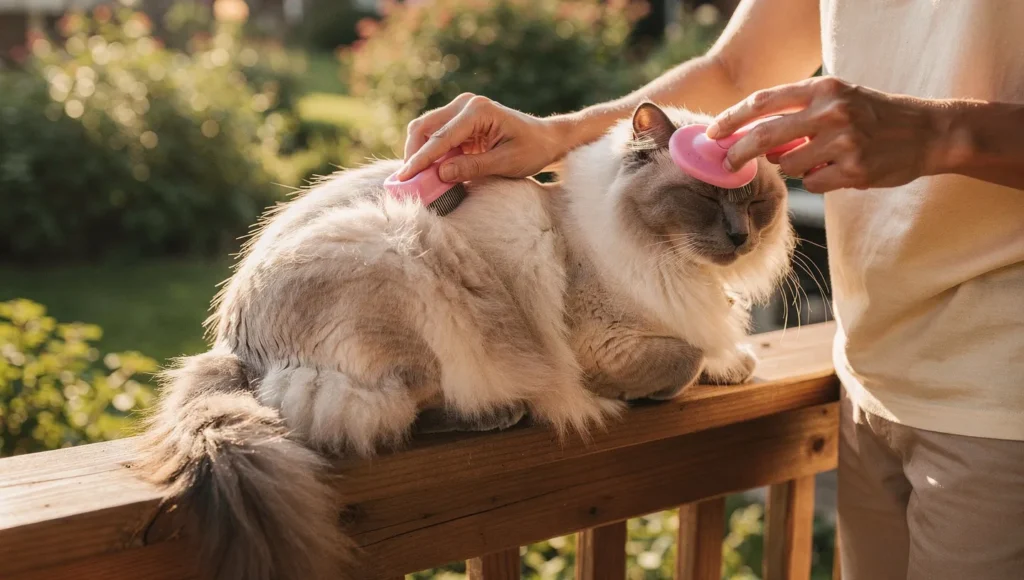
- Brush 2–3 times per week with a slicker brush — this is the non-negotiable minimum
- During shedding season, bump it up to every other day
- Always brush in the direction of the fur, not against it
- Focus on the belly, armpits, and behind the ears — these are the mat danger zones
- Make it a calm ritual, not a wrestling match. Biscuit gets a treat after every session.
He’s now conditioned to show up the moment he sees the brush, which is both
adorable and slightly manipulative
Most people get this wrong by waiting until the mats are already there.
Prevention is dramatically easier than the alternative — and if you’ve never tried to detangle a stubborn mat from a cat who’s done cooperating, consider yourself lucky.
For the full brushing technique, I put together everything I learned the hard
way in this guide: How to Brush Your Cat: A Stress-Free Guide. And if you’re already dealing with mats, this one will save you: How to Remove Matted Cat Fur Safely.
Beyond brushing: trim nails every 2–3 weeks, wipe the corners of the eyes gently if needed (some Ragdolls get mild discharge — completely normal), and check the ears monthly. Honestly, that’s the whole ragdoll cat care grooming routine in a nutshell. Not complicated. Just consistent.
Ragdoll Health: The 3 Things Every Owner Must Know
Here’s where I’m going to be straight with you, because most articles gloss over this part and I think that’s a disservice.
Ragdolls are generally healthy cats. But there are three things worth knowing before you bring one home.
1. HCM — Hypertrophic Cardiomyopathy
This is the big one. HCM is a genetic heart condition where the heart muscle thickens over time, reducing its ability to pump efficiently. It’s the most common heart disease in cats overall, but Ragdolls have a known genetic predisposition to it.
This doesn’t mean your cat will develop it. It means responsible breeders test their breeding cats for the specific gene mutation (MyBPC3), and you should ask for documentation. According to the Cornell Feline Health Center, regular cardiac screening is recommended for the breed, especially after age 2. Annual vet visits matter here more than with some other breeds.
2. Obesity
And this is important.
Ragdolls are large cats naturally — males can hit 20 pounds at a healthy weight. But “large” and “overweight” are two different things, and because Ragdolls are calm and indoor-only, they can slide into obesity faster than more active breeds.
An overweight Ragdoll puts extra strain on the joints and heart — which you really don’t want given the HCM risk. Portion control isn’t optional. It’s part of the care routine. If your cat is already carrying extra weight, this guide breaks down how to help them lose it safely: Cat Weight Loss: The Ultimate Stress-Free Guide.
3. Urinary Issues
Male cats across many breeds are prone to urinary blockages, and Ragdoll males are no exception. Hydration is genuinely critical here. If your Ragdoll is primarily eating dry food and barely drinking water, that’s a combination worth addressing. A cat water fountain changed Biscuit’s drinking habits completely — he went from ignoring the bowl to treating the fountain like a personal spa.
For early warning signs that something’s off healthwise, this is the guide I keep bookmarked: How to Tell if Your Cat is Sick: 10 Critical Signs.
Ragdoll Cat Care Tip 1: Feeding Without Overcomplicating It
Ragdolls are obligate carnivores. High-protein, meat-first food is the foundation — not a premium.
Personally, I wouldn’t rely exclusively on dry food for a Ragdoll.
Wet food helps with hydration, which supports kidney and urinary health, and it’s generally closer to what cats are biologically designed to eat. A combination works well: wet food as the primary meal, dry food (measured, not free-fed) if needed.
What to look for on the label:
- Named protein source as the first ingredient (chicken, turkey, salmon —
not “meat by-products” as the lead) - No excessive fillers like corn, wheat, or soy as primary ingredients
- Moisture content above 70% for wet food
- AAFCO statement confirming the food is “complete and balanced”
For portion sizing: follow the feeding guide on the package as a starting point, then adjust based on your cat’s body condition. You should be able to feel the ribs without pressing hard, but not see them. That’s the simple rule.
More detail on choosing the right food for an indoor cat:
Best Cat Food for Indoor Cats. And for the wet vs. dry debate broken down properly: Wet vs Dry Cat Food: The Ultimate Guide.
On hydration specifically — don’t underestimate this.
Cat Hydration: The Complete Guide covers everything from how to spot early dehydration to practical tricks for getting stubborn cats to actually drink more water.
Is a Ragdoll Right for You? (Honest Answer)
This is where I want to be genuinely useful and not just enthusiastic.
A Ragdoll is probably a great fit if:
- ✅ You work from home or spend a lot of time at home
- ✅ You have kids or a multi-person household (more people = more attention coverage)
- ✅ You’re a first-time cat owner who actually wants a cat that wants you back
- ✅ You have time for a consistent grooming routine
- ✅ You’re okay with a cat on the couch, the bed, and your lap during every Zoom call
A Ragdoll is probably not the right fit if:
- ❌ You travel frequently and live alone
- ❌ You want an independent, do-your-own-thing cat
- ❌ You’re not prepared for the grooming commitment
- ❌ You’re gone 10+ hours a day with no other pets or people at home
This is real. Ragdolls can develop genuine separation anxiety — not “oh, the cat seems a little sad” anxiety, but behavioral changes, appetite loss, and stress-related symptoms. Cat Separation Anxiety: The 14-Day Blueprint goes deep on this if you’re concerned.
If you’re comparing the Ragdoll to a similar breed and can’t decide,
Ragamuffin vs Ragdoll: 9 Real Differences breaks down exactly what sets them apart — personality, size, coat, health risks, and cost. Worth reading before you commit.
And if this is your first cat ever:
Best Cat Breeds for Beginners gives you an honest comparison of which breeds actually suit new owners.

Real Questions About Ragdoll Cat Care (Answered Honestly)
Is it easy to take care of a Ragdoll cat?
Easier than most longhaired breeds, yes — but not truly “easy.”
They need regular grooming, consistent feeding, and most importantly, your time and presence. If you’re home a lot and consistent with a simple routine, they’re wonderfully manageable.
Do Ragdoll cats need special care?
Not “special” in a complicated way. Their main needs are: coat brushing 2–3x per week, high-protein diet with good hydration, annual cardiac screening after age 2, and genuine social interaction daily. That last one is the one people underestimate.
Are Ragdolls clingy?
Honestly? Yes. That’s not a bug — it’s the whole feature.
They will follow you from room to room, wait outside closed doors, and actively seek your lap whenever you sit down. If you want a cat that wants you, this is your cat. If you want a cat that does its own thing, look elsewhere.
Do Ragdoll cats sleep with you?
Most likely, yes. Biscuit has strong opinions about which side of the bed is his. We’ve reached a compromise. I won’t say who got the better deal.
What is the 3-3-3 rule for cats?
It’s a guideline for newly adopted cats: 3 days to decompress, 3 weeks to learn the routine, 3 months to truly feel at home. Ragdolls often follow this pattern closely — don’t panic if the first few days feel uncertain. They settle in beautifully.
Biscuit Says Hi — And So Do I
A few months into this whole Ragdoll experiment, I ran into Marcus in the break room. He asked how Biscuit was doing.
I told him: the cat sleeps on my face, follows me to the bathroom, destroyed one good blazer, and I’ve spent more on lint rollers in three months than I have on actual clothing.
Marcus nodded. “So basically everything I told you would happen.”
I stared at him for a long moment.
He is wrong. He was wrong then and he’s wrong now. But Biscuit is asleep on my lap as I write this, making that low quiet purr that sounds like a tiny motor running on contentment, and I genuinely cannot imagine my apartment without him.
So. To Sofia — thank you for not letting me panic-Google at 2 AM.
To Dave — the second litter box advice was life-changing, you were right. To Priya — yes, he found my face. He finds it every single night.
And to you — the person reading this, wondering if a Ragdoll is worth it.
It is. Just keep a lint roller nearby.
And maybe don’t ask Marcus.
If Biscuit’s story sounds familiar — or if your own cat has done something that left you simultaneously exhausted and completely in love — drop it in the comments. We read every single one over here at Felina Care Hub, and honestly, your stories make our day. Share this with the friend in your life who thinks cats are cold and indifferent. Let them meet a Ragdoll on paper first. The rest takes care of itself.