

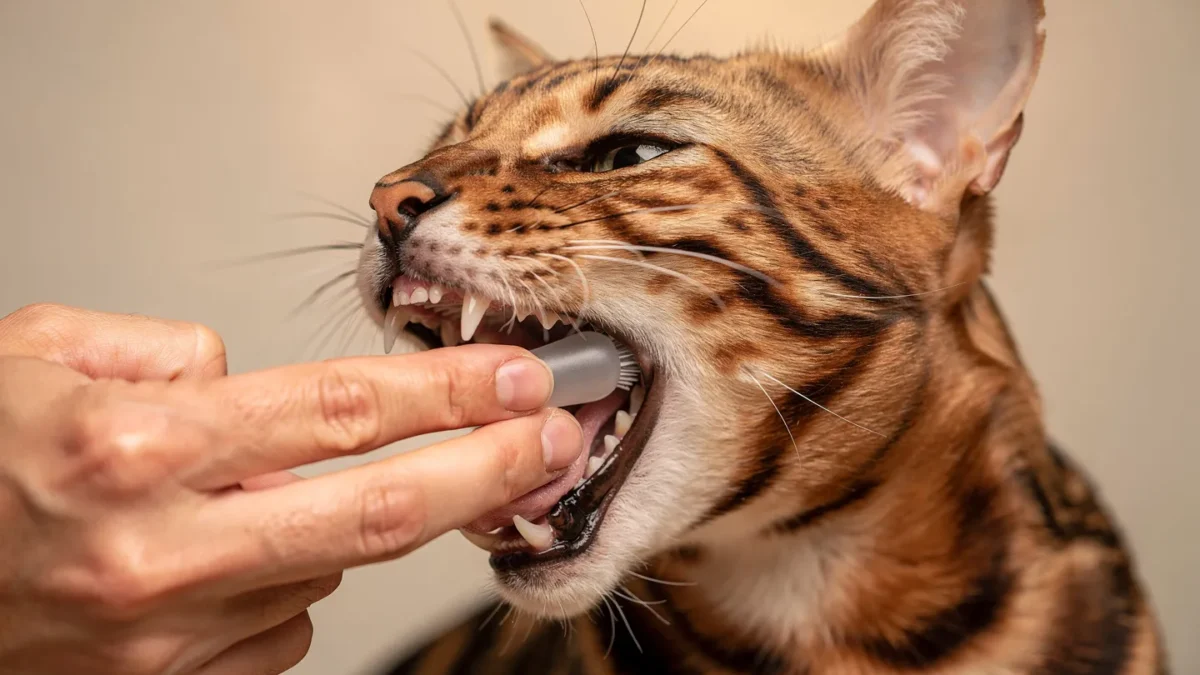
I’ll be honest with you — for the first two years of having Kovu, I genuinely thought bad cat breath was just… normal.
Like, he’s a cat. He eats fish. Of course his breath smells like the bottom of a fishing boat. That’s just the deal, right?
Wrong. So painfully wrong.
It was a regular Saturday night at Marcus’s place. Kovu had somehow made his way onto the couch — which, yes, I know, but try telling a Bengal that furniture has rules — and decided that Marcus’s face was the perfect target for an unsolicited grooming session.
Marcus froze.
He slowly turned to me with the expression of a man who had just witnessed something deeply wrong with the universe and said, completely deadpan:
“Luca. That is not tuna breath. That is a biological hazard. I think my eyebrows just died.”
Lena gasped and immediately blamed Dave, because honestly, that’s just how our group works.
Dave, to his credit, looked genuinely offended.
And then Dr. Sami put down his drink, looked at Kovu, looked at me, and said something that made everyone go quiet:
“That smell is periodontal disease. If you ignore it, the bacteria will reach his kidneys. And his heart.”
Nobody laughed after that.
I went home that night and realized I needed a complete crash course in cat dental care. And what I learned . And what I learned genuinely surprised me — because almost everything I’d been doing (or rather, not doing) was wrong.
This guide is everything I wish someone had told me sooner.
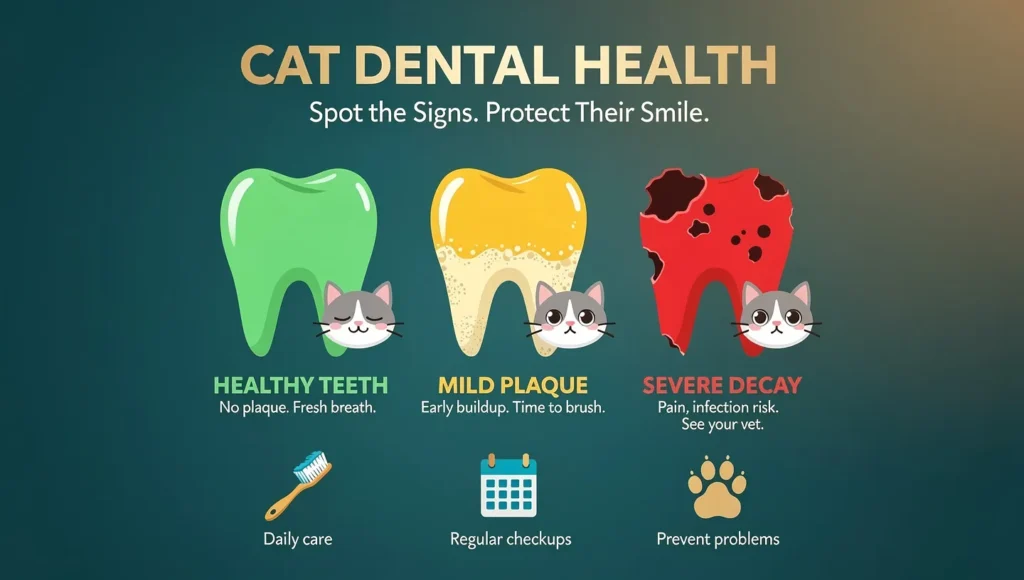
Table of Contents
- 🟢🟡🔴 Quick Dental Health Check: What Does Your Cat’s Breath Tell You?
- The Feline Halitosis Myth: Why “Tuna Breath” Is Safely Hiding a Disaster
- Feline Periodontal Disease: The Invisible Stage of Plaque
- It’s Not Just Bad Breath — It’s a Kidney and Heart Hazard
- The Cat Dental Care Tool Kit (And Why Dave Is Permanently
- Cat Toothpaste vs. Human Toothpaste: A Fatal Mistake
- Brushes, Wipes, and Finger Covers: Choosing the Right Weapon
- Dental Water Additives & Treats: Do They Actually Work?
- How to Brush Your Cat’s Teeth Without Losing a Finger
- Step 1 — The Scent Familiarization Trick
- Step 2 — The Lip Lift and Desensitization
- Step 3 — The 45-Degree Angle Sweep
- Breed-Specific Dental Risks — Who Needs Extra Attention?
- Red Flags — When It’s Time to Stop DIY and Call Dr. Sami
- Quick Answers: Your Cat Dental Care Questions
- How often should I brush my cat’s teeth?
- What can I use instead of brushing?
- Can bad cat breath fix itself?
- Is bleeding normal when brushing cat teeth?
- The Night Kovu’s Breath Stopped Being a Weapon
🟢🟡🔴 Quick Dental Health Check: What Does Your Cat’s Breath Tell You?
Before we go deep, here’s a fast reference so you know exactly where your cat stands right now:
| Signal | What It Means | Action Needed |
|---|---|---|
| 🟢 Mild, neutral odor | Healthy mouth — keep up the routine | Maintain regular brushing |
| 🟢 Slight fishy smell after eating | Normal post-meal odor | Monitor only |
| 🟡 Persistent bad breath daily | Early plaque buildup likely | Start brushing + dental treats |
| 🟡 Slightly swollen or red gums | Early gingivitis forming | Vet check within 2–3 weeks |
| 🔴 Strong, rotting smell constantly | Active periodontal disease | Vet visit this week |
| 🔴 Drooling + pawing at mouth | Pain — possible tooth damage | Emergency vet visit |
| 🔴 Refusing dry food suddenly | Tooth or gum pain | Vet visit immediately |
If your cat is anywhere in the 🔴 zone right now, skip ahead to the Red Flags section first. Seriously.
A quick note before we continue: Everything in this guide is based on my personal experience with Kovu, conversations with Dr. Sami, and research from trusted veterinary sources.
This is for informational purposes only and is not a substitute for professional veterinary advice. If your cat is showing serious symptoms, please consult your vet directly.
The Feline Halitosis Myth: Why “Tuna Breath” Is Safely Hiding a Disaster
Here’s the thing most cat owners never realize until it’s too late.
Bad breath in cats isn’t a personality quirk. It isn’t a diet side effect. And it definitely isn’t something you just… live with.
In almost every case, persistent bad breath is your cat’s mouth sending you a distress signal — and most of us are too busy blaming the tuna to actually listen.
Cat dental care isn’t optional. It’s one of the most overlooked health priorities in the entire cat-owning world, and the consequences of ignoring it go way beyond a smelly cuddle session.
Feline Periodontal Disease: The Invisible Stage of Plaque
This is where things get genuinely alarming.
Every single day, a thin layer of bacteria forms on your cat’s teeth. It’s called plaque, and in the early stages, you can’t see it, smell it, or feel it.
Left alone, that plaque hardens into tartar — a rough,
yellowish crust that bonds to the tooth surface and slowly creeps below the gumline. Once it’s there, no amount of brushing at home will remove it. Only a professional dental cleaning under anesthesia can do that.
And here’s the part that actually kept me up at night after Dr. Sami explained it:
According to the American Veterinary Medical Association (AVMA), an estimated 70% of cats show signs of periodontal disease by the age of three.
Three years old.
Kovu was two and a half when Marcus’s eyebrows nearly fell off. I was already behind — and I hadn’t even started
a basic cat dental care routine yet.
The disease progresses in stages — from mild inflammation (gingivitis) to full tissue destruction where teeth loosen and fall out. And because cats are masters at hiding pain, most owners don’t notice anything is wrong until the disease is already advanced.
Most people get this wrong — they wait for obvious signs. But by the time it’s obvious, the damage is already done.
It’s Not Just Bad Breath — It’s a Kidney and Heart Hazard
This is the part Dr. Sami said that silenced the entire room.
When bacteria builds up in your cat’s mouth and the gum tissue becomes inflamed, those bacteria don’t just stay there. They enter the bloodstream.
And once they’re in the bloodstream, they can travel — to the kidneys, to the liver, to the heart valves.
Research cited by the ASPCA confirms that untreated dental disease in cats has been linked to serious systemic conditions, including kidney disease and cardiac issues.
Honestly? That information alone changed everything for me.
I wasn’t dealing with bad breath anymore.
I was dealing with a silent health risk that I had been cheerfully ignoring for two years because I thought it was just “tuna smell.”
Personally, I think this is the piece of information that every cat owner deserves to hear on day one — not after their cat is already sick.
The good news?
Most cases of early and mid-stage periodontal disease are completely preventable with a consistent routine at home. And that routine doesn’t have to be complicated or stressful — for you or your cat.
But first, you need the right tools.
The Cat Dental Care Tool Kit (And Why Dave Is Permanently
Banned From Buying Toothbrushes)
Let me tell you exactly how Dave almost poisoned my cat while trying to help with cat dental care.
It was the week after the Marcus Incident — that’s what we call it now, officially, in our group chat — and I had just told everyone I was going to start taking Kovu’s dental health seriously.
Dave, being Dave, decided to help.
He showed up at my apartment the next day holding a tube of Colgate with the energy of someone who had just solved world hunger.
“It’s mint flavored,” he said proudly. “Cats like fish, mint is basically fish-adjacent, right?”
I didn’t even know where to start.
Fortunately, Dr. Sami was in the group chat.
His response was two words: “Call poison control.”
Then three more: “I’m not joking.”
Cat Toothpaste vs. Human Toothpaste: A Fatal Mistake
Here’s what Dave didn’t know — and honestly, what most people don’t know until someone tells them.
Human toothpaste contains fluoride.
Fluoride is highly toxic to cats.
Unlike humans, cats can’t spit. Whatever goes in their mouth gets swallowed. And according to the ASPCA Animal Poison Control, fluoride ingestion in cats can cause serious gastrointestinal distress, seizures, and in severe cases, heart and kidney damage.
So no. Mint is not fish-adjacent, Dave.
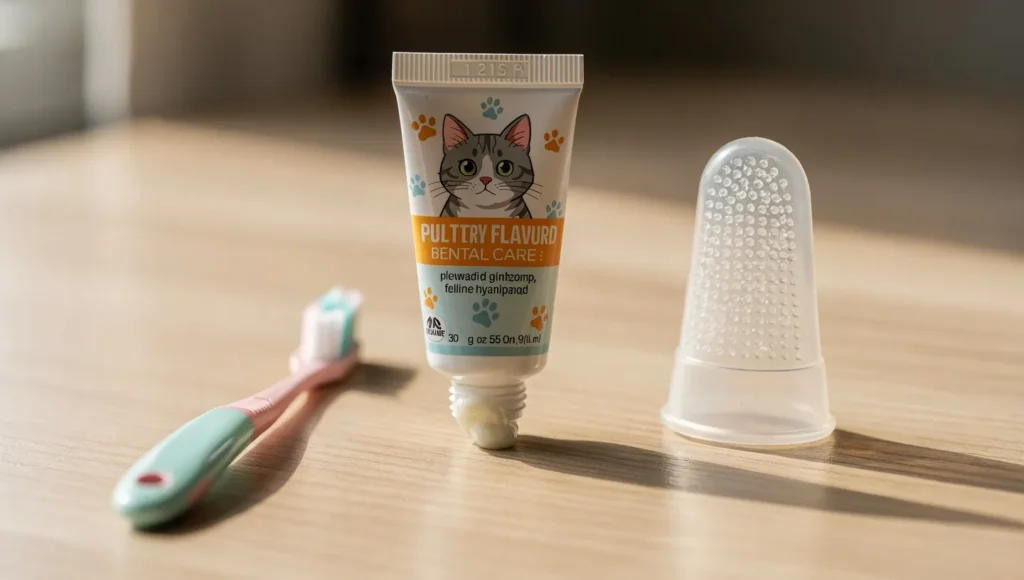
What you actually need — the foundation of any real cat dental care routine — is toothpaste specifically formulated for cats.The good ones come in flavors like:
- Chicken
- Fish (obviously)
- Beef
- Malt
And here’s the thing — Kovu went from running away from the toothbrush to actively trying to lick the tube. The right flavor makes an enormous difference.
What to look for on the label:
- Enzymatic formula (breaks down plaque chemically)
- No fluoride (this should be obvious now, Dave)
- No xylitol (also toxic to cats)
- Veterinary approved
Brushes, Wipes, and Finger Covers: Choosing the Right Weapon
Not every cat is going to let you come at them with a full-sized toothbrush on day one.
Kovu absolutely was not.
The first time I tried, he looked at me like I had personally insulted his entire ancestry, leaped off the counter, and disappeared under the bed for forty minutes.
So here’s the honest breakdown of your options:
| Tool | Best For | Pros | Cons |
|---|---|---|---|
| Finger brush (silicone) | Beginners + nervous cats | Gentle, great control | Less reach on back teeth |
| Small cat toothbrush | Cats comfortable with brushing | Better coverage | Can feel intrusive at first |
| Dental wipes | Cats who hate everything | Easy, low-stress | Surface clean only |
| Gauze pad | DIY option | Cheap, accessible | Least effective long-term |
Personally, I started with the finger brush and enzymatic toothpaste. Kovu tolerated it within about a week. The key is going slow — and we’ll get to exactly how to do that in the next section.
Dental Water Additives & Treats: Do They Actually Work?
Okay, real talk — because there’s a lot of marketing noise around this topic.
Dental water additives are liquids you add to your cat’s water bowl that claim to reduce plaque and freshen breath. Some dental treats make similar promises.
Here’s the honest answer: they can help, but they are not a replacement for brushing.
Think of them the way you think about mouthwash for yourself. Useful as a supplement. Completely useless as your only dental hygiene strategy.
The treats that actually show some evidence of effectiveness are those carrying the Veterinary Oral Health Council (VOHC) seal — that’s the closest thing to a third-party endorsement in the pet dental world.
Water additives work best for cats who genuinely refuse any form of direct dental contact. They won’t reverse existing tartar, but they can slow down new buildup when used consistently.
Marcus, predictably, did a full cost-benefit analysis of dental treats versus brushing and presented it to our group chat in a spreadsheet.
Nobody asked him to do this.
We all read it anyway.
His conclusion: brush the cat.
How to Brush Your Cat’s Teeth Without Losing a Finger
(The Vet-Backed 3-Step Protocol)
Dr. Sami was very clear about one thing when I asked him how to actually do this:
“Never force it. The second your cat associates the toothbrush with stress, you’ve already lost.”
So here’s the exact cat dental care protocol that worked for me and Kovu — built on patience, not brute force.
Step 1 — The Scent Familiarization Trick
Before the brush even enters the picture, let your cat taste the toothpaste on your finger for 3–5 days straight. That’s it. No brush. No pressure. Just let them decide they like the flavor.
Kovu was licking my finger by day two. Chicken flavor. Every time.
Step 2 — The Lip Lift and Desensitization
Once they’re comfortable with the taste, start gently lifting the lip and touching the gum line with your finger. Do this for another 3–5 days before introducing the brush.
- Use slow, calm movements
- Keep sessions under 30 seconds
- End every session with a treat or playtime
- If your cat pulls away — stop. Try again tomorrow.
My first attempt at this with Kovu ended with him dramatically flopping onto his side like he’d been betrayed by his closest ally.
We tried again the next day. It went better.
Step 3 — The 45-Degree Angle Sweep
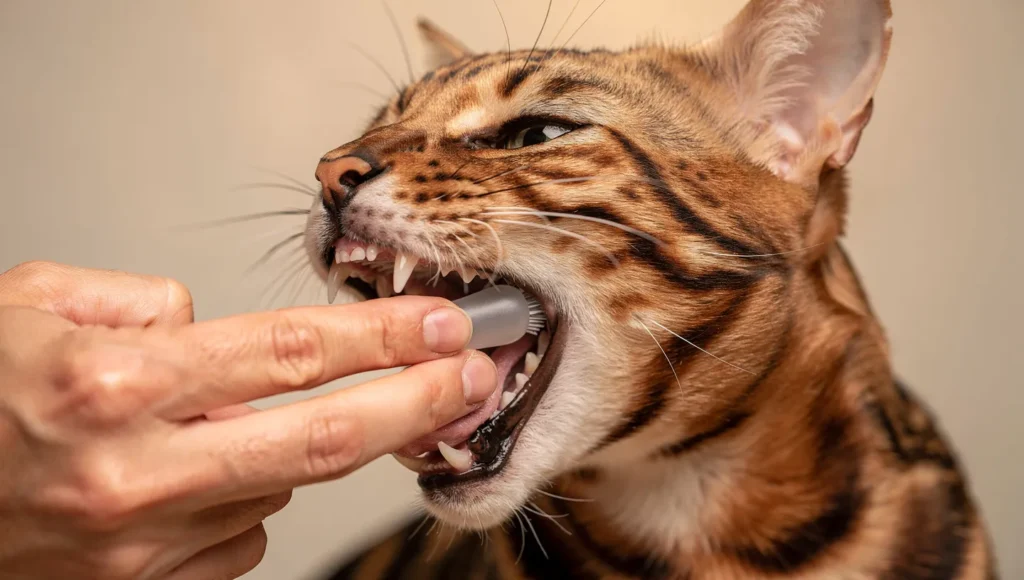
Hold the brush at a 45-degree angle to the gum line and use small circular motions. Focus on the outer surfaces — that’s where plaque builds fastest.
- 30 seconds per side is enough
- Once or twice a week minimum
- Daily is ideal but don’t stress if life happens
And here’s something nobody talks about — if your cat’s chin area looks dark or bumpy after starting a dental routine, that’s sometimes related to bacteria and saliva buildup. Worth reading our guide on cat chin blackheads to understand what’s normal and what isn’t.
Breed-Specific Dental Risks — Who Needs Extra Attention?
Not all cats start from the same baseline.
Brachycephalic breeds — cats with flat faces — have naturally compressed jaw structures that cause their teeth to crowd together. That crowding creates more surface area for plaque to hide, which means faster buildup and higher risk.
The breeds that need the most dental attention:
- Persian — narrow jaw, severe crowding
→ Full Persian care guide here - Exotic Shorthair — same flat-face genetics as Persian
→ Exotic Shorthair health guide - British Shorthair — rounder skull, moderate crowding risk
- Scottish Fold — structural compression affects jaw alignment
If you own any of these breeds, weekly cat dental care isn’t optional — it’s essential. And professional cleanings may be needed more frequently than average.
Red Flags — When It’s Time to Stop DIY and Call Dr. Sami
Home care is powerful. But it has limits.
If your cat shows any of these signs, put down the finger brush and call your vet — today:
- 🔴 Excessive drooling — not normal, ever
- 🔴 Suddenly refusing dry food — tooth or gum pain → could explain why your cat isn’t eating
- 🔴 Pawing at the mouth repeatedly — active discomfort
- 🔴 Bleeding gums that don’t stop — beyond early gingivitis
- 🔴 Brown or black tooth discoloration — advanced decay
- 🔴 Loose or missing teeth — late-stage periodontal disease
And one thing worth knowing — low-quality food high in refined carbohydrates accelerates plaque buildup significantly. Learning how to read cat food labels properly is one of the smartest preventive moves you can make for your cat’s dental health.
Quick Answers: Your Cat Dental Care Questions
How often should I brush my cat’s teeth?
Ideally, a few times a week. Daily if you can manage it. Once a week is the bare minimum to see any real benefit. Consistency matters more than frequency.
What can I use instead of brushing?
Dental wipes, water additives with the VOHC seal, and enzymatic treats can all help slow plaque buildup. But none of them fully replace brushing. Think supplement, not substitute.
Can bad cat breath fix itself?
Mild odor after eating? Yes, that’s normal and temporary. Persistent daily bad breath? No — it will not fix itself and will almost certainly get worse without intervention.
Is bleeding normal when brushing cat teeth?
A tiny amount of pink in the first few sessions can happen as gums adjust. Actual bleeding that’s visible and consistent means gingivitis is already present — time to see your vet.
The Night Kovu’s Breath Stopped Being a Weapon
About three weeks after the Marcus Incident, I had everyone over again.
Kovu jumped onto the couch, walked directly toward Marcus, and sniffed his face.
Marcus braced himself.
Then slowly relaxed.
“Huh,” he said. “Nothing. I smell absolutely nothing.”
Dave immediately tried to take credit for suggesting dental treats. Lena pointed out that we never actually used his suggestion. Dave said that was beside the point.
Dr. Sami didn’t say anything.
He just smiled in that quiet way he has when he knows he was right and doesn’t need to say it out loud.
Honestly? That little moment — Marcus not recoiling from my cat’s face — felt like a genuine win.
Not just for Kovu’s health.
But for all of us who had to share a room with him.
If you’ve been putting off cat dental care the same way I did — thinking the smell is normal, thinking it’ll sort itself out, thinking it’s not really a big deal — I hope this changes things for you.
Because it’s not about fresh breath.
It’s about giving your cat more healthy years.
And honestly, that’s worth a little chicken-flavored toothpaste and thirty seconds twice a week.
Drop a comment below and tell me — has your cat ever cleared a room with their breath? Because I cannot be the only one. And don’t forget to share this article with your friends so they can benefit too.