
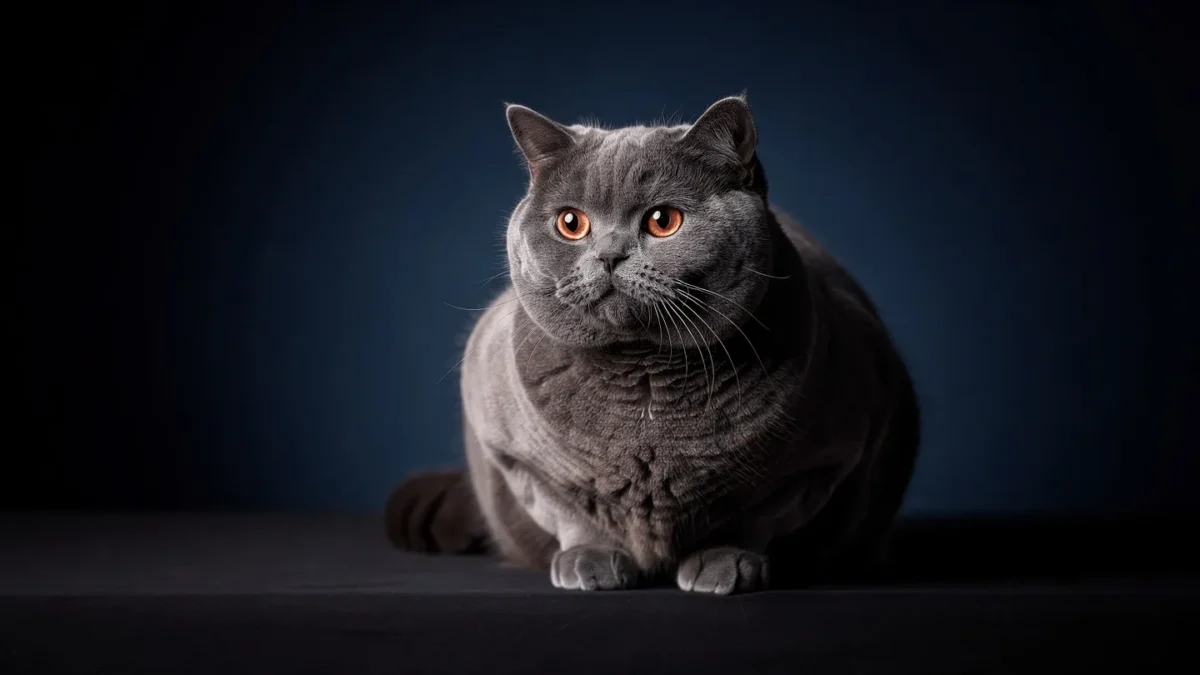
My first encounter with an Exotic Shorthair wasn’t in person. It was a random photo that popped up while I was scrolling through cat breeds late one night — and I genuinely stopped scrolling.
Round copper eyes the size of small marbles. A face so flat it looked like it pressed up against a glass window and just… stayed that way. And that coat. Thick, plush, almost velvety — like someone wrapped a teddy bear in cat fur.
I typed the name into Google immediately.
And honestly? That search changed everything for me.
Quick note before we dive in: This article is based on personal experience raising multiple cat breeds, along with research from trusted sources like ASPCA and PetMD. It’s for informational purposes only and doesn’t replace professional veterinary advice. When in doubt, always check with your vet.
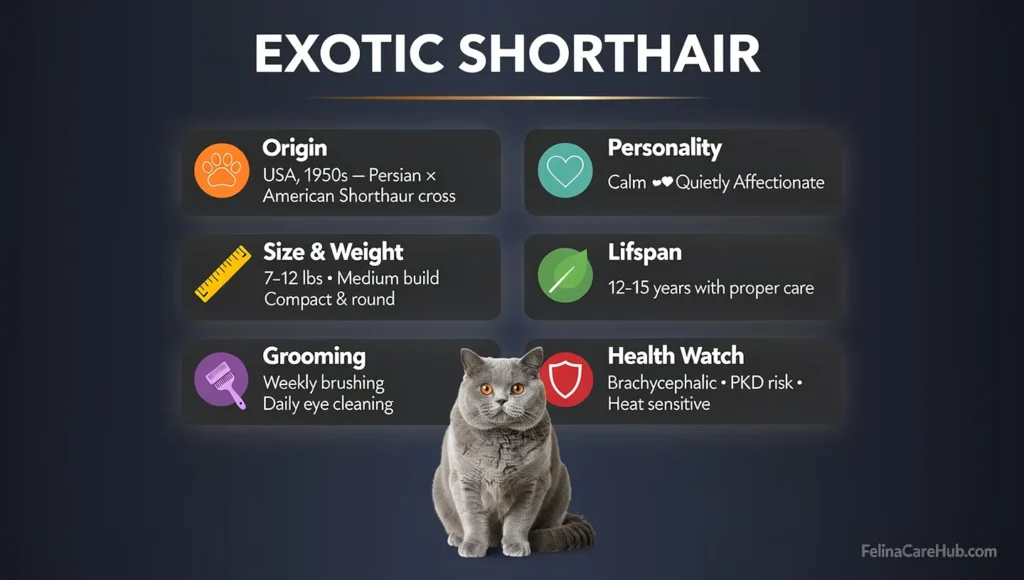
Table of Contents
- So, What Exactly Is an Exotic Shorthair?
- The Garfield Effect — Personality & Temperament
- What Their Personality Actually Looks Like Day-to-Day
- Is an Exotic Shorthair Good for Beginners?
- How They Do With Other Pets and Kids
- Daily Care — More Than Just Cute Looks
- The Eye Cleaning Thing (Yes, It’s Daily)
- Grooming the Coat
- Feeding and Nutrition
- Litter Box
- Quick Daily & Weekly Care Summary
- Health Issues You Need to Know (Especially the Breathing Thing)
- Brachycephalic Syndrome — The Flat Face Price Tag
- Heat Sensitivity — This One Can Be Dangerous
- Polycystic Kidney Disease (PKD)
- Eye Conditions
- Health Snapshot
- How Much Does an Exotic Shorthair Really Cost?
- The Initial Cost
- The Hidden Costs (This Is the Part Nobody Talks About)
- Is the Price Worth It?
- Exotic Shorthair vs Persian — A Quick, Honest Comparison
- Is an Exotic Shorthair Right for YOU?
- ✅ You’ll Probably Love This Breed If…
- ❌ Think Twice If…
- Quick Decision Tree
- Real Questions Every Exotic Shorthair Owner Asks
- How long do Exotic Shorthairs live?
- Do Exotic Shorthairs shed a lot?
- Are they good for people with allergies?
- Can they be left alone during the day?
- Do they get along with other cats?
- One Last Thing Before You Go
So, What Exactly Is an Exotic Shorthair?
The Exotic Shorthair is a short-coated version of the Persian cat, bred to have the same calm temperament and flat face — but with a much easier-to-manage coat. Most people call them “the lazy man’s Persian,” and honestly, that’s not wrong.
They were developed in the 1950s by crossing Persians with American Shorthairs, and the result was something special: all the charm of a Persian, without the two-hour daily grooming sessions.
Here’s a quick breakdown of how they compare:
| Feature | Exotic Shorthair | Persian |
|---|---|---|
| Coat | Short, dense, plush | Long, silky, high-maintenance |
| Grooming | Weekly brushing | Daily brushing required |
| Face | Flat (brachycephalic) | Flat (brachycephalic) |
| Energy Level | Low to moderate | Low |
| Vocalization | Quiet | Quiet |
| Beginner-Friendly | ✅ Yes | ⚠️ With commitment |
The thing that surprises most new owners? That plush coat. It’s not just pretty — it’s genuinely soft in a way that feels almost therapeutic to pet. Like running your hand over warm velvet.
But here’s what the pictures don’t tell you.
That flat face? It comes with responsibilities most people don’t find out about until after they bring one home.
More on that in a minute.
The Garfield Effect — Personality & Temperament
Let’s be real. Half the people searching for Exotic Shorthairs are lowkey hoping they found a real-life Garfield.
And in some ways? They’re not wrong.
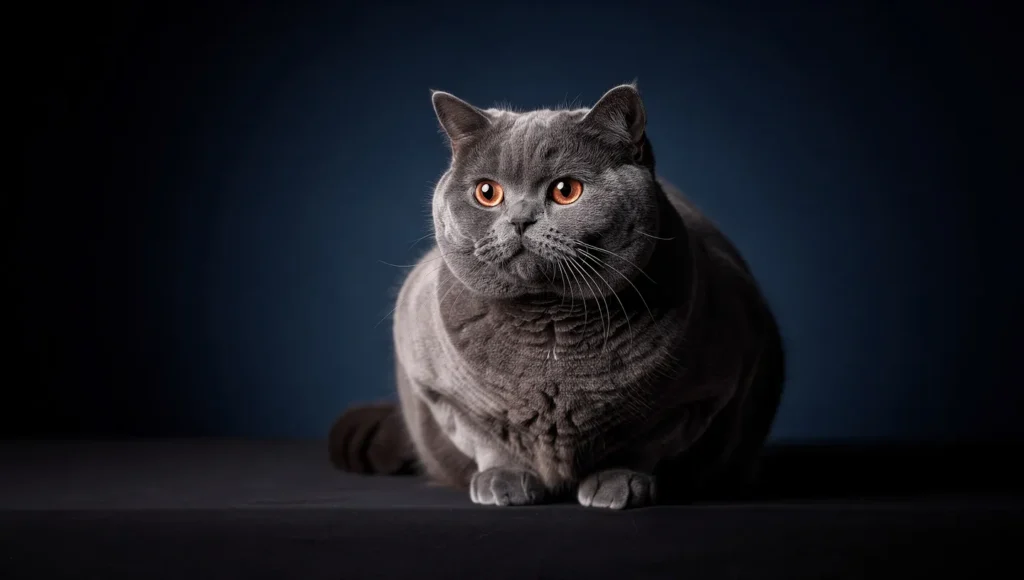
These cats are calm, low-energy, and have a resting expression that looks permanently unimpressed with everything around them. My Persian-mix, Luna, has that same energy — but my Exotic Shorthair, Mochi, took it to a whole new level. First week I had her, she sat on the couch, stared at me for a solid five minutes, then slowly looked away like I’d failed some kind of audition.
Honestly. The audacity.
But here’s the thing — underneath that unbothered exterior, Exotic Shorthairs are genuinely affectionate cats. They’re just not loud about it.
What Their Personality Actually Looks Like Day-to-Day
They don’t demand attention the way a Siamese would. They won’t follow you from room to room meowing like the world is ending. Instead, they’ll quietly position themselves near you. On the armrest. At the foot of the bed. Just… present.
It’s a subtle kind of love. But once you recognize it, it hits different.
A few things that surprised me about Mochi’s personality:
- She plays — just on her own schedule. Don’t expect zoomies at 2am. But
dangle a feather wand around 7pm? Suddenly she’s a different cat entirely. - She’s great with kids, surprisingly. Patient. Doesn’t scratch. Just
relocates when she’s done socializing. - She took a while to warm up to my other cats. Not aggressive — just
indifferent. Which, honestly, felt very on-brand.
Is an Exotic Shorthair Good for Beginners?
Short answer: yes, with one condition.
They’re forgiving with inexperienced owners because they’re not high-strung or demanding. They don’t need constant entertainment. They’re not going to knock everything off your shelves at 3am just to feel something.
Most people get this wrong — they assume “calm” means “easy.” And it mostly is.
But the eye cleaning, the breathing awareness, the vet costs? Those require a committed owner, not just a chill one.
If you’re a first-time cat owner trying to figure out which breed fits your lifestyle, I actually wrote a full breakdown on the best cat breeds for beginners — worth a read before you decide.
How They Do With Other Pets and Kids
| Situation | Exotic Shorthair Behavior |
|---|---|
| Young children | Tolerant, gentle, patient |
| Other cats | Neutral to slow-warm |
| Dogs | Depends on the dog’s energy |
| Alone time | Handles it well (not clingy) |
| Strangers | Reserved at first, then curious |
This is where they genuinely shine compared to more reactive breeds. They’re not going to cause drama. They’re going to observe the drama from across the room with those giant round eyes and judge everyone silently.
Which, honestly, is a mood.
Daily Care — More Than Just Cute Looks
This is where I need to be completely honest with you.
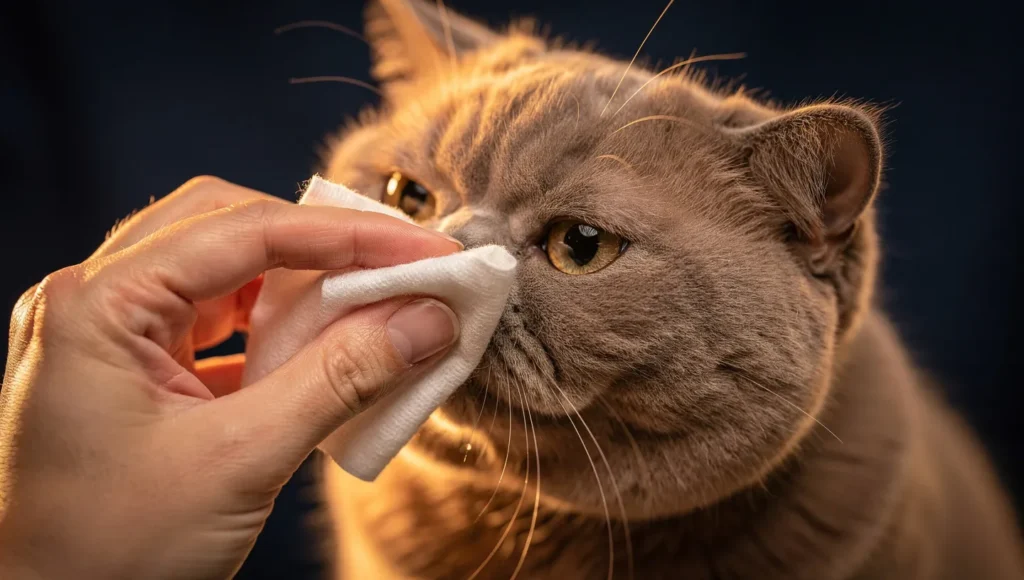
When I got Mochi, I thought the hardest part would be the grooming. Spoiler: it wasn’t. The hardest part was the eyes. Nobody — and I mean nobody — warned me about the daily eye situation before I brought her home.
The Eye Cleaning Thing (Yes, It’s Daily)
Because of their flat faces, Exotic Shorthairs have shallow eye sockets. Tears don’t drain properly. Instead, they overflow and collect in the folds around the eyes, leaving dark, crusty discharge that builds up fast.
We’re talking every. single. day.
Here’s what I use:
- Soft cotton pads (not cotton balls — the fibers catch)
- Saline solution or a vet-recommended eye cleaning solution
- A little patience and a treat nearby for bribery purposes
The process takes about two minutes once you get used to it. But if you skip a day or two? It gets crusty, uncomfortable for the cat, and honestly a little alarming-looking if you’re not expecting it.
This is where things change for a lot of new owners. They fall in love with the look of this breed and don’t realize the upkeep tied to that flat face. It’s not hard — but it is non-negotiable.
For more on what healthy cat eyes should look like (and when discharge becomes a red flag), check out this guide on cat eye meaning and health signals — it helped me a lot early on.
Grooming the Coat
Here’s the good news: the coat is genuinely low-maintenance compared to a Persian. Weekly brushing is usually enough to keep it looking good and reduce shedding.
What works best:
- A soft slicker brush for the body
- A wide-tooth comb for the chest and belly area
- A gentle brush session once a week, twice during shedding season
Mochi actually likes being brushed. She’ll lean into it like she’s getting a spa treatment. Total diva behavior, fully supported.
If you want a full step-by-step brushing routine, I have a detailed guide on how to brush your cat without stress that covers tools and technique.
Feeding and Nutrition
Exotic Shorthairs are not particularly food-obsessed cats — but they can gain weight easily because of their low activity level. That combination is sneaky.
A few things that worked for Mochi:
- High-protein wet food as the main meal (helps with hydration too,
since flat-faced cats sometimes drink less water) - Measured portions — free feeding is a fast track to an overweight cat
- Fresh water available at all times, ideally from a cat fountain
For a deeper look at indoor cat nutrition, this guide on best cat food for indoor cats has solid practical advice.
Litter Box
Nothing exotic here (pun absolutely intended). Standard litter box rules apply — clean it daily, keep it in a quiet spot, and use unscented litter since flat-faced cats can be more sensitive to strong smells.
One tip: go for a low-entry litter box. Some Exotic Shorthairs are
a little… let’s say, architecturally challenged when it comes to jumping in and out of high-sided boxes. Mochi made this very clear to me after one particularly undignified incident I will not be describing further.
Quick Daily & Weekly Care Summary
| Task | Frequency | Time Required |
|---|---|---|
| Eye cleaning | Daily | ~2 minutes |
| Fresh water check | Daily | 1 minute |
| Coat brushing | Weekly | 5–10 minutes |
| Litter box cleaning | Daily | 2–3 minutes |
| Nail trimming | Every 2–3 weeks | 5 minutes |
| Vet checkup | Every 6–12 months | Varies |
Health Issues You Need to Know (Especially the Breathing Thing)
Personally, I think this is the most important section in this entire article.
Not because Exotic Shorthairs are unhealthy cats — they’re not, generally speaking. But because their specific health challenges are directly tied to the features that make them so irresistible. And if you go in uninformed, you might find yourself in a vet’s office feeling blindsided.
I’ve been there. It’s not fun.
Brachycephalic Syndrome — The Flat Face Price Tag
“Brachycephalic” is just a fancy word for flat-faced. And while that squished face is objectively adorable, it comes with some real respiratory consequences.
The nostrils are often narrower than they should be. The soft palate can be elongated. The airway is just… smaller. Which means these cats have to work harder to breathe than a regular cat does.
What this sounds like in real life:
- Soft snoring during sleep (actually kind of endearing)
- Occasional snuffling or snorting while eating
- Louder breathing after play or excitement
- In more serious cases: open-mouth breathing or obvious labored breathing
That last one? That’s a vet call. Immediately.
According to ASPCA, brachycephalic cats require extra monitoring during hot weather, anesthesia, and physical exertion — all situations where their limited airway becomes a real risk factor.
If your Exotic Shorthair ever starts showing signs beyond normal snoring — like wheezing, clicking sounds, or open-mouth breathing at rest — read through the warning signs covered in this guide on cat respiratory infection symptoms before you wait it out.
Heat Sensitivity — This One Can Be Dangerous
Here’s something most breed guides casually mention in one sentence and then move on from. I’m not going to do that.
Exotic Shorthairs cannot regulate body temperature as efficiently as normal cats. Their restricted airways mean less airflow, which means less ability to cool down through panting.
In practical terms:
- Never leave them in a hot car. Ever. Not for two minutes.
- Keep your home below 80°F (27°C) during summer months
- Watch for excessive panting, drooling, or lethargy on warm days —
these are heat stress signs that need immediate attention - Avoid vigorous play sessions during the hottest parts of the day
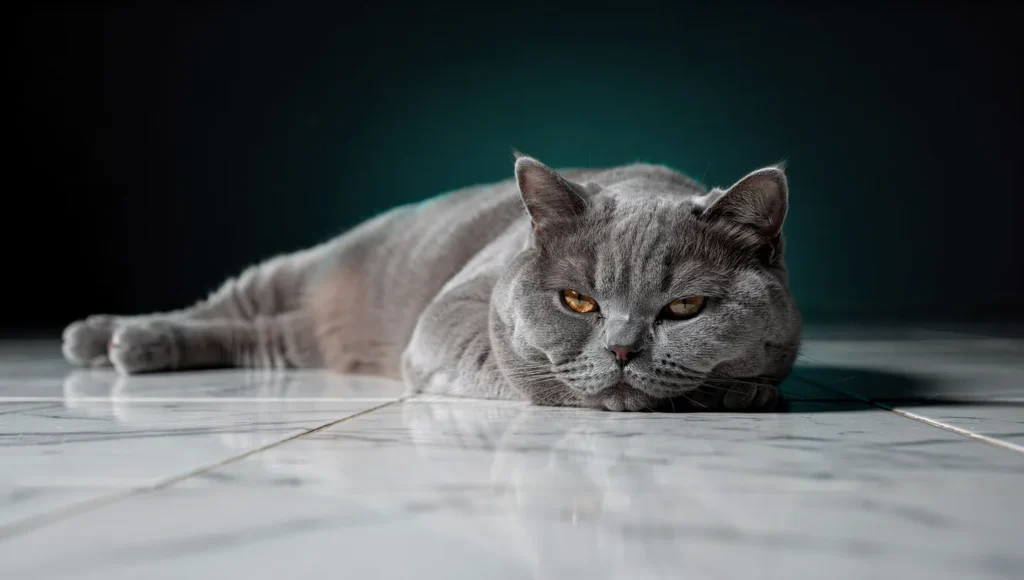
Mochi has a dramatic reaction to anything above 78°F. She finds the coldest tile in the apartment and spreads herself across it like a tiny, disapproving fur rug. Her way of letting me know the AC needs to be on. Immediately.
I respect the communication style.
Polycystic Kidney Disease (PKD)
This is the one that genuinely worries me most as an owner.
PKD is a genetic condition where small cysts develop on the kidneys over time. It’s inherited from Persian ancestors and is unfortunately present in a percentage of Exotic Shorthairs.
The tricky part: it’s often asymptomatic until the disease has progressed significantly.
Early signs to watch for:
- Increased thirst and urination
- Weight loss without diet changes
- Decreased appetite
- Lethargy that feels different from their normal laziness
This is important: When buying from a breeder, always ask for PKD-negative certification on both parents. A responsible breeder will have this documentation. If they can’t provide it — walk away.
Eye Conditions
We already talked about daily discharge management. But there are actual eye conditions to watch for beyond normal tearing:
- Entropion — eyelids that fold inward, causing the lashes to
irritate the eye surface - Corneal ulcers — from chronic irritation or injury
- Cherry eye — a prolapsed gland that looks like a small red
mass in the corner of the eye
None of these are guaranteed — but all of them are more common in flat-faced breeds than in others. Regular vet checkups catch most of these early.
Health Snapshot
| Condition | Risk Level | Watch For |
|---|---|---|
| Brachycephalic Syndrome | High | Labored breathing, snoring |
| Heat Sensitivity | High | Panting, drooling, lethargy |
| PKD | Moderate | Thirst, weight loss, appetite loss |
| Eye Conditions | Moderate | Redness, discharge, squinting |
| Obesity | Moderate | Weight gain, reduced mobility |
Honestly, none of this should scare you away from the breed. But it should make you a more prepared owner. And a prepared owner means a healthier, happier cat.
How Much Does an Exotic Shorthair Really Cost?
Let’s talk numbers. Because this is where a lot of people get surprised — and not in a good way.
The purchase price is just the beginning.
The Initial Cost
From a reputable breeder, an Exotic Shorthair kitten typically runs between $1,200 and $2,500. Show-quality cats or rare colorings can push that even higher — sometimes up to $3,500+.
Adoption is possible but rare. These cats don’t end up in shelters often, but it’s worth checking breed-specific rescues if budget is a concern.
One thing I’ll say clearly: if someone is offering an Exotic
Shorthair for $300 or $400 with no health certifications — that’s a red flag, not a deal. You’ll likely pay far more in vet bills later.
The Hidden Costs (This Is the Part Nobody Talks About)
| Expense | Estimated Annual Cost |
|---|---|
| High-quality cat food | $400 – $700 |
| Routine vet visits (x2/year) | $200 – $400 |
| Eye cleaning supplies | $50 – $100 |
| Grooming tools | $30 – $60 (one-time) |
| Litter and litter box | $150 – $250 |
| Pet insurance (recommended) | $300 – $600/year |
| Emergency vet fund | $500 – $1,500+ |
That last line? Don’t skip it.
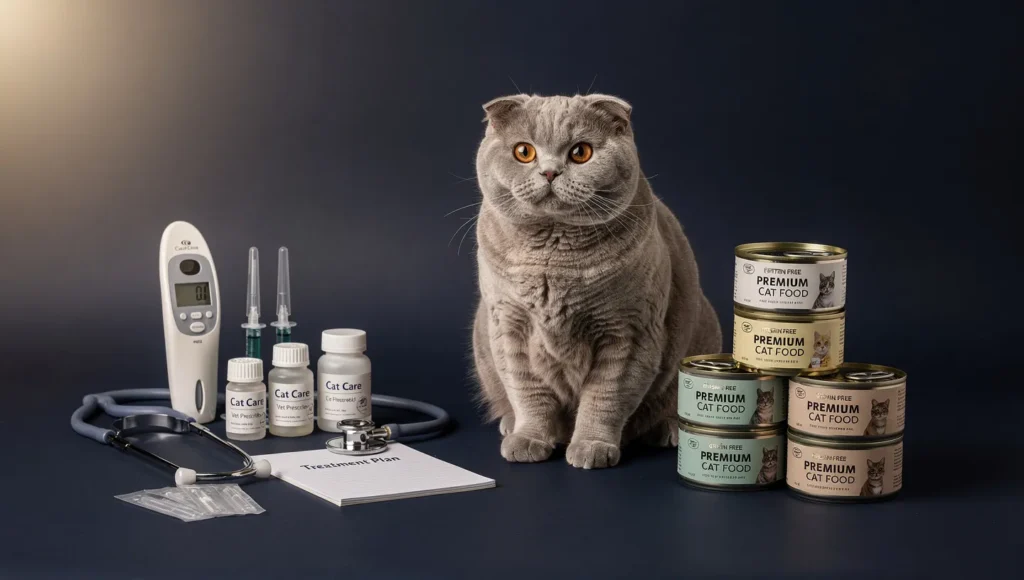
Because brachycephalic breeds have a higher likelihood of needing respiratory-related procedures, dental cleanings under anesthesia, or eye treatments — pet insurance for an Exotic Shorthair isn’t a luxury. It’s genuinely smart budgeting.
I didn’t have it when Mochi needed an eye treatment in her second year. That bill was a very expensive lesson in financial preparedness.
Is the Price Worth It?
Honestly? For the right person — yes.
But “worth it” only makes sense when you go in with clear eyes (unlike Mochi’s, which require daily cleaning, as we’ve established).
Exotic Shorthair vs Persian — A Quick, Honest Comparison
I get this question a lot. And the answer really depends on what you’re looking for.
| Feature | Exotic Shorthair | Persian |
|---|---|---|
| Coat maintenance | Low (weekly) | High (daily) |
| Energy level | Low-moderate | Low |
| Affection style | Quiet, present | Gentle, lap cat |
| Health concerns | Similar (brachycephalic) | Similar + more coat issues |
| Beginner-friendly | ✅ More so | ⚠️ Requires commitment |
| Price range | $1,200 – $2,500 | $1,000 – $3,000 |
| “Wow factor” | Teddy bear energy | Elegant, regal |
For a deeper dive into Persian care and what daily life actually looks like with one, check out this full guide on Persian cat care — especially if you’re torn between the two.
The bottom line: if you love the Persian look but want something more manageable day-to-day, the Exotic Shorthair was literally bred for you.
Is an Exotic Shorthair Right for YOU?
Here’s where I stop describing the breed and start talking directly to you.
Because the truth is — this cat is not for everyone. And knowing that before you fall completely in love is the kindest thing I can do for both you and the cat.
✅ You’ll Probably Love This Breed If…
- You want a calm, low-drama companion
- You work from home or spend a lot of time indoors
- You live in an apartment (they don’t need much space)
- You’re okay with a daily 2-minute eye cleaning routine
- You can budget for quality food and regular vet care
- You want affection that’s subtle but genuinely real
❌ Think Twice If…
- You’re looking for a highly active, playful cat
- You travel frequently and can’t arrange consistent care
- You’re not prepared for potential respiratory or eye vet costs
- You want a cat that comes when called and fetches toys
(that’s a dog, my friend) - You live somewhere very hot without reliable air conditioning
Quick Decision Tree
Real Questions Every Exotic Shorthair Owner Asks
How long do Exotic Shorthairs live?
Most live between 12 and 15 years with proper care. Some make it well past that. The biggest factors? Diet, vet care, and keeping them indoors away from heat and stress.
Do Exotic Shorthairs shed a lot?
Moderate shedding — more than you’d expect from a short-haired cat, honestly. That dense plush coat releases quite a bit, especially in spring and fall. Weekly brushing keeps it manageable.
Are they good for people with allergies?
Not particularly. They’re not hypoallergenic. If allergies are a concern, you’d want to spend time with the breed before committing — not after.
Can they be left alone during the day?
Yes, better than most breeds actually. They’re independent enough to handle a work day without separation anxiety. That said, they do appreciate company — another cat can help if you’re away for long hours regularly.
Do they get along with other cats?
Usually yes, though it takes time. They’re not aggressive — just cautious. A slow, patient introduction process makes a big difference. Here’s a guide on how to introduce two cats that actually works without drama.
One Last Thing Before You Go
I’ve had Mochi for four years now.
She still judges me from across the room sometimes. She still requires daily eye cleaning that she tolerates with the energy of someone filing a formal complaint. And she still finds the coldest tile in the apartment every summer and refuses to move.
But she also curls up next to me every single night. Quietly. Without being asked.
And that’s the thing about Exotic Shorthairs — they don’t love loudly. They just love consistently. And for a lot of people, that’s actually the best kind.
Now I want to hear from you.
If you already share your home with an Exotic Shorthair, drop your story in the comments. The good stuff, the weird stuff, the “nobody warned me about THIS” stuff. I read every single one, and honestly — your real-life experiences help future owners more than any guide ever could.
And if you know someone who’s been eyeing this breed?
Share this article with them. It might save them from a very unexpected vet bill — or convince them they’ve finally found their perfect cat.
Either way, Mochi approves. Probably. It’s hard to tell
with her face.* 😄