

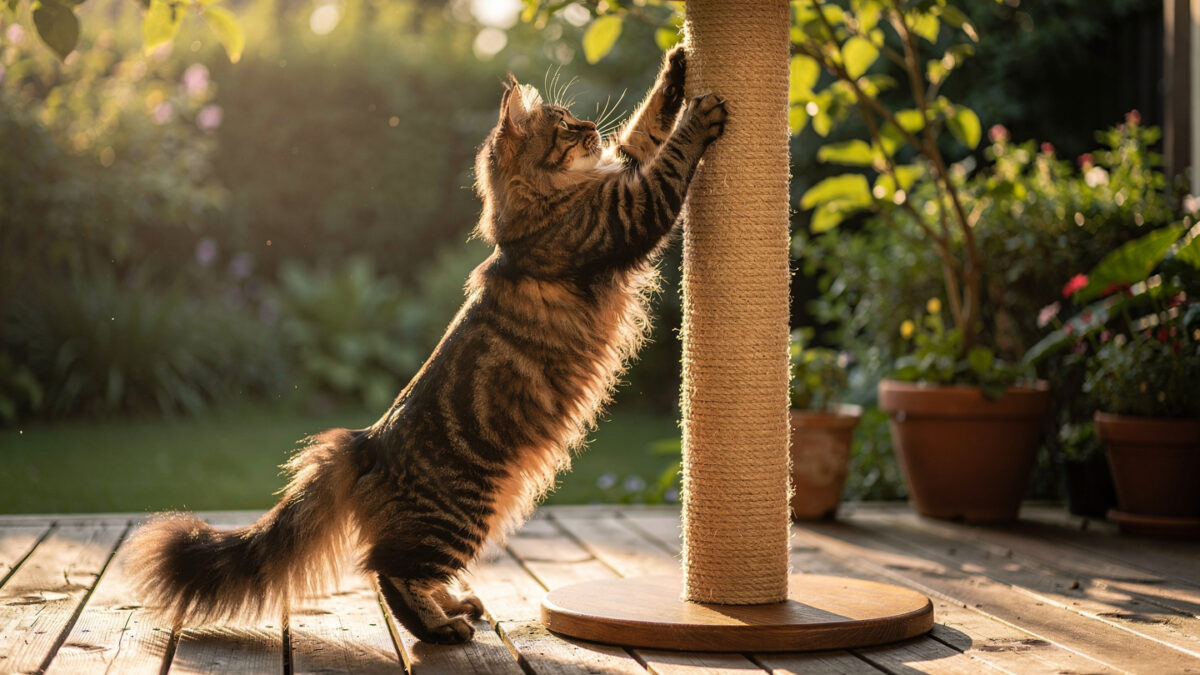
I’m going to be honest with you: finding a reliable large cat scratching post is a nightmare.
The first time I bought a scratching post for Atlas — my Maine Coon, who is builtlike a small linebacker — I did what every well-meaning cat owner does. I opened Amazon, filtered by “cute,” sorted by reviews, and landed on this absolutely adorable mushroom-shaped post. Pink cap. Fluffy base. Four-and-a-half stars. The photos looked incredible.
I bought it immediately. No hesitation.
It arrived in two days. I assembled it in about six minutes. I even placed it dramatically in the living room like I was unveiling a sculpture.
Atlas walked over, sniffed it once, gave me a look that I can only describe as pity, stretched his full body against it — and the entire thing tipped sideways, knocked into the coffee table, and died on my living room floor.
The pink mushroom never recovered.
My couch, however, became the official scratching destination for the next three weeks. And for a while, I genuinely thought Atlas was just being difficult.
He wasn’t. The problem was never him.
It was the scratching post — and everything I didn’t know about what a large cat scratching post actually needs to do.
That one mistake cost me a scratching post, part of my couch armrest, and a decent amount of dignity. But it also sent me down a rabbit hole of feline biomechanics, behavioral science, and scratching post engineering that I wish someone had handed me in a guide before I ever clicked “Add to Cart.”
This is that guide.
A quick note before we dive in: Everything in this article is based on personal experience owning large-breed cats, extensive research from trusted veterinary sources, and conversations with my vet, Dr. Sami — who has patiently talked me off the ledge more than once when I thought Atlas was broken. This article is for informational purposes only and doesn’t replace professional veterinary advice. If your cat has specific health concerns, always check with your vet first.
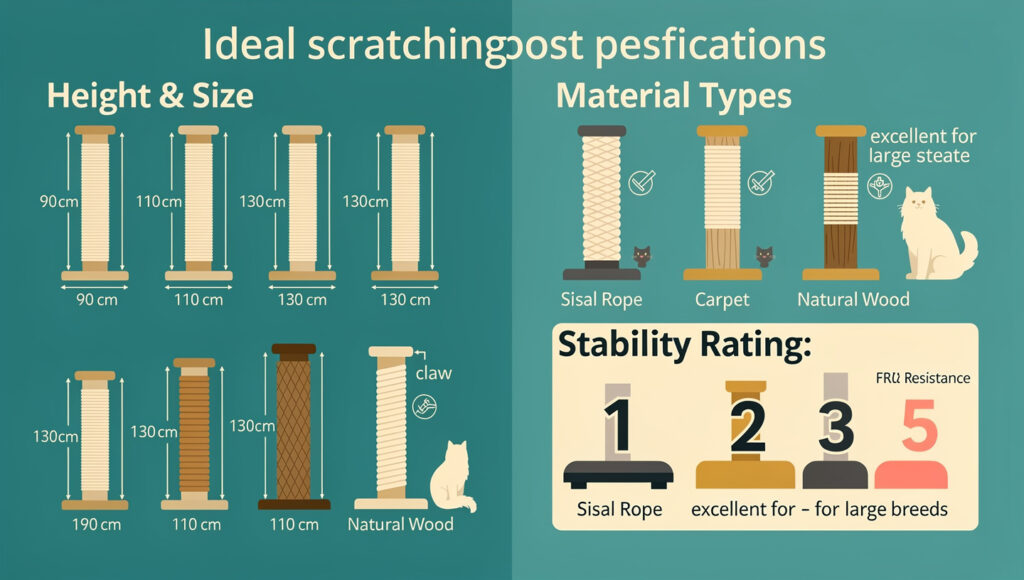
Table of Contents
- Why Large Cats Destroy Regular Scratching Posts (It’s Not Their Fault)
- The Physics Behind the Destruction
- It’s Not Misbehavior — It’s Biology
- The Large Cat Scratching Post Buying Guide (The Framework Nobody Gives You)
- Height — The Non-Negotiable Rule
- Stability — Why Most Posts Are Engineering Failures
- Material Matters More Than You Think
- Horizontal vs. Vertical — Which Does YOUR Cat Actually Prefer?
- Large Cat Scratching Posts by Breed — What Actually Works
- Best Scratching Post for Maine Coon Cats
- High-Energy Bengal Cat Scratching Solutions
- Heavy-Duty Posts for Norwegian Forest Cats
- Extra-Tall Solutions for Savannah & Large Domestic Mixes
- Why Your Cat Is Ignoring the Scratching Post (And How to Fix It)
- Location Psychology
- The Scent Introduction Trick
- Multi-Cat Territorial Dynamics
- Red Flags — When to Walk Away From a Product
- FAQ: The Stuff You Actually Want to Know
- How tall should a large cat scratching post be?
- What’s the best scratching post for Maine Coon cats?
- Do large cats prefer vertical or horizontal scratching?
- Why does my cat scratch furniture instead of the post?
- Can a scratching post help with cat aggression?
- The Bottom Line (And a Thank You That Comes From the Heart)
Why Large Cats Destroy Regular Scratching Posts (It’s Not Their Fault)
Here’s the short answer for anyone already Googling in frustration:
standard scratching posts are designed for average-sized cats, and large cats are not average. A post that works perfectly for an 8-pound domestic shorthair will absolutely fail a 16-pound Maine Coon — not because your cat is aggressive or misbehaving, but because the physics simply don’t hold up.
But let’s go deeper than that, because understanding why will completely change how you shop.
The Physics Behind the Destruction
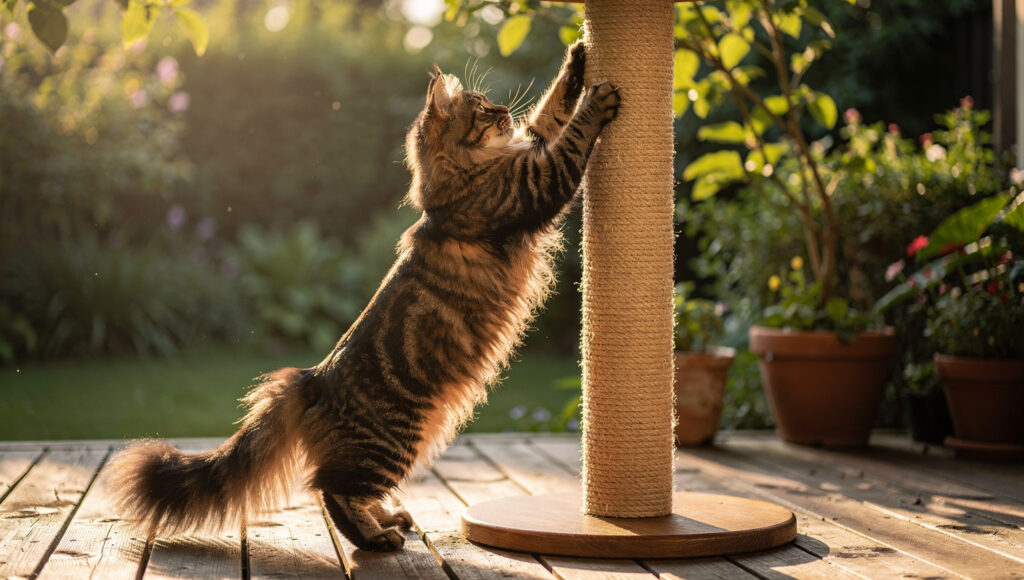
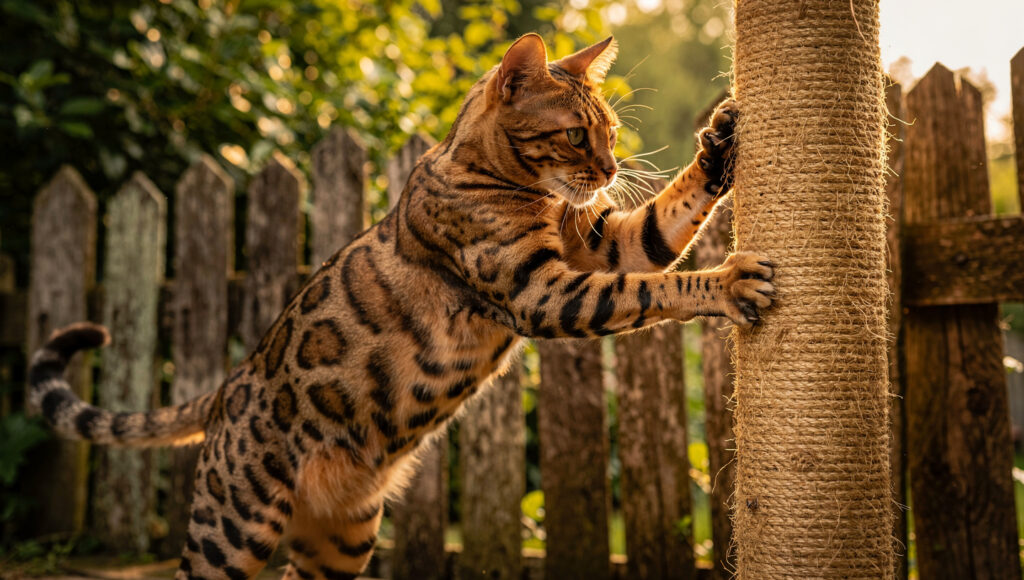
When a large cat scratches, it’s not just dragging its claws downward. It’s performing a full-body biomechanical stretch — pressing its front paws high, locking its shoulder blades, and pulling its entire weight through its spine and hindquarters.
For a Maine Coon or a Savannah, that’s 15 to 25 pounds of force being applied at the top of a tall, narrow post. If the base isn’t proportionally heavy enough to counterbalance that leverage — and most commercial posts aren’t — the post tips.
Every time. Without fail.
This is basic engineering, and the cheap scratching post industry largely ignores
it.
The math is simple: the taller the post, the heavier and wider the base needs to be.
A post that’s 32 inches tall needs a fundamentally different base than one that’s 18 inches. Most manufacturers build for the smaller cat because smaller cats are the majority of the market — and because a wider, heavier base costs more to produce.
So you end up with a product that looks fine in photos but fails immediately under real large-cat use — which is exactly why choosing the right large cat scratching post starts with understanding force, not aesthetics.
It’s Not Misbehavior — It’s Biology
Most people get this wrong.
Scratching isn’t a personality flaw. It’s not spite. It’s not your cat “punishing” you for something. Scratching is one of the most deeply wired survival behaviors in feline biology, and for large cats especially, it serves several critical functions at once.
Territory marking. Cats have scent glands in their paw pads. Every scratch leaves both a visual mark and a chemical signature. For large breeds with stronger territorial instincts — Bengals, Savannahs, Norwegian Forest Cats — this isn’t optional. They need to mark their space. If the scratching post isn’t satisfying that need, the couch will.
Stress regulation. Scratching releases tension. It’s essentially a physical reset button. A cat that can’t scratch effectively — because the post keeps wobbling or tipping — is a cat that stays stressed. And a stressed large cat will find another outlet. Usually your furniture.
Joint and muscle health. That full-body stretch I described? It’s not just
about the claws. It’s a full spinal extension that keeps the shoulder muscles loose, the back flexible, and the front joints mobile. For senior large cats or overweight cats, this stretch is genuinely important for physical health. A post that’s too short or too unstable denies them that.
Nail maintenance. Scratching sheds the outer layer of the claw, keeping it sharp and healthy. Large cats produce more claw material and scratch with more force — meaning they need a surface that holds up to repeated, vigorous use without compressing or matting down.
Here’s the thing: your cat isn’t scratching your furniture because it hates the scratching post. It’s scratching your furniture because the scratching post failed to meet its needs. That’s a crucial distinction — because it means the solution is always about finding the right post, not about changing the cat.
You can also check out our guide to understanding cat body language if you want to read the other signals your large cat might be sending you every day.
The Large Cat Scratching Post Buying Guide (The Framework Nobody Gives You)
Let me save you the $40, $60, or $80 you’re about to waste.
Most buying guides online will show you a list of products with affiliate links and call it a day. That’s not what this is. What I’m about to give you is the actual decision framework I built after three failed purchases, one very patient veterinarian, and a Saturday afternoon that ended with spilled tea and a structural engineering lesson from my friend Marcus.
More on that in a moment.
First — the four pillars. Get these right, and you almost can’t buy wrong.
Get even one of them wrong, and you’re back to square one.
Height — The Non-Negotiable Rule
This is where most people start, and most people still get it wrong — because
they measure wrong.
The rule isn’t “buy the tallest post you can find.” The rule is: the post must allow your cat to fully extend its body from floor to paw without running out of post.
For most large breeds, that means:
- Maine Coon: minimum 36 inches, ideally 38–42 inches
- Bengal: minimum 32 inches (they jump more than they lean, but still need the stretch)
- Norwegian Forest Cat: minimum 34–36 inches
- Savannah (F1–F3): minimum 38 inches — these cats are long
- Large domestic mixes over 14 lbs: minimum 32–34 inches
Here’s the simple test: watch your cat stretch against a wall. Measure from the floor to where its paws reach. That number is your minimum post height. Not a recommendation. A minimum.
Personally, I’d add two inches to whatever you measure, because cats tend to reach higher when they’re really into it.
The tragedy of the pink mushroom post — rest in peace — was that it was 18 inches tall. A proper large cat scratching post for Atlas should have been at least double that. Atlas needed at least 36. I essentially bought him a toy he couldn’t use and expected him to be satisfied. That’s like handing a professional basketball player a hoop at five feet and wondering why he’s not impressed.
Stability — Why Most Posts Are Engineering Failures
And this is where things get really interesting.
Height without stability is actually worse than no post at all. Here’s why: if a post tips once while your cat is mid-stretch, that cat will remember. Cats are wired to avoid unstable surfaces — it’s a survival instinct. One bad experience is enough to make them abandon the post permanently, even after you fix it.
So stability isn’t just about the post surviving. It’s about your cat feeling safe enough to use it fully.
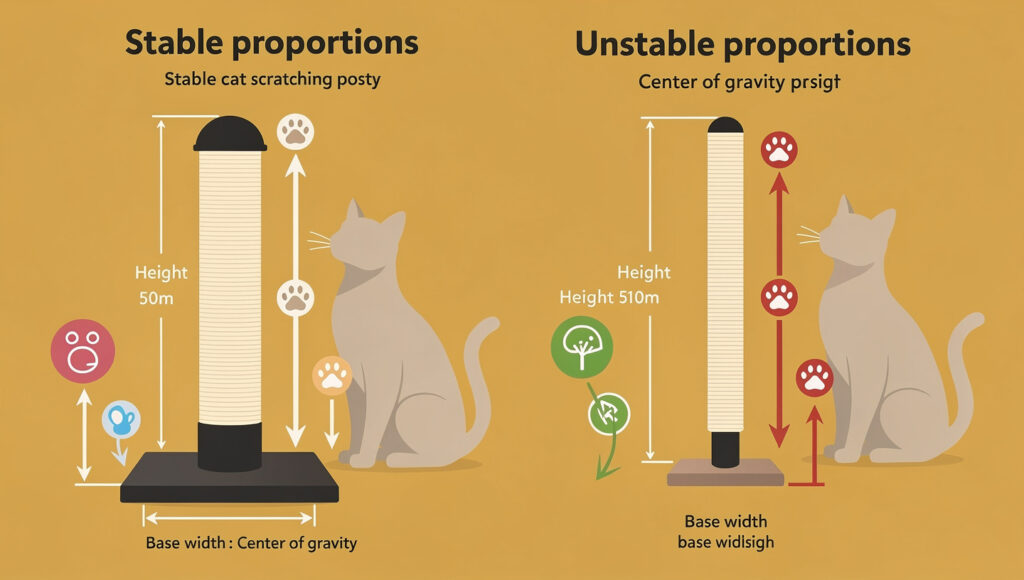
The engineering principle is simple: base width should be at least 40–50% of post height for large cats. A 36-inch post needs a base that’s roughly 16–18 inches across, and that base needs to be heavy — we’re talking 10+ pounds of actual weight, not just size.
Most commercial posts fail this ratio by a wide margin. They’re designed to look stable in a product photo, not to withstand 20 pounds of Maine Coon at full stretch.
Which brings me to the Saturday afternoon I mentioned.
My friend Dave came over to help with some work — him, Marcus, and Lena, sitting around the coffee table with laptops and green tea. I’d just assembled a new scratching post I’d ordered, and I was genuinely proud of this one. It looked solid. Thick sisal, wide-ish base, good reviews.
Dave, being Dave, spotted it immediately.
“Ooh, that’s a nice one,” he said, walking over with the confidence of a man who has never owned a cat and therefore fears nothing. “Looks sturdy.”
He pressed his hand against the top of the post, leaning his weight into it casually — the exact same motion Atlas would use.
The post didn’t tip slowly. It went fast. Caught the edge of the coffee table on
the way down, launched Marcus’s tea across his open notebook, and landed with a spectacular crash that brought Atlas sprinting in from the bedroom to investigate.
Atlas sniffed the fallen post. Looked at Dave. Walked away.
Marcus — soaked, unbothered, already reaching for napkins — looked up and said, perfectly calm: “You know, the base-to-height stability ratio on that is completely off. The torque distribution at the contact point would never hold a cat Atlas’s size.”
Lena put her head in her hands.
Dave apologized for three weeks.
And I finally understood, viscerally, what “stability” actually meant — because I’d watched a grown adult barely lean on the post and bring the whole thing down. My 20-pound cat never stood a chance.
The lesson: before you buy, do the Dave Test. Press your hand firmly against the top of the post and push sideways. If it moves more than half an inch, your large cat will tip it. Guaranteed.
Material Matters More Than You Think
Here’s something nobody in the “Top 10 scratching posts” articles ever explains: the material isn’t just about durability. It’s about sensory satisfaction.
Large cats scratch harder and more frequently than small cats. The material needs to hold up physically, yes — but it also needs to give the cat the right tactile and auditory feedback, or they simply won’t use it.
Sisal rope is the gold standard for large cats. It’s rough, it shreds satisfyingly, it engages the full claw, and it produces that ripping sound that cats find deeply rewarding. The downside: lower-quality sisal rope compresses over time, especially under heavy use, and once it’s matted down it loses its appeal. Look for tightly wound, thick-gauge rope.
Sisal fabric (flat woven sisal, as opposed to rope) is actually preferred by
many cats — including, I discovered, Atlas — because the texture is more consistent and it doesn’t unravel the way rope does. It’s often used on flat scratching pads and the sides of cat trees. Highly underrated for large breeds.
Carpet-covered posts are the worst option for large cats, full stop.
Carpet compresses almost immediately under large-cat pressure, provides minimal claw engagement, and — this is the part that actually causes problems — it can confuse cats into thinking carpet in general is an acceptable scratching surface. Which is the last thing you want.
Wood core vs. cardboard core: Always, always go for wood core.
Cardboard cores feel sturdy in the box and fail within weeks under a large cat. A solid wood dowel or PVC core wrapped in sisal is what you’re looking for. It won’t flex, won’t compress, and won’t lose its structural integrity after a few months.
Honestly, I’d rather spend $80 on a wood-core sisal post that lasts three years than $35 on a cardboard-core post I’m replacing twice a year.
Horizontal vs. Vertical — Which Does YOUR Cat Actually Prefer?
Most people assume all cats want a vertical post. This is wrong, and it might be exactly why your cat is ignoring the perfectly good post you bought.
Cats have scratching preferences, and those preferences are usually consistent and personality-driven. Some cats are vertical scratchers. Some are horizontal. Some want both, depending on the time of day and their mood. And large cats — particularly senior large cats — sometimes shift toward horizontal scratching as their joints age, because the angle is easier on their shoulders.
Signs your cat prefers vertical scratching:
- They scratch door frames, couch arms (the vertical edge), or wooden chair legs
- They reach upward instinctively when stretching
- They like to climb and jump to high surfaces
Signs your cat prefers horizontal scratching:
- They scratch rugs, floor-level furniture edges, or the base of the couch
- They stretch flat along the floor frequently
- They’re a senior cat or a heavier breed with joint stiffness
The multi-surface solution: If you’re not sure — and honestly most people aren’t — get both. A tall vertical post and a flat horizontal scratcher. The horizontal one doesn’t need to be elaborate; a large flat sisal pad works
perfectly. Let your cat tell you which one it prefers over the first two weeks.
Then invest more in that format going forward.
For overweight cats or seniors, I’d always include a horizontal option regardless of preference. The lower angle puts significantly less stress on the front joints and shoulders during the stretch, which matters more as cats age.
Dr. Sami actually flagged this for me during one of Atlas’s annual checkups — large cats especially benefit from having scratching options that don’t require them to fully bear their weight on their front legs at a steep angle.
If your large cat is struggling with scratching behavior or seems to be avoiding the post entirely, you might also want to check our 7-day plan to stop cat scratching furniture — it covers the behavioral side of this in detail, including how to transition a cat that’s already fixated on the wrong surface.
And if you’re noticing what looks like frustrated or redirected energy around the scratching post area, our guide to cat aggression signs is worth reading — sometimes what looks like aggression is actually displacement behavior from unmet scratching needs.
Large Cat Scratching Posts by Breed — What Actually Works
Every large cat is different, and not every large cat scratching post works for every breed. Here’s what actually matters:
Best Scratching Post for Maine Coon Cats
Maine Coons need minimum 38–42 inches of height and a base wide enough to anchor 20+ pounds of full-stretch force. Sisal rope or fabric only — no carpet. Floor-to-ceiling tension poles work beautifully for this breed because stability is guaranteed by design. Our full Maine Coon care guide covers their behavioral needs in depth if you want the bigger picture.
High-Energy Bengal Cat Scratching Solutions
Bengals don’t just scratch — they attack. They need a post that can take repeated, aggressive use without wobbling or unraveling. Look for:
- Sisal fabric over rope (holds up to high-frequency scratching better)
- Wood core, no exceptions
- Height: minimum 32 inches, but they’ll appreciate 36+
Bengals also tend to scratch as part of territorial play, especially in multi-cat homes. More on that in our Bengal cat behavior guide.
Heavy-Duty Posts for Norwegian Forest Cats
Norwegian Forest Cats are climbers first, scratchers second — so the best investment for this breed is often a tall cat tree with integrated sisal posts rather than a standalone post. They want vertical height and something to perch on at the top. A post with no landing platform will get used, but a post with a platform will get loved. See how they compare to Maine Coons physically in our Norwegian Forest Cat vs Maine Coon guide.
Extra-Tall Solutions for Savannah & Large Domestic Mixes
Savannahs are in a category of their own. F1 and F2 Savannahs can reach nearly 24 inches in body length — meaning a 36-inch post barely gives them a full stretch. For this breed specifically: floor-to-ceiling poles or wall- mounted sisal panels are often the only real solution. Don’t let anyone sell you a 28-inch post for a Savannah. It won’t work.
Why Your Cat Is Ignoring the Scratching Post (And How to Fix It)
This is where most people give up. Don’t. The fix is almost always simple.
Location Psychology
Cats scratch to mark territory, which means they scratch in visible, high-traffic areas — not tucked in a corner behind the door. If your post is hidden, your cat has no reason to use it. Move it next to the furniture they’re already scratching. Yes, it’ll be in the way. That’s the point. Once they establish the habit, you can slowly — one inch per day — relocate it somewhere more convenient.
The Scent Introduction Trick
Rub a small amount of your cat’s cheek scent onto the base of the new post by gently pressing a soft cloth against their cheek, then wiping it on the sisal.
You can also place a worn t-shirt near the base for the first few days. Familiar scent = safe territory = scratching begins. According to ASPCA guidelines on destructive scratching, scent familiarity is one of the most effective ways to redirect cats to appropriate scratching surfaces.
Multi-Cat Territorial Dynamics
In multi-cat homes, one post is never enough. Each cat needs their own scratching territory — ideally one post per cat, plus one extra. Scratching is a communication tool between cats, and competition over a single post creates stress that actually increases furniture scratching. More scratching posts = less furniture damage. Every time.
Red Flags — When to Walk Away From a Product
Save yourself the return shipping. Avoid any large cat scratching post that has:
- Height under 32 inches — non-negotiable for any cat over 12 lbs
- Cardboard or hollow plastic core — will fail within weeks
- Base narrower than 40% of the post height — the Dave Test will destroy it
- Carpet covering — wrong texture, wrong signal to the cat
- No weight listed for the base — if they won’t tell you, it’s too light
- “Suitable for all cats” marketing — this phrase means “designed for small cats, we just didn’t say that”
- Sisal rope that feels loose or thin in product photos — it’ll unravel fast
Personally, I’d also walk away from any post priced under $45 for a large breed. The economics simply don’t support quality materials at that price point. I learned this the hard way — three times.
For a deeper look at what quality cat furniture actually looks like, our best cat trees guide breaks down the construction standards worth paying for.
FAQ: The Stuff You Actually Want to Know
How tall should a large cat scratching post be?
At minimum, tall enough for your cat to fully extend its body from floor to paw.
For most large breeds, that’s 34–42 inches. Measure your cat’s full stretch against a wall — that’s your actual minimum for any large cat scratching post worth buying.
What’s the best scratching post for Maine Coon cats?
Floor-to-ceiling tension poles or heavy-base sisal posts with a minimum height of 38 inches and a wide, weighted base. Wood core, sisal fabric or rope, no carpet.
Do large cats prefer vertical or horizontal scratching?
Most prefer vertical, but this varies by individual cat and age. Senior and overweight large cats often shift toward horizontal as joints stiffen. Offering both options is always the safest approach — let your cat tell you.
Why does my cat scratch furniture instead of the post?
Usually one of three reasons: the post is too short, too unstable, or in the wrong location. Check all three before assuming it’s a behavioral issue. Our 7-day furniture scratching reset plan walks you through the fix step by step.
Can a scratching post help with cat aggression?
Yes — redirected and frustrated energy is a real driver of aggression in large breeds. A post that meets their physical needs reduces tension significantly. If aggression persists, our cat aggression signs guide can help you identify what’s really going on. And according to
AVMA feline care guidelines, environmental enrichment — including appropriate scratching surfaces — is a core component of behavioral health in cats.
The Bottom Line (And a Thank You That Comes From the Heart)
If there’s one thing I want you to walk away with, it’s this: the scratching post isn’t furniture. It’s emotional infrastructure. It’s how your large cat manages stress, claims safe territory, maintains its body, and communicates with the world. When we get it wrong, we’re not just losing a couch armrest — we’re leaving a real need completely unmet.
Get the height right. Get the stability right. Match the material to your cat’s actual preference. Put it in a location that makes territorial sense. And stop buying small-cat solutions for large-cat problems.
Atlas figured all of this out before I did. He just didn’t have a way to explain it to me — except through the couch.
Now, I have to say this properly, because this guide didn’t come from nowhere.
Dr. Sami — thank you. For answering my panicked voice messages at odd hours, for never once making me feel ridiculous for calling about a scratching post, and for explaining the joint health piece with more patience than I probably deserved.
You are the reason I actually understand why any of this matters, not just what to buy.
Marcus — your impromptu lecture on torque distribution and base-to-height ratios, delivered while blotting tea off your notebook with complete composure, is genuinely the reason this guide has an engineering section. You are insufferably knowledgeable and I mean that as the highest compliment.
Lena — “I’ve tried every scratching post on the market and I understand nothing” is the most relatable sentence ever spoken, and I’m putting it in the guide where it belongs.
And Dave. Sweet, fearless, cat-inexperienced Dave. You sacrificed your dignity and my coffee table so that this guide could have a real-world stability test with genuine consequences. The cats of the internet owe you one. Your hands are safe. The post is not. Thank you.
Now it’s your turn.
What’s the most spectacular scratching post failure you’ve ever witnessed?
Did your cat give it one look and walk away? Did it tip into something expensive? Did a Dave-equivalent in your life “test” it for you?
Tell me in the comments. I read every single one, and at this point I feel like we’ve all lost enough money to bad scratching posts to have a support group.
Share this with every large-cat owner you know — because somewhere out there, someone is about to click “Add to Cart” on a pink mushroom post.
Save them.