
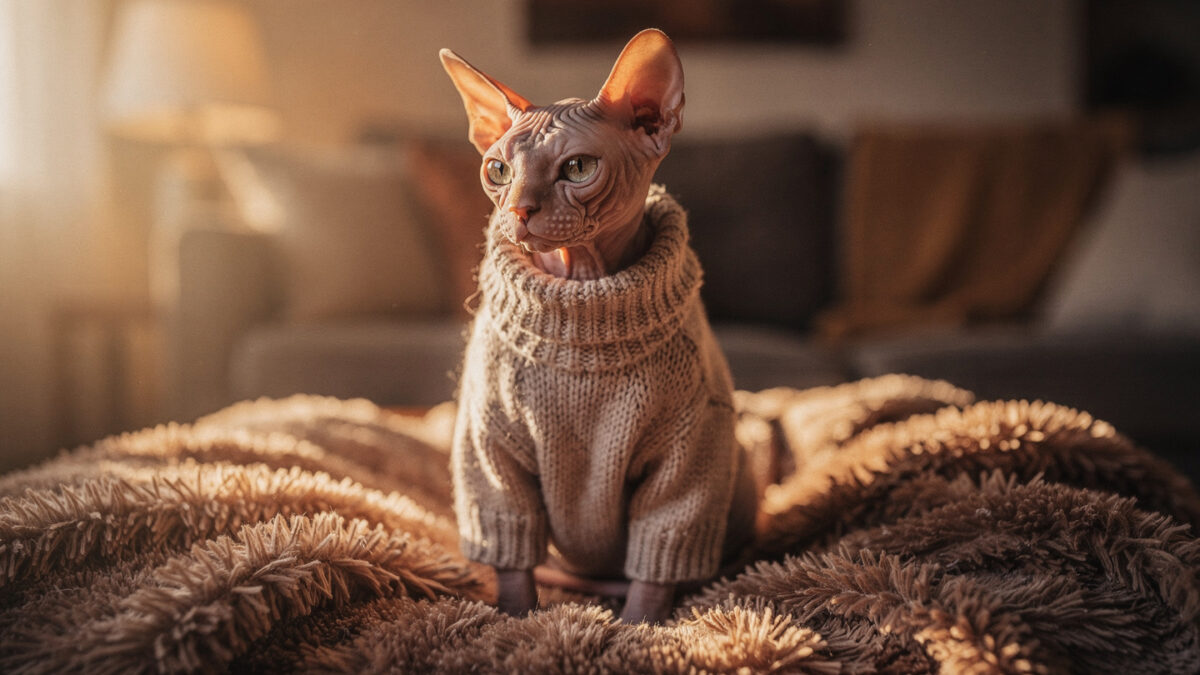
You are a new Sphynx cat owner, and the first bath night shocked you.
No one warned you about the greasy skin, the waxy ears, or the fact that this cat would need more hands-on care than any pet you’ve ever owned.
Sphynx cat care isn’t complicated — but it’s different. And without a clear routine, most new owners end up overwhelmed in the first few weeks.
This guide gives you exactly what you need: a realistic daily and weekly care system, the biggest mistakes to avoid, and the truth about what life with a hairless cat actually looks like.
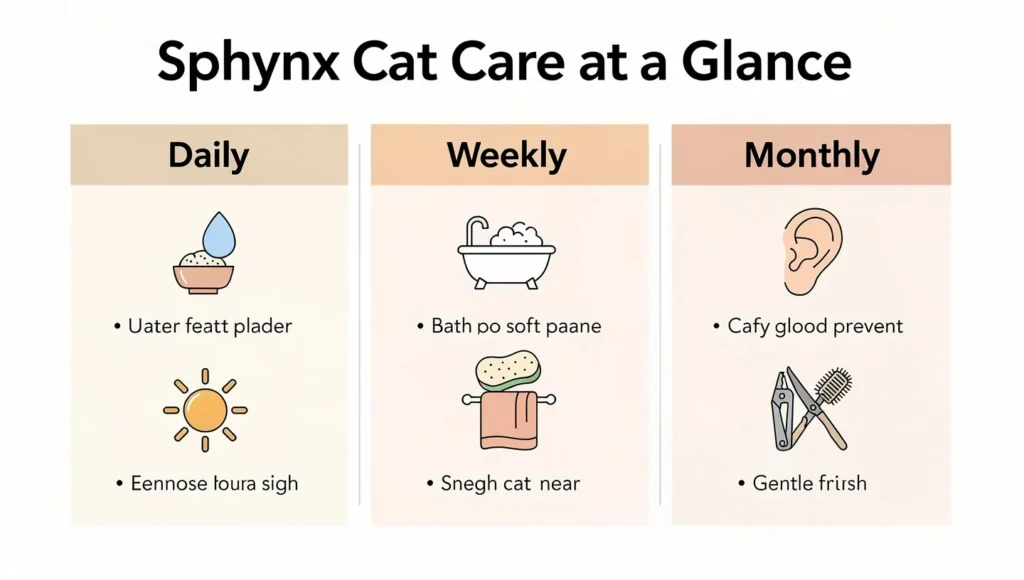
Table of Contents
- What Makes Sphynx Cat Care So Different?
- 🧼 The Complete Daily & Weekly Sphynx Cat Care Routine
- ⏰ Daily Routine (Simple & Realistic)
- 📅 Weekly Routine
- 🧴 Sphynx Cat Skin Care — The #1 Priority
- ⚠️ What NOT to Do with Sphynx Skin
- 🍗 Feeding a Sphynx Cat — Fuel for Skin & Energy
- 🥫 Wet vs Dry Food for Sphynx
- 💧 Hydration Is Critical
- 🧠 Behavior & Personality — What to Expect
- ⚠️ Common Behavior Problems
- ⚠️ 7 Common Mistakes New Sphynx Owners Make
- ❓ Are Sphynx Cats Hard to Take Care Of?
- 🟢 Are They Easy for Beginners?
- 🔴 Who Should NOT Own a Sphynx?
- ⏳ Sphynx Cat Lifespan & Health Expectations
- 🛒 Essential Sphynx Cat Care Products
- ✅ Quick Care Checklist — Daily, Weekly & Monthly
- ❓ Sphynx Owner’s Cheat Sheet: Quick Answers to Common Doubts
- How often should you bathe a Sphynx cat?
- Do Sphynx cats get cold easily?
- Can Sphynx cats stay alone?
- Why is my Sphynx cat greasy?
- 🧲 The Routine Is the Relationship
What Makes Sphynx Cat Care So Different?
Sphynx cat care stands apart from caring for most other breeds — and it all comes down to one thing: no fur.
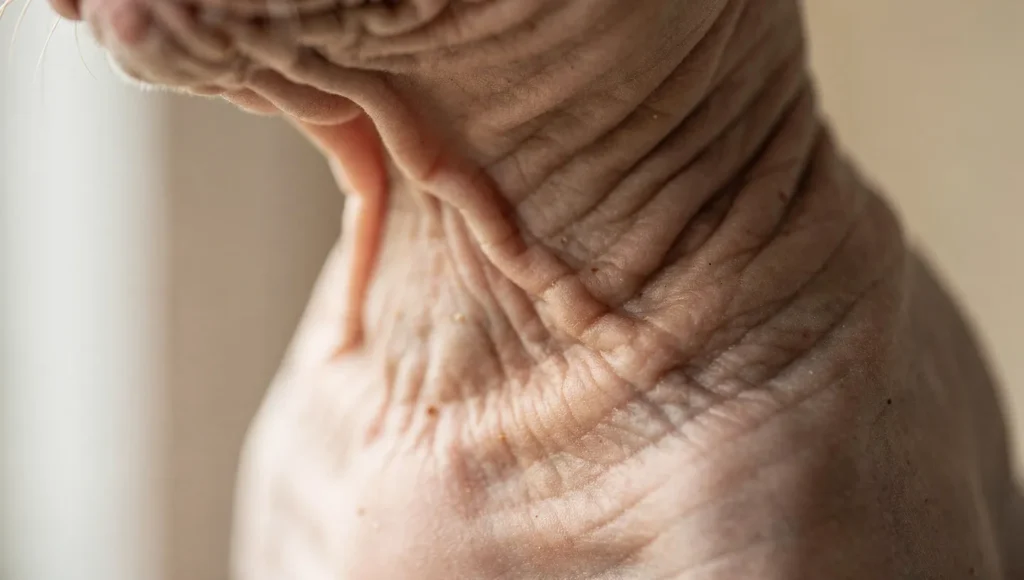
Most cats rely on their coat to absorb the natural oils their skin produces. The Sphynx has no coat. That means every bit of oil, dirt, and environmental residue sits directly on bare skin, with nowhere to go.
What this means in practice:
- Oil buildup happens fast. Within a few days, you’ll notice a greasy film on your cat’s skin — especially around the neck, belly, and skin folds.
- Ears collect wax quickly. Without fur to slow it down, wax accumulates in the ear canal at a much faster rate than in coated breeds.
- Temperature sensitivity is real. Sphynx cats can’t regulate body heat the way other cats do. They get cold faster, they seek warmth constantly, and they need environmental support year-round.
- Skin infections become a real risk if oil and moisture aren’t managed consistently.
In my experience, owners who struggle with Sphynx care aren’t dealing with a difficult cat — they’re dealing with a different kind of routine. Once you understand the “why” behind the skin, the ears, and the warmth, everything else makes sense.
Understanding your cat’s signals is part of that — learning to read their body language will tell you a lot about how they’re feeling, especially when something feels off. And if you ever notice behavioral changes paired with physical ones, knowing how to tell if your cat is sick early can make a real difference.
🧼 The Complete Daily & Weekly Sphynx Cat Care Routine
Sphynx cat care routine doesn’t need to be complicated — it just needs to be consistent.
The owners who thrive with this breed are the ones who build a simple rhythm and stick to it. Here’s what that looks like in real life.
⏰ Daily Routine (Simple & Realistic)
You don’t need an hour. You need about 10 to 15 focused minutes each day.
Skin wipe-down:
Use unscented, hypoallergenic baby wipes or a damp soft cloth to gently wipe your cat’s neck, armpits, belly, and skin folds. This removes daily oil buildup before it has a chance to turn into a problem.
Eye check:
Sphynx cats tend to produce more eye discharge than coated breeds. Use a clean, damp cotton pad to gently wipe the inner corners of each eye. Always use a fresh pad for each eye.
Hydration check:
Make sure fresh water is available and that your cat is drinking. Because of their higher metabolism, Sphynx cats need consistent hydration. A fountain-style water bowl works well for encouraging intake.
Warmth check:
Confirm that your cat has access to a warm blanket, heated bed, or sunny spot. In my experience, a Sphynx that seems restless or irritable is often just cold.
📅 Weekly Routine
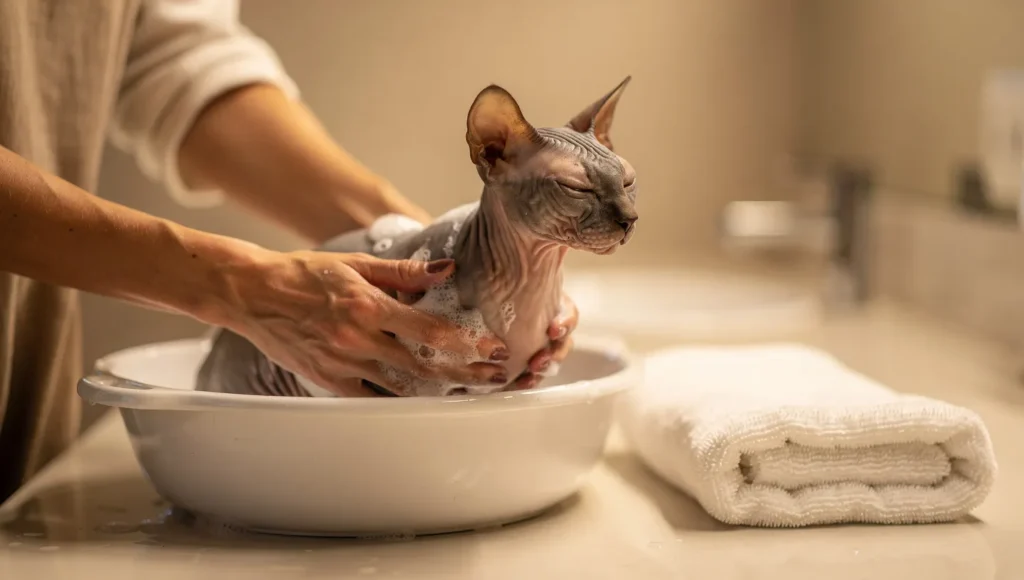
Bathing (once a week):
This is the most important part of Sphynx cat care. Weekly baths remove the oil buildup that daily wiping can’t fully address. Use a cat-specific, gentle shampoo — never human shampoo. Warm water, calm environment, short sessions.
For a full walkthrough of the bathing process, the guide on how to bathe a cat covers everything you need, including temperature, technique, and drying.
Ear cleaning:
Sphynx cats are one of the breeds that need the most consistent ear attention. Dark, waxy buildup is normal — but it needs to be removed weekly to prevent infections. Use a vet-approved ear cleaner and a cotton ball (never a cotton swab inside the canal).
A step-by-step breakdown is available in the guide on cleaning cat ears safely.
Nail trimming:
Without carpet or outdoor surfaces to wear them down naturally, Sphynx nails grow fast and sharp. Weekly trimming keeps them manageable and protects both your furniture and your cat’s skin during grooming. The guide on how to trim cat nails safely walks you through the process without stress.
📋 Expert Tip
Build your weekly bath night into a consistent schedule — same day, same time, same room. Sphynx cats are creatures of habit. When the routine is predictable, the resistance drops significantly. Most owners find that by week three or four, their cat walks into the bathroom on their own.
🧴 Sphynx Cat Skin Care — The #1 Priority
If there’s one thing that separates a healthy Sphynx from a sick one, it’s skin care.
The sebaceous glands in a Sphynx cat’s skin produce oil constantly. In a coated cat, that oil spreads through the fur naturally. In a Sphynx, it pools. It collects in folds, around the ears, under the chin, and between the toes.
Left unmanaged, that buildup creates the perfect environment for bacterial and yeast infections — which show up as redness, odor, and skin irritation.
Best practices for Sphynx skin care:
- Wipe daily with hypoallergenic wipes between baths
- Bathe weekly with a gentle, cat-formulated shampoo
- Pay extra attention to skin folds — the neck, armpits, and groin area
- After bathing, dry thoroughly. Moisture trapped in folds is just as problematic as oil
- Check the skin regularly for redness, unusual spots, or changes in texture
According to the Cornell Feline Health Center, skin conditions in cats are often preventable with consistent at-home hygiene, and the Sphynx breed benefits significantly from a structured grooming routine.
⚠️ What NOT to Do with Sphynx Skin
One mistake I often see with new Sphynx owners is reaching for whatever shampoo is nearby.
Human shampoo — even “gentle” or “baby” formulas — is formulated for a different skin pH than cats. Using it regularly strips protective oils and can cause dryness, flaking, and irritation that looks exactly like a skin condition.
Over-bathing is the other common error. More than once a week actually makes the problem worse — the skin responds to being stripped by producing more oil, faster.
Avoid:
- Human shampoo or dish soap ❌
- Bathing more than once per week ❌
- Skipping the drying step ❌
- Using scented wipes or products with alcohol ❌
- Ignoring skin folds because they “look clean” ❌
The goal is balance: enough cleaning to prevent buildup, not so much that you disrupt the skin’s natural function.
Don’t overlook dental hygiene either — it’s a health area that’s easy to skip but matters just as much. The guide on cat dental care is a good next step once your skin routine is solid.
🍗 Feeding a Sphynx Cat — Fuel for Skin & Energy
Sphynx cats run hot — metabolically speaking. Their bodies work harder to maintain
warmth, which means they burn through calories faster than most breeds.
Underfeeding a Sphynx doesn’t just affect energy. It shows up directly on their skin.
What to prioritize:
- High-protein diet — real meat as the first ingredient
- Moderate fat content to support skin health
- Consistent meal schedule (free-feeding can lead to weight issues)
🥫 Wet vs Dry Food for Sphynx
Both have a place, but wet food wins for Sphynx cats. It supports hydration,
delivers more protein per calorie, and is easier on digestion.
Dry food can supplement, but shouldn’t be the primary source.
The full breakdown is in the guide on
wet vs dry cat food —
worth reading before you settle on a feeding routine.
💧 Hydration Is Critical
A dehydrated Sphynx shows it in their skin — dullness, stickiness,
and increased irritation are all early signs. Fresh water,
a fountain bowl, and wet food together cover most of the hydration gap.
For practical strategies, the
cat hydration guide
covers seven methods that work even for stubborn drinkers.
🧠 Behavior & Personality — What to Expect
Sphynx cats are not lap cats. They’re shadow cats — they follow you,
watch you, and insert themselves into everything you do.
Energetic, vocal, social, and deeply attached to their people.
Personality snapshot:
- Extremely social and people-oriented
- High energy with playful bursts throughout the day
- Intelligent and curious — they get bored fast
- Tend to bond intensely with one or two people
⚠️ Common Behavior Problems
The two most common issues I see with Sphynx cats both stem from the same root:
they need more interaction than owners expect.
- Over-dependence — becomes anxious when left alone for long periods.
The guide on
cat separation anxiety has a structured 14-day plan that works well for this breed. - Nighttime activity — Sphynx cats can be relentlessly active after dark.
An interactive play session before bed usually solves it.
More context in the guide on
cat meowing at night.
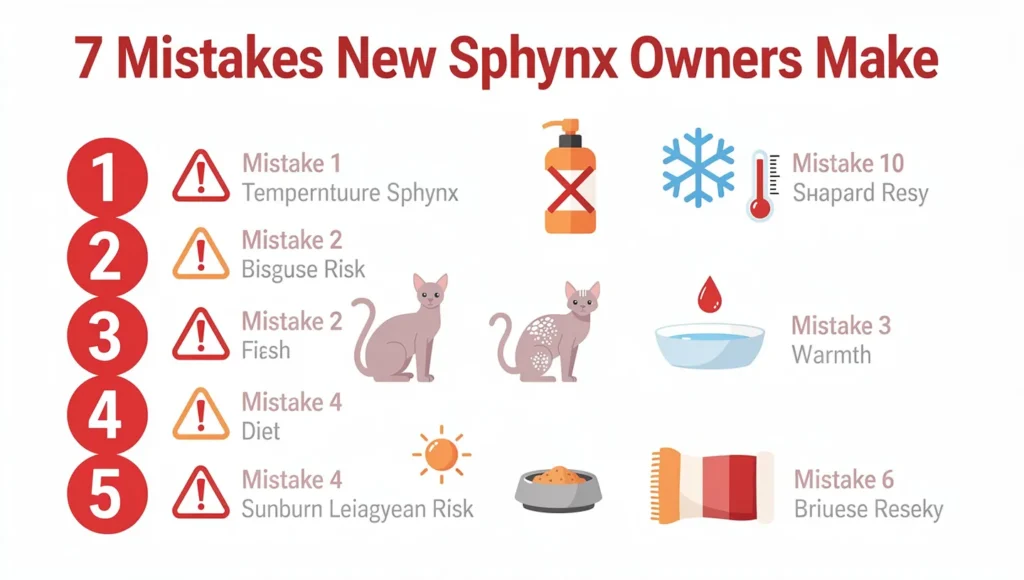
⚠️ 7 Common Mistakes New Sphynx Owners Make
One mistake I often see is treating Sphynx care like regular cat care —
same schedule, same products, same level of attention. It doesn’t work.
- Skipping weekly baths — oil buildup becomes a skin infection fast
- Using human shampoo — damages the skin’s pH balance
- Ignoring ear cleaning — wax builds up weekly without fur to slow it down
- Underfeeding — high metabolism means higher caloric needs than average cats
- No warming setup — no blankets, no heated spots, leads to chronic stress
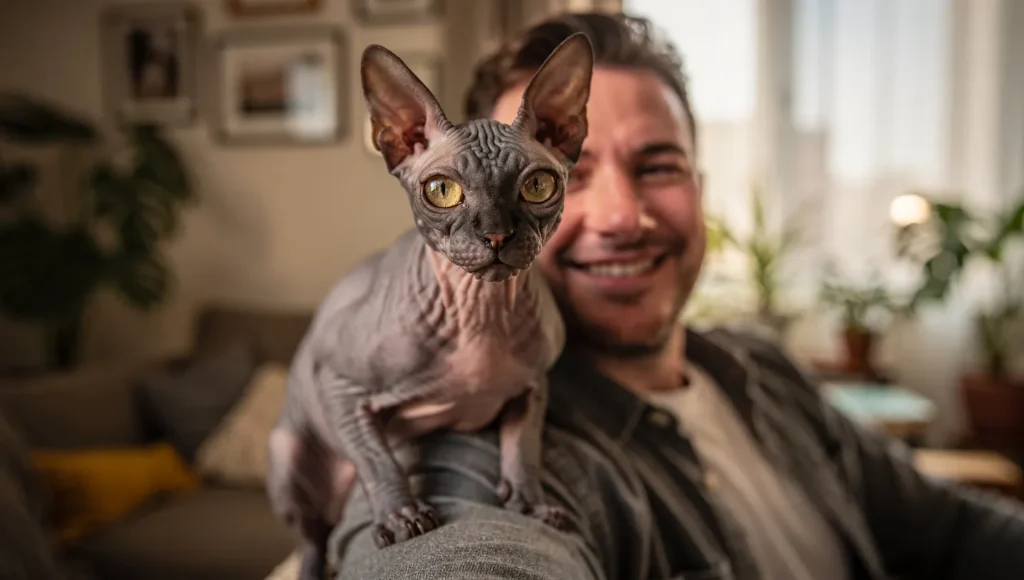
- Leaving them alone too long — this breed doesn’t do well with isolation
- Inconsistent routine — Sphynx cats thrive on predictability;
disruption shows up as behavioral and physical symptoms
❓ Are Sphynx Cats Hard to Take Care Of?
Direct answer: more maintenance than average, but not difficult once you have a system.
The learning curve is real. The first month is the hardest.
After that, the routine becomes second nature — and most owners say
they can’t imagine going back to a coated breed.
🟢 Are They Easy for Beginners?
Yes — with preparation. If you’re willing to commit to a weekly bath and daily check-ins,
you can absolutely thrive with a Sphynx as a first-time owner.
🔴 Who Should NOT Own a Sphynx?
- People with very busy, unpredictable schedules
- Those who travel frequently without a dedicated pet sitter
- Anyone looking for a low-maintenance, independent cat
⏳ Sphynx Cat Lifespan & Health Expectations
The average sphynx cat life expectancy is 8 to 15 years,
with well-cared-for cats frequently reaching the higher end of that range.
Common health concerns to watch:
- Hypertrophic Cardiomyopathy (HCM) — the most serious genetic risk in the breed
- Skin infections — directly linked to inconsistent hygiene routines
- Respiratory sensitivity — they’re more vulnerable to cold and drafts than other cats
- Dental disease — routine oral care matters more than most owners realize
According to research published by the
Journal of Feline Medicine and Surgery,
HCM screening and early preventive care significantly improve outcomes
in predisposed breeds like the Sphynx.
Knowing the early warning signs makes a real difference —
the guide on
how to tell if your cat is sick covers the 10 critical signals every owner should know.
🛒 Essential Sphynx Cat Care Products
You don’t need a lot — but what you use matters.
| Product | What to Look For |
|---|---|
| Baby wipes / cat wipes | Unscented, alcohol-free, hypoallergenic |
| Cat shampoo | pH-balanced, gentle formula, no sulfates |
| Ear cleaner | Vet-approved solution, not alcohol-based |
| Warming blanket / heated bed | Machine washable, safe for unsupervised use |
| Nail clippers | Small, sharp, cat-specific — not human clippers |
| Fountain water bowl | Encourages drinking, easy to clean |
✅ Quick Care Checklist — Daily, Weekly & Monthly
| Frequency | Task |
|---|---|
| Daily | Skin wipe-down, eye check, hydration check, warmth check |
| Weekly | Bath, ear cleaning, nail trim, full skin inspection |
| Monthly | Dental check, weight check, environmental review (temperature, bedding) |
❓ Sphynx Owner’s Cheat Sheet: Quick Answers to Common Doubts
How often should you bathe a Sphynx cat?
Once a week is the standard. More than that strips the skin;
less than that allows oil and bacteria to build up.
Do Sphynx cats get cold easily?
Yes. Without fur, they lose body heat quickly.
Heated beds, blankets, and a warm home environment are non-negotiable.
Can Sphynx cats stay alone?
Short periods, yes. Long hours daily, no.
This breed is highly social and prone to separation anxiety
without enough stimulation and companionship.
Why is my Sphynx cat greasy?
That’s normal sebaceous oil production — every cat has it,
but Sphynx cats have no fur to absorb it.
Weekly bathing and daily wiping are what keep it in check.
🧲 The Routine Is the Relationship
Caring for a Sphynx cat asks more of you than most breeds — and gives back more too.
The weekly baths, the daily wipe-downs, the warmth checks —
they’re not chores once you see them for what they are:
the daily investment in a cat that is genuinely devoted to you.
With the right routine, sphynx cat care becomes second nature.
And the bond you build through consistent, hands-on care?
That’s something no coated breed can quite replicate.
Start simple. Stay consistent. Your Sphynx will do the rest.