
I still remember the exact moment I realized I had absolutely no idea what can cats eat — or what was actually safe to give them from my own kitchen.
It was a Tuesday night. Long day at work. I finally made it home, kicked off my shoes, and collapsed on the couch with a warm bowl of pasta. Bliss. Total bliss.
That lasted about four seconds.
Luna — my first cat, a ridiculously dramatic tortoiseshell — was already stationed next to the coffee table. Sitting perfectly upright. Staring at me. Not blinking.
And then there was Timo.
Timo decided to take a different approach. He walked up slowly, sat directly in front of
my face, and let out this tiny little “mrrp” — not a full meow, just enough to say: I see you. I see that pasta. We need to talk.
His eyes were huge. Genuinely, cartoonishly huge. Like he hadn’t eaten in three weeks — despite the fact that his food bowl was sitting there, full, not six feet away.
I looked at my pasta. I looked at Timo. I looked at Luna (who had now placed one velvet-soft paw on my knee, just to really drive the point home).
And I thought: Can I just… give them a little bit of this chicken?
Honestly, I had no idea. I didn’t know what was safe, what was dangerous, or where the line was between “cute little treat” and “emergency vet visit at midnight.”
So I did what any responsible cat owner does at 9 PM on a Tuesday.
I panicked and Googled everything.
Quick note before we dive in: everything in this article is based on my personal experience, a lot of research, and information from trusted sources like the ASPCA and PetMD. It’s here to inform, not to replace your vet’s advice. If your cat has a health condition or you’re ever unsure, always check with a professional first.
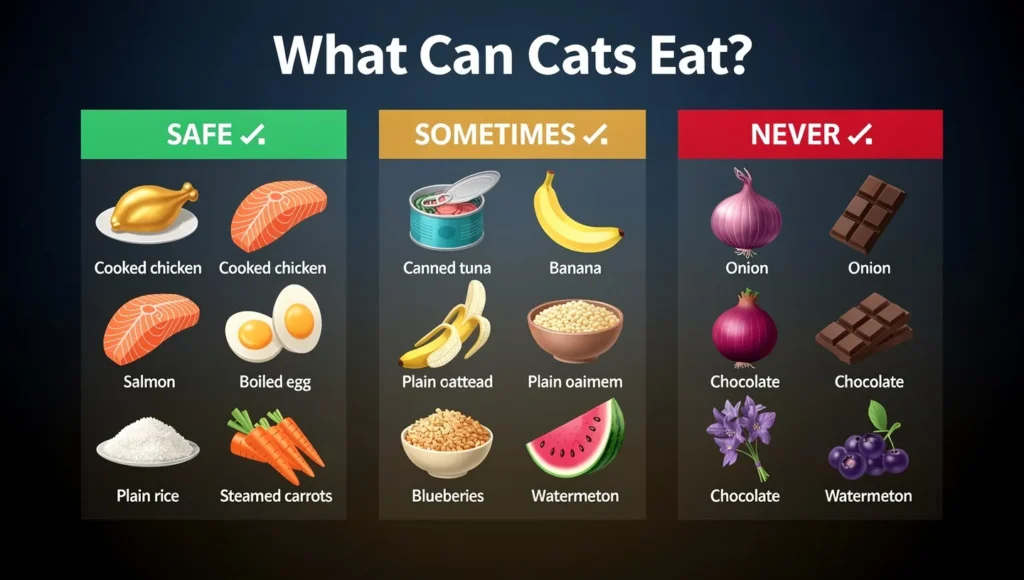
Table of Contents
- So, What Can Cats Actually Eat? (The Short Answer)
- Safe Human Foods for Cats — The Real List
- 🥩 Proteins: The Good Stuff (And the Base of Everything)
- 🥦 Vegetables Cats Can Eat (Some of Them, Anyway)
- 🍓 Fruits (Yes, Some Are Fine — In Moderation)
- 🍚 Other Safe Foods Worth Knowing
- Quick Reference: Safe Foods at a Glance
- Foods That Can Seriously Hurt Your Cat
- 🚫 The Dangerous List — No Exceptions, No “Just a Little Bit”
- ⚡ Danger Level at a Glance
- 🔥 If You Have No Cat Food Right Now — Read This First
- ✅ What’s Safe to Grab From the Fridge Right Now
- ❌ What to Avoid Even in an Emergency
- 📋 Emergency Feeding — Quick Decision Card
- The Morning After — What My Coworkers Had to Say 😄
- What Can Cats Eat Every Day? (Building a Real Routine)
- Protein First. Always.
- Hydration Is Non-Negotiable
- The 10% Rule for Treats
- Kitten vs. Adult vs. Senior — It’s Not One-Size-Fits-All
- Questions I Get Asked All the Time
- What human food can cats eat every day?
- What can cats eat from the fridge?
- Can cats eat rice or pasta?
- What can I feed my cat if I don’t have cat food?
- What are the most dangerous foods for cats — the ones I should never have in reach?
- One Last Thing Before You Go
So, What Can Cats Actually Eat? (The Short Answer)
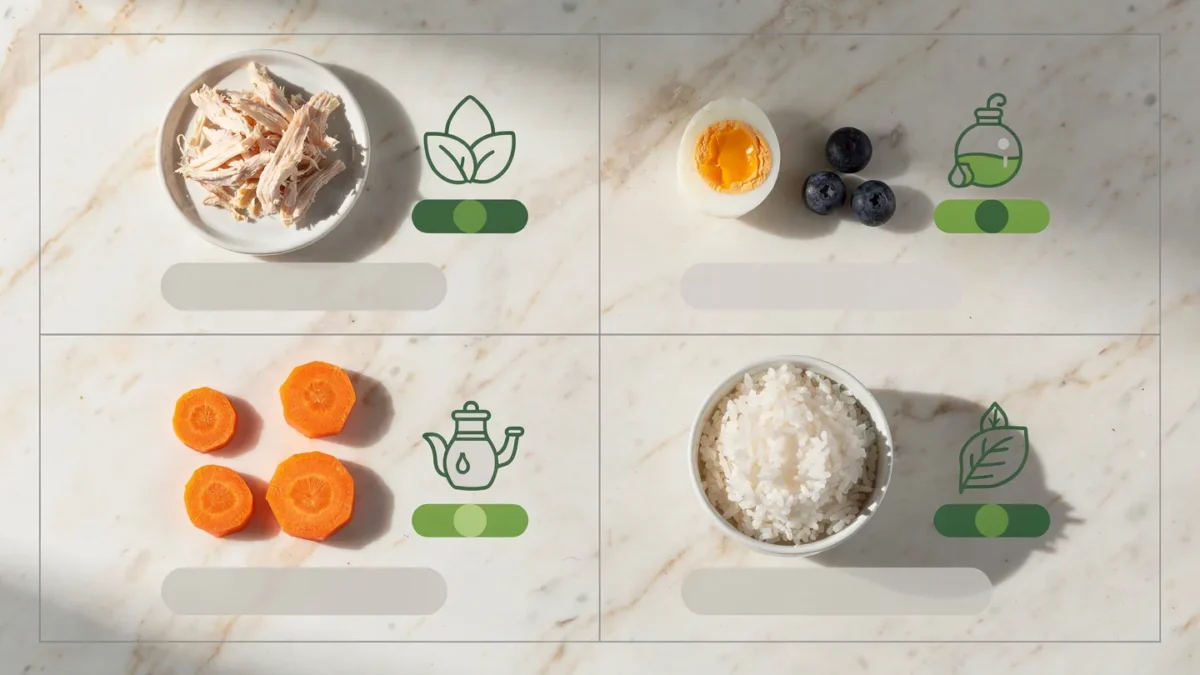
Cats can safely eat plain, cooked proteins like chicken, turkey, salmon, and eggs. Some vegetables and fruits are fine in small amounts too — think steamed carrots, blueberries, or a tiny piece of watermelon. The key word here is plain — no seasoning, no sauces, no garlic, no onions. Ever.
That’s the short version. Now let’s get into the details.
Safe Human Foods for Cats — The Real List
Here’s the thing — a lot of people ask what can cats eat from their own fridge, and honestly, not all human food is off-limits. Some of it is actually fine, even beneficial in small amounts. The problem is most people either assume everything is safe (bad idea) or assume nothing is safe (also not quite right).
Let me break it down properly.
🥩 Proteins: The Good Stuff (And the Base of Everything)
This is where cats thrive. They’re obligate carnivores — meaning their bodies are literally built around animal protein. So yes, meat is their thing.
What’s safe:
- Cooked chicken — Plain, boneless, no skin. This is probably the safest option out
there. My cats go absolutely feral for it. - Cooked turkey — Same rules as chicken. Great for variety.
- Cooked beef — Fine in small amounts. Lean cuts are better.
- Cooked salmon — A favorite. Just make sure it’s fully cooked, boneless, and has
zero seasoning. A piece about the size of your thumbnail is plenty. - Cooked tuna — Okay occasionally, but don’t make it a daily thing.
(More on that later — there’s actually a whole tuna addiction situation that’s more
common than you’d think. Read about it here before you open that can.) - Cooked eggs — Scrambled or boiled, plain. Good protein source.
Skip the raw eggs entirely — salmonella risk is real.
One rule that applies to ALL of these:
No salt. No butter. No garlic powder. No “just a little bit of seasoning.” Plain means plain.
🥦 Vegetables Cats Can Eat (Some of Them, Anyway)
Cats don’t need vegetables the way we do — and if you’re wondering what can cats eat from the produce drawer, the list is shorter than you’d think. But some veggies are harmless and even useful as a fiber boost.
Safe options:
- Steamed carrots — Soft, plain, small pieces. Some cats actually like the texture.
- Peas — Cooked or thawed frozen peas. You’ll find these in a lot of commercial
cat foods already. - Zucchini — Plain, cooked. Low calorie, good filler.
- Steamed broccoli — Small amounts only. Some cats love it, some will look at you
like you’ve personally offended them. - Spinach — Tiny amounts are okay for healthy cats. Skip it if your cat has
any kidney or urinary issues.
Raw veggies are usually fine too, but cooked is easier to digest — especially for older cats.
🍓 Fruits (Yes, Some Are Fine — In Moderation)
Cats don’t technically need fruit — but when people ask what can cats eat as a sweet treat, a few safe options do exist. But if yours is curious and wants to sniff your blueberries, a few won’t hurt.
Safe fruits:
- Blueberries — Antioxidant-rich, safe, and kind of adorable to watch them eat.
- Watermelon — Remove ALL seeds and the rind. The flesh is fine in small pieces.
Good for hydration on hot days. - Banana — A thin slice is okay. High in sugar though, so keep it rare.
- Cantaloupe — Some cats are weirdly obsessed with this one. Small pieces,
no skin. - Peeled apple slices — Remove seeds and core completely. The seeds contain
cyanide compounds. Yes, really.
For a more complete breakdown of what fruits are actually safe (and which ones look innocent but aren’t), this guide covers everything: Safe Fruits for Cats.
🍚 Other Safe Foods Worth Knowing
- Plain cooked rice — Easy on the stomach. Good option if your cat has mild
digestive issues. - Plain oatmeal — Small amounts, cooked, no sugar or flavoring.
Some vets actually recommend it for fiber. - Plain pumpkin — This one’s genuinely useful. A small spoonful can help with
both constipation and diarrhea. It’s one of those things that sounds weird but
actually works. If you want the full breakdown on dosage and how to use it,
this article on pumpkin for cats is worth reading. - Plain cooked pasta — In very small amounts, it’s not toxic. But honestly,
it has zero nutritional value for cats. (Timo would disagree, but Timo isn’t
a nutritionist.)
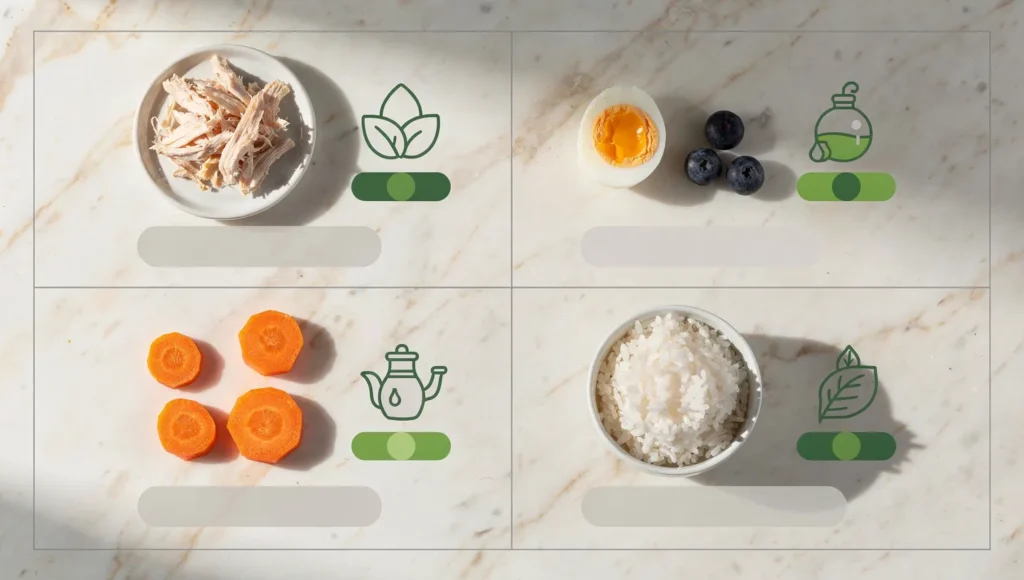
Quick Reference: Safe Foods at a Glance
| Food | Safe? | Notes |
|---|---|---|
| Cooked chicken | ✅ Yes | Plain only, no bones |
| Cooked salmon | ✅ Yes | Boneless, no seasoning |
| Cooked eggs | ✅ Yes | Scrambled or boiled |
| Blueberries | ✅ Yes | Small amounts |
| Watermelon | ✅ Yes | No seeds or rind |
| Steamed carrots | ✅ Yes | Soft, plain |
| Plain rice | ✅ Yes | Good for upset stomach |
| Plain pumpkin | ✅ Yes | Great for digestion |
| Tuna (canned) | ⚠️ Sometimes | Occasional only |
| Banana | ⚠️ Sometimes | High sugar — rarely |
| Spinach | ⚠️ Sometimes | Avoid with kidney issues |
| Raw eggs | ❌ No | Salmonella risk |
| Onions / garlic | ❌ Never | Toxic — no exceptions |
| Grapes / raisins | ❌ Never | Can cause kidney failure |
Foods That Can Seriously Hurt Your Cat
Most people get this wrong — especially when it comes to what can cats eat safely from their kitchen.
They assume the dangerous foods are obvious — like, of course you wouldn’t give your cat a glass of wine. But the ones that actually send cats to the emergency vet? They’re the everyday stuff. The things sitting on your kitchen counter right now.
This is where things change.
🚫 The Dangerous List — No Exceptions, No “Just a Little Bit”
Onions & Garlic (and anything in that family)
This one surprises people every single time. Onions, garlic, chives, leeks — all of them damage a cat’s red blood cells and can cause a type of anemia that builds up slowly. The scary part? Cooked, raw, powdered — it doesn’t matter. Garlic powder on that rotisserie chicken you’re about to share? That counts.
According to the ASPCA Animal Poison Control Center, even small repeated exposures can accumulate into a serious problem over time.
Grapes & Raisins
No one fully understands why yet — and that’s exactly what makes it terrifying. Even a single grape has been linked to sudden kidney failure in some cats. There’s no safe amount. There’s no “well my cat ate one last year and was fine” logic that holds here. Just keep them away. Full stop.
Chocolate & Caffeine
Theobromine and caffeine are both toxic to cats — and cats metabolize them far more slowly than we do. Dark chocolate is the most dangerous, but milk chocolate and coffee are not safe either. Even a small amount can cause tremors, rapid heart rate, or worse.
Xylitol
This is the one most people have never heard of — and it’s hiding in more places than you’d think. Xylitol is an artificial sweetener found in sugar-free gum, some peanut butters, certain yogurts, and even some toothpastes. It causes a dangerous drop in blood sugar and can lead to liver failure. Check labels on anything “sugar-free” before it gets anywhere near your cat.
Raw Dough & Alcohol
Raw yeast dough expands in the stomach and produces alcohol as it ferments — which means it’s a double threat. As for actual alcohol: even a teaspoon can cause serious neurological damage in a cat. Not a joke, not an exaggeration.
Dairy (More Than You’d Expect)
Honestly, this one broke my heart a little when I first found out. That classic image of a cat happily lapping up a bowl of milk? Mostly a myth. Most adult cats are lactose intolerant. A splash here and there might be okay for some cats, but regular dairy leads to digestive upset — vomiting, diarrhea, the works.
If you want the full story on cats and dairy, this breakdown on whether cats can drink milk explains exactly what happens and what to offer instead.
And the full list goes deeper than this.
There are over 400 substances toxic to cats — including some common houseplants, medications, and foods that look completely harmless. For the complete safety guide, this is the one to bookmark:
Human Foods Toxic to Cats — The Ultimate Safety Guide.
⚡ Danger Level at a Glance
| Food | Risk Level | What It Can Cause |
|---|---|---|
| Onions / Garlic | 🔴 High | Anemia, red blood cell damage |
| Grapes / Raisins | 🔴 High | Sudden kidney failure |
| Chocolate | 🔴 High | Tremors, heart issues |
| Xylitol | 🔴 High | Liver failure, blood sugar crash |
| Raw dough | 🔴 High | Bloating, alcohol toxicity |
| Alcohol | 🔴 High | Neurological damage |
| Caffeine | 🔴 High | Rapid heart rate, seizures |
| Dairy (regular) | 🟡 Medium | Vomiting, diarrhea |
| Raw fish (daily) | 🟡 Medium | Thiamine deficiency |
| Salty snacks | 🟡 Medium | Excessive thirst, sodium issues |
🔥 If You Have No Cat Food Right Now — Read This First
Okay. Real talk.
You opened the cabinet. No cat food. Your cat is staring at you with the energy of someone who has been personally betrayed. It’s 10 PM. The store is closed — or far enough away that you’re seriously considering options.
I’ve been there. We’ve all been there.
Here’s what you can actually do — safely.
✅ What’s Safe to Grab From the Fridge Right Now
These are your best emergency options, assuming they’re already cooked and plain:
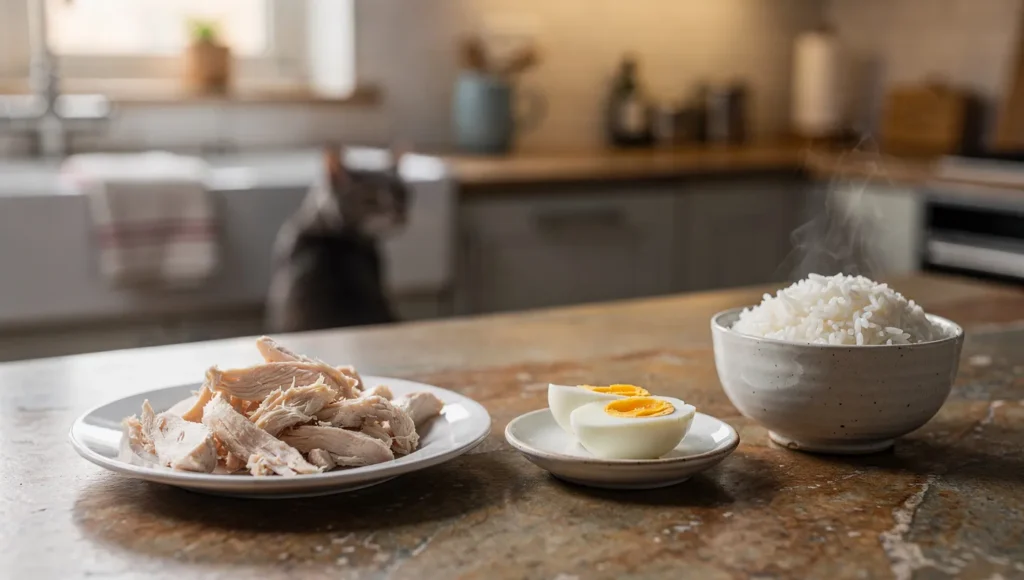
- Plain cooked chicken breast — Pull it apart into small pieces. No skin, no bones,
no seasoning. This is your best-case scenario. - Plain cooked turkey — Same rules. Thanksgiving leftovers minus the gravy?
Actually fine. - Plain scrambled or boiled egg — Quick to make, good protein, cats usually
accept it without drama. - Plain cooked fish — Salmon or white fish, fully cooked, boneless,
zero seasoning. A portion the size of two of your fingers is enough for one meal. - Plain cooked rice — Not a protein source, but it works as a temporary filler
if combined with a little protein. Good for settling a sensitive stomach too.
One meal of any of these won’t hurt your cat. This is purely a bridge until you can get proper food. What can cats eat long-term is a different conversation — human food alone is never a complete solution.
❌ What to Avoid Even in an Emergency
This is important — panic does funny things to our decision-making.
- Deli meats — Loaded with sodium and preservatives. Skip them.
- Canned tuna in oil — The oil content and salt levels are too high for emergency
use. If it’s tuna in water with zero salt, a small amount is okay. - Leftovers with any sauce, seasoning, or garlic — I know it’s tempting. Don’t.
- Milk “just to give them something” — It’ll likely cause stomach upset, which
makes the situation worse, not better. - Dog food — Not toxic in a single meal, but it lacks the taurine and nutrients
cats specifically need. Not a real solution.
📋 Emergency Feeding — Quick Decision Card
Do you have plain cooked chicken, turkey, or fish?
↓ YES ↓ NO
✅ Give a small Do you have eggs?
portion, plain ↓ YES
and boneless ✅ Scramble one, plain, no butter
↓ NO
Do you have plain cooked rice?
↓ YES
⚠️ Small amount only — get real cat
food as soon as possible
↓ NO
🔴 Don’t improvise. Water is fine
for one night. Get cat food
first thing tomorrow.
And if your cat is refusing to eat entirely — not just tonight, but for more than 24 hours — that’s a different situation worth paying attention to. This guide on cats not eating walks through exactly when to worry and what to do.
The Morning After — What My Coworkers Had to Say 😄
So the next morning at work, I mentioned the whole pasta situation to a few people during our morning coffee break.
Big mistake.
Sarah — who has two cats and approximately zero chill — immediately gasped like I’d confessed to a crime. “You almost gave them PASTA?! With sauce?!”
I tried to explain that I didn’t actually give them anything, but she was already pulling up something on her phone to show me.
Then Marcus chimed in from across the room: “Bro, I used to give my cat a little bit of everything. Cheese, chips, whatever. Turns out he was lactose intolerant the whole time. Three years of mysterious vomiting — solved in one vet visit.”
Everyone laughed. Marcus did not look amused.
And then there was Jamie, who somehow managed to top everyone by casually mentioning that she once gave her cat a small piece of onion because — and I quote — “it looked like it wanted some.”
The table went silent.
“Jamie,” someone said slowly. “Onions are toxic to cats.”
The color drained from her face. Her cat, she informed us, was completely fine (apparently it was a very small amount, years ago, and the cat is still thriving at age 11) — but the panic in her eyes in that moment was something I will never forget.
The point of all this?
We’ve all been there. Most of us are figuring this out as we go, Googling things at weird hours, and learning from moments that could have gone differently. That’s exactly why I wanted to put all of this in one place.
What Can Cats Eat Every Day? (Building a Real Routine)
Here’s something a lot of articles skip over: knowing what’s safe is only half the equation. The other half is knowing what a healthy daily diet actually looks like — so you’re not just avoiding disasters, you’re actively doing right by your cat.
Protein First. Always.
Cats are obligate carnivores. That’s not a preference — it’s biology. Their bodies can’t produce certain essential nutrients (like taurine and arachidonic acid) on their own, so they have to get them through animal protein. A diet that’s low in quality protein isn’t just unsatisfying for your cat — it’s genuinely harmful over time.
According to the American Veterinary Medical Association (AVMA), cats require significantly more protein in their diet compared to most other domestic animals. This is why cat food and dog food are not interchangeable — and why “a little bit of everything from the fridge” isn’t a real feeding strategy.
Personally, I feed my cats a combination of high-quality wet food as the base — for the protein and hydration — with dry food available during the day. That balance has worked really well for both Luna and Timo, and it’s something a lot of vets recommend for indoor cats specifically.
Hydration Is Non-Negotiable
This one doesn’t get enough attention.
Cats have a naturally low thirst drive — they evolved in desert environments and were designed to get most of their moisture from prey. Which means a cat eating only dry kibble is often operating in a state of mild, chronic dehydration without anyone realizing it.
Signs your cat isn’t getting enough water: dry coat, low energy, infrequent urination, or urine that’s very dark and concentrated.
The fix is usually simpler than people expect — wet food, a water fountain, or even just changing the location of the water bowl can make a real difference. For a full
breakdown of how to keep your cat properly hydrated (and the signs that things have gone wrong), this cat hydration guide is genuinely one of the most useful things you can read as a cat owner.
The 10% Rule for Treats
Any treat — homemade or store-bought, healthy or indulgent — should make up no more than 10% of your cat’s daily caloric intake. That sounds like a lot until you realize how small a cat’s daily calorie budget actually is.
An average adult indoor cat needs somewhere between 180–250 calories per day.
Ten percent of that is about 18–25 calories. Which is roughly:
- 2–3 small pieces of cooked chicken
- 1 teaspoon of plain canned fish
- A few blueberries
Not a lot. Which is why “just a little treat” can add up faster than you’d think — especially if multiple people in the household are all giving “just a little.”
Kitten vs. Adult vs. Senior — It’s Not One-Size-Fits-All
Kittens need significantly more calories per pound of body weight than adult cats.
They also need higher levels of protein and fat to support rapid growth. If you have a kitten at home, this feeding chart breaks down exactly how much to feed by age and weight: How Much to Feed a Kitten.
Adult cats (roughly 1–10 years) do well on a consistent routine — same food, same schedule, measured portions. Free-feeding dry food all day is the fastest route to an overweight cat, which comes with its own set of health problems down the line.
Senior cats (10+ years) often have changing nutritional needs — sometimes needing more protein to maintain muscle mass, sometimes requiring lower phosphorus for kidney health. If your cat is getting older, it’s worth having a conversation with your vet about whether their current food is still the right fit.
Questions I Get Asked All the Time
What human food can cats eat every day?
Small amounts of plain cooked chicken, turkey, or fish can be given regularly as a
supplement — but they shouldn’t replace a complete, balanced cat food. Think of them
as a topping, not the main meal. Variety is good; relying on a single human food
daily can lead to nutritional gaps over time.
What can cats eat from the fridge?
If it’s plain, cooked, and unseasoned — cooked chicken, turkey, fish, or eggs are your safest bets. Avoid anything with sauces, marinades, garlic, onion, or heavy salt. Cold food straight from the fridge is fine, though some cats prefer it slightly warmed to room temperature.
Can cats eat rice or pasta?
Plain cooked rice? Yes, in small amounts — it’s easy to digest and can actually help with mild stomach upset. Plain pasta? Technically not toxic, but it has almost no nutritional value for cats. It won’t hurt them in a tiny amount, but there’s no real reason to make it a habit. (Sorry, Timo.)
What can I feed my cat if I don’t have cat food?
Plain cooked chicken or turkey is your best option. Plain scrambled eggs work well too. In a real pinch, a small amount of plain cooked rice is okay as a short-term filler. The key word across all of these: plain. No seasoning, no sauces, nothing fancy. And get proper cat food as soon as you can — one emergency meal is fine, but human food isn’t nutritionally complete for cats long-term.
What are the most dangerous foods for cats — the ones I should never have in reach?
The non-negotiables: onions, garlic, grapes, raisins, chocolate, caffeine, xylitol, and alcohol. These aren’t “give only a little” situations — they’re hard stops. Even small or repeated exposures to some of these can cause serious, sometimes irreversible damage. If you ever suspect your cat ate something toxic, the ASPCA Animal Poison Control hotline (888-426-4435) is available 24/7.
One Last Thing Before You Go
Understanding what can cats eat doesn’t have to be complicated. You don’t have to be a nutrition expert to feed your cat well.
You just have to know the basics, stay curious, and not panic-Google at midnight while your cat stares at your pasta. (Although, honestly — been there, learned a lot.)
The real takeaway from all of this: once you understand what can cats eat and what to avoid, quality protein is the foundation, hydration matters more than most people think, and when in doubt — plain and simple beats creative every single time.
Luna and Timo have both figured out that the pasta is not for them.
They’re handling it with dignity.
Mostly.
If any of this reminded you of your own “wait, can my cat eat that?” moment — drop it in the comments below. I read every single one, and I promise the stories never get old. And if this helped you, share it with a fellow cat parent who might need it.