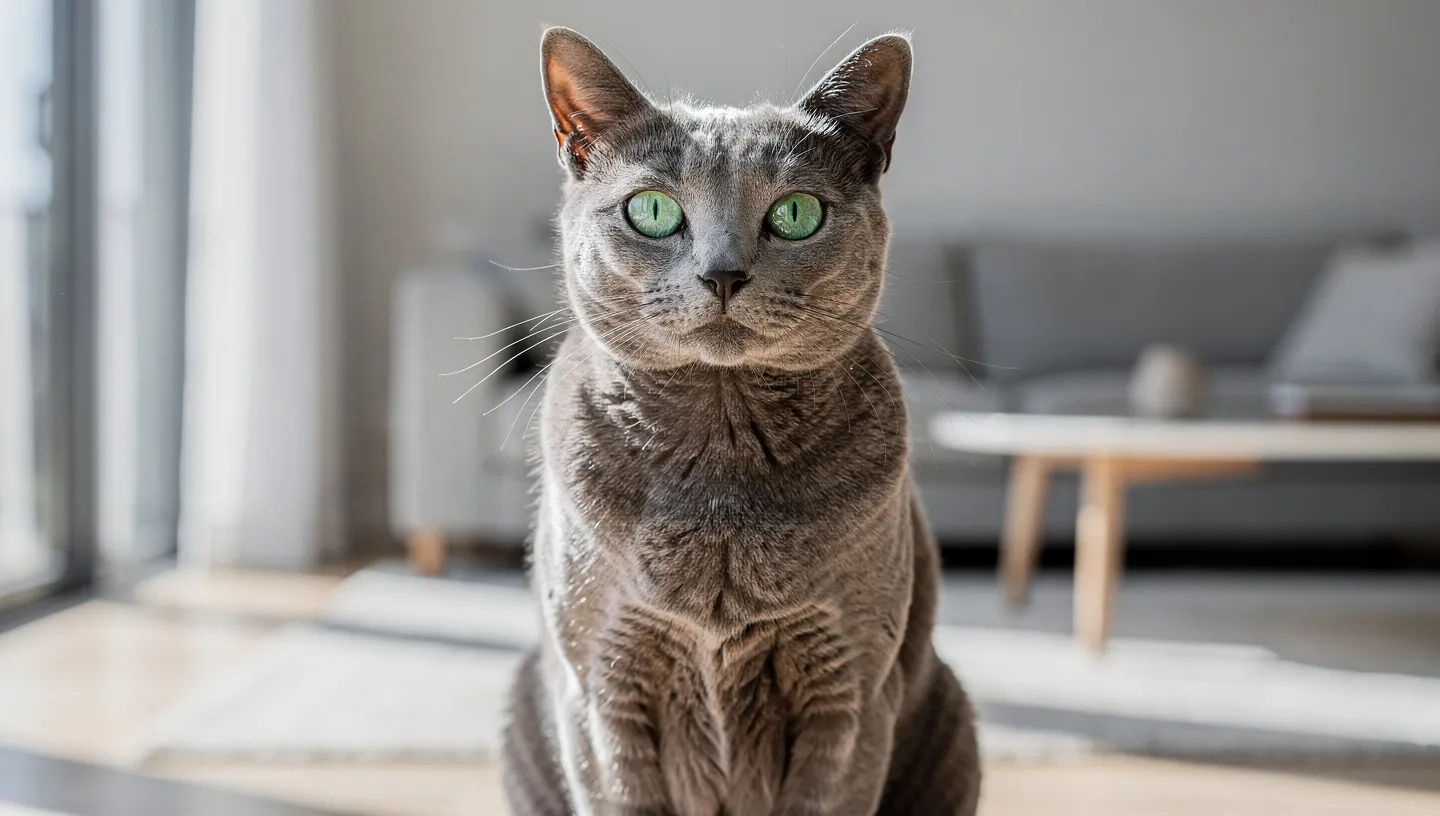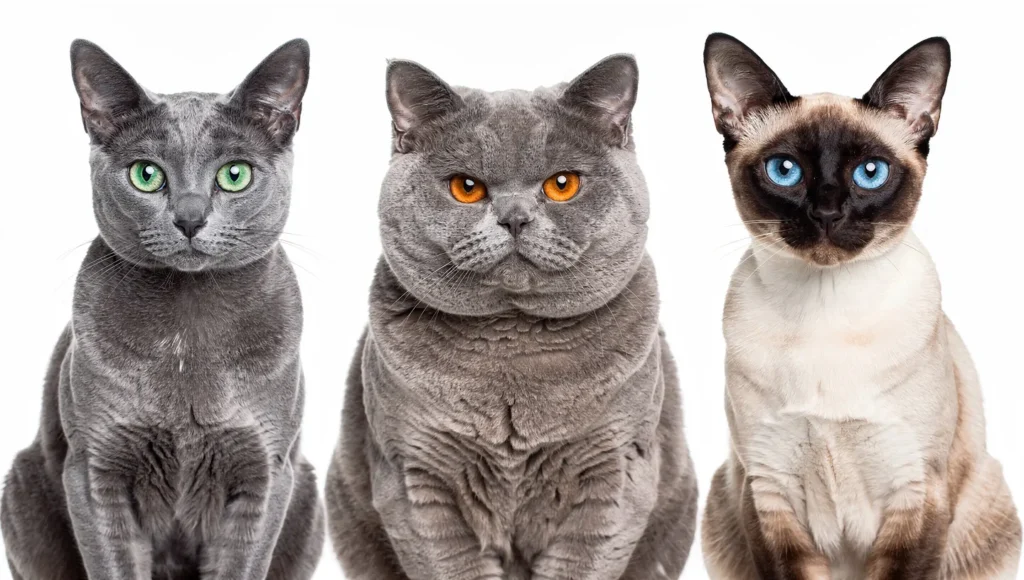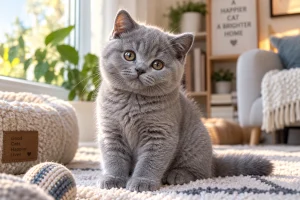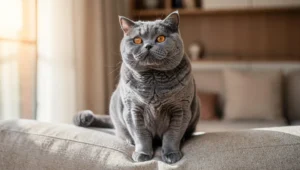
You’ve fallen for those emerald eyes and that shimmering silver coat—but is a Russian Blue really the “hypoallergenic, low-maintenance” cat everyone claims? Or are you about to discover that your sweet gray kitten is actually a domestic shorthair with excellent PR?
Here’s the truth: I’ve spent over a decade working with Russian Blues, and I can tell you that the myths surrounding this breed are almost as thick as their double coat. Some owners are disappointed when their “Russian Blue” never develops green eyes. Others are shocked by the vet bills for bladder stones—a condition rarely mentioned in those glossy breeder brochures.
But when you get it right? When you understand what this breed actually needs (not what Instagram tells you they need)? You’ll have a loyal, intelligent companion who bonds with you in ways that feel almost telepathic.
This guide strips away the fairy tales. We’re covering everything from the science behind their “hypoallergenic” reputation to the real costs of ownership in 2026. Whether you’re considering adoption, dealing with a suspected mixed breed, or just trying to understand why your Russian Blue acts like a tiny, judgmental philosopher, you’re in the right place.

Table of Contents
- Quick Facts: Russian Blue Cat at a Glance
- 🐾 What Makes the Russian Blue Cat Unique? (The “Archangel” Legacy)
- The Shimmering Silver-Blue Double Coat
- Those Mesmerizing Green Eyes (And Why Kittens Start Yellow)
- The Body Structure: Elegant but Muscular
- 🔍 Is Your Cat a TRUE Russian Blue? (The Grey Guardian Checklist)
- ✅ The 5-Point Verification System
- 🧬 The “Paw Pad Test” (The Secret Weapon)
- 🎭 Personality as a Clue (But Not Proof)
- 🚨 The “Green Eye Timeline” Rule
- 🏆 Celebrate the Truth (Whatever It Is)
- 🧬 Russian Blue Personality: Are They Really “One-Person Cats”?
- The Shy Intellectual: What to Expect
- Intelligence & Trainability (Yes, They Can Play Fetch!)
- Living With a Russian Blue: Routine-Obsessed & Noise-Sensitive
- The “Velcro Cat” Myth (It’s Loyalty, Not Clinginess)
- Socialization Tips (If You Adopt a Kitten)
- 🤧 Are Russian Blue Cats Hypoallergenic? (The Science Behind the Myth)
- 🧬 The Fel d 1 Protein Explanation
- 🧪 The “Trial Period” Protocol (Before You Commit)
- 🏠 Environmental Controls (For Mild Allergy Sufferers)
- ❌ What Doesn’t Work (Save Your Money)
- 🎯 The Bottom Line (Should You Risk It?)
- 💎 Russian Blue Cat Price & Cost Breakdown (2026 Reality Check)
- 💰 Adoption vs. Breeder: The True Investment
- 📊 First-Year Costs: What They Don’t Warn You About
- 💵 Annual Maintenance Costs (Years 2+)
- 🏥 Hidden Costs: The “Fine Print” Expenses
- 🎯 Where to Splurge vs. Where to Save
- 💳 Financing Options (If You’re Tight on Cash)
- 🏆 Final Verdict: Is It Worth the Price?
- 🏥 Health & Longevity: What Every Russian Blue Owner Must Know
- 🧬 Common Health Issues: The Vet-Approved Watchlist
- ⏱️ Lifespan Expectations: The 15-20 Year Reality
- 🩺 The Annual Vet Exam: Why You Can’t Skip It
- 💊 Vaccinations & Preventive Care Schedule
- 🎯 Final Health Advice: You’re Their Advocate
- 🛁 Caring for Your Russian Blue: The Weekly Routine
- 🪮 Grooming Needs: Low-Maintenance Doesn’t Mean Zero-Maintenance
- 🍽️ Dietary Requirements: Preventing the “Chunky Russian” Syndrome
- 🎮 Exercise & Enrichment: Mental Stimulation is Non-Negotiable
- 📅 The Weekly Care Checklist (Print & Post on Your Fridge)
- 🎯 Final Care Advice: Consistency > Perfection
- 🆚 Russian Blue vs. Other Gray Cats: The Ultimate Comparison
- ❓ Frequently Asked Questions About Russian Blue Cats
- 🎯 Final Verdict: Is a Russian Blue Right for You?
- ✅ Perfect For:
- ❌ Not Ideal For:
- 🔚 Conclusion: Your Russian Blue Journey Starts Here
Quick Facts: Russian Blue Cat at a Glance
| Characteristic | Details |
|---|---|
| Origin | Arkhangelsk, Russia (1860s) |
| Weight | 7-12 lbs (3-5.5 kg) |
| Lifespan | 15-20 years (with proper care) |
| Coat Type | Short, dense double coat with silver tipping |
| Temperament | Gentle, reserved, intelligent, one-person loyal |
| Hypoallergenic Status | Lower Fel d 1 protein (but NOT 100% allergen-free) |
| Activity Level | Moderate (playful but not hyperactive) |
| Vocalization | Quiet (soft, infrequent meows) |
| Price Range (2026) | $1,000-$2,000 (Reputable Breeder) / $75-$150 (Shelter Adoption) |
| Best Suited For | Quiet households, singles, couples, mild allergy sufferers |
Why This Matters: Before you spend thousands on a “purebred” kitten, use this table as your baseline. If a seller claims their Russian Blue will stay under 6 pounds or has orange eyes, you’re not getting the real deal—and that’s something we’ll unpack in the next section.
🐾 What Makes the Russian Blue Cat Unique? (The “Archangel” Legacy)
There’s a reason Russian Blues were once called “Archangel Cats”—and no, it’s not because they have halos (though their silver-tipped fur might fool you). These cats sailed from the port city of Arkhangelsk in northern Russia during the 1860s, arriving in England as prized companions for sailors who swore by their rat-catching skills and unusually gentle temperament.
But what separates a true Russian Blue from the dozens of gray cats flooding shelter websites? It comes down to three unmistakable traits that breeders guard like state secrets—and that every potential owner needs to verify before signing any paperwork.
The Shimmering Silver-Blue Double Coat
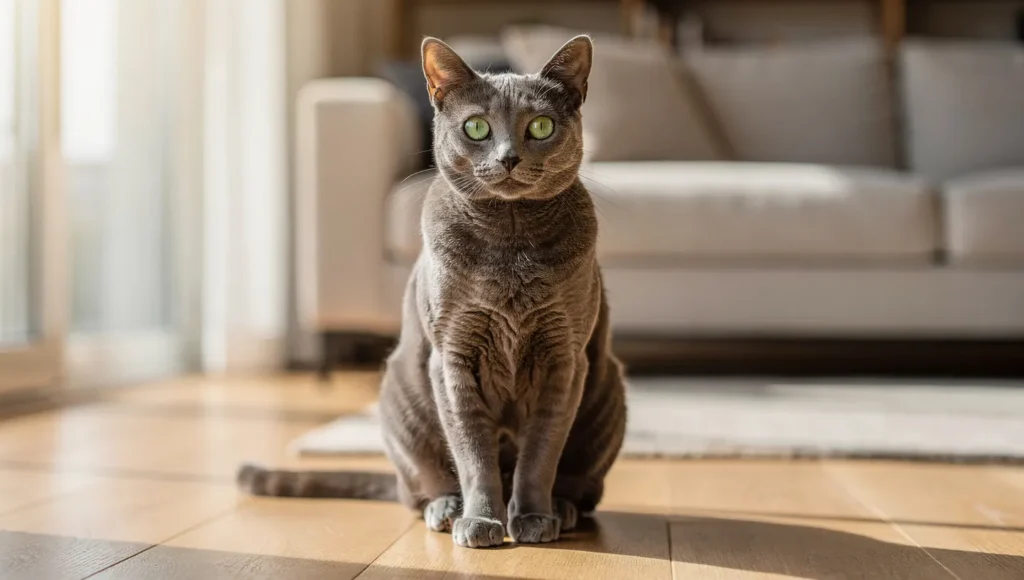
If you’ve ever seen a Russian Blue under direct sunlight and thought, “Wait, is that cat glowing?”—you weren’t imagining things. This breed has a double coat with a unique optical trick called silver tipping. Each individual hair shaft is blue-gray at the base but ends in a colorless, reflective tip that catches light like tiny prisms.
Here’s the test I teach every first-time owner: Run your fingers backward through your cat’s fur (against the grain). If you see a soft silver “halo” effect around the disturbed fur, you’re holding the real deal. Regular gray domestic shorthairs have single-layer coats that look flat and matte by comparison—no shimmer, no depth, just solid gray.
Why This Matters for Care: That double coat isn’t just for show. It means Russian Blues shed year-round (yes, even the “low-shedding” ones), and they need weekly brushing to prevent mats. I’ve seen too many owners skip grooming because they believed the “no-maintenance” myth, only to deal with hairballs and digestive issues later. We’ll cover the exact brushing technique that works for their dense fur in the care section.

Those Mesmerizing Green Eyes (And Why Kittens Start Yellow)
Let’s address the number one source of buyer’s remorse: All Russian Blue kittens are born with blue eyes that turn yellow around 4 weeks, then gradually shift to green between 4-12 months. If you’re looking at a 6-month-old “Russian Blue” with amber or hazel eyes, you’re either dealing with a mixed breed or an unethical breeder.
The transition happens because of melanin production in the iris. True Russian Blues carry a genetic marker that triggers green pigmentation—specifically, a vivid emerald or bottle-green that almost glows in low light. By 12 months, the color should be fully set. No exceptions.
🔍 Expert Tip: If your “Russian Blue” has yellow eyes past 12 months, it’s likely a mixed breed—and that’s completely okay! Mixed breeds often have fewer genetic health issues and can live just as long. What’s not okay is paying $2,000 for a cat that isn’t what the breeder promised. Always ask for proof that the kitten’s parents have green eyes, or better yet, meet the parents in person.
The Body Structure: Elegant but Muscular
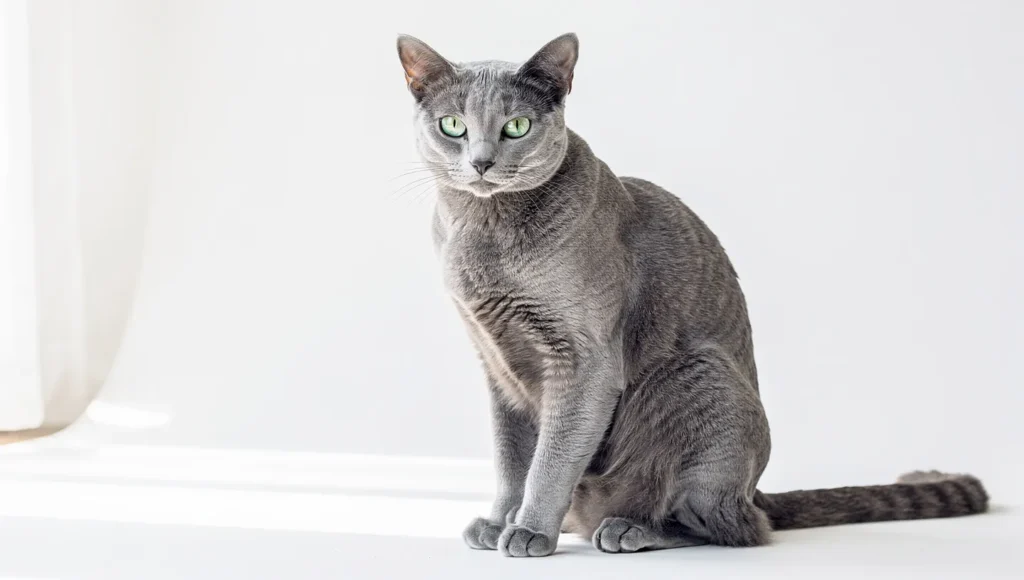
Forget the chubby British Shorthair build. Russian Blues are fine-boned but surprisingly strong—think ballet dancer, not bodybuilder. Their legs are long and slender, their necks graceful, and their overall silhouette should look athletic even when they’re lounging.
Here’s what I notice when a Russian Blue walks into our clinic: They move with deliberate, almost cautious grace. No clumsy leaps or bulldozer landings. This isn’t just personality—it’s biomechanics. Their lighter bone structure makes them natural climbers who prefer vertical exploration over horizontal sprints.
The Weight Reality Check: Males typically reach 10-12 pounds, females 7-10 pounds. If your vet says your Russian Blue is 15 pounds and “just big-boned,” we need to have a conversation about weight management. Obesity is the silent epidemic in this breed because their calm temperament tricks owners into thinking they need less food—when actually, they need controlled portions to match their moderate activity levels.

🔍 Is Your Cat a TRUE Russian Blue? (The Grey Guardian Checklist)
Here’s the uncomfortable truth that costs cat owners thousands every year: Up to 60% of cats sold as “Russian Blues” online are actually domestic shorthairs with good lighting in their photos. I’ve seen it happen to friends, clients, and even experienced breeders who got fooled by convincing paperwork.
So before you invest emotionally (or financially) in a cat labeled “Russian Blue,” use this veterinary-backed verification system. It’s the same checklist we use at Felina Care Hub when owners bring in their new kittens and ask, “Did I get scammed?”
✅ The 5-Point Verification System
| Feature | ✓ True Russian Blue | ✗ Look-Alike Gray Cat |
|---|---|---|
| Eye Color (Adult) | Vivid emerald or bottle-green (after 12 months) | Yellow, orange, hazel, or copper |
| Coat Texture | Dense double coat—plush, almost velvet-like when stroked with the grain | Single-layer coat—feels smooth but flat, no “bounce back” |
| Silver Tipping | Visible shimmer in natural light; run fingers backward to see silver halo | Solid gray with no light reflection; looks matte even in direct sun |
| Paw Pads | Mauve, lavender, or rosy-pink (never black or dark gray) | Standard pink, black, or mottled colors |
| Body Type | Fine-boned, elegant, long-legged (7-12 lbs for adults) | Stockier build or significantly heavier (13+ lbs suggests mixed breed) |
💡 The Reality Check: If your cat checks 3 out of 5 boxes, you likely have a Russian Blue mix—which is fantastic. Mixed breeds often dodge genetic health issues like Progressive Retinal Atrophy (PRA) and can live just as long as purebreds. The problem isn’t the genetics; it’s paying $2,000 for a cat worth $150.
If your cat checks 0-2 boxes? Congratulations—you have a beautiful domestic shorthair. Love them exactly the same, but maybe have a stern conversation with whoever sold them to you.

🧬 The “Paw Pad Test” (The Secret Weapon)
This is the detail that separates casual Google searches from real breed knowledge. Russian Blue paw pads should be mauve or lavender-toned—not the bright pink you see on most cats, and definitely not black.
Here’s how to check: Gently press on your cat’s paw to expose the pads (do this when they’re relaxed, not during a nail trimming wrestling match). Hold the pad up to natural light. True Russian Blues have pads that look almost purple-ish or dusty rose. If they’re bubble-gum pink or charcoal black, you’re not looking at a purebred.
Why This Matters: Paw pad color is controlled by the same genetic markers that produce the blue coat and green eyes. It’s one of the hardest features to fake, which is why backyard breeders who mix Russian Blues with gray tabbies always get caught on this detail.
🎭 Personality as a Clue (But Not Proof)
Temperament isn’t foolproof—cats have personalities that defy breed standards all the time—but Russian Blues overwhelmingly share these behavioral traits:
- Reserved with strangers: They won’t greet visitors at the door. Instead, they’ll observe from a high perch for 20-30 minutes before deciding if someone is “safe.”
- Routine-obsessed: Change their feeding time by 30 minutes, and they’ll stare at you like you’ve committed a war crime.
- Soft-spoken: When they do vocalize, it’s a quiet, chirpy meow—not the yowling you hear from Siamese cats.
- “Velcro cat” with one person: They’ll follow their chosen human from room to room but remain polite and independent with everyone else.
If your gray cat is a social butterfly who greets strangers with headbutts and never stops meowing, that’s wonderful—but it’s not Russian Blue behavior. Understanding cat body language can help you decode whether your cat’s personality aligns with breed expectations or if you’re working with a delightful mutt.
🚨 The “Green Eye Timeline” Rule
Let me save you months of anxiety: If your kitten doesn’t have fully green eyes by 14 months, they’re not a purebred Russian Blue. Period.
I’ve had owners contact me in tears at the 18-month mark because their cat’s eyes are still yellowish-green, and the breeder insists, “Just wait another year!” No. The genetic switch flips by 12 months in 95% of cases, with stragglers finishing by 14 months.
What “Green” Actually Means: We’re talking about a saturated, jewel-tone green—not lime, not hazel, not “greenish-gold.” Pull up a photo of an emerald gemstone. That’s your target. If your cat’s eyes look more like sea glass or moss, you’ve got a mixed breed.
🔗 Next Step: If you’ve confirmed your cat isn’t a purebred but you’re worried about health issues, don’t panic. Most Russian Blue mixes are healthier than purebreds because hybrid vigor protects them from genetic conditions. Focus on preventive care, which we’ll break down in the health section.

🏆 Celebrate the Truth (Whatever It Is)
Here’s what a decade in feline care has taught me: The bond you build with your cat has absolutely nothing to do with their pedigree. I’ve seen $3,000 purebreds who were aloof and neurotic, and I’ve seen $50 shelter cats who acted like emotional support animals without any training.
If your “Russian Blue” turns out to be a domestic shorthair mix, you haven’t lost anything except bragging rights. In fact, you’ve gained a cat who’s statistically likely to live longer, cost less in vet bills, and have fewer behavioral quirks tied to inbreeding.
But if you paid premium prices for a cat that doesn’t meet breed standards, document everything. Ethical breeders offer health guarantees and will work with you. Scammers will ghost you. Know the difference before the return window closes.
🧬 Russian Blue Personality: Are They Really “One-Person Cats”?
If you’re expecting a lap cat who greets guests with purrs and belly rolls, let me stop you right there. Russian Blues are the introverts of the cat world—the ones who’d rather observe a party from the top of the bookshelf than participate in it. But does that make them “unfriendly” or “standoffish”? Absolutely not. It makes them discerning.
In my years working with Russian Blues at Felina Care Hub, I’ve noticed they treat socialization like a PhD program—slow to trust, meticulous in their evaluations, but once they bond with you, you become their entire universe. The problem is that most owners mistake their reserved nature for rejection, when in reality, they’re just watching to see if you’re worthy of their affection.
Let’s decode what’s actually happening in that brilliant little brain.
The Shy Intellectual: What to Expect
Russian Blues aren’t born confident. They’re born cautious—and there’s a survival reason for that. In their ancestral Russian winters, boldness meant exposure to predators. The cats who survived were the ones who observed first and acted second. That genetic wiring is still intact today.
What This Looks Like in Your Home:
- Stranger Danger: When someone new visits, your Russian Blue won’t rush to investigate. They’ll disappear to a high perch (top of the fridge, cat tree, back of the closet) and spend 20-30 minutes analyzing the intruder’s voice, movements, and scent before deciding whether to make an appearance.
- The “Chosen One” Phenomenon: They’ll pick one person in the household to bond with—usually the quietest, most predictable human. If you’re loud, chaotic, or constantly rearranging furniture, don’t be surprised if they gravitate toward your introverted partner instead.
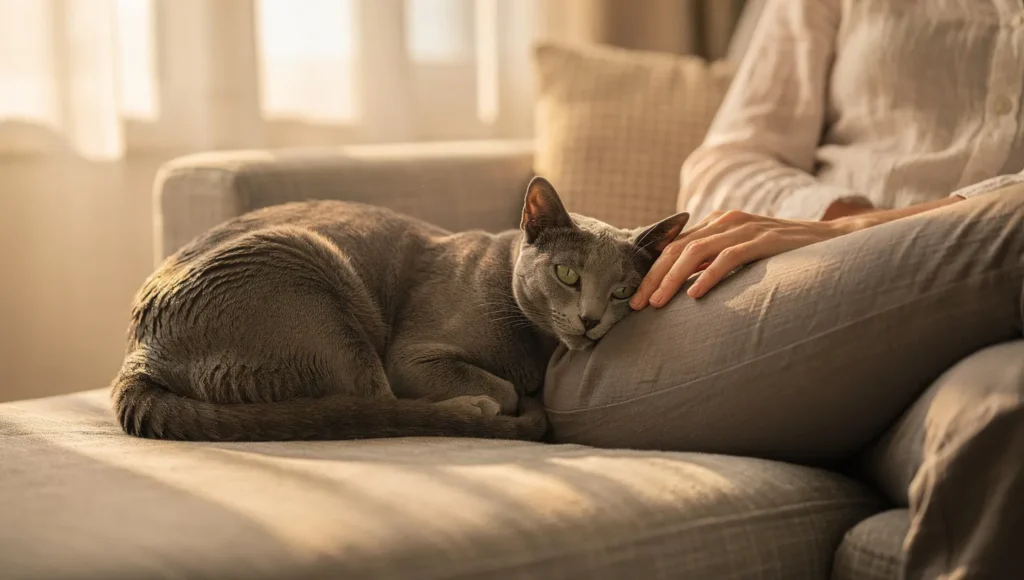
- Slow-Burn Affection: It might take 3-6 months before your Russian Blue fully trusts you. But once they do? You’ll have a shadow who follows you from room to room, sleeps on your pillow, and makes soft chirping sounds when you come home. That’s when you realize the wait was worth it.
💡 Personal Insight: In our experience at Felina Care Hub, we’ve found that Russian Blues thrive with owners who don’t force interaction. The fastest way to earn their trust? Ignore them. Seriously. Let them approach you on their timeline, and you’ll build a bond that feels almost telepathic. Understanding their subtle body language cues—like slow blinks and tail twitches—makes all the difference in reading their comfort levels.

Intelligence & Trainability (Yes, They Can Play Fetch!)
Here’s what separates Russian Blues from your average house cat: They’re problem-solvers. Not in the “knock everything off the counter to see what happens” way (that’s your orange tabby), but in the “I’ve watched you open this door 47 times and now I’ve figured out the handle” way.
I’ve seen Russian Blues:
- Learn to open cabinets within a week of moving into a new home
- Master puzzle feeders that stump other breeds for months
- Play fetch with small toys (yes, like a dog)—bringing the toy back 8-10 times before losing interest
- Recognize their names and respond to basic commands like “come” or “down”
Why This Matters for Enrichment: A bored Russian Blue is a destructive Russian Blue. Their intelligence demands mental stimulation, which means you can’t just toss them a feather wand and call it a day. They need:
- Puzzle feeders to slow down eating and engage their brains
- Rotate toys weekly so nothing becomes “boring”
- Interactive play sessions (15-20 minutes, twice daily) that mimic hunting—think laser pointers, feather wands, and toys they can “capture”
We’ve compiled a full guide to interactive toys that specifically challenge high-intelligence breeds like Russian Blues. If you skip enrichment, don’t be shocked when they start “redecorating” your home at 3 a.m.
Living With a Russian Blue: Routine-Obsessed & Noise-Sensitive
If you’re the type of person who feeds your cat “whenever you remember,” a Russian Blue will train you within two weeks. These cats are creatures of ritual, and disrupting their routine is like canceling a meeting without notice—they’ll hold a grudge.
The Daily Routine Checklist (According to Your Russian Blue):
- Feeding: Same time every day. Change it by 30 minutes, and they’ll stare at you with the intensity of a disappointed parent.
- Playtime: Preferably before meals (mimics the hunt-eat-groom-sleep cycle).
- Quiet Hours: They hate loud noises—vacuum cleaners, shouting, door slamming. If your household sounds like a rock concert, expect a stressed, hiding cat.
- Sleep Schedule: They’ll sync their sleep to yours. If you’re a night owl, they’ll adjust. If you wake at 6 a.m., so will they (and they’ll remind you it’s breakfast time).
🚨 Warning Box: Loud households or frequent guests can stress Russian Blues to the point of behavioral issues—litter box avoidance, excessive grooming (leading to bald spots), or aggression. They thrive in calm, predictable environments. If you’re throwing parties every weekend or have toddlers who treat cats like stuffed animals, this isn’t the right breed for your lifestyle.
The “Velcro Cat” Myth (It’s Loyalty, Not Clinginess)
People call Russian Blues “Velcro cats” because they follow their chosen person everywhere—bathroom, kitchen, home office, you name it. But let’s be clear: This isn’t neediness. This is loyalty.
They’re not going to paw at your laptop demanding attention (that’s your Siamese). They’re not going to yowl for pets every five minutes (that’s your Maine Coon). Russian Blues will simply be near you—sitting on the corner of your desk while you work, curled up on the armrest while you watch TV, sleeping at the foot of your bed while you scroll your phone.
What They Want From You:
- Parallel companionship: Your presence is enough. They don’t need constant interaction.
- Predictable routines: So they know when to expect affection, food, and play.
- Respect for boundaries: When they retreat to their “safe space,” leave them alone. Forcing attention breaks trust.
The Upside: You’ll never feel lonely with a Russian Blue. They’re the quiet, steady presence that makes coming home feel like reuniting with a best friend who doesn’t ask you to explain your day—they just sit with you through it.
Socialization Tips (If You Adopt a Kitten)
If you’re bringing home a Russian Blue kitten, you have a narrow window (8-16 weeks) to shape their adult temperament. Miss this critical period, and you might end up with a cat who hides under the bed anytime the doorbell rings.
The Socialization Blueprint:
- Gentle Handling (Daily): Touch their paws, ears, and tail gently every day. This preps them for nail trims and vet exams later.
- Controlled Introductions: Invite calm friends over (not loud children) and let the kitten approach on their terms. Reward with treats.
- Sound Desensitization: Play recordings of doorbells, vacuums, and traffic at low volume while they eat. Gradually increase volume over weeks.
- Safe Spaces: Always provide a high perch or hiding spot where they can retreat without being cornered.
If you’re adopting an adult Russian Blue, understand that their personality is mostly set. You can earn their trust, but you probably won’t turn a shy adult into a social butterfly. And honestly? That’s part of their charm.
💬 Reality Check: If you’re introducing a Russian Blue to other cats, expect a slow process. They’re not naturally social with other animals, so follow a proper cat introduction protocol—separate rooms, scent swapping, supervised meetings over 2-4 weeks. Rush it, and you’ll create lifelong tension.

🤧 Are Russian Blue Cats Hypoallergenic? (The Science Behind the Myth)
Let’s cut through the marketing noise: No cat is 100% hypoallergenic. Not Russian Blues, not Siberians, not even those $5,000 hairless Sphynx cats that look like warm potatoes. If someone promises you a cat that won’t trigger allergies, they’re either lying or scientifically illiterate.
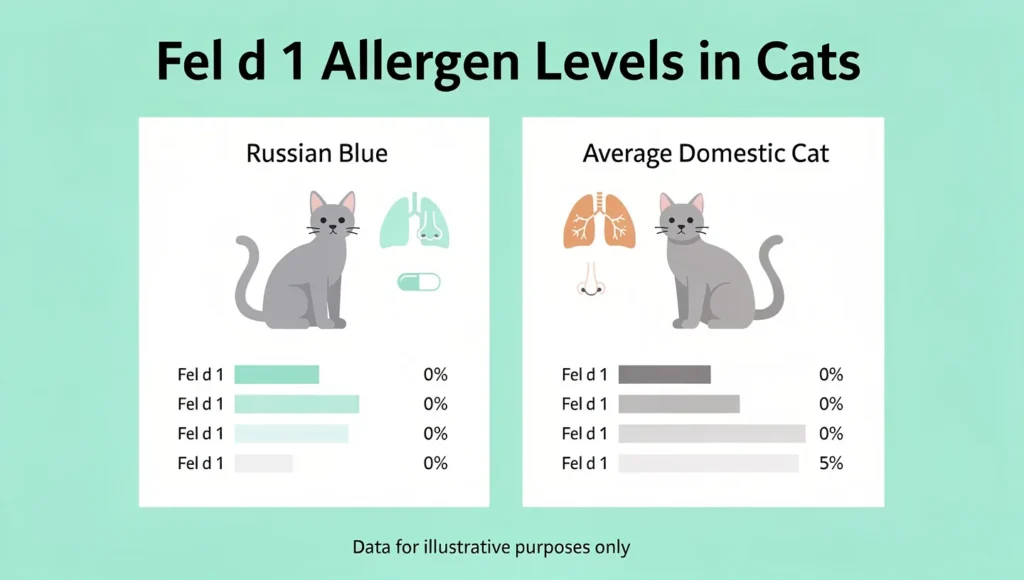
But here’s the nuance that actually matters: Russian Blues do produce lower levels of the primary allergen (Fel d 1 protein) compared to most other breeds. Does that make them safe for allergy sufferers? Sometimes. Does it guarantee you won’t sneeze? Absolutely not.
After a decade of working with allergy-prone cat owners at Felina Care Hub, I’ve seen people with severe reactions adopt Russian Blues with zero issues—and I’ve also seen mild allergy sufferers end up back at the shelter within two weeks. The difference? Understanding the science, managing expectations, and implementing the right environmental controls.
Let me show you what the research actually says (and what the Instagram ads won’t tell you).
🧬 The Fel d 1 Protein Explanation
Cat allergies aren’t caused by fur—they’re caused by Fel d 1, a protein produced in a cat’s saliva, skin glands, and urine. When cats groom themselves, they spread this protein onto their fur. When the fur sheds or the saliva dries, microscopic particles become airborne. You breathe them in. Your immune system overreacts. Cue the sneezing, itchy eyes, and regret.
Why Russian Blues Are “Better” (But Not Perfect):
Studies published by the National Center for Biotechnology Information (NCBI) show that Russian Blues produce significantly lower levels of Fel d 1 compared to high-shedding breeds like Persians or Maine Coons. Researchers aren’t entirely sure why—it might be genetic, it might be tied to their coat structure, or it could be hormonal differences.
What we do know:
- Male cats produce more Fel d 1 than females (neutering reduces it by 50-75%)
- Intact cats produce more than spayed/neutered cats
- Stress increases Fel d 1 production (which is why some allergy sufferers react more during the first few weeks of adoption)
📊 Quick Comparison Table:
| Breed | Fel d 1 Production Level | Allergy Risk |
|---|---|---|
| Russian Blue | Low to Moderate | Lower risk (but not zero) |
| Siberian | Low (some bloodlines) | Lower risk (varies by breeder) |
| Sphynx (Hairless) | Moderate to High | Higher risk (no fur to trap protein, so it spreads more) |
| Persian | High | Higher risk (long fur, heavy shedding) |
| Domestic Shorthair | Moderate to High | Varies widely (most fall in the moderate range) |
💡 The Myth Buster: Hairless cats like Sphynx are often marketed as hypoallergenic because they don’t shed fur. But they still produce Fel d 1—and without fur to trap it, the protein spreads directly onto surfaces via their oily skin. Many allergy sufferers actually react worse to hairless breeds. Russian Blues, by contrast, have dense fur that traps some of the protein before it becomes airborne.

🧪 The “Trial Period” Protocol (Before You Commit)
If you have cat allergies and you’re considering a Russian Blue, do NOT skip this step. I’ve seen too many heartbroken families surrender cats after two weeks because they didn’t test compatibility first.
The 2-Hour Rule:
Before adopting, spend at least 2 hours in a room with the specific cat you’re considering. Not just any Russian Blue—the actual cat you plan to bring home. Fel d 1 levels vary from cat to cat, even within the same breed.
What to Do During the Trial:
- Pet the cat extensively (face, neck, back—areas they groom most)
- Let them sit on your lap for 15-20 minutes
- Touch your face after handling them (controversial, but this is the real test)
- Wait 1-2 hours before deciding—some allergic reactions are delayed
If you make it through without symptoms (sneezing, watery eyes, itchy throat), that’s a green light. If you react mildly but can tolerate it, there are management strategies. If you have a severe reaction (difficulty breathing, hives), walk away—no cat is worth an asthma attack.
🔗 Breeder Tip: Ethical breeders will always allow trial visits. If a breeder pressures you to pay a deposit before meeting the cat, that’s a red flag. They’re either running a scam or they know their cats aren’t as “hypoallergenic” as advertised.
🏠 Environmental Controls (For Mild Allergy Sufferers)
If you passed the trial period but still experience minor symptoms, these strategies can reduce allergen exposure by 60-80%. I’ve used this exact protocol with dozens of clients who successfully kept their Russian Blues despite mild allergies.
The 5-Step Allergy Management Plan:
1. HEPA Air Purifiers (Non-Negotiable)
- Place one in your bedroom and one in the main living area
- Run them 24/7, not just when you’re home
- Replace filters every 3-6 months (cheaper filters don’t capture Fel d 1 particles)
2. Weekly Grooming Routine
- Brush your Russian Blue outside or in a bathroom with the door closed (to contain dander)
- Use a damp cloth to wipe down their fur after brushing—this removes loose saliva and dander before it becomes airborne
- Full grooming guide: proper brushing techniques for double coats
3. Bedroom = Cat-Free Zone
- Your bed should be the only place in your home where allergens don’t accumulate
- Keep the door closed, always. No exceptions for “just five minutes”
- Wash bedding weekly in hot water (130°F / 54°C minimum to kill allergens)
4. Hard Floors > Carpet
- Carpet traps Fel d 1 for months, even with vacuuming
- If you can’t remove carpet, vacuum with a HEPA-filter vacuum 2-3 times per week
- Steam clean carpets every 3 months
5. Reduce Stress = Reduce Fel d 1
- Remember: stress increases allergen production
- Keep routines consistent, provide vertical spaces, and avoid loud environments
- A calm Russian Blue produces measurably less Fel d 1 than an anxious one
💬 Real Talk: If you’re doing all of this and still sneezing constantly, the cat isn’t the problem—your immune system is. At that point, you’re choosing between allergy medication (antihistamines like Zyrtec or Claritin) or rehoming. There’s no shame in admitting a cat isn’t compatible with your health. But if you can manage symptoms with these controls, a Russian Blue is one of your best-bet breeds.
For a deeper dive into dander management, check our comprehensive guide on reducing cat allergens in your home.
❌ What Doesn’t Work (Save Your Money)
I’ve seen allergy sufferers waste hundreds of dollars on products that promise miracles but deliver nothing. Here’s what to skip:
Allergy-Reducing Cat Food: Some brands claim their food reduces Fel d 1 in saliva. Early studies show a 20-30% reduction in some cats—but that’s not enough to matter if you’re highly allergic. Save your money for air purifiers.
“Allergy-Free” Cat Wipes: Unless you’re wiping your cat down daily (which will stress them out and increase Fel d 1), these are pointless. A damp cloth does the same job for free.
Frequent Bathing: Bathing reduces allergens temporarily (for 2-3 days), but it’s stressful for cats and disrupts their coat’s natural oils. Russian Blues don’t need baths unless they get into something messy. Our guide on stress-free cat bathing covers when it’s actually necessary.
🎯 The Bottom Line (Should You Risk It?)
If you have mild to moderate allergies and you’re willing to commit to HEPA purifiers, weekly grooming, and a cat-free bedroom, a Russian Blue is one of the safest breeds to try. Their lower Fel d 1 production combined with environmental controls gives you a fighting chance.
If you have severe allergies or asthma triggered by cats, don’t gamble. No amount of air purifiers will save you from a full-blown reaction. Consider fostering a Russian Blue first—most rescues allow trial periods where you can test compatibility before committing.
And if you’re adopting a Russian Blue because they’re “hypoallergenic” but you don’t actually have allergies? Ignore this entire section and just enjoy your cat. The “hypoallergenic” label is overrated for people without sensitivities.

💎 Russian Blue Cat Price & Cost Breakdown (2026 Reality Check)
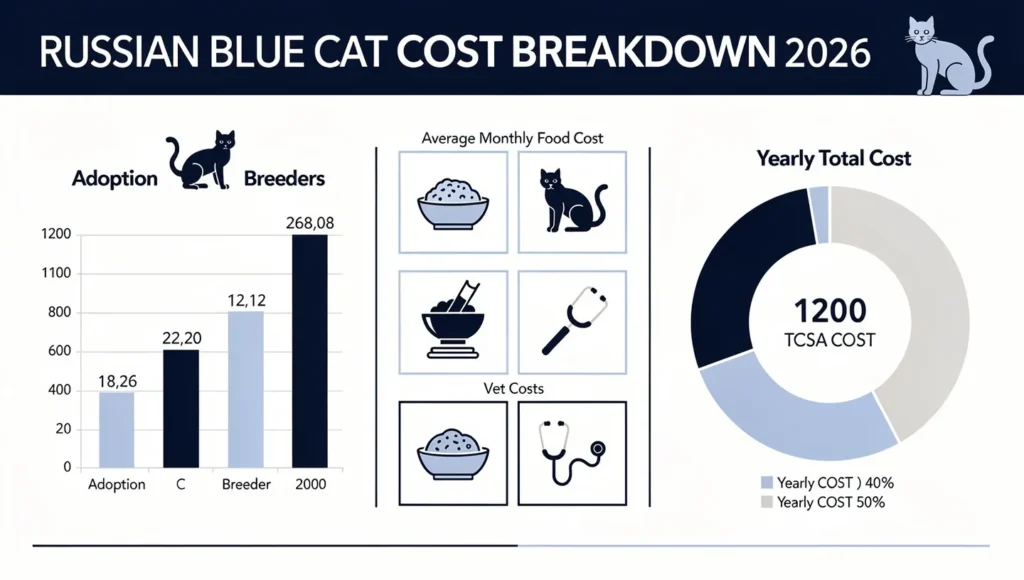
Let’s talk about the number that makes most people’s eyes water: $1,000 to $2,000 for a purebred Russian Blue kitten from a reputable breeder. And that’s just the upfront cost. By the time you factor in first-year vet bills, supplies, and food, you’re looking at an additional $1,200-$1,800.
But here’s what the breeder websites won’t tell you: You don’t need to spend $2,000 to get a healthy, loving Russian Blue. I’ve seen shelter cats with impeccable bloodlines surrendered because their owners didn’t understand the breed’s personality. I’ve also seen $3,000 “show-quality” kittens with genetic health issues because the breeder prioritized profit over responsible breeding.
The real question isn’t “How much does a Russian Blue cost?” It’s “How much should you actually spend, and where does that money go?”
Let me break down the math—and show you where people waste money versus where they should invest more.
💰 Adoption vs. Breeder: The True Investment
The price gap between shelter adoption and buying from a breeder is massive—but so are the trade-offs. Here’s the honest comparison based on what I’ve seen over the past decade working with Russian Blue owners.
| Source | Upfront Cost | What You Get | Pros | Cons |
|---|---|---|---|---|
| Shelter/Rescue Adoption | $75-$150 | Adult cat (usually 1-5 years old), spayed/neutered, vaccinated, sometimes microchipped | ✅ Save a life ✅ Lower cost ✅ Already personality-tested ✅ Skip the destructive kitten phase | ❌ May be mixed breed (not guaranteed purebred) ❌ Unknown health history ❌ Limited availability (Russian Blues are rare in shelters) |
| Reputable Breeder | $1,000-$2,000 | Kitten (8-12 weeks old), health guarantee, pedigree papers, initial vaccinations, often microchipped | ✅ Verified bloodline ✅ Health testing for genetic conditions (PRA, PKD) ✅ Breeder support for life ✅ Choose your kitten’s personality | ❌ Expensive upfront ❌ Wait lists (3-12 months) ❌ Kitten chaos (zoomies, training, teething) |
| “Backyard” Breeder | $300-$700 | Kitten with questionable lineage, may lack vaccinations or health records | ⚠️ Lower price | ❌ NOT RECOMMENDED ❌ No health guarantees ❌ Higher risk of genetic diseases ❌ Supports unethical breeding practices ❌ Often mixed breeds sold as purebreds |
🚨 Warning Box: If someone is selling “Russian Blue kittens” for under $500 with no health records, pedigree papers, or references from past buyers, you’re not getting a deal—you’re funding a kitten mill. These operations prioritize volume over animal welfare, and you’ll pay the difference in vet bills within the first year.
💡 The Shelter Wildcard: Russian Blues in shelters are rare, but they exist—usually because:
- The owner moved and couldn’t bring the cat
- The owner underestimated the breed’s need for routine and quiet
- The owner had allergies (even with “hypoallergenic” breeds)
- The cat was inherited and the new owner couldn’t keep them
If you find a Russian Blue in a shelter, jump on it. You’ll get a calmer, already-socialized adult cat for 90% less than a kitten. Just verify the breed using our Grey Guardian Checklist before committing.

📊 First-Year Costs: What They Don’t Warn You About
The purchase price is just the beginning. Here’s the financial breakdown for Year 1 with a Russian Blue—based on real invoices from Felina Care Hub clients (I’ve rounded to the nearest $25 for simplicity).
| Expense Category | Cost Range (Year 1) | Why It Matters |
|---|---|---|
| Initial Vet Visit | $150-$300 | Wellness exam, blood work, fecal test, deworming |
| Spay/Neuter (if not done) | $200-$500 | Required for health and behavior; reduces Fel d 1 by 50-75% |
| Vaccinations | $100-$200 | Core vaccines (FVRCP, rabies); boosters at 16 weeks |
| Microchip | $45-$75 | One-time fee; increases recovery chances if lost |
| Food (Premium Quality) | $400-$600 | High-protein, grain-free diet ($30-$50/month) |
| Litter & Supplies | $150-$250 | Litter ($15-$20/month), litter box, scoop, mats |
| Cat Tree/Vertical Space | $100-$300 | Non-negotiable for mental health; see our cat tree guide |
| Interactive Toys | $50-$100 | Puzzle feeders, feather wands, laser pointers; rotate monthly |
| Grooming Supplies | $30-$75 | Brushes, nail clippers, dental care; see nail trimming guide |
| Carrier | $40-$80 | Hard-sided for vet visits; budget for quality |
| Pet Insurance (Optional) | $180-$360 | $15-$30/month; worth it if you can’t afford emergency vet bills |
| Emergency Fund | $500+ | Unplanned illness, injury, or dental work |
| TOTAL (Year 1) | $1,945-$3,340 | Average: $2,640 (excluding the cat’s purchase price) |
💬 Reality Check: Most people budget $300-$500 for the first year and then panic when their kitten needs emergency dental surgery at 6 months ($800-$1,200). If you can’t comfortably afford $2,500-$3,000 in Year 1, wait until you’re financially stable. Russian Blues live 15-20 years—you’re committing to $15,000-$25,000 over their lifetime.
💵 Annual Maintenance Costs (Years 2+)
After the first year, costs stabilize—but they don’t disappear. Here’s what to budget annually once your Russian Blue is an adult:
| Expense | Annual Cost | Notes |
|---|---|---|
| Food | $400-$600 | Premium grain-free wet/dry mix; see complete diet guide |
| Litter | $150-$250 | $13-$20/month for clumping, low-dust litter |
| Vet Checkups | $200-$400 | Annual wellness exam, vaccines, blood work (seniors) |
| Flea/Tick Prevention | $120-$180 | $10-$15/month (even for indoor cats) |
| Dental Cleaning | $300-$600 | Every 2-3 years; see dental care guide |
| Toys/Enrichment | $50-$100 | Replace worn toys, add new puzzles |
| Pet Insurance | $180-$360 | Optional but recommended for peace of mind |
| Emergency Fund Contribution | $200-$500 | Build to $1,000-$2,000 over time |
| TOTAL (Annual) | $1,600-$2,990 | Average: $2,200/year |
📉 Cost-Saving Tip: Buy food and litter in bulk during sales. I’ve saved clients $200-$300/year just by switching from monthly pet store trips to quarterly online orders with auto-ship discounts. But never compromise on food quality—cheap food leads to expensive vet bills (obesity, diabetes, urinary issues).
🏥 Hidden Costs: The “Fine Print” Expenses
These are the costs that blindside new Russian Blue owners because breeders and adoption sites don’t mention them:
1. Breed-Specific Health Issues
- Progressive Retinal Atrophy (PRA) genetic testing: $150-$300 (one-time)
- Bladder stone treatment: $800-$2,500 (if it occurs)
- Dental disease treatment: $500-$1,500 (common in cats over 7 years)
2. Behavioral Problems (If You Don’t Socialize Properly)
- Veterinary behaviorist consultation: $200-$400/session
- Anti-anxiety medication: $30-$60/month
- Environmental enrichment upgrades: $200-$500 (cat trees, hiding spots, pheromone diffusers)
3. Travel & Boarding
- Pet sitter: $20-$50/day
- Boarding facility: $25-$60/day
- Airline pet fee: $100-$200 per flight; see our travel guide
4. End-of-Life Care (The Conversation No One Wants)
- Senior cat care (ages 15-20): Expect costs to double due to chronic conditions (kidney disease, hyperthyroidism)
- Euthanasia & cremation: $200-$600 (when the time comes)
💡 The Bottom Line: If spending $2,200/year feels “too expensive,” that’s a sign to reconsider cat ownership—not just Russian Blues, but any cat. These aren’t luxury costs; they’re baseline care for a healthy animal.
🎯 Where to Splurge vs. Where to Save
After watching hundreds of Russian Blue owners manage costs, I’ve identified where money is well-spent and where it’s wasted.
✅ Worth the Investment:
- Premium, high-protein food ($50-$70/month): Prevents obesity, diabetes, and urinary issues
- HEPA air purifier ($150-$300): Essential for allergy management and air quality
- Tall, sturdy cat tree ($150-$300): Mental stimulation + exercise; see our top picks
- Annual vet exams ($150-$250): Catch problems early when they’re cheap to fix
- Pet insurance ($180-$360/year): Pays for itself if your cat needs surgery
❌ Where to Save:
- Designer carriers/beds: A $30 carrier works as well as a $150 one
- Automatic feeders: Russian Blues do better with routine feeding by their human
- Fancy litter boxes: A $15 basic box works; save “smart” boxes for multiple-cat households
- Cat clothes/costumes: Russian Blues hate them; you’re wasting money and stressing your cat
💳 Financing Options (If You’re Tight on Cash)
If you can’t afford $2,000 upfront for a kitten but you’re financially stable otherwise, here are ethical ways to manage costs:
1. CareCredit or Pet Payment Plans
- Many vets accept CareCredit (0% interest for 6-12 months)
- Use it for spay/neuter, initial exams, vaccinations—not the cat itself
2. Pet Insurance with Low Deductibles
- Plans start at $15/month for kittens
- Cover accidents, illnesses, and some hereditary conditions
- Not a substitute for an emergency fund, but a safety net
3. Adopt an Adult Russian Blue
- Many shelters waive adoption fees for cats over 7 years old
- You skip the expensive kitten phase (training, spay/neuter, vaccines)
- Senior cats are calmer and often already litter-trained
🚨 What NOT to Do:
- Don’t put the cat’s purchase price on a high-interest credit card
- Don’t skip vet care to “save money”—you’ll pay 10x more later
- Don’t buy from “cheap” breeders to save $500—you’ll lose it in health issues
🏆 Final Verdict: Is It Worth the Price?
A Russian Blue is a premium investment, not an impulse purchase. You’re paying for:
- 15-20 years of companionship
- Lower Fel d 1 production (better for allergy sufferers)
- Predictable temperament (calm, loyal, intelligent)
- Fewer genetic health issues than many purebreds (if from a reputable breeder)
If you’re comparing prices between breeds, remember: A $2,000 Russian Blue from a health-tested bloodline will cost less over its lifetime than a $500 “bargain” cat with chronic health problems.
But if the price tag makes you hesitate, consider a shelter cat—purebred or not. Some of the best Russian Blues I’ve ever met were mixed breeds who landed in rescues through no fault of their own. Their owners got the personality and loyalty of the breed for a fraction of the cost.
💬 My Advice After 10+ Years: Don’t choose a cat based on price alone. Choose based on whether you can commit to 15-20 years of consistent care, regardless of cost. If you can do that, a Russian Blue is one of the most rewarding breeds you’ll ever own.
🏥 Health & Longevity: What Every Russian Blue Owner Must Know
Here’s the good news: Russian Blues are one of the healthiest cat breeds you can own. With proper care, they routinely live 15-20 years—and I’ve personally met Russian Blues who made it to 22 and 23 years old, still chasing laser pointers and demanding breakfast at 6 a.m.
The bad news? They’re not invincible. Like all purebreds, Russian Blues carry genetic predispositions to certain health conditions—some manageable, some expensive, and a few that can be heartbreaking if you don’t catch them early.
After a decade of working with Russian Blue owners at Felina Care Hub, I’ve noticed a pattern: The cats who live the longest aren’t necessarily from the “best” bloodlines. They’re the ones whose owners stayed vigilant, recognized warning signs early, and didn’t skip annual vet exams to save $150.
This section covers the three most common health issues in Russian Blues, the early warning signs you can’t afford to ignore, and the preventive care protocol that’s kept our community’s cats thriving well into their senior years.
🧬 Common Health Issues: The Vet-Approved Watchlist
Russian Blues are generally robust, but these three conditions appear more frequently in this breed than in mixed-breed cats. If you know what to look for, you can catch problems before they become emergencies.
1. Progressive Retinal Atrophy (PRA): The Silent Vision Thief
What It Is:
Progressive Retinal Atrophy is a genetic eye disease that causes gradual vision loss, eventually leading to total blindness. It’s caused by a recessive gene, which means a cat needs to inherit the faulty gene from both parents to develop the disease.
Early Warning Signs:
- Night blindness (bumping into furniture in dim lighting around 6-12 months of age)
- Dilated pupils that don’t constrict normally in bright light
- Hesitation before jumping (they can’t judge distances accurately)
- Clumsiness in familiar environments (missing the litter box, knocking over water bowls)
What to Do:
If you notice any of these signs, schedule a vet visit immediately. An ophthalmologist can diagnose PRA with an electroretinogram (ERG) test. Unfortunately, there’s no cure—but cats adapt remarkably well to blindness if their environment stays consistent.
Prevention:
Reputable breeders test breeding cats for the PRA gene before mating. If you’re buying from a breeder, demand proof of genetic testing for both parents. If they can’t provide it, walk away. The Veterinary Centers of America (VCA) recommend this as a standard screening for all Russian Blue bloodlines.
💡 Cost Reality: PRA genetic testing costs $150-$300 per cat. If a breeder charges $2,000 for a kitten but hasn’t done this $200 test, they’re cutting corners—and you’ll pay the emotional (and financial) price later.
2. Bladder Stones (Urolithiasis): The Dehydration Disaster
What It Is:
Bladder stones (uroliths) are mineral crystals that form in the urinary tract, causing painful urination, bloody urine, and in severe cases, life-threatening blockages. Russian Blues are prone to calcium oxalate stones—the type that can’t be dissolved with diet alone and often require surgery.
Early Warning Signs:
- Straining in the litter box (crouching for long periods with little to no urine output)
- Blood in urine (pink or red-tinged)
- Frequent trips to the litter box (urinating small amounts multiple times per hour)
- Crying or howling while urinating (sign of pain)
- Urinating outside the litter box (especially on cool surfaces like tile or bathtubs—they seek relief from the burning sensation)
What to Do:
Bladder stones are a medical emergency. If your cat is straining and producing no urine, they could have a complete blockage—this is fatal within 24-48 hours if untreated. Get to an emergency vet immediately.
Prevention:
The best defense is hydration. Russian Blues, like most cats, have a low thirst drive and don’t drink enough water on their own. Here’s the protocol we recommend:
🚰 The Hydration Protocol:
- Wet food > Dry food: Feed at least 50% wet food (ideally 80-100%). Wet food contains 70-80% moisture; dry food contains only 10%.
- Water fountains: Cats prefer moving water. A $25 fountain can increase water intake by 30-50%.
- Multiple water stations: Place water bowls in different rooms—cats drink more when water is readily accessible.
- Ice cubes in water: Some Russian Blues love playing with ice, which increases water consumption.
For a detailed breakdown of hydration strategies, see our guide on senior cat hydration and specialized diets (the advice applies to all ages, not just seniors).
💬 Real Story: I’ve seen a client spend $3,500 on bladder stone surgery that could’ve been prevented with a $30/month wet food upgrade. Don’t let your cat become a statistic.
3. Obesity: The Indoor Cat Epidemic
What It Is:
Obesity isn’t a “disease” in the traditional sense, but it’s the #1 preventable health crisis in indoor Russian Blues. Studies show that 40% of indoor cats are overweight or obese—and Russian Blues are particularly vulnerable because their calm, low-energy temperament makes owners think they need less food when they actually need portion control.
How It Happens:
- Free-feeding dry food (the #1 culprit)
- Overestimating activity levels (“She runs around for 5 minutes a day, so she’s active!”)
- Treating with human food (cheese, deli meat, etc.)
- Underestimating calorie needs (a 10-pound cat needs ~200 calories/day—one cup of dry food is 300-400 calories)
Health Consequences:
- Diabetes: Obese cats are 3-5x more likely to develop diabetes
- Arthritis: Extra weight destroys joints, leading to chronic pain
- Hepatic Lipidosis: If an obese cat stops eating for 2-3 days, their liver can fail (often fatal)
- Reduced lifespan: Obese cats live 2-3 years less than healthy-weight cats
Prevention:
Measure food. Seriously. Buy a $10 digital kitchen scale and weigh portions. The feeding guidelines on cat food bags are estimates—often inflated because manufacturers profit when you feed more.
✅ Ideal Body Condition:
- Ribs: You should feel them easily under a thin layer of fat (like running your fingers over the back of your hand)
- Waist: Visible when looking from above (hourglass shape)
- Belly tuck: Slight upward slope from chest to hips when viewing from the side
If your Russian Blue looks like a furry sausage with legs, check our science-backed weight loss guide for a step-by-step protocol.

⏱️ Lifespan Expectations: The 15-20 Year Reality
Russian Blues are long-lived cats—but “15-20 years” isn’t automatic. It’s the result of consistent preventive care, not genetic luck.
Factors That Extend Lifespan:
| Factor | Impact | How to Implement |
|---|---|---|
| High-Quality Diet | +2-3 years | Feed high-protein (40%+), grain-free, wet food majority; see complete diet guide |
| Weight Management | +2-3 years | Monitor body condition monthly; adjust portions proactively |
| Annual Vet Exams | +1-2 years | Catch diseases early (kidney disease, hyperthyroidism, dental disease) |
| Dental Care | +1-2 years | Brush teeth 2-3x/week or provide dental treats; see dental care guide |
| Stress Reduction | +1-2 years | Maintain routines, provide vertical spaces, avoid loud environments |
| Indoor-Only Lifestyle | +5-7 years | Eliminates risks of cars, predators, diseases, fights |
💡 Expert Insight: The oldest Russian Blue in our Felina Care Hub community lived to 23 years and 4 months. Her owner’s secret? She fed a strict wet food diet, brushed the cat’s teeth every other day, and never skipped annual blood work—even when the cat “seemed fine.” Early detection of chronic kidney disease at age 18 gave her vet 5 extra years to manage the condition.
🚨 Warning Signs of Aging (After Age 12):
Even healthy Russian Blues slow down as they age. Watch for these changes that warrant a vet visit:
- Weight loss (even if appetite is normal—sign of hyperthyroidism or kidney disease)
- Increased thirst/urination (diabetes or kidney disease)
- Bad breath (dental disease or kidney failure)
- Vomiting (more than once a month—sign of IBD or pancreatitis)
- Lethargy (sleeping 20+ hours/day or refusing to jump)
For senior-specific care, our senior cat guide covers hydration, diet adjustments, and managing chronic conditions.
🩺 The Annual Vet Exam: Why You Can’t Skip It
I’ll be blunt: Skipping annual vet exams to save $150-$250 is the dumbest financial decision you can make as a cat owner. By the time cats look sick, the disease is already advanced—and treatment costs 10-20x more than it would’ve if caught early.
What Your Vet Checks (That You Can’t See at Home):
- Blood work: Detects kidney disease, liver disease, diabetes, hyperthyroidism
- Urinalysis: Catches bladder stones, infections, early kidney failure
- Dental exam: Identifies broken teeth, gum disease, oral tumors
- Heart auscultation: Detects heart murmurs (common in older cats)
- Body condition scoring: Professional assessment of weight/muscle mass
📊 Cost vs. Benefit:
- Annual exam: $150-$250
- Treating advanced kidney disease: $2,000-$5,000+
- Emergency surgery for bladder blockage: $2,500-$4,000
- Managing undiagnosed diabetes: $100-$200/month for life
Do the math. Prevention is always cheaper than treatment.
💊 Vaccinations & Preventive Care Schedule
Even indoor Russian Blues need vaccinations and preventive care. Here’s the protocol we recommend:
Kitten Schedule (8-16 Weeks):
- FVRCP (Core Vaccine): Protects against feline viral rhinotracheitis, calicivirus, panleukopenia—given at 8, 12, and 16 weeks
- Rabies (Core Vaccine): Given at 12-16 weeks (required by law in most states)
- FeLV (Optional): Only if the cat will go outdoors or live with FeLV-positive cats
Adult Schedule (1-7 Years):
- FVRCP booster: Every 1-3 years (depends on vaccine type)
- Rabies booster: Every 1-3 years (check state laws)
- Annual wellness exam: Blood work, urinalysis, physical exam
Senior Schedule (8+ Years):
- Bi-annual exams: Every 6 months (diseases progress faster in seniors)
- Annual blood work: Comprehensive panel to catch kidney/thyroid issues
- Dental cleanings: Every 2-3 years (under anesthesia)
🔗 Additional Resources:
For guidance on recognizing early signs of illness, see our 10 critical signs every owner must know.
🎯 Final Health Advice: You’re Their Advocate
Your Russian Blue can’t tell you when something hurts. They’re hardwired to hide pain and illness—it’s a survival instinct from their wild ancestors. By the time they’re visibly sick, they’ve been suffering for weeks or months.
That’s why preventive care isn’t optional—it’s the contract you signed when you brought them home. If you can’t commit to annual vet exams, proper nutrition, and monitoring for warning signs, please reconsider cat ownership.
But if you can do those things? Your Russian Blue will reward you with 15-20 years of quiet companionship, head bonks at 6 a.m., and the kind of loyalty that makes you understand why ancient Egyptians worshipped cats.
🛁 Caring for Your Russian Blue: The Weekly Routine
If you’ve read this far hoping for confirmation that Russian Blues are “low-maintenance,” I have good news and bad news. The good news: They don’t need daily baths, professional grooming appointments, or constant entertainment like some high-energy breeds. The bad news: “Low-maintenance” doesn’t mean “zero-maintenance.”
Russian Blues have specific care needs that, when ignored, lead to matted coats, behavioral problems, and expensive vet bills. But when you nail the routine? You’ll have a cat with a glossy coat, healthy weight, and the kind of calm confidence that comes from knowing their needs are consistently met.
After working with hundreds of Russian Blue owners at Felina Care Hub, I’ve distilled care down to a weekly system that takes 30-45 minutes total. It’s not glamorous, but it works—and it’s the difference between a thriving cat and one who’s just “getting by.”
Let’s break down what your Russian Blue actually needs (not what Instagram influencers say they need).
🪮 Grooming Needs: Low-Maintenance Doesn’t Mean Zero-Maintenance
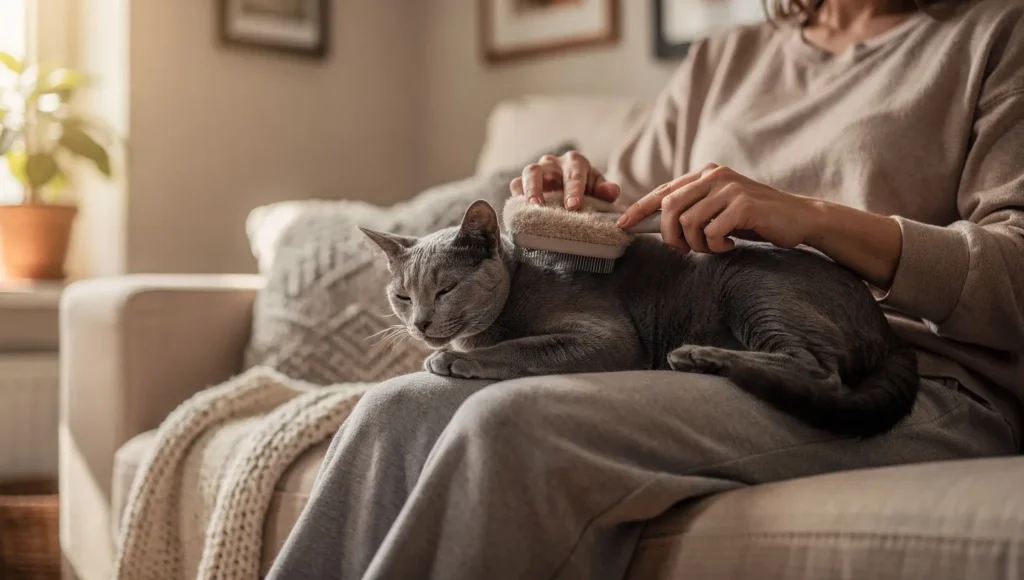
Here’s the myth that trips up new owners: “Russian Blues have short coats, so they don’t need brushing.” Wrong. They have a dense double coat that sheds year-round—and without weekly brushing, you’ll find fur tumbleweeds under every piece of furniture and hairballs on your carpet every other week.
The Weekly Grooming Protocol:
🔹 Brushing (1x per week, 10-15 minutes):
Russian Blues don’t mat like Persians, but their undercoat traps loose fur that needs to be manually removed. Here’s the technique I teach every new owner:
Step 1: Use a slicker brush or metal comb (not a rubber brush—those don’t penetrate the double coat)
Step 2: Brush with the grain first to remove surface-level loose fur
Step 3: Brush against the grain gently to lift the undercoat and remove trapped dead hair
Step 4: Finish by brushing with the grain again to smooth the coat and distribute natural oils
💡 Pro Tip: Brush your Russian Blue outside or in a closed bathroom. The amount of fur that comes off during a proper brushing session will shock you—and you don’t want it circulating through your home’s air ducts.
For a detailed walkthrough with photos, check our stress-free brushing guide that covers double-coat techniques.
Why This Matters:
Regular brushing reduces hairballs by 60-70%, which means fewer digestive issues and less vomiting. It also reduces dander in the air (critical for allergy sufferers) and keeps their coat’s silver shimmer intact. Neglected coats look dull and flat—properly brushed coats catch light like polished silver.

🔹 Nail Trimming (Every 2-3 weeks, 5 minutes):
Russian Blues are indoor cats, so their nails don’t wear down naturally like outdoor cats. If you skip nail trims, you’ll deal with:
- Painful ingrown nails (the nail curls and pierces the paw pad)
- Scratched furniture and torn upholstery
- Accidental scratches during play
The 3-Step Nail Trim:
- Wait for calm moments: Don’t wrestle a hyper cat. Wait until they’re sleepy or post-meal relaxed.
- Press the paw gently to extend the claws—you’ll see a pink “quick” (blood vessel) and a clear nail tip.
- Trim only the clear tip (2-3mm)—cutting into the pink quick causes bleeding and pain.
If your Russian Blue fights nail trims like it’s a UFC match, our stress-free nail trimming guide covers desensitization training and two-person techniques.
🚨 Emergency Tip: If you accidentally cut the quick and it bleeds, apply styptic powder or cornstarch to stop bleeding within 30 seconds. Don’t panic—it’s painful but not dangerous.
🔹 Ear Checks (Weekly visual inspection, deep clean every 4-6 weeks):
Russian Blues have upright ears that generally stay clean, but you should still check weekly for:
- Wax buildup (normal if it’s light brown and minimal)
- Dark, coffee-ground texture (sign of ear mites—needs vet treatment)
- Redness or swelling (sign of infection)
- Foul odor (yeast infection or bacterial infection)
How to Clean (When Needed):
Use a vet-approved ear cleaner (never rubbing alcohol or hydrogen peroxide—these damage ear tissue). Squirt a small amount into the ear canal, massage the base of the ear for 10 seconds, then let your cat shake their head. Wipe the outer ear with a cotton ball—never insert Q-tips into the ear canal.
For a full breakdown of when cleaning is necessary vs. harmful, see our guide on safe ear cleaning for cats.
🔹 Dental Care (3x per week minimum, daily if possible):
Here’s the care task most owners skip—and the one that costs the most to fix later. Dental disease affects 70% of cats over age 3, and Russian Blues are no exception.
The Toothbrushing Reality:
Yes, you’re supposed to brush your cat’s teeth. No, most people don’t. But if you care about preventing $800-$1,500 dental cleanings (under anesthesia) every 2-3 years, it’s worth the 2-minute effort.
How to Brush:
- Use a cat-specific toothbrush (or a finger brush for kittens) and enzymatic cat toothpaste (never human toothpaste—xylitol is toxic to cats)
- Start by letting them lick the toothpaste off your finger for 3-5 days (they need to accept the taste)
- Gradually introduce the brush, focusing on the outer surfaces of the teeth (the inner surfaces clean themselves via tongue action)
- Brush in small circles along the gum line—this is where plaque builds up
If your Russian Blue refuses toothbrushing, dental treats like Greenies or water additives can reduce plaque by 30-40%—not as effective as brushing, but better than nothing.
Full protocol in our dental care and bad breath guide.
🍽️ Dietary Requirements: Preventing the “Chunky Russian” Syndrome
Russian Blues have a reputation for being “easy keepers” when it comes to food—which is code for “they’ll eat anything and pack on pounds if you let them.” Their calm, low-energy lifestyle means they burn fewer calories than active breeds, so portion control is non-negotiable.
The Ideal Diet Formula:
| Component | Requirement | Why It Matters |
|---|---|---|
| Protein | Minimum 40% (higher is better) | Cats are obligate carnivores; protein maintains muscle mass |
| Fat | 15-20% | Energy source; supports coat health and brain function |
| Carbohydrates | Under 10% (grain-free preferred) | Cats can’t digest grains efficiently; excess carbs = weight gain |
| Moisture | 70-80% (wet food) or 10% (dry) | Prevents dehydration and bladder stones (see Health section) |
🔹 Wet Food vs. Dry Food (The Debate Ends Here):
After years of watching Russian Blue owners struggle with weight and urinary issues, my recommendation is clear: Feed at least 50% wet food, ideally 80-100%.
Why Wet Food Wins:
- Hydration: Wet food is 70-80% water; dry food is 10%. Russian Blues don’t drink enough water on their own.
- Portion control: A 3-ounce can of wet food is ~70 calories; a ¼ cup of dry food is ~100 calories. It’s easier to overfeed dry food.
- Satiety: Wet food fills the stomach better, reducing begging behavior.
- Lower carbs: Most wet foods are under 5% carbs; dry foods range from 15-40%.
When Dry Food Works:
If your Russian Blue maintains a healthy weight on dry food, drinks plenty of water, and has no urinary issues, it’s fine to continue. But measure portions and don’t free-feed. Obesity is the #1 preventable health crisis in this breed.
For a complete breakdown of reading labels, calculating portions, and choosing quality brands, see our ultimate diet guide.
🔹 Feeding Schedule (Consistency is Key):
Russian Blues are routine-obsessed, so feeding at the same times every day reduces anxiety and begging.
Recommended Schedule:
- 2 meals per day (morning and evening, 12 hours apart)
- No free-feeding (measured portions only)
- Remove uneaten food after 30 minutes (prevents spoilage and teaches them to eat when served)
💡 Portion Size Guide:
- Active adult (2-5 years): 200-250 calories/day (roughly 1.5-2 cans of wet food or ⅓ cup dry)
- Sedentary adult (5-10 years): 180-220 calories/day
- Senior (10+ years): 160-200 calories/day (metabolism slows with age)
Adjust based on body condition—if you can’t feel ribs easily, reduce portions by 10-15%.
🎮 Exercise & Enrichment: Mental Stimulation is Non-Negotiable
This is where most Russian Blue owners fail: They assume a calm cat doesn’t need much stimulation. Wrong. Boredom leads to destructive behavior—scratching furniture, knocking objects off counters, excessive meowing, and even litter box avoidance.
Russian Blues are intelligent problem-solvers who need mental challenges, not just physical exercise.
🔹 The Daily Play Protocol (15-20 minutes, 2x per day):
Morning Session (Before Work):
Use this to burn energy so they sleep while you’re gone.
- Feather wand or string toy: Mimic bird/prey movements (darting, hiding, pouncing)
- End with a “kill”: Let them catch the toy and hold it for 10-15 seconds (satisfies hunting instinct)
Evening Session (Before Dinner):
Mimics the natural hunt → eat → groom → sleep cycle.
- Laser pointer: Great for cardio, but always end by “catching” a physical toy (laser-only play causes frustration)
- Interactive toys: Toys they can stalk and capture
🚨 Common Mistake: Playing right before bed leads to 2 a.m. zoomies. Play before dinner, not before sleep.
For toy recommendations tailored to intelligent breeds, see our interactive toy guide.
🔹 Vertical Space (The Secret to a Happy Russian Blue):
Russian Blues are natural climbers who feel safest when they can observe from height. Without vertical space, they become anxious and withdrawn.
Minimum Requirements:
- Tall cat tree (5+ feet) with multiple perches; see our top-rated cat trees
- Window perches for bird-watching; check safe window perch options
- Shelves or cleared bookcase space so they can climb without jumping on counters
💡 Behavioral Insight: A Russian Blue who hides under the bed all day isn’t “shy”—they’re stressed because they don’t have a safe elevated space to observe from. Fix the environment, and you’ll fix the behavior.
🔹 Puzzle Feeders (Combat Boredom + Slow Eating):
Puzzle feeders are toys that make your cat “work” for their food—perfect for Russian Blues because it engages their problem-solving brain and slows down fast eaters.
Types That Work:
- Ball feeders: Cat rolls the ball, kibble falls out
- Treat mazes: Cat uses paws to extract food from compartments
- Slow-feed bowls: Ridges force them to eat slowly (reduces vomiting)
When to Use:
If your Russian Blue inhales food in 30 seconds and vomits 10 minutes later, a puzzle feeder extends mealtime to 10-15 minutes—giving their stomach time to register fullness.
📅 The Weekly Care Checklist (Print & Post on Your Fridge)
Here’s the system that keeps Russian Blues thriving without overwhelming their owners:
| Task | Frequency | Time Required |
|---|---|---|
| Brushing | 1x per week | 10-15 minutes |
| Nail trimming | Every 2-3 weeks | 5 minutes |
| Ear checks | Weekly visual | 2 minutes |
| Ear cleaning (if needed) | Every 4-6 weeks | 5 minutes |
| Tooth brushing | 3-7x per week | 2 minutes per session |
| Interactive play | 2x daily | 15-20 minutes per session |
| Litter box scooping | Daily | 3 minutes |
| Full litter change | Weekly | 10 minutes |
| Food/water refresh | Daily | 2 minutes |
Total Weekly Time Commitment: ~3 hours (includes daily tasks)
🎯 Final Care Advice: Consistency > Perfection
You don’t need to be perfect. You don’t need $500 worth of gear. You just need to be consistent.
A Russian Blue who gets brushed every Tuesday, plays for 15 minutes every morning, and eats measured portions at the same times every day will be healthier and happier than a cat whose owner does marathon grooming sessions once a month and free-feeds whenever they remember.
Set reminders on your phone. Create a routine. Stick to it. Your Russian Blue will notice—and they’ll reward you with that slow-blink trust that makes all the effort worthwhile.
🆚 Russian Blue vs. Other Gray Cats: The Ultimate Comparison
If you’re choosing between gray cat breeds, this table clarifies the key differences:
| Feature | Russian Blue | British Shorthair | Chartreux |
|---|---|---|---|
| Origin | Russia | England | France |
| Eye Color | Emerald green | Orange/copper | Gold/orange |
| Coat Texture | Silky double coat with silver tipping | Dense, plush “teddy bear” coat | Woolly, water-resistant |
| Body Type | Fine-boned, elegant | Stocky, muscular, round face | Robust, athletic |
| Personality | Reserved, one-person loyal, routine-obsessed | Independent, calm, tolerates solitude | Playful, dog-like, social |
| Vocalization | Quiet, soft chirps | Quiet | Moderate |
| Price (2026) | $1,000–$2,000 | $1,200–$2,500 | $1,000–$1,500 |
Who Should Choose a Russian Blue? If you value loyalty over social butterflies, prefer predictable routines, and can provide a calm environment, the Russian Blue is your match. They’re ideal for quiet households and owners who appreciate subtle affection. For detailed care of British Shorthairs, see our British Shorthair guide.

❓ Frequently Asked Questions About Russian Blue Cats
1. Are Russian Blue cats good house cats?
Yes. Their calm temperament, quiet nature, and moderate energy make them ideal for apartment living and indoor-only households.
2. Do Russian Blue cats meow a lot?
No. They’re one of the quietest breeds, using soft chirps and trills rather than loud meowing. If your cat is excessively vocal, see our guide on nighttime meowing.
3. Are they good with children?
They’re better suited for older children (ages 10+) who understand gentle handling. Toddlers and young kids may overwhelm their shy nature.
4. Can Russian Blues be left alone during the day?
Yes, but provide enrichment (puzzle feeders, vertical spaces, toys). They’re independent but still need mental stimulation to prevent boredom.
5. Do they get along with other cats?
With proper introductions, yes—but they’re slow to warm up. Follow our cat introduction protocol for a 2-4 week gradual process.
6. Why does my Russian Blue hide all the time?
Hiding is normal for this shy breed, especially during transitions. If it persists beyond 2-3 weeks or they refuse food, consult our hiding behavior guide.

🎯 Final Verdict: Is a Russian Blue Right for You?
✅ Perfect For:
- Quiet households with predictable routines
- Singles or couples seeking a loyal companion
- People with mild cat allergies (lower Fel d 1 production)
- First-time owners who want a low-drama, intelligent cat
❌ Not Ideal For:
- Families with young children (under 8)
- High-energy households with frequent guests
- Owners who want an immediately affectionate “lap cat”
- Anyone unable to commit to routine vet care and consistent feeding schedules
Our Recommendation: Russian Blue cats reward patience with unmatched loyalty. If you value quality over quantity in affection and can provide a calm, structured environment, this breed will thrive. Mixed breeds or shelter Russian Blues offer the same temperament at a fraction of the cost—don’t overlook them.
🔚 Conclusion: Your Russian Blue Journey Starts Here
Russian Blue cats are elegant, intelligent companions who thrive with consistent care, proper nutrition, and quiet environments. Whether you choose a purebred or a shelter mix, understanding their unique needs—from hydration protocols to routine-based lifestyles—ensures a healthy, happy cat for 15-20 years.
Ready to welcome a Russian Blue? Share your experience or questions in the comments below. Download our printable Weekly Care Checklist to stay on track, and explore our other breed guides for more expert insights.
Remember: Pedigree papers don’t guarantee love. The right cat is the one whose needs match your lifestyle—and that’s where real companionship begins.